


 Call Us



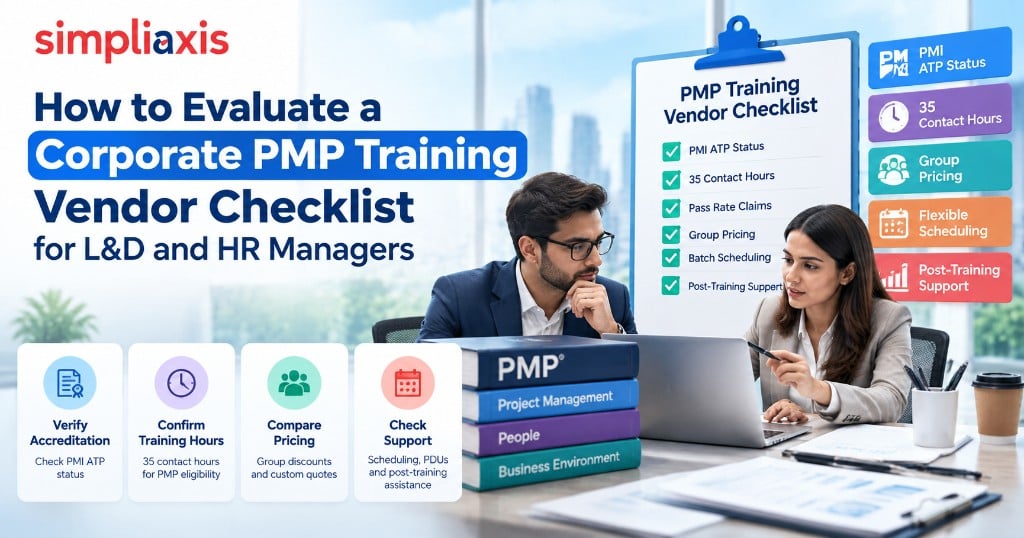
This corporate PMP training vendor checklist starts with one rule: confirm the vendor's PMI Authorized Training Partner status directly in PMI's own directory, verify that the programme genuinely delivers the 35 contact hours PMI requires for PMP exam eligibility, and get written clarity on group pricing, batch scheduling and post-training PDU support before any contract is signed. Pass-rate claims made by training companies are self-reported and should never be the deciding factor on their own. This checklist walks an L&D, HR or PMO buyer through the specific questions, red flags and comparison criteria that separate a genuinely PMI-recognised provider from one that only sounds like it.
Key Highlights of Corporate PMP Training Vendor Checklist
- PMI Authorized Training Partner (ATP) status is the single most important thing to verify before paying for a team's PMP training, and it can be checked independently in PMI's own training partner directory rather than taken on a vendor's word.
- PMI requires 35 contact hours of formal project management education before anyone can sit the PMP exam, and PMI has signalled that from late 2026 live contact hours will increasingly need to come from an ATP, an accredited academic programme, or a China Registered Education Provider to count.
- Pass-rate percentages quoted by training vendors are self-reported marketing claims. PMI does not publish provider-level pass-rate data, so a number alone proves nothing without a look at how it was calculated.
- Group pricing for corporate PMP training is genuinely negotiable, with most providers offering tiered discounts that increase with headcount, alongside custom quotes for larger departments.
- Scheduling flexibility, evening or weekend batches, staggered start dates and the ability to mix formats, matters as much as course content for teams who cannot all step away from live project work at once.
- What happens after the live sessions end, PDU tracking, renewal reminders and access to recorded content, is where many vendors quietly under-deliver relative to what was promised during the sales conversation.
- A short, structured vendor questionnaire sent to two or three shortlisted providers, asked in identical wording, makes it far easier to compare answers fairly than judging each vendor's pitch in isolation.
What Does PMI Authorized Training Partner (ATP) Status Actually Mean?
PMI Authorized Training Partner status means PMI itself has reviewed and approved a training organisation's business practices, instructor qualifications and course content against its own standards, and granted that organisation access to official PMI-developed course material. According to PMI, ATP status is awarded only to established, financially sound project management education providers whose instructors have completed PMI's Train the Trainer programme and whose courses align with the PMI Talent Triangle of technical, leadership and strategic business skills. This is a materially different thing from a vendor simply saying it teaches "PMI-aligned" or "PMI-approved" content, phrases that carry no formal weight on their own.
For a corporate buyer, this distinction has direct financial consequences. If a vendor is not an ATP, an accredited academic programme, or a China Registered Education Provider, the contact hours your team completes may not count cleanly toward PMP eligibility, and your organisation could end up paying twice, once for the training itself and again for a second course that actually satisfies PMI's requirement. PMI has communicated to its training partner network that this distinction is becoming stricter over time, with live contact hours expected to count toward the 35-hour requirement only when delivered by one of those three recognised categories from late 2026 onward. That makes ATP verification a financial risk-control step, not a box-ticking formality.
PMI Authorized Training Partner Verification: How Do You Check a Vendor's ATP Status?
The only reliable way to verify ATP status is to check the provider directly against PMI's own published information on PMI's Authorized Training Partner programme page, rather than relying on a badge displayed on the vendor's marketing site.
A genuine ATP will typically be able to state its partner number without hesitation, and that number should be traceable back to PMI's own records. Simpliaxis, for example, publishes its PMI Global Authorized Training Partner number on its own accreditation page, alongside its other partnerships with bodies such as AXELOS, PEOPLECERT, scrum.org and ICAgile, which is the kind of specific, checkable detail a genuine ATP should be willing to disclose without being asked twice.
Beyond the ATP badge itself, it is worth asking the vendor directly whether their instructors have completed PMI's Train the Trainer certification for the specific course being delivered, since ATP status covers the organisation but individual instructor authorisation is a separate check worth confirming for a corporate cohort. A useful independent step once your team has completed the exam is knowing how to confirm the certification landed correctly in PMI's own records, which is exactly what a resource like this guide to verifying PMP certification through the PMI registry walks through.
| Signal | Genuine PMI ATP | Non-ATP or Unclear Status |
| Verification | Listed on PMI's own authorized partner information and can state a partner number | Vague claims of being "PMI-approved" with no checkable number |
| Course content | Uses PMI-developed official course materials | Uses generic or third-party materials rebranded as PMP prep |
| Instructors | Completed PMI's Train the Trainer programme for the course taught | Credentials unclear or unverifiable |
| Contact hours | 35 hours issued and reportable toward PMP eligibility | Hours may not be accepted by PMI, especially after late 2026 rule changes |
Corporate PMP Training Vendor Checklist: 10 Checks Before You Sign
Beyond accreditation, a corporate buyer needs to work through a short set of operational and commercial questions before committing budget to any single provider. The following ten checks reflect what L&D and procurement teams consistently ask training vendors before signing a contract, adapted specifically for PMP certification training bought for a group rather than an individual.
- Confirm ATP status independently. Do not accept a screenshot or a badge image as proof, check the claim yourself against PMI's own information before requesting a proposal.
- Ask exactly how the 35 contact hours are delivered. Confirm whether hours are live instructor-led, self-paced, or a blend, and whether a certificate of completion showing the full 35 hours is issued to each learner individually.
- Request the pass-rate methodology, not just the number. Ask whether the quoted pass rate covers first-attempt results only, what sample size it is based on, and over what time period, since PMI itself does not publish this data and every vendor figure is self-reported.
- Get the full group pricing structure in writing. Ask for the discount at your specific headcount, whether pricing changes if the group grows or shrinks before the start date, and what happens to unused seats.
- Confirm batch scheduling options that fit working teams. Ask about weekend, evening and staggered-start batches, and whether a cohort can be rescheduled without penalty if project deadlines collide with the training dates.
- Ask what happens if an employee fails the exam. Some vendors offer a retake allowance or extended access to materials, others offer nothing beyond the original course, and this should be clarified before signing rather than after a failed attempt.
- Clarify what post-training support looks like. Ask specifically whether the vendor helps with PDU tracking once employees are certified, or whether that responsibility falls entirely on the individual and the L&D team.
- Ask for a single point of contact for the whole cohort. A dedicated account or corporate contact who can answer scheduling, billing and enrolment questions for the group saves considerable administrative time compared with each employee dealing with support individually.
- Ask whether case studies and examples can reflect your industry. Generic PMP content works for exam preparation, but teams often get more applied value when examples are drawn from sectors similar to their own.
- Request references from a comparable corporate client. A vendor with genuine group training experience should be able to point to another organisation of similar size that has been through the same programme.
What Will Your Team Actually Learn? A Note on the PMP Exam Content Outline
Every legitimate PMP training programme is built around PMI's Examination Content Outline, which organises exam content into three domains: People, Process and Business Environment. According to PMI's published outline, the Process domain carries the largest weighting on the exam, followed by People, with Business Environment weighted lightly by comparison, and agile and hybrid delivery concepts are woven across all three domains rather than treated as a separate topic.
When comparing vendors, it is reasonable to ask how their course structure maps onto these domains, and whether the materials have been updated to reflect PMI's most recent outline rather than an older version of the exam. A provider such as Simpliaxis structures its PMP certification training course around this current outline, which is worth confirming with any vendor rather than assuming.
Corporate PMP Training Pricing: How Should You Think About Group Discount Tiers?
Corporate PMP training pricing is genuinely negotiable, and most providers structure discounts in tiers that scale with the number of employees enrolled together. Industry pricing guides for corporate group training commonly describe a smaller discount band for groups in the single digits and a larger one once a cohort reaches into the double digits, with fully custom quotes typical for departments large enough to justify a dedicated batch. Because these bands vary by provider, the only way to know what applies to your organisation is to ask for the exact figure at your specific headcount rather than relying on an advertised "up to" percentage.
| Typical Group Size | What to Expect | What to Ask |
| 3 to 5 employees | Entry-level group discount, smallest of the available tiers | Is this the lowest tier, and what does the next tier require? |
| 6 to 15 employees | Mid-tier discount, often the most common corporate booking size | Can the batch be scheduled exclusively for our team rather than mixed with public enrolments? |
| 16 or more employees | Custom quote, frequently with dedicated account support | What reporting or tracking dashboard is included for a cohort this size? |
Some providers advertise headline discount figures for corporate bookings. Simpliaxis, for instance, states corporate discounts of up to fifty percent off published pricing through its corporate and group training programme, alongside customised workshops built around a client's specific challenges. Whatever headline figure a vendor quotes, treat it as a starting point for negotiation rather than a fixed number, and always confirm what that discount is measured against.
What Scheduling Flexibility Should a Working Team Expect?
Scheduling flexibility matters for corporate PMP training because project team members rarely have four or five consecutive full days free at the same time, which makes rigid, one-format course delivery a real adoption risk for a group booking.
A vendor worth shortlisting should be able to offer live virtual instructor-led delivery, evening or weekend batch options, and the ability to stagger start dates for employees who cannot join the initial cohort. It is also worth asking whether a private batch exclusively for your organisation is available at your headcount, since a dedicated cohort allows the trainer to weave in your industry's own project scenarios rather than generic examples shared with an open public class.
Equally important is what happens when real project deadlines collide with scheduled training dates, which happens often enough in any active PMO that it should be addressed contractually rather than assumed. Ask directly whether a session can be rescheduled without financial penalty, how much notice is required, and whether an employee who misses a live session can catch up through a recording or a later cohort without paying again.
How Should You Read a Vendor's Pass-Rate Claims?
A vendor's pass-rate claim should be read as a self-reported marketing statistic rather than an independently audited fact, because PMI does not publish provider-level pass-rate data and has not declared an official passing score or pass rate for the PMP exam.
This means any number a vendor quotes, however precise it sounds, reflects that vendor's own internal tracking methodology, which can vary widely in what it counts and over what period. A pass rate quoted without a defined sample size, time frame, or explanation of whether it covers first-attempt results only is not verifiable and should be treated with appropriate scepticism rather than taken as a comparison point between vendors.
A more useful line of questioning is to ask how the vendor supports a candidate who does not pass on the first attempt, what a satisfaction or training guarantee actually covers, and whether that guarantee applies to the training experience itself or to exam outcomes. Reviewing an independent, criteria-based comparison such as this comparison of PMP certification training providers alongside a vendor's own marketing claims can help an L&D buyer see how a specific pass-rate figure stacks up against accreditation, pricing and course structure rather than in isolation.
What Happens After Training Ends? PDU Tracking and Ongoing Support
Once employees pass the PMP exam, PMI requires them to earn 60 professional development units, known as PDUs, every three years to keep the certification active, and these are reported through PMI's own Continuing Certification Requirements System. This is a genuine, ongoing administrative burden across a whole department, not a one-time event, and it is a part of the buying decision that is easy to overlook during the initial sales conversation. Before signing a contract, ask the vendor directly whether they provide any structured support for PDU tracking once training ends, such as reminders, a recommended list of eligible activities, or continued access to materials that can themselves be logged as PDUs later.
PMI's own guidance on maintaining certification, published on PMI's certification maintenance resource page, sets out exactly what counts toward the 60-PDU requirement and how the three-year renewal cycle works, and it is worth sharing this with your team directly rather than relying entirely on the training vendor's own summary of the requirement. Some corporate buyers also find it useful to keep a simple internal reference for employees, and a general resource such as this set of frequently asked questions on PMP certification can be a helpful supplement for a cohort working through the process together.
What Are the Red Flags That Should Make You Walk Away?
Certain patterns in a vendor's pitch should prompt an L&D or procurement team to pause the evaluation entirely rather than negotiate around them. The clearest warning signs, echoed consistently across guidance on PMP training scams, include a guaranteed pass with no defined study requirement, pricing that sits far below every other quote for what is supposedly the same 35-hour ATP-delivered course, and reluctance to provide a verifiable ATP number when asked directly.
- A vendor cannot or will not provide a PMI Authorized Training Partner number that can be independently checked.
- Pricing is dramatically lower than comparable ATP-delivered courses, with no clear explanation of what is different about the delivery.
- The "guarantee" on offer is vague, unwritten, or only described verbally during a sales call rather than in the contract.
- Course materials appear generic or generic-looking, with no clear mapping to PMI's current Examination Content Outline.
- The vendor cannot describe what post-certification support, if any, is included once the live sessions finish.
- There is pressure to sign quickly, with a discount that expires within days, rather than time to complete a proper comparison.
What Questions Should You Send to Every Shortlisted Vendor?
Sending an identical, written set of questions to every shortlisted vendor is the single most effective way to keep a comparison fair, since it prevents one provider's polished sales pitch from overshadowing a genuinely stronger offer from a less rehearsed competitor. The following questions work well as a short written questionnaire attached to a request for proposal.
- What is your PMI Authorized Training Partner number, and can it be verified independently?
- How many of the 35 required contact hours are live instructor-led versus self-paced, and how is that documented for each learner?
- What is your pass-rate figure based on, what sample size, and over what time period?
- What is the exact discount at our specific headcount, and does that change if the group size shifts before the start date?
- What scheduling formats are available, and can a private batch be arranged exclusively for our team?
- What happens, contractually, if an employee needs to reschedule or misses a live session?
- What support is provided if an employee does not pass the exam on the first attempt?
- What ongoing support do you offer for PDU tracking after certification is achieved?
- Can you provide a reference from another corporate client of comparable size?
- Who is our single point of contact for billing, scheduling and enrolment questions across the whole cohort?
A Simple Scoring Framework for Comparing Vendors Side by Side
A structured scoring table turns a set of vendor conversations into a defensible decision rather than a gut feeling, which matters when the training budget has to be justified to finance or a department head. Score each shortlisted vendor from one to five against the same set of criteria, using the written answers gathered from the questionnaire above rather than impressions from the sales call alone.
| Criteria | What Good Looks Like | Weight |
| Verified ATP status | Partner number independently confirmed | High |
| Contact hour delivery | Full 35 hours documented per learner, ATP-delivered | High |
| Group pricing transparency | Exact discount confirmed in writing for your headcount | Medium |
| Scheduling flexibility | Multiple formats, reschedule terms clearly stated | Medium |
| Post-training support | Defined PDU tracking or renewal support after certification | Medium |
| Pass-rate transparency | Methodology disclosed, not just a headline figure | Low to Medium |
| Corporate references | At least one comparable client reference provided | Medium |
Conclusion
Choosing a corporate PMP training vendor is fundamentally a procurement and risk decision dressed up as a training purchase, and the vendors that survive close scrutiny are the ones willing to put specifics in writing rather than in a sales pitch. Verified PMI Authorized Training Partner status, a clear account of how the 35 contact hours are delivered, an honest explanation of what a pass-rate figure actually measures, and written group pricing and scheduling terms together do more to protect a training budget than any single glossy proposal.
The organisations that get the best outcome from group PMP training are consistently the ones that send the same written questionnaire to every shortlisted vendor, insist on independently checking accreditation claims rather than accepting a badge at face value, and think through PDU tracking and post-certification support before the contract is signed rather than after the first employee's renewal deadline arrives.
Used consistently, this checklist turns what is often a rushed, single-quote decision into a comparison that a finance team, an HR director and the employees actually sitting the exam can all stand behind.







 Lowest-Price Challenge











 Personalized Path


.webp)


 USA
USA  Canada
 India
India UK
UK Australia
 Singapore


