


 Call Us



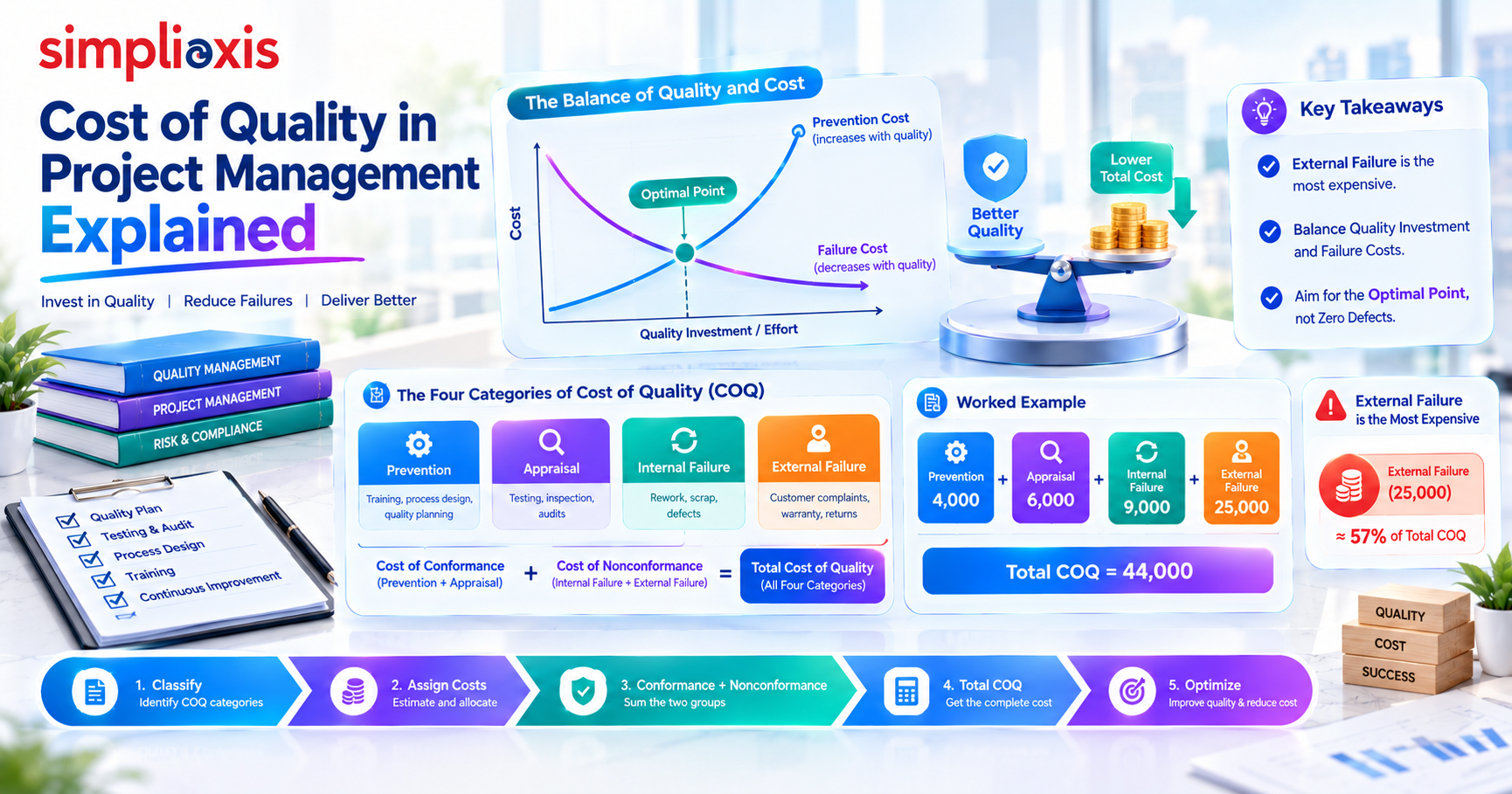
Cost of Quality (COQ) is the total amount an organisation spends both on preventing poor quality and on dealing with it after it happens. It is made up of two broad categories: the cost of conformance, covering prevention and appraisal, and the cost of nonconformance, covering internal and external failure. The core idea behind COQ is that spending a small amount upfront on prevention is almost always cheaper than paying for rework, rejected deliverables, or customer complaints later. Project managers use COQ to decide how much quality-related spend is justified and to make the business case for investing in prevention rather than inspection.
Key Highlights
- Cost of Quality splits into the cost of conformance (prevention and appraisal) and the cost of nonconformance (internal and external failure).
- Prevention costs are spent before defects occur; appraisal costs are spent detecting defects; failure costs are spent because defects occurred.
- Internal failure costs are incurred before a deliverable reaches the customer; external failure costs are incurred afterwards and are typically the most expensive.
- A widely cited rule of thumb holds that the cost of fixing a defect grows sharply the later it is caught, which is why prevention spend is rarely wasted.
- The PMBOK Guide treats Cost of Quality as a core input to the Plan Quality Management process and a tool for justifying quality-related budget decisions.
- Total Cost of Quality is optimised, not minimised to zero, since driving failure costs to nothing usually means spending far more on prevention and appraisal than the failures would have cost.
- Lean Six Sigma programmes use Cost of Quality data to prioritise which process improvements deliver the largest financial return.
What Is Cost of Quality
Cost of Quality is a project quality management concept that quantifies everything an organisation spends, directly or indirectly, because of quality, whether that spend goes toward preventing defects or toward fixing them after the fact. It is formally defined within PMI's quality management guidance as the total cost incurred to prevent poor quality and to correct it when prevention was not enough. The concept did not originate with PMI; it traces back to quality management pioneers such as Philip Crosby and Armand Feigenbaum, whose work on quality economics became a standard input to project quality management practice generally, including how PMI frames it in the PMBOK Guide's quality management knowledge area.
In a project context, Cost of Quality is not owned or mandated by a single certifying body in the way an exam content outline is. Instead, it functions as a shared vocabulary: PMI examines it as PMP exam content, Lean Six Sigma bodies of knowledge treat it as a core measurement tool, and individual organisations build their own COQ tracking into project budgets and quality management plans. What is consistent across all of these is the same four-category breakdown and the same underlying logic that quality has a real, measurable cost whether or not a team chooses to track it explicitly.
It helps to separate Cost of Quality from quality itself. A project can have excellent quality outcomes and still have a poorly managed Cost of Quality, for example if it achieved that quality through excessive appraisal spend, endless rounds of inspection and testing, rather than through prevention. Equally, a project can have a low Cost of Quality on paper simply because no one is tracking failure costs properly, which understates the true price of the defects that did occur. COQ is a measurement discipline layered on top of quality management, not a substitute for it, and its value comes specifically from making trade-offs between prevention, appraisal, and failure spend visible and comparable in the same currency.
The Four Cost of Quality Categories
- Prevention costs: spending intended to stop defects occurring in the first place, such as training, process design, quality planning, and supplier qualification.
- Appraisal costs: spending on inspecting, testing, and auditing work to detect defects before a customer sees them, such as quality audits and testing cycles.
- Internal failure costs: costs incurred when a defect is found before the deliverable reaches the customer, such as rework, scrap, and re-testing.
- External failure costs: costs incurred after a defective deliverable has already reached the customer, such as warranty claims, returns, penalty clauses, and reputational damage.
Prevention and appraisal are collectively called the cost of conformance, the price of doing things right. Internal and external failure are collectively called the cost of nonconformance, the price of not doing things right, and it is almost always more expensive than conformance once reputational and contractual consequences are included.
The Cost of Quality Formula
Total Cost of Quality is calculated by adding all four categories together:
| Component | Formula Element | Nature of Spend |
| Cost of Conformance | Prevention Cost + Appraisal Cost | Proactive, planned spend |
| Cost of Nonconformance | Internal Failure Cost + External Failure Cost | Reactive, unplanned spend |
| Total Cost of Quality | Cost of Conformance + Cost of Nonconformance | Full quality-related spend on the project |
A common industry observation, often summarised as a "1-10-100" pattern, is that the cost of correcting an issue grows sharply the later it is caught: cheapest to fix during prevention, more expensive during appraisal or testing, and most expensive once a defect has already reached the customer as an external failure. This is the practical justification for weighting quality spend toward prevention rather than relying on inspection or post-delivery fixes.
The Optimal Point Is a Balance, Not a Minimum
Plotting prevention and appraisal spend against failure cost on the same chart typically produces two curves moving in opposite directions: as prevention and appraisal spend rises, failure costs fall, but only up to a point. Beyond that point, additional prevention and appraisal spend costs more than the failure cost it prevents, because the easy, high-value defects have already been designed out and what remains is increasingly rare and expensive to catch. The practical implication for a project manager is that "spend more on prevention" is not a universally correct answer; it is correct only up to the point where the marginal pound spent on prevention still saves more than a pound in avoided failure cost. Below that optimal point, a project is genuinely under-investing in quality. Above it, a project is over-engineering its quality process at the expense of budget that could be better used elsewhere.
Worked Example
Consider a software delivery team that spends the following across one release cycle: training and process design (prevention) cost 4,000; testing and code review (appraisal) cost 6,000; bugs caught and fixed before release (internal failure) cost 9,000; and a production defect that reached customers, requiring a hotfix and goodwill credits (external failure), cost 25,000. The cost of conformance is 4,000 + 6,000 = 10,000. The cost of nonconformance is 9,000 + 25,000 = 34,000. The total Cost of Quality for the release is 44,000, and more than three-quarters of that figure came from failure costs that additional upfront prevention spend might have reduced.
Cost of Conformance vs Cost of Nonconformance
| Aspect | Cost of Conformance | Cost of Nonconformance |
| Categories included | Prevention, appraisal | Internal failure, external failure |
| Timing of spend | Planned, incurred proactively | Unplanned, incurred reactively |
| Typical examples | Training, process design, audits, testing | Rework, scrap, warranty claims, penalties |
| Effect on schedule and reputation | Generally low, absorbed into planned work | Often high, especially for external failures |
| Management goal | Invest enough to prevent failure, not more | Minimise, since every unit of nonconformance cost is avoidable spend |
Neither figure should be driven to zero. A project with zero nonconformance cost is usually over-investing in cost types like appraisal, while a project with zero conformance cost is almost certain to be absorbing high, unplanned failure costs instead. The management goal is the point where total Cost of Quality, both categories combined, is as low as it can reasonably be.
Why Cost of Quality Matters for Project Budgets
Project managers who can quantify Cost of Quality bring a financial argument to quality conversations that "we should test more" or "we need better training" cannot make on their own. Being able to show that a proposed prevention investment is smaller than the failure costs it is likely to avoid turns a quality discussion into a budget discussion stakeholders take seriously. This is one reason Cost of Quality is examined directly within the PMP certification and forms a foundational metric within Simpliaxis's Six Sigma Fundamentals Certification Training, where COQ data is routinely used to prioritise which process improvement projects deliver the largest financial return. Professionals who progress into Simpliaxis's Lean Six Sigma Green Belt Certification are frequently expected to build and defend a Cost of Quality business case as part of any improvement project charter.
This matters most at the exact moment a project manager needs budget approval for something that looks, on the surface, like extra cost rather than saved cost, an additional test cycle, a training session, a stricter supplier qualification step. Without a Cost of Quality figure, that request competes against every other line item in the budget on the strength of the requester's argument alone. With a Cost of Quality figure attached, the same request becomes a comparison between a known, bounded cost and a previously observed or reasonably estimated failure cost, which is a fundamentally easier case for a sponsor or steering committee to approve. This is precisely the skill that separates project managers who can only flag quality risk from those who can actually secure the budget to address it.
Where Cost of Quality Tracking Usually Breaks Down
- Tracking only failure costs and ignoring prevention and appraisal spend, which makes it impossible to see whether quality investment is actually working.
- Treating Cost of Quality as a target to minimise to zero rather than a figure to optimise, leading to either excessive inspection or under-investment in prevention.
- Confusing cost of conformance with total project cost; conformance cost is only the quality-related portion of spend, not the whole budget.
- Underestimating external failure costs by counting only the direct fix and ignoring penalty clauses, lost repeat business, and reputational damage.
- Assuming a single COQ calculation at project close is enough, rather than tracking it through the project so prevention spend can be adjusted while it still matters.
- Applying the same COQ ratios across very different project types without adjusting for how expensive failure actually is in that context, such as safety-critical work versus low-risk internal tooling.
How Enterprises and Six Sigma Programmes Use Cost of Quality
Large organisations running formal quality management programmes routinely build Cost of Quality tracking into project reporting, not just as a PMP exam concept but as a genuine management lever. Manufacturing and engineering firms in particular have long used COQ to justify investment in process capability and supplier quality, since external failure in these industries can trigger product recalls, regulatory penalties, and warranty costs that dwarf the original prevention spend that would have avoided them. Enterprises running Lean Six Sigma programmes typically require every improvement project charter to include a Cost of Quality estimate, since it is the figure used to rank competing improvement initiatives against each other and to prove the programme's return on investment to leadership.
This is also why Cost of Quality sits so naturally alongside the Define phase of a DMAIC project: before a Six Sigma team commits resources to fixing a process, the project charter typically needs a costed estimate of what the current defect rate is actually costing the business, and Cost of Quality is the standard way that estimate is built. Enterprise quality functions frequently maintain a running COQ figure by product line or process area specifically so that improvement resources are directed at the highest-cost problems first rather than the most visible ones.
Making the Case for Extra Testing or Inspection
This is where Cost of Quality earns its keep as a budgeting tool rather than a reporting exercise. A construction project manager proposing an additional round of material inspections after a supplier's previous batch caused rework can estimate the appraisal cost of the extra inspection against the internal failure cost of the last incident, and show the inspection pays for itself even if it only catches one similar defect. A software team debating extra automated testing before a major release can compare that appraisal cost against the external failure cost of its last production incident, support hours and customer credits included, and turn the investment into a cost-saving argument rather than a schedule risk. A manufacturing team tracking Cost of Quality by product line can spot that one line carries a disproportionately high external failure cost from warranty claims, and direct a supplier qualification programme, a prevention cost, specifically at that line rather than funding a general quality initiative that spreads the same budget too thinly to move the number.
From Activity List to a Single COQ Figure
- List every quality-related activity on the project and classify each one as prevention, appraisal, internal failure, or external failure.
- Assign a cost to each activity, using actual spend where it exists and reasonable estimates where it does not.
- Sum prevention and appraisal costs to get the cost of conformance, and sum internal and external failure costs to get the cost of nonconformance.
- Add both totals together to get the Total Cost of Quality for the project or reporting period.
- Compare the ratio of conformance to nonconformance cost; a high nonconformance ratio signals under-investment in prevention.
- Identify the highest-cost failure categories and evaluate whether a specific, costed prevention or appraisal investment would reduce them by more than it costs.
- Track Cost of Quality across multiple project cycles, not just once, so the effect of any new prevention investment can actually be measured.
Conclusion
Cost of Quality turns an often qualitative conversation about testing, training, and rework into a figure that can be tracked, compared, and used to justify investment decisions. The core discipline is simple: classify every quality-related cost as prevention, appraisal, internal failure, or external failure, then use the resulting totals to decide whether more should be spent upfront or whether current prevention and appraisal spend is already proportionate. Project managers and quality professionals who can produce this figure on demand are able to make a financial case for quality investment that qualitative arguments alone cannot.
Key Takeaways
- Cost of Quality splits into cost of conformance (prevention + appraisal) and cost of nonconformance (internal + external failure).
- Total Cost of Quality = Prevention + Appraisal + Internal Failure + External Failure; external failure is usually the most expensive category.
- The goal is to optimise, not minimise to zero; overspending on prevention and appraisal past the optimal point wastes budget too.
- Cost of Quality is examinable PMP content and a core Lean Six Sigma metric used to prioritise improvement projects.
- It should be tracked continuously, by activity and by cost category, not calculated once at project close.
- Framing a prevention or appraisal request against the failure cost it avoids is what turns a quality argument into a budget approval.







 Lowest-Price Challenge











 Personalized Path


.webp)


 USA
USA  Canada
 India
India UK
UK Australia
 Singapore


