


 Call Us



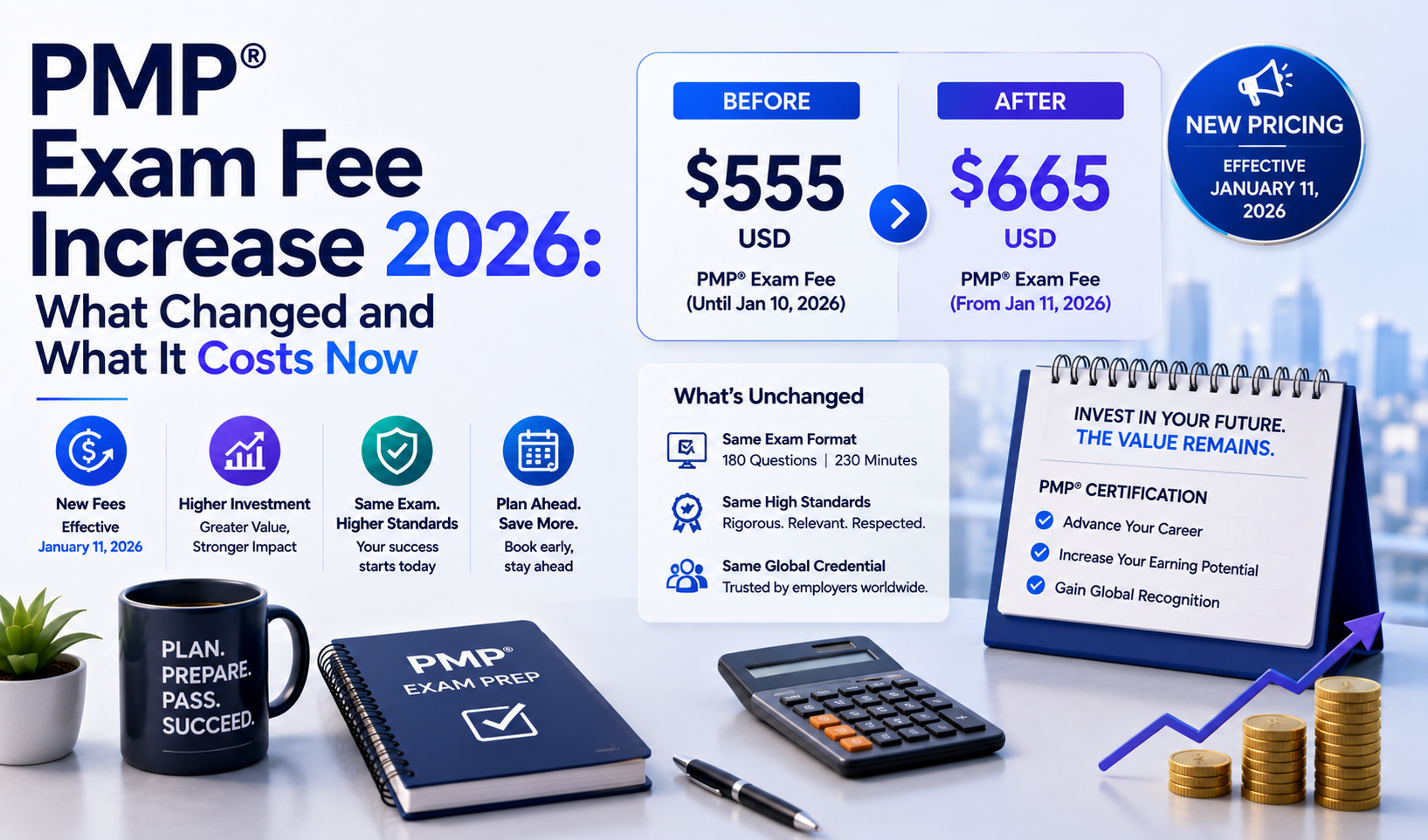
PMI raised the PMP exam fee on 6 August 2026: the member price moved from $405 to $445 and the non-member price moved from $555 to $675, according to PMI's published fee schedule. That widens the member versus non-member gap to $230, more than the $139 to $159 annual cost of joining PMI, so becoming a member before registering now saves money immediately rather than merely offering a discount. Candidates who paid before 6 August locked in the older, lower fee. Anyone registering after that date is on the new schedule, and retake fees have moved in step, so budgeting and training decisions made this month should account for the higher figures. Because PMI can revise pricing again, candidates should confirm the exact current fee on PMI.org before paying.
Key Highlights of PMP Exam Fee Increase
- PMI increased the PMP exam fee on 6 August 2026 from $405 to $445 for PMI members and from $555 to $675 for non-members, a $40 rise for members and a $120 rise for non-members.
- The member-to-non-member gap on the exam fee alone widened to $230, comfortably more than the $139 to $159 annual PMI membership fee.
- PMP retake fees are commonly reported at $275 for members and $375 for non-members under the new schedule, though retake pricing is reported less consistently than the primary exam fee across sources.
- The fee change followed closely on the 9 July 2026 launch of the updated PMP exam, which re-weighted domains and added content aligned with PMBOK 8 themes, so candidates are absorbing a content change and a cost change in the same exam cycle.
- Candidates who registered and paid before 6 August 2026 kept the older, lower fee for that attempt; the new fee applies to registrations made on or after that date.
- Joining PMI before registering is now the financially rational default for almost every first-time candidate, not only those planning to renew or use PMI resources long-term.
- Simpliaxis's own PMP exam fee resource and other cost pages are being updated to reflect the new figures; treat any page still quoting $405/$555 as pre-increase and confirm on PMI.org.
What exactly changed on 6 August 2026?
PMI raised the price of sitting the PMP exam for every candidate, splitting the increase unevenly between members and non-members. According to PMI's published fee schedule and corroborated by a wide range of independent training providers and exam-prep publishers, the PMP exam fee for PMI members rose from $405 to $445, a $40 increase, while the fee for non-members rose from $555 to $675, a $120 increase. In percentage terms, the non-member fee rose by roughly 21.6%, well above the member-side increase of about 9.9%.
| Fee Type | Before 6 August 2026 | From 6 August 2026 | Change |
| PMP exam fee, PMI member | $405 | $445 | +$40 (+9.9%) |
| PMP exam fee, non-member | $555 | $675 | +$120 (+21.6%) |
| Member-to-non-member gap | $150 | $230 | +$80 |
| PMP retake fee, member | lower tier, varied by source | $275 (commonly cited) | see note below |
| PMP retake fee, non-member | lower tier, varied by source | $375 (commonly cited) | see note below |
Retake pricing is reported less consistently across sources than the primary exam fee, so treat the $275/$375 figures as the commonly cited retake fees under the new schedule rather than a fixed, PMI-guaranteed constant, and verify the exact amount before booking a retake. The primary $445/$675 figures, by contrast, are corroborated across a wide range of independent training providers, exam-prep sites and certification blogs, which is why this article treats them as reliable enough to state directly, while still recommending a final check before payment. It is also worth noting that a large share of existing PMP cost content online, including pages that were accurate as recently as July 2026, still quotes the older $405/$555 figures simply because the change is so recent; a page quoting those numbers is not necessarily wrong so much as out of date.
Why did PMI raise the PMP exam fee now?
PMI has not published a detailed public breakdown of the reasoning behind the increase beyond standard language about maintaining certification quality and periodically reviewing pricing. What is clear from the timing is that the fee increase landed less than a month after PMI's updated PMP exam went live on 9 July 2026, which restructured the Examination Content Outline, re-weighted the Business Environment domain, and introduced content aligned with PMBOK 8 themes such as AI-augmented delivery, sustainability and advanced hybrid delivery models. Whether or not the two changes are formally linked in PMI's own reasoning, candidates are dealing with a materially different exam and a materially higher price within the same few weeks, which is precisely the kind of compressed timeline that catches unprepared candidates out.
PMI periodically revises exam pricing across its portfolio of certifications, and past increases have generally moved in a similar direction: incremental rises for members, larger proportional rises for non-members, which has the effect of steadily widening the incentive to join PMI rather than pay the non-member rate. The August 2026 change fits that pattern closely, just with a noticeably larger step than recent years, particularly on the non-member side. Candidates researching PMI's own certification pages, such as the official PMP certification overview on PMI.org, will find the current fee schedule and any further updates listed directly, which is the authoritative source this article recommends checking before any payment.
Is PMI membership worth it after the fee increase?
Yes, for almost anyone about to sit the PMP exam, PMI membership pays for itself on the exam fee saving alone. Annual PMI membership costs approximately $139 to $159, depending on the exact fee schedule and any one-time application charge, and membership immediately drops the applicable exam fee from $675 to $445, a saving of $230. That means the membership fee is recovered in full, with $70 to $90 left over, before counting any of the other membership benefits.
The breakeven math is straightforward:
| Scenario | Cost |
| Non-member: exam fee only | $675 |
| Member: membership ($139 to $159) + member exam fee ($445) | $584 to $604 |
| Net saving from joining before registering | roughly $71 to $91 |
On top of that immediate saving, PMI membership includes a free digital copy of the PMBOK Guide, discounted access to PMI webinars and on-demand PDU content, and a lower renewal fee later on, since renewing the PMP certification costs around $60 for members against roughly $150 for non-members per three-year cycle. The only candidates for whom membership arguably does not make sense are those who are certain they will never renew and who can access equivalent study material for free elsewhere, which describes very few people preparing to sit a $445 to $675 exam. The practical sequencing that follows from the math is to join PMI first, then register for the exam, not the other way round, since paying the non-member fee and then joining afterwards forfeits the saving entirely for that attempt.
It is also worth being precise about what the breakeven calculation does and does not include. It compares only the exam fee against the membership fee for a single exam sitting; it does not yet count the PMBOK Guide access, the free or discounted PDU content, or the lower renewal fee three years later, all of which push the net financial case for membership further in its favour over time. Very few cost comparisons in professional certification are this one-sided, which is precisely why most competing coverage of the fee increase treats membership as a minor footnote rather than the central decision it now represents.
What does this mean if you have not registered or paid yet?
If you have not yet paid your PMP exam fee, you are on the new $445/$675 schedule and should plan your budget around those figures rather than the older $405/$555 numbers that many published guides have not yet updated. There is no indication that PMI is offering a grandfathering window for candidates who simply intended to register before the change; the increase applies from 6 August 2026 onward regardless of how long a candidate has been preparing or how close they were to registering.
Three practical steps follow directly from this:
- Join PMI before you pay the exam fee. Since membership more than pays for itself against the new non-member rate, applying for PMI membership should happen before, not after, exam registration.
- Rebudget your total certification cost. Combine the new exam fee with training costs, since the exam fee and the training component are usually paid separately and at different points in the process, and the exam fee alone is no longer the smaller of the two line items for every candidate.
- Confirm the current fee on PMI.org immediately before paying. Fee schedules can change again, and the exact figure quoted during PMI application and exam scheduling is the one that governs your payment, not any figure quoted in a blog article, including this one.
Candidates who were mid-way through preparing for the exam before the increase, having already booked training or built a study schedule around the old cost assumptions, do not need to restart anything. The exam content and the exam fee are governed separately: someone who registers now sits the current (post 9 July 2026) exam version and pays the current (post 6 August 2026) fee, but any preparation aligned to the updated Examination Content Outline remains valid regardless of exactly when it was booked.
How do retake fees fit into the new cost picture?
Retake fees matter more after a headline fee increase because a failed first attempt now costs more to recover from in absolute terms, even though the retake discount off the full fee remains substantial. Under the new schedule, PMP retake fees are commonly cited at $275 for PMI members and $375 for non-members, figures repeated across multiple independent exam-prep sources, though not all of them agree on the exact prior-year baseline, so treat this as the best current estimate rather than a PMI-confirmed fixed number and check the live figure before booking a retake.
Candidates get three attempts at the PMP exam within a one-year eligibility window. If all three attempts are used or the eligibility year lapses, the candidate must reapply and pay the full first-attempt fee again, which under the new schedule means $445 for members or $675 for non-members rather than the lower retake rate. That makes thorough preparation more financially consequential now than it was before 6 August 2026: the practical cost of walking into the exam under-prepared, failing, and eventually exhausting all three attempts has risen alongside the base fee. Separately, candidates should also budget for PMI's standard rescheduling rules: changes made more than 30 days before an exam appointment are free, while changes made 30 days or fewer but more than 48 hours before the appointment attract a fee, and changes inside 48 hours can forfeit the entire registration fee, so scheduling changes close to an appointment now carry a real cost on top of the higher base fee.
Investing in structured preparation is one of the few levers a candidate fully controls in this equation, since the exam fee itself is fixed by PMI. Simpliaxis's PMP online training course is built around minimising exactly this risk, covering the current Examination Content Outline in depth so that candidates are less likely to need a retake at the new, higher fee.
How does the fee increase interact with training cost decisions?
The exam fee is only one line item in the total cost of becoming PMP certified, and a rise in that one line item changes the relative weight of the others without necessarily changing the total budget decision. Before booking training, it is worth confirming eligibility first, since PMI requires either 35 contact hours of project management education or an equivalent, alongside standard experience and education prerequisites. Paying a higher exam fee for an attempt a candidate is not yet eligible to sit, or is under-prepared for, is the most avoidable cost in the entire process, and it is now a more expensive mistake than it was before 6 August 2026.
A useful way to think about total spend after the increase is to separate the fixed regulatory costs, which are now higher, from the discretionary training spend, which is not. The table below reflects the post-increase picture for a first-time PMI member candidate.
| Cost Component | Typical Range (post-6 August 2026) | Notes |
| PMI membership | $139 to $159 | Optional but financially recommended before registering |
| PMP exam fee (member) | $445 | $675 if not a PMI member |
| PMP training/prep course | varies by provider and format | Covers the 35-hour education requirement and exam readiness |
| Potential retake fee (member) | $275 (commonly cited) | Applies within the one-year eligibility window; confirm current figure before booking |
Because training costs are the one variable in this table that a candidate can still actively shape, this is also the point at which comparing course formats and providers makes the most financial sense. A detailed, up-to-date breakdown of exam and training costs together is available on Simpliaxis's PMP certification cost guide, which candidates should read alongside this article since the two cover complementary ground: this piece explains the fee change itself and its financial implications, while that page details the full certification cost structure across training, application and exam fees.
One point that most coverage of the fee increase misses entirely is that the increase changes the relative return on investment of getting the exam right the first time. When the exam fee was $405 to $555, a well-structured training programme priced in the hundreds of dollars represented a modest premium over the exam fee itself. At $445 to $675, and with a retake fee and a real risk of exhausting three attempts within a year, the case for investing properly in preparation the first time round is stronger in relative terms than it was a month ago, not weaker, even though the headline training spend has not changed at all.
What should candidates do right now?
Four actions address the immediate practical impact of the fee increase, in the order they should generally happen.
- Confirm your current status. If you already paid before 6 August 2026, your exam fee is locked at the older rate for that attempt; check your PMI account confirmation to be certain rather than assuming.
- Apply for PMI membership before registering, if you have not already. The math above shows this saves money immediately for almost every candidate, not just long-term PMI users.
- Lock in your eligibility and education hours early. Reviewing the standard experience and education requirements and completing the required 35 contact hours of project management education through a structured course reduces the risk of a costly retake under the new, higher fee schedule.
- Check PMI.org directly before you pay. Fee schedules are set and changed by PMI, not by any training provider or content site, and this article's figures, however well corroborated, should be treated as a snapshot rather than a permanent price. The PMI.org website is the authoritative source for the live fee at the moment of registration.
Candidates already holding a PMP certification and thinking ahead to renewal should also note that the renewal fee itself, distinct from the exam fee, remains a separate line item covered in detail on Simpliaxis's PMP certification renewal fee guide, and PMI membership reduces that cost too, reinforcing the same breakeven logic across the full certification lifecycle, not just the initial exam. Anyone still confirming they meet the basic experience and education requirements before committing to an exam date should also check the standard PMP certification prerequisites so that the fee, whichever tier applies, is being paid for an attempt the candidate is actually eligible to sit.
Conclusion
The 6 August 2026 fee increase is a straightforward cost event with an equally straightforward practical response: the PMP exam fee is now $445 for PMI members and $675 for non-members, retake fees have moved up alongside it to a commonly cited $275/$375, and the widened $230 member discount means joining PMI before registering is now close to a default financial decision rather than an optional one. What most coverage of this change gets wrong is treating it purely as a number update rather than a decision point, when in fact it lands squarely alongside PMI's July 2026 exam content overhaul, meaning candidates are budgeting for a costlier exam and a changed exam in the same cycle, and few published guides connect the two or walk through the membership breakeven math in full. Anyone who has not yet paid should join PMI first, confirm the live fee before payment, and use a structured preparation path to minimise the far more expensive risk of needing a retake at all. Simpliaxis's PMP certification training programme is built around exactly that outcome: passing on the first attempt under the current exam version, at the current fee, without the added cost of a second try.



_1787035951.jpg)





 Lowest-Price Challenge











 Personalized Path


.webp)


 USA
USA  Canada
 India
India UK
UK Australia
 Singapore


