


 Call Us


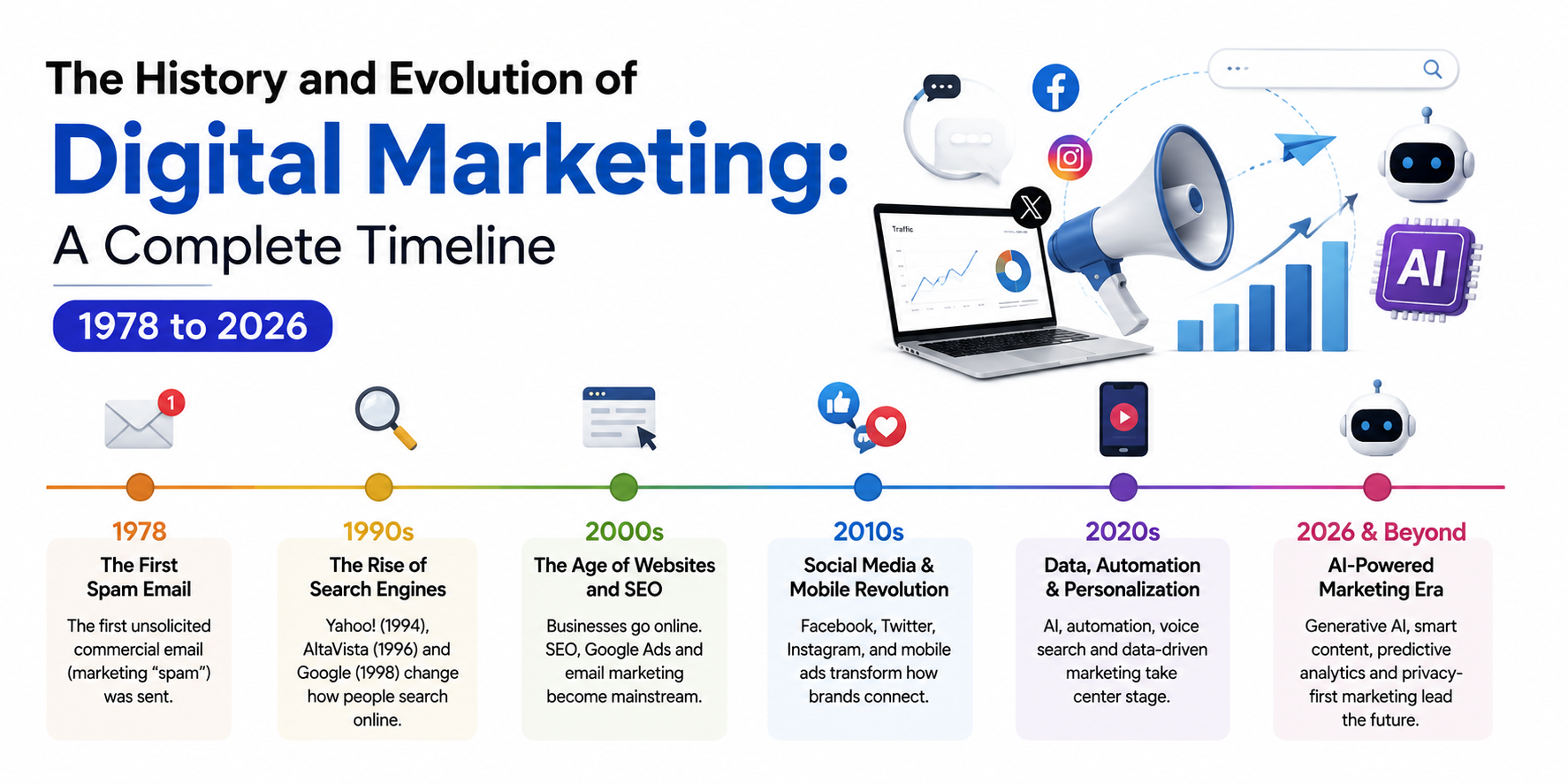
Digital marketing evolved over roughly five decades, starting with the first mass unsolicited email in 1978, moving through the Web 1.0 and banner ad era of the 1990s, the search and social media boom of the 2000s, the mobile and programmatic advertising surge of the 2010s, and the privacy first, AI driven era of the 2020s. Each phase was triggered by a specific technology shift, such as the arrival of the World Wide Web, the smartphone, or generative AI, that changed how brands could reach and measure their audiences. Understanding this timeline helps marketers see today's tools, from SEO to AI powered campaigns, as the latest step in a continuing pattern rather than an isolated trend.
Key Highlights of History and Evolution of Digital Marketing
- The first mass unsolicited commercial email was sent in 1978, and the first clickable web banner ad appeared on HotWired.com in October 1994, marking the two earliest forms of digital marketing.
- Google's 1998 founding and its AdWords launch in October 2000 created the self-serve, auction-based advertising model that still underpins search marketing today.
- Social platforms launched in a tight cluster, LinkedIn and MySpace in 2003, Facebook in 2004, YouTube in 2005, and Twitter in 2006, turning marketing into a two-way, public conversation.
- The 2007 iPhone launch and the 2008 App Store, combined with real-time bidding ad exchanges that emerged the same years, made mobile and programmatic buying the default way ads were bought and shown by the early 2010s.
- Data privacy law and platform policy, especially the European Union's GDPR in 2018 and Apple's App Tracking Transparency in 2021, forced a structural shift away from third-party tracking toward first-party data and consent-based marketing.
- Generative AI tools became mainstream marketing infrastructure between 2023 and 2025, with adoption surveys showing a majority of organizations using AI in some marketing function by 2024.
The Pre Internet Roots of Digital Marketing (1970s to 1980s)
Digital marketing did not begin with a website. It began with a network built for research, and a marketer who saw an opportunity to use it for sales. On May 3, 1978, Gary Thuerk, a marketing manager at Digital Equipment Corporation, sent an email announcing a product demonstration to 393 recipients on ARPANET, the U.S. government funded precursor to the internet. The message reportedly generated about 12 million dollars in sales and is widely credited, including by Guinness World Records, as the first instance of what would later be called spam, and by extension, the first piece of digital marketing ever sent. Thuerk's stunt also drew an immediate rebuke from ARPANET's managing authority, an early sign that digital marketing and platform rules would be in tension from the very start.
Through the 1980s, digital communication remained confined to universities, government agencies, and a small population of early computer network users, so marketing stayed almost entirely in traditional channels: print, television, radio, and direct mail. The infrastructure for a true digital marketing industry was not yet in place. That changed with two developments at the turn of the decade: the invention of the World Wide Web by Tim Berners-Lee at CERN in 1989 to 1991, and the rollout of graphical web browsers in the early 1990s, which together turned a research network into a medium the public could actually browse.
The 1990s: Web 1.0, Email, and the First Banner Ad
The 1990s is when digital marketing became a recognizable discipline rather than a curiosity. Websites in this period, often called Web 1.0, were largely static, one-directional brochures: companies published information and users read it, with almost no interactivity, commenting, or personalization.
The First Banner Ad (1994)
On October 27, 1994, AT&T paid Wired magazine's online offshoot HotWired 30,000 dollars to run a banner ad reading "Have you ever clicked your mouse right HERE? You will," widely documented as the first clickable web banner ad. Early reports cite an extraordinary click-through rate of around 44 percent, a number that would be almost unthinkable for a banner ad today and that reflects how novel that first exposure was to internet users. This one placement effectively created the display advertising industry that now includes retargeting, native ads, and programmatic exchanges.
Search Engines Emerge
Search became commercially viable almost immediately. Yahoo launched in 1994 as a curated web directory and quickly became one of the most visited destinations on the early web. AltaVista and other crawler based search engines followed in 1995, giving rise to the first search engine optimization tactics as site owners tried to be found in results pages. The most consequential arrival came on September 4, 1998, when Larry Page and Sergey Brin incorporated Google in a Menlo Park garage, built on their PageRank algorithm that ranked pages by the quality and quantity of links pointing to them rather than by keyword stuffing alone, which fundamentally changed what good SEO would come to mean.
Email Marketing Matures
By the late 1990s, email had gone from Thuerk's one-off stunt to a structured marketing channel, with dedicated email service providers and permission-based list building emerging as businesses recognized email's low cost per contact compared to direct mail. The channel grew fast enough, and unsolicited enough, that it eventually needed federal regulation: the United States Congress passed the CAN-SPAM Act in 2003, signed into law on December 16, 2003 and effective January 1, 2004, requiring commercial emails to carry accurate sender information, honest subject lines, and a working opt-out mechanism. It was the first major piece of U.S. legislation written specifically to govern a digital marketing channel, a role GDPR and CCPA would later play for data collection more broadly.
The 2000s: Search Engines, SEO, and the Rise of Social Networks
Paid Search Goes Self-Serve
Google launched AdWords, its self-serve pay-per-click advertising platform, on October 23, 2000, initially on a pay-per-impression model before shifting to the auction-based, pay-per-click structure that became the industry standard. This single product created an entirely new, measurable advertising category and is the direct ancestor of today's Google Ads, giving small businesses the same access to search placement that only large advertisers with agency relationships previously had.
Social Networking Arrives
A remarkably tight cluster of launches between 2003 and 2006 built the social media landscape marketers still use. LinkedIn launched in 2003 as the first mainstream professional network. MySpace launched on August 1, 2003 and by 2006 had become the most visited social network in the world. Mark Zuckerberg launched Facebook, then called "TheFacebook," from a Harvard dorm room on February 4, 2004, initially restricted to university students before opening to the public in September 2006. YouTube followed in 2005, creating the first mass platform for consumer generated video. Twitter was founded in San Francisco and sent its first public tweet, Jack Dorsey's "just setting up my twttr," on March 21, 2006, before launching publicly on July 15, 2006.
Inbound and Content Marketing Get Named
As search and social matured, a counter-movement against interruptive advertising took shape. Marketer Joe Pulizzi began using the term "content marketing" as early as 2001 and founded what became the Content Marketing Institute in 2007. In June 2006, MIT graduate students Brian Halligan and Dharmesh Shah founded HubSpot and coined the term "inbound marketing" to describe attracting customers with useful content rather than interrupting them with ads, publishing the influential book "Inbound Marketing" in 2009. Companies exploring this shift toward structured, agile marketing operations and campaign-based teams can review the Agile for Marketing microcredentials course, which applies the same iterative, sprint-based thinking that reshaped software teams to modern marketing workflows.
Advertising Platforms Follow the Users
Facebook introduced its first advertising products in 2007, including the Facebook Ads platform and the short-lived, privacy-controversial Beacon product, marking the moment social networks began monetizing their audiences directly rather than leaving that opportunity to search engines and display networks alone.
Web Analytics Becomes Free and Universal
Marketers in the early 2000s could tell whether an ad was clicked, but had limited free tooling to understand what a visitor did on-site afterward. That changed when Google acquired the web measurement company Urchin Software in the spring of 2005 and, on November 14, 2005, released the acquired technology to the public for free as Google Analytics. Demand was reportedly so high that Google had to pause new sign-ups within a week of launch. By making detailed traffic, conversion, and funnel data available to any business at no cost, Google Analytics did for measurement what AdWords had done for buying: it removed the barrier that had kept sophisticated digital marketing limited to large, well-funded advertisers.
The 2010s: Mobile, Social Advertising, and Programmatic Buying
The Smartphone Rewrites the Channel Map
Apple unveiled the iPhone on January 9, 2007 and released it in the United States on June 29, 2007. The App Store followed on July 10, 2008 with 552 apps at launch and roughly 10 million downloads in its first weekend, a number that seems small in hindsight but signaled a durable shift of consumer attention from desktop browsers to mobile apps. Marketing budgets followed that attention over the following decade, with mobile-first design, SMS and app-push campaigns, and location-based targeting becoming standard practice by the mid-2010s.
Programmatic Advertising and Real-Time Bidding
Between 2007 and 2010, the mechanics of buying display advertising were automated. Yahoo's Right Media, acquired by Yahoo in 2007, is widely credited as one of the first real-time bidding ad exchanges, with Google's DoubleClick Ad Exchange following as an early RTB-enabled marketplace around 2009. Real-time bidding let advertisers bid on individual ad impressions at the moment a page loaded, based on data about that specific viewer. Adoption accelerated quickly: RTB represented only about 2 percent of UK display ad spend in 2010 but had risen to roughly 18 percent by 2011, and within a few years programmatic buying became the default method for purchasing most display and video inventory.
New Platforms, New Formats
Instagram launched in 2010 and passed a million users within two months, later adding Instagram Ads and Stories formats that became central to influencer and visual brand marketing. Snapchat launched in 2011, and ByteDance launched the short-form video app Douyin in China in September 2016, relaunching it internationally as TikTok on September 29, 2017 before merging it with Musical.ly in August 2018, a combination that helped TikTok become the most downloaded app in the United States within about a year. Marketing automation platforms and customer relationship management tools matured in parallel across the decade, letting teams personalize email and lifecycle campaigns at a scale that had been impossible in the 1990s and 2000s.
The 2020s: The Privacy Shift and AI Driven Marketing
Regulation Redraws the Rules
The European Union's General Data Protection Regulation, formally Regulation (EU) 2016/679, was adopted in April 2016 and became directly enforceable across the EU on May 25, 2018, imposing strict consent, transparency, and data-handling obligations on any organization marketing to EU residents regardless of where that organization is based. California's Consumer Privacy Act took effect January 1, 2020, extending similar consumer data rights in the United States. Together these laws made consent management and first-party data strategy a board-level marketing concern rather than a legal afterthought.
Apple's App Tracking Transparency
Apple made App Tracking Transparency mandatory with iOS 14.5 in April 2021, requiring every app to ask explicit permission before tracking a user's activity across other companies' apps and websites. Global opt-in rates settled at roughly 15 to 25 percent, meaning most users declined cross-app tracking. The immediate effect on performance marketers was significant: conversion tracking broke, retargeting pools shrank, lookalike audience models lost signal, and Meta's own reporting showed its share of U.S. direct-to-consumer ad spending falling from about 34.9 percent in Q1 2021 to 27.0 percent in Q1 2022 as advertisers redistributed budgets. This pushed the industry toward first-party data collection, server-side (rather than browser-side) tracking, and modeled or aggregated measurement.
The Cookie That Would Not Die
Google originally announced plans to phase out third-party cookies in Chrome by 2022, then repeatedly delayed the deadline to 2024 and 2025 while building alternative "Privacy Sandbox" technologies such as the Topics API. In July 2024 Google proposed a new user-choice prompt instead of full deprecation, and in April 2025 it confirmed it would not deprecate third-party cookies in Chrome or add that prompt at all, leaving existing browser privacy controls in place. The multi-year reversal illustrates how unsettled the technical foundation of ad targeting still is, even as marketers were told for years to prepare for a cookieless future.
Generative AI Becomes Marketing Infrastructure
The public release of ChatGPT in late 2022 triggered the fastest enterprise software adoption curve marketing had seen. Generative AI investment reached roughly 25.2 billion dollars in 2023, nearly nine times 2022 levels, and organizational use of generative AI in some function roughly doubled between 2023 and 2024, with a majority of organizations reporting regular use by 2024. Marketing-specific applications, AI-written ad copy and email variants, AI-generated images and video, automated audience segmentation, and conversational AI for customer service, moved from experimental to standard practice across 2023 to 2025, alongside a parallel discipline of optimizing content to be cited by AI answer engines such as ChatGPT, Gemini, and Perplexity rather than only ranking in traditional search results. Teams building this capability internally can review Simpliaxis's Generative AI for Marketing and Sales Business Users course, built specifically to help marketing and sales professionals apply generative AI tools to real campaign and revenue workflows.
Digital Marketing Timeline Table: Year, Milestone, Impact
| Year | Milestone | Impact on Marketing |
|---|---|---|
| 1978 | Gary Thuerk sends the first mass unsolicited commercial email over ARPANET | Establishes email as a direct, low-cost sales channel, and creates the first backlash against unsolicited marketing |
| 1989 to 1991 | Tim Berners-Lee invents the World Wide Web at CERN | Creates the medium that all subsequent digital marketing channels are built on |
| 1994 | Yahoo launches; AT&T runs the first clickable banner ad on HotWired.com (Oct 27) | Launches web search as a discovery channel and display advertising as a paid channel |
| 1998 | Google is founded (Sept 4) on the PageRank algorithm | Redefines search ranking around link-based relevance, birthing modern SEO |
| 2000 | Google AdWords launches (Oct 23) | Creates self-serve, auction-based paid search advertising |
| 2003 to 2004 | CAN-SPAM Act signed into U.S. law (Dec 2003, effective Jan 2004) | First major law regulating a digital marketing channel directly |
| 2005 | Google Analytics launches free to the public (Nov 14) | Makes detailed traffic and conversion measurement free for every business, not just large advertisers |
| 2003 to 2004 | LinkedIn and MySpace launch (2003); Facebook launches (Feb 4, 2004) | Opens social networking as a marketing surface |
| 2005 to 2006 | YouTube launches (2005); Twitter launches (2006); HubSpot coins "inbound marketing" | Adds video and real-time public conversation; formalizes content-led marketing as a strategy |
| 2007 to 2008 | iPhone launches (2007); App Store launches (2008); Facebook Ads and early RTB exchanges launch | Shifts attention to mobile and automates display ad buying |
| 2010 to 2011 | Instagram launches (2010); programmatic RTB spend rises sharply | Establishes visual, mobile-first social marketing and automated ad buying as mainstream |
| 2016 to 2018 | Douyin launches in China (2016); relaunches globally as TikTok (Sept 2017); merges with Musical.ly (2018) | Establishes short-form video as a dominant marketing and content format |
| 2018 | EU's GDPR becomes enforceable (May 25) | Forces consent-based data collection and transparency across global marketing |
| 2020 | California's CCPA takes effect (Jan 1) | Extends consumer data rights and marketing compliance obligations to the U.S. |
| 2021 | Apple's App Tracking Transparency ships with iOS 14.5 (April) | Breaks cross-app tracking and retargeting, accelerating the shift to first-party data |
| 2022 to 2025 | ChatGPT launches (Nov 2022); generative AI adoption surges; Google reverses third-party cookie deprecation (April 2025) | Makes AI-assisted content and targeting mainstream while cookie-based tracking persists longer than predicted |
Why This History Matters for Marketers Today
Every major shift in this timeline followed the same pattern: a new technology arrives, marketers rush to exploit it with minimal restraint, regulators or platforms eventually respond, and the channel matures into a more disciplined, measurable version of itself. Email went from unsolicited spam to permission-based lifecycle marketing. Banner ads went from a novelty with a 44 percent click rate to a mature, heavily targeted (and heavily ad-blocked) format. Cross-app tracking went from unrestricted to consent-gated. Recognizing this pattern is useful in a very practical way: it suggests that today's generative AI marketing boom will likely follow the same arc, rapid experimentation now, followed by platform policy and possibly regulation, followed by a more disciplined standard practice within a few years. Marketers and organizations that build durable skills, such as first-party data strategy, structured content operations, and now applied generative AI, tend to outlast whichever specific tool or platform is trending in a given year. Professionals looking to build that foundation can explore Simpliaxis's broader certification and training resource library for structured, credentialed learning paths.
Where Digital Marketing Is Headed Next
Several trends visible by 2025 to 2026 look set to define the next phase of this history rather than being isolated one-off changes. First, answer engine optimization, structuring content so that AI systems such as ChatGPT, Gemini, and Perplexity can accurately cite and summarize it, is emerging as a parallel discipline to traditional SEO rather than a replacement for it. Second, first-party data and zero-party data (information customers volunteer directly) continue to gain strategic weight as third-party tracking remains legally and technically constrained even though Chrome ultimately kept third-party cookies active. Third, marketing teams are increasingly structured around continuous, iterative delivery, borrowing agile principles from software development, rather than the large, infrequent campaign cycles that defined earlier decades. None of these shifts erase what came before; they build on the search, social, mobile, and data foundations laid down since the 1990s.
Key Takeaways
- Digital marketing's origin predates the web itself, tracing to a 1978 mass email sent over ARPANET.
- The 1990s built the two founding channels of digital marketing, email and search, alongside the first banner ad in 1994 and Google's 1998 founding.
- The 2000s added social networks (2003 to 2006) and self-serve paid search (Google AdWords, 2000), plus the naming of content and inbound marketing as disciplines.
- The 2010s were defined by the smartphone (2007 to 2008) and the automation of ad buying through real-time bidding.
- The 2020s have been shaped by privacy regulation (GDPR 2018, CCPA 2020), Apple's App Tracking Transparency (2021), and the rapid rise of generative AI in marketing (2023 to 2025).
- Each era followed the same pattern of rapid adoption followed by regulatory or platform correction, a pattern likely to repeat as AI-driven marketing matures.










 Lowest-Price Challenge











 Personalized Path


.webp)


 USA
USA  Canada
  India
India  UK
UK  Australia
  Singapore


