


 Call Us



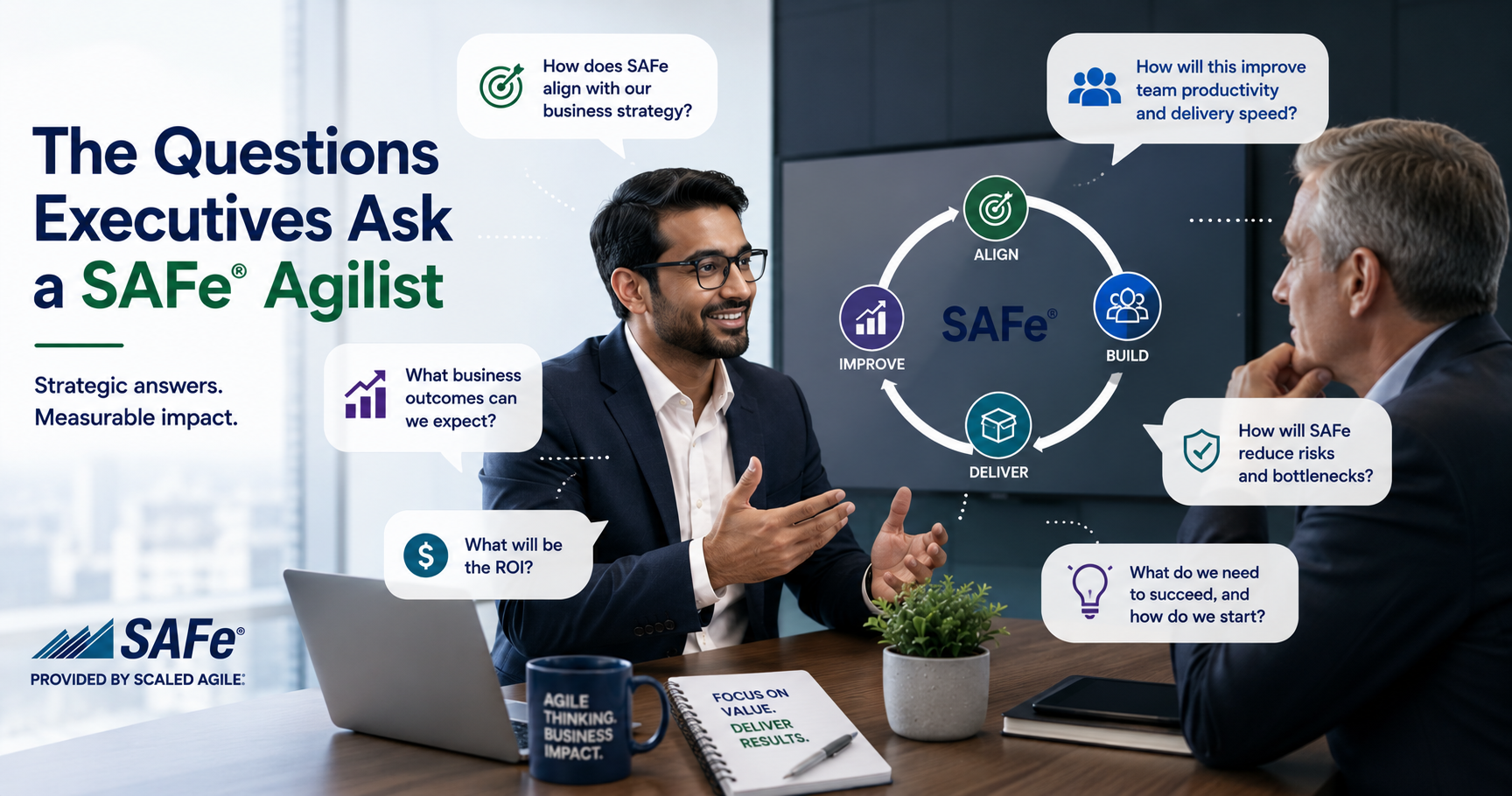
Executives ask a narrower set of questions than most newly certified leaders expect, and almost none of them are about the framework. They ask what it costs, when it pays back, why delivery has not improved yet, and whether this is different from the last three initiatives. Answering those well matters more to an adoption than knowing what an Inspect and Adapt workshop produces, and it is the part the certification does not prepare anyone for.
Key Highlights
- Executive questions cluster around cost, timing, evidence and credibility, not around framework mechanics.
- The hardest question is usually why delivery has not improved yet, and it arrives around three months in, before any structural change has had time to work.
- Answering with framework vocabulary is the most common failure. Executives who hear Program Increment and Inspect and Adapt in reply to a question about cost conclude the answer is evasive.
- The question about whether this differs from previous failed initiatives is genuine rather than rhetorical, and the honest answer involves funding rather than method.
- Scaled Agile positions SAFe Agilist as a foundational certification, which means it establishes framework literacy and does not develop the ability to hold these conversations.
- Preparing three or four specific answers in advance is worth more than any amount of additional framework study.
Why these conversations decide adoptions
An adoption is a series of budget and authority decisions taken by people who will never attend a PI Planning event.
That is worth sitting with, because most preparation goes into the delivery layer. The teams get trained, the events get scheduled, the boards get built. Meanwhile the decisions that determine whether any of it works are taken in meetings where the framework is a line item and the person defending it has ten minutes.
A SAFe Agilist who can explain the framework precisely and cannot answer why it has not worked yet will lose those meetings. The reverse is rarely true, because an executive who trusts the person will extend the timeline, and an executive who does not will cut it regardless of how correct the explanation was.
This is the gap Leading SAFe certification training can only partly close. It gives you the reasoning; the delivery of it under pressure is practice.
What is this going to cost
The first question, and the one people answer badly by underestimating.
The visible cost is training and certification, which is easy to quantify and is the smallest component. The real costs are the ones that do not appear on a purchase order.
Planning time. A train of a hundred people in a two-day PI Planning event is four hundred person-days per Program Increment. Over a year that is a substantial capacity commitment, and it is the number to lead with rather than hide, because the executive will find it eventually and finding it themselves is worse.
The Innovation and Planning Iteration. Dedicated time each PI for innovation, learning and the planning events. Presented as lost capacity by anyone hostile to the adoption.
The transition period. Delivery usually gets worse before it gets better, because people are learning a new way of working while still delivering.
The strong answer states all three plainly and then makes the argument. Coordination is already being paid for, in delays, rework and dependencies discovered late. The framework moves that cost into visible planning time. The claim is not that it becomes cheaper but that it becomes predictable, and predictability is what the executive actually wants.
When will we see results
The second question, and the one where overpromising ends careers.
The honest answer has two parts. Improvements in planning quality and dependency visibility appear within one or two Program Increments, because the events surface things immediately. Improvements in delivery throughput take considerably longer, because they depend on structural changes to funding and governance that have their own timeline.
The trap is quoting the first and letting the executive hear the second. Six months later there is a conversation about why velocity has not moved, and the credibility loss from that is worse than any delay would have been.
Commit to something checkable and modest instead. Dependencies identified at planning rather than at integration. Improvement items delivered. A decision the train made without escalating. Those are visible in one or two increments and they are genuine evidence rather than sentiment.
Why has nothing improved yet
The hardest question, and it arrives at around three months.
By this point the training has happened, the trains are running, and delivery looks approximately as it did before. The executive who sponsored it is being asked by peers what the return has been.
Two answers fail. Defending the framework, which sounds like excuse-making. And asking for more time without saying what will be different, which sounds like hoping.
The answer that works is diagnostic. Establish what has actually changed and what has not, specifically. In most cases at three months the delivery layer has changed and the governance layer has not, which means teams plan on a twelve-week cadence and still wait eleven weeks for an approval. That is a finding rather than an excuse, and it points at a decision the executive can take.
This is why the preparation work matters. A leader who has been tracking whether funding decisions changed, whether improvement items got delivered, and whether anything was decided without escalation has an evidenced answer. One who has been tracking event attendance has nothing to say.
How is this different from the last time we tried this
Asked with justified scepticism in any organisation with a history of failed change programmes, and it is a genuine question rather than a challenge.
Weak answers describe the framework as better. Every previous initiative was also described as better, and the executive remembers.
The strong answer is uncomfortable and lands well. Most previous attempts changed how teams worked without changing how the organisation funded and governed them, so they reverted. This will do the same unless the funding model changes, and here is the specific change required.
That answer does two things. It acknowledges the pattern honestly rather than claiming immunity from it. And it moves the conversation to the decision that actually matters, which is the one only the executive can take.
It also carries a risk worth accepting: the executive may decline. That is a better outcome than proceeding with an adoption that will fail for a knowable reason.
Why do we need all this process
The objection dressed as a question, and usually fair.
Do not defend the process. Ask what problem it was adopted to solve, and work back. If nobody can name one, that is the real finding and it is worth surfacing.
Where there is a problem, the argument is proportional. A single team shipping independently does not need PI Planning. Nine teams that have to integrate on a shared date do, because the alternative is discovering the dependencies at integration, which is the most expensive possible time.
The framing that works with executives is that the process is not overhead added to delivery. It is coordination cost made visible. It was always being paid, in a form nobody could see or budget for.
Are we doing it right
Deceptively simple and usually asked when something has gone wrong.
The instinct is to answer against the framework: are we running the events, do we have the roles. That produces a compliance answer and misses the question, which is really about whether it is working.
Answer against outcomes instead. Do teams change their plans during PI Planning, which indicates genuine commitment. Do improvement items get delivered, which indicates the loop is closed. Does bad news arrive early, which indicates transparency. Can a train name a decision it made without escalating, which indicates the decentralisation happened.
Four questions, all answerable, none requiring framework vocabulary. An executive can understand every one of them, and they are considerably better indicators than event attendance. This diagnostic frame is what our piece on SAFe anti-patterns is built around.
What they are really assessing
Behind the questions there are three judgements being made about you, and knowing them changes how you answer.
Do you understand our business or just your framework? An answer framed entirely in SAFe terms signals that you have learned a model and not applied it here. Answers that reference the organisation's actual constraints, the approval that takes eleven weeks, the budget cycle that fixes scope in October, signal the opposite.
Are you telling me the whole picture? Executives assume optimism bias in anyone reporting on their own initiative, and correctly. A report containing only progress is discounted automatically. One that names what has not moved is treated as more reliable across the board, including the good parts.
Can I put you in front of my peers? The unstated one. An executive sponsoring an adoption is exposed, and they are assessing whether you will hold up when questioned by people with no stake in it succeeding.
None of these is about the framework. All three are about credibility, which is why the answer to a technical question is so often a business answer.
Building the evidence before you need it
The questions arrive whether or not you have prepared. What separates a good answer from a defensive one is having tracked the right things from the start.
Track decisions, not attendance. How many decisions were made by a train without escalating. That number moving is the clearest evidence that decentralisation is happening, and it is the one executives find most persuasive because it is unambiguous.
Track when dependencies surface. At planning, or at integration. Moving from the second to the first is exactly what the framework claims to do, and it is checkable.
Track improvement items delivered. Not identified. Delivered. Our piece on Inspect and Adapt covers why the gap between the two is where most adoptions quietly fail.
Track approval latency. How long from a train deciding it needs something to getting it. If this has not moved, no delivery metric will, and knowing that early lets you name the constraint rather than be surprised by it.
Four numbers, none requiring a measurement programme, all collectable by one person paying attention. A leader with these at three months has an evidenced answer to the hardest question. One without them has an opinion.
What if it does not work
Rarely asked directly and frequently present in the room.
Have an answer. An adoption with no defined point at which it would be judged unsuccessful is a commitment rather than a decision, and executives notice that even when they do not say so.
The credible version names a review point and the evidence that would be examined. Two or three Program Increments, assessed against whether dependencies are surfacing earlier, whether improvement items are being delivered, and whether the funding change enabled anything. If those have not moved, something is wrong with the implementation and it is worth stopping to find out what.
Offering this makes the rest of your answers more believable, because it demonstrates you are describing an experiment with a hypothesis rather than advocating for a belief.
The meeting itself
A note on format, since the content is only half of it.
Ten minutes is the realistic slot. Adoptions get reviewed alongside eleven other things. Preparing forty minutes of material for a ten-minute item means the important part gets cut by the clock rather than by you.
Lead with the answer. Executives are used to being briefed, not walked through reasoning. State the position first and hold the supporting detail for the questions that follow.
Bring one number and one story. The number gives it substance and the story makes it memorable. A specific dependency caught at planning that would previously have surfaced at integration does more work than any chart.
Name the decision you want. Most of these conversations are wasted because the presenter reports and does not ask. If the funding change is the constraint, say so and say what you need decided.
The Leading SAFe course curriculum covers the reasoning behind all of this in its later modules, and the target audience breakdown is worth reading if you are unsure whether the class is pitched at your level.
How to prepare for these conversations
Five things, in order of return.
Know your numbers. Planning time in person-days, how many teams, how many trains, what the transition period costs. Vagueness on cost is read as concealment.
Have one concrete example of something that changed. Not a metric. A specific instance: a dependency caught at planning that would previously have surfaced at integration.
Know what has not changed. Being able to say the funding model has not moved yet, and that this is the constraint, is more credible than a uniformly positive report.
Drop the framework vocabulary. Say planning event rather than PI Planning, and coordination meeting rather than ART Sync, unless the executive already uses the terms. Vocabulary signals expertise to peers and evasion to executives.
Rehearse the three-month question. It is coming, it is the hardest, and improvising it is how adoptions lose their sponsor.
Understanding what each event is supposed to produce is the foundation for all of this, and the free Leading SAFe practice test is a quick way to confirm you have it.
When the answer is that it is not working
The conversation nobody prepares for, and the one that most protects your credibility long term.
Sometimes an adoption genuinely is not delivering, and the reason sits outside your control: funding sits at group level, the executive sponsor left, the organisation reorganised around something else. Continuing to defend it in that situation is the fastest way to lose the standing you will need for the next attempt.
The honest version has three parts. State what was expected to change and has not. State the specific mechanism preventing it, in terms of funding, authority or reporting rather than culture. And state what you would do differently, which is usually a smaller scope with a genuine funding change rather than a broader rollout.
Executives respond to this far better than most people expect, because it is rare and because it gives them something to decide. What they cannot act on is a report that everything is progressing well when their own peers are telling them otherwise.
This is also the moment where the framework knowledge earns its place, because you need to be able to say precisely which mechanism is broken. That precision is what Leading SAFe certification training provides and what the free practice test is a quick way to confirm you hold. Current certification costs are listed separately.
The one sentence to have ready
If you take nothing else into these meetings, have a single sentence describing the current state honestly.
Something of the form: the delivery layer has changed and is working, the funding layer has not changed and is now the constraint, and the specific decision required is this.
That sentence does an unusual amount. It reports progress without overclaiming. It names the obstacle without blaming anyone. It gives the executive something to decide rather than something to absorb. And it demonstrates that you are tracking the organisation rather than the ceremonies.
Constructing it requires the evidence described above, which is why the tracking matters more than the presentation. A leader who can say that sentence and support it with four numbers is in a completely different position from one who reports that the trains are running well.
The underlying point
Executives are not evaluating the framework. They are evaluating whether the person in front of them understands their own organisation and is telling the truth about it.
A leader who reports uniformly good progress at three months is either not looking or not saying. One who can name precisely what has improved, what has not, and which decision is blocking the rest is someone worth extending the timeline for.
That is the actual skill, and it is why the leadership material occupies as much of Leading SAFe certification training as the framework mechanics do. Current certification costs are listed separately if you are weighing the credential itself.


_1738229154.jpg)
_1712725475.jpg)
_1738223190.jpg)





 Lowest-Price Challenge











 Personalized Path


.webp)


 USA
USA  Canada
  India
India  UK
UK  Australia
  Singapore


