


 Call Us



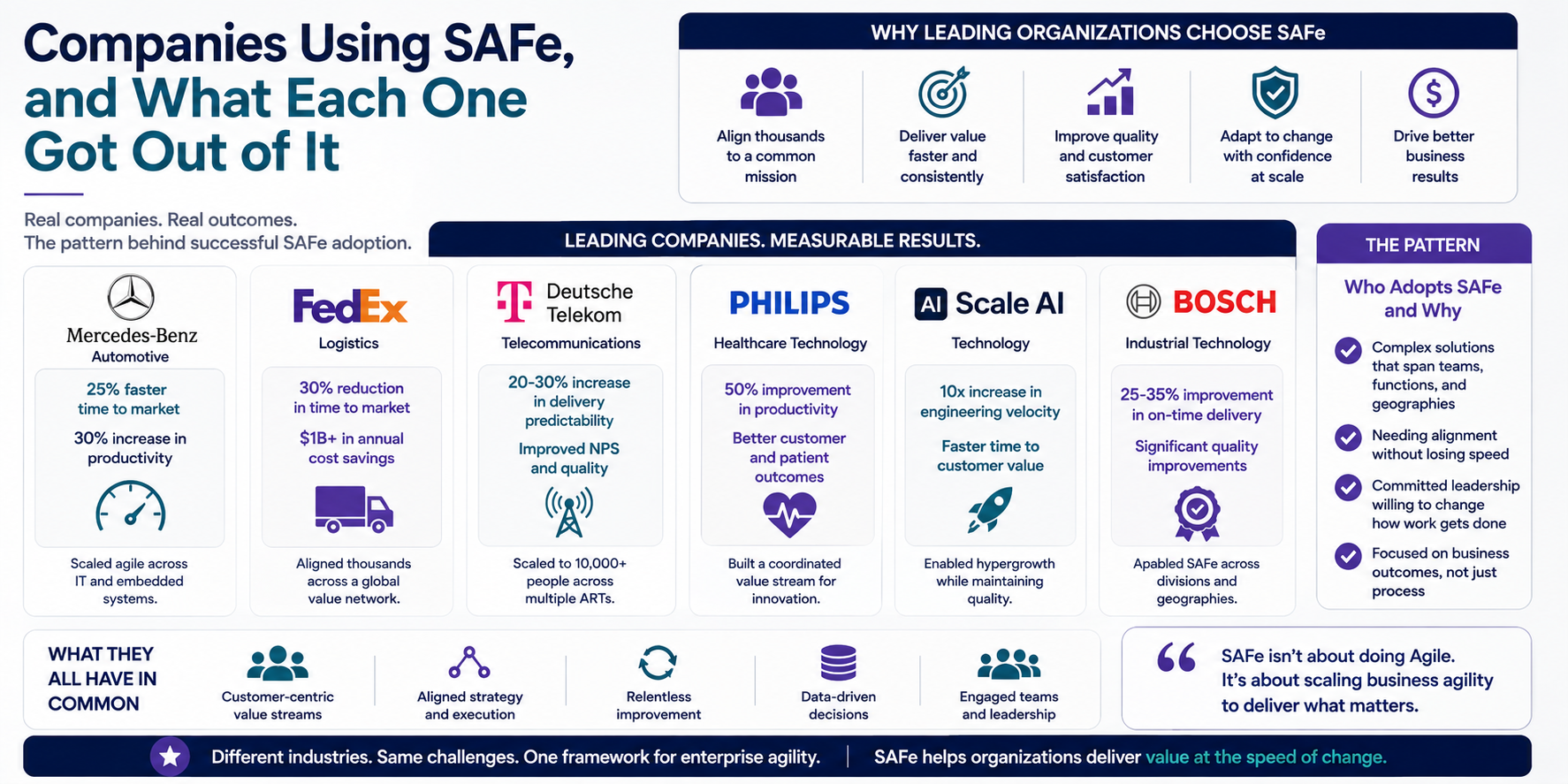
SAFe adoption is concentrated in large organisations with hardware and software running together, heavy regulatory load, or both. Scaled Agile publishes customer stories from Mercedes-Benz, Porsche, FedEx, Southwest Airlines, CVS Health, Deutsche Telekom, Nordea Bank, Handelsbanken, Oracle and Petrobras among others, and the pattern across them is consistent: these are organisations where dozens of teams have to ship something integrated on a shared date. That is the specific problem the framework exists to solve, and it explains why the adopter list looks the way it does.
Key Highlights
- Deutsche Telekom scaled from zero to 130 Agile Release Trains in three years, one of the largest documented SAFe rollouts.
- Handelsbanken reported a 30 percent improvement in average process time for developing features after adopting SAFe.
- Southwest Airlines reported delivering more than 80 percent of its business value through the framework.
- Automotive adopters including Mercedes-Benz and Porsche use SAFe to coordinate vehicle engineering with software and IT, which is the hardware and software integration problem the framework handles best.
- Petrobras describes its adoption as the largest-scale Agile transformation in Brazil within its first year.
- The common factor across adopters is not industry. It is scale plus integration: many teams that must deliver something combined, on a cadence.
Why these organisations and not others
Look at the list and the pattern is structural rather than sectoral.
Mercedes-Benz and Porsche are automotive. FedEx is logistics. Nordea and Handelsbanken are banks. CVS Health is healthcare. Deutsche Telekom and Console Connect are telecoms. Oracle is enterprise software. Petrobras is energy. There is no industry thread there at all.
What they share is a delivery problem with three features. Many teams working on one solution. A need to integrate that work rather than ship it independently. And a business consequence if the parts arrive at different times. A car's software has to work with the car. A bank's new product has to clear compliance, core banking and the app together.
That is the condition under which an Agile Release Train earns its overhead. Organisations without that condition, where teams can genuinely ship independently, usually find SAFe heavier than the problem requires, and that is a reasonable conclusion rather than a failure to understand it.
Automotive: hardware meeting software
Mercedes-Benz frames its adoption around the shift from hardware to software. That framing is the industry's whole story in one line. A vehicle programme used to be an engineering schedule with some electronics attached, and is now a software platform with a car around it.
Porsche describes integrating vehicle engineering with IT for digital innovation. Same underlying problem: two organisations with different cadences, different release mechanics and different definitions of done, now shipping one product.
This is the hardest version of the coordination problem and it is why automotive shows up so heavily in SAFe case material. Software teams can deploy continuously. A vehicle programme cannot. The framework's cadence and synchronisation model exists precisely to let those two operate together without one dictating terms to the other.
Banking and financial services: regulation plus release
Handelsbanken reported improving average process time for developing features by 30 percent. Nordea Bank describes becoming a top digital performer among European retail banks.
Banking adopts SAFe for a reason worth naming. Regulated change cannot be shipped by an autonomous team without oversight, but oversight applied per team creates a bottleneck. The framework's answer is to move governance up to the portfolio and the train, so compliance engages with the plan rather than with every individual release. Whether that works depends entirely on whether the organisation actually shifts the governance, or simply adds SAFe ceremonies underneath the existing approval gates.
That second outcome is common enough to be worth flagging if you are evaluating adoption stories. A train that plans on cadence and still waits eleven weeks for a change advisory board has not solved its problem.
Aviation, logistics and healthcare
Southwest Airlines reported delivering more than 80 percent of its business value through the framework. FedEx describes increased employee engagement and satisfaction, which is a less common metric to lead with and a more interesting one, since transformation programmes frequently damage both.
CVS Health used it for COVID response coordination. That case is instructive because it is the framework applied under genuine time pressure rather than as a planned multi-year adoption. Coordination across many teams at speed is the core claim, and a crisis is where the claim gets tested.
Telecoms and technology
Deutsche Telekom scaled from zero to 130 Agile Release Trains in three years. That figure is worth sitting with. 130 trains implies somewhere in the region of a thousand teams operating on a shared cadence, which is an organisational undertaking rather than a process change.
Console Connect, part of PCCW Global, describes using it to attract and train staff in a competitive market, which points at a benefit organisations rarely plan for. A named framework with a credential path makes hiring and onboarding legible. A candidate knows what a Release Train Engineer does before they arrive.
Oracle describes a mission-critical cloud migration bridging business and IT. Migration programmes are a natural fit for the framework because they have the two conditions that make it pay: many teams touching one estate, and a cutover date that cannot slip independently for each of them.
The telecoms concentration is not accidental either. Network, billing, provisioning and customer-facing systems all have to change together for a single new service to reach a customer, and each of those sits with a different group. That is the coordination problem in its purest form.
Energy, government and public sector
Petrobras describes the largest-scale Agile transformation in Brazil within its first year. Tracasa, working as Avantius, modernised the justice system in northern Spain. FRED IT delivered an end-to-end ePrescription solution. Audinate customised the framework for innovation and market responsiveness rather than adopting it wholesale.
The Audinate case is the one most worth noting, because customisation is where a lot of adoptions quietly live. The framework is presented in configurations of increasing scope, and starting with the smallest is both permitted and sensible. Our breakdown of the four levels of the Scaled Agile Framework covers what each adds.
The full published list, at a glance
| Organisation | Sector | What Scaled Agile reports |
| Deutsche Telekom | Telecommunications | Scaled from zero to 130 Agile Release Trains in three years |
| Handelsbanken | Banking | Improved average process time for developing features by 30 percent |
| Southwest Airlines | Aviation | Delivered more than 80 percent of its business value |
| Mercedes-Benz | Automotive | Shift from hardware to software |
| Porsche | Automotive | Integrated vehicle engineering with IT for digital innovation |
| Nordea Bank | Banking | Became a top digital performer among European retail banks |
| FedEx | Logistics | Increased employee engagement and satisfaction |
| CVS Health | Healthcare | COVID response coordination and empowerment |
| Oracle | Cloud computing | Mission-critical cloud migration bridging business and IT |
| Petrobras | Energy | Largest-scale Agile transformation in Brazil in its first year |
| Console Connect (PCCW Global) | Telecommunications | Attracted and trained new staff in a competitive market |
| Tracasa (Avantius) | Justice and legal technology | Modernised the justice system in northern Spain |
| FRED IT | Healthcare | Delivered an end-to-end ePrescription solution |
| Audinate | Audio and video networking | Customised SAFe for innovation and market responsiveness |
Two things stand out when the list is laid flat. The reported outcomes are not comparable with one another, because each organisation chose its own measure. And several of the most interesting ones are not delivery metrics at all: FedEx leads with engagement, Console Connect with recruitment, CVS Health with coordination under pressure.
How these organisations actually rolled it out
The published stories describe two broadly different approaches, and the distinction is more useful than the outcome figures.
Scaled rollout. Deutsche Telekom's zero to 130 trains in three years is the clearest example. This is adoption as a programme in its own right, with dedicated funding, a transformation function, and a sequence of value streams being converted on a schedule. It requires sustained executive commitment across years and it is expensive.
Contained start. Audinate's story describes customising the framework rather than adopting it wholesale, which is the pattern for organisations that begin with one train and expand only where the coordination problem justifies it. The framework explicitly supports this: the smallest configuration is designed for a single Agile Release Train, and there is no requirement to progress beyond it.
The second approach is far more common than the case studies suggest, because a single-train adoption rarely produces a story worth publishing. If you are planning your own, the contained start is almost always the right first move, and the SAFe implementation roadmap sequences it that way for a reason.
Whichever route an organisation takes, the leadership capability it depends on is the same, and that is what Leading SAFe certification training is built to establish before the structural changes begin.
One pattern worth noting across all fourteen: none of the published outcomes is a productivity claim. They describe process time, business value delivered, engagement, coordination and scale. That is unusual for transformation material and it is worth reading as a signal about what the framework actually changes.
What the case studies do not tell you
Published customer stories are marketing artefacts. They are useful as evidence that large organisations have done this at scale, and much less useful as evidence about what happens on average.
Three things to hold in mind. Organisations that abandoned an adoption do not publish a story about it, so the sample is self-selecting. Reported figures are supplied by the adopter rather than independently audited. And the timeframes are usually generous: a 30 percent improvement over an unstated baseline across an unstated period is directionally interesting and not something to plan against.
The useful read is not the percentage. It is the shape of the problem each organisation had before adopting, because that is what tells you whether your own situation resembles theirs.
The benefit nobody plans for
Two of the published stories lead with people rather than delivery, and that is worth pulling out because it is the least anticipated return on adoption.
Console Connect describes using the framework to attract and train staff in a competitive market. FedEx leads with increased employee engagement and satisfaction.
The mechanism is the same in both cases and it is unglamorous: a named framework with defined roles and a public credential path makes an organisation legible to the people joining it. A candidate can find out what a Release Train Engineer does before the interview. A new joiner has a vocabulary shared with everyone around them within a week rather than a quarter. Internal mobility gets easier because roles mean the same thing across departments.
None of that is why organisations adopt SAFe, and it is frequently the benefit they notice first. It also explains why the framework spreads more easily in organisations that hire at volume, since the onboarding saving compounds.
The engagement finding is more interesting still, because large transformation programmes usually damage engagement rather than improve it. Where it goes the other way, the common factor in the published material is that teams were given decisions rather than ceremonies.
Where SAFe does not fit
The published stories only cover organisations that adopted successfully and chose to talk about it. The absent cases matter just as much, and their shape is predictable.
Small organisations with independent teams. Below roughly one Agile Release Train, the coordination machinery costs more than the coordination problem. A single product team running Scrum does not need a portfolio Kanban.
Genuinely decoupled architectures. If teams deploy independently behind stable interfaces and rarely break each other, the integration problem the framework solves has already been solved architecturally. Adding train cadence on top adds ceremony without adding value.
Organisations unwilling to change funding. This is the significant one. SAFe moves money to value streams and decisions toward the work. An organisation that keeps annual project funding and per-release approval gates, then adds PI Planning underneath, has bought the cost of the framework and none of the benefit. It is the most common way adoptions fail and it is a leadership decision rather than a delivery one.
Early-stage product discovery. Where the product itself is still uncertain, planning a Program Increment commits to a direction the business has not earned yet.
Recognising which of these applies is a more valuable skill than knowing the framework, and it is the judgement Leading SAFe certification training is meant to develop in leaders before they commit an organisation to anything.
How to read a transformation case study
A short method, useful well beyond SAFe.
Find the baseline. A 30 percent improvement against what, measured how, over what period. Where the baseline is absent, the figure tells you the direction of travel and nothing about the magnitude.
Check what is being measured. Process time for developing features is a flow metric. Business value delivered is an outcome metric. Employee engagement is neither. These are not interchangeable and an organisation usually leads with the one that moved.
Look for the governance change. Every adoption that produced a durable result changed how decisions or money moved. If a case study describes new ceremonies and says nothing about funding, approval or reporting, it is describing a process rollout rather than a transformation.
Note the timeframe. Deutsche Telekom's figure covers three years. Adoption at scale is measured in years, and anyone promising a quarter is selling something.
Ask who wrote it. Published customer stories are produced with the vendor. That does not make them false, and it does mean they describe the intended version rather than the lived one.
What this means if you are evaluating SAFe
Three questions, drawn from what the adopters have in common.
Do your teams have to integrate? If they can ship independently without breaking each other, the coordination machinery is overhead. This is the single most useful filter.
Is there a shared date that matters? Cadence is valuable when something has to arrive together. Where there is no such date, the planning event is expensive theatre.
Will leadership actually change how it governs? Every adoption in the list above involved moving decisions, funding or oversight. The ones that fail tend to be the ones that added ceremonies while leaving governance where it was. That is the substance of the SAFe implementation roadmap and it is a leadership commitment rather than a delivery practice.
Before committing budget to an adoption, it is worth checking how much of the framework your leadership team already understands. The Leading SAFe practice test is a quick way to find out, and it usually surfaces that the vocabulary is less shared than everyone assumed.
If the answer to all three is yes, the framework is addressing a problem you actually have. If the answer to the third is no, adoption will produce the ceremonies and not the outcome, whatever the case studies report.
Understanding which of these applies to your organisation is what Leading SAFe certification training is designed to give leaders, and the business agility framing is where the course starts
Where to go next
The adopter list is worth reading for pattern rather than for reassurance. Mercedes-Benz and Handelsbanken have almost nothing in common as businesses, and everything in common as delivery problems: many teams, one integrated output, a date that matters.
If your organisation matches that shape, the next question is not whether SAFe works but whether your leadership will make the governance changes it depends on. That is the part the case studies gloss and the part that decides the outcome.
Leading SAFe certification training covers the framework and the adoption reasoning across two days, including the SAFe Agilist exam attempt. If you want to test your grounding first, the free Leading SAFe practice test takes a few minutes, and current Leading SAFe certification costs are listed separately.







 Lowest-Price Challenge











 Personalized Path


.webp)


 USA
USA  Canada
  India
India  UK
UK  Australia
  Singapore


