


 Call Us



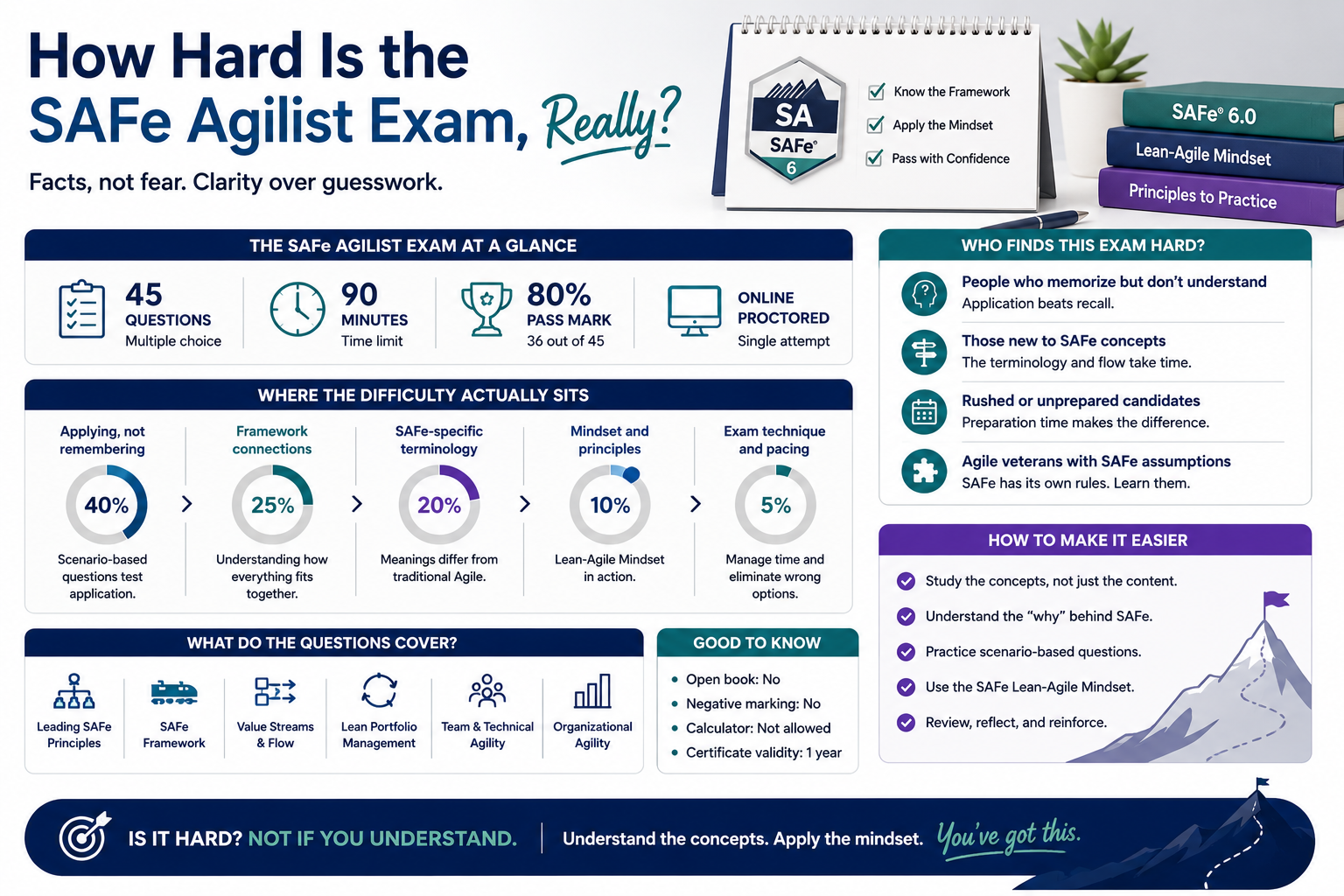
The SAFe Agilist exam is 45 multiple-choice questions in 90 minutes with an 80 percent pass mark, which means 36 correct answers out of 45. That pass mark is the reason the exam is harder than its foundational label suggests. You can afford nine wrong answers across the entire framework, and most people who fail do so because they treated a foundational-level credential as a low-effort one.
Key Highlights
- The SAFe Agilist exam is 45 questions in 90 minutes, and Scaled Agile sets the passing score at 80 percent, meaning 36 of 45 correct.
- 80 percent is a high bar for a foundational credential. It leaves a margin of nine wrong answers with no partial credit.
- Scaled Agile lists no prerequisites for the certification, and the training course is not required in order to sit the exam.
- Two minutes per question is generous for recall questions and tight for scenario questions, so pacing matters more than speed.
- The credential renews annually and requires a minimum of 12 Continuing Education Units each year.
- Most failures come from definitional imprecision on sizing and roles, not from the strategic content the course spends most of its time on.
What the numbers actually mean
Take the format apart before deciding how worried to be.
| Element | Detail |
| Questions | 45 |
| Time | 90 minutes |
| Passing score | 80 percent |
| Correct answers needed | 36 of 45 |
| Margin for error | 9 questions |
| Format | Multiple choice |
| Prerequisites | None |
| Course required to sit it | No |
| Level | Foundational |
| Renewal | Annually, minimum 12 CEUs |
Two minutes per question sounds comfortable and largely is. The time pressure is real only if you get stuck rereading scenario questions, which is where the minutes disappear.
The pass mark is the part worth taking seriously. An 80 percent threshold on a 45-question paper is unforgiving in a specific way: there is no partial credit, no weighting toward topics you know well, and no compensation across sections. Nine wrong answers and you are done.
For comparison within the same framework family, the SAFe Scrum Master exam sets its bar lower. Assuming the SAFe Agilist paper works the same way because both sit in the SAFe family is a mistake people make and then pay for.
So is it hard
Harder than its foundational label implies, and easier than the pass mark alone suggests. Both things are true and the reason is the question mix.
The exam splits roughly into recall questions and scenario questions. Recall questions ask what something is: which event produces which output, how a Feature is sized, what the Core Values are. These are straightforwardly learnable and there is no excuse for losing them.
Scenario questions describe a situation and ask what a leader should do. These are where the 80 percent bar bites, because plausible-sounding answers are deliberately offered. Knowing the ten Lean-Agile principles as a list will not get you through these. Knowing which principle applies to a described situation will. Our breakdown of the SAFe Lean-Agile principles works through each with the kind of application the exam tests.
The practical consequence: you cannot pass this on the recall questions alone, and you cannot pass it on general Agile intuition alone either.
Where candidates actually lose marks
Five patterns, in rough order of how often they cost people the exam.
Sizing definitions. The distinction between an Epic, a Capability, a Feature and a Story is the single most tested area, and the most commonly muddled. A Feature is sized for one Agile Release Train within one Program Increment. A Capability spans multiple ARTs and is still sized for one PI. Size alone does not make something a Capability. The number of ARTs does.
Enabler treated as a level. Enabler is a type of backlog item, not a fifth tier in the hierarchy. It can exist as an Epic, a Capability, a Feature or a Story. Questions exploit this constantly.
Event outputs. Knowing that PI Planning exists is not the same as knowing what it produces. Each event has a defined output, and questions frequently pair an event with the wrong one. Our PI Planning guide covers the agenda and what comes out of each part.
Role accountabilities. Who assigns business value to PI Objectives. Who owns the ART Backlog. Who is accountable for the architectural runway. These are precise in the framework and vague in most workplaces, which is exactly why people answer from experience and get them wrong.
Answering from how your company does it. The most damaging pattern of all. The exam tests the framework as Scaled Agile defines it, not as your organisation has implemented it. If your ART runs a modified version, and most do, you have to consciously set that aside.
What a scenario question actually looks like
Worth walking one through, because the difference between recall and scenario is where the exam is won and it is hard to appreciate in the abstract.
A recall question asks something like which event produces the ART Backlog, or how many Core Values SAFe defines. One correct answer, three clearly wrong ones, and either you know it or you do not.
A scenario question describes a situation. A train has finished PI Planning. Two teams have both committed to work that depends on a third team's component, which has not been scheduled. The question asks what should happen. The options will typically include something that sounds decisive and is wrong, something that defers the problem and is wrong, something that describes a real SAFe mechanism applied in the wrong place, and the correct answer.
What makes these hard is that the wrong options are not absurd. They are things that happen in real organisations every week. Answering them correctly requires knowing not just that the framework has a dependency mechanism but where in the cadence it belongs and who owns it.
The practical implication for revision: memorising definitions prepares you for perhaps half the paper. The other half needs you to have thought about how the pieces interact, which is why sitting practice questions beats rereading material. Our free Leading SAFe practice test is the fastest way to find out which half you are weak on.
How it compares to the other SAFe exams
Useful context if you are planning a certification path rather than a single exam.
SAFe Agilist sits at foundational level and covers the framework broadly: structure, principles, roles, events and the leadership view. Its difficulty comes from breadth plus a high pass mark rather than from depth on any one area.
The role-specific exams work differently. They cover less ground and go deeper into the mechanics of one role, which suits people who already work in that role and is harder for people who do not. The SAFe Release Train Engineer exam is the clearest example: narrower, more operational, and considerably easier if you have actually facilitated PI Planning.
Two practical consequences. First, taking SAFe Agilist before a role-specific credential is the sensible order, because the framework knowledge is assumed by the later courses rather than retaught. Second, do not calibrate your expectations for one SAFe exam from another. The pass marks and question styles differ across the family, and assuming otherwise is a recurring cause of underpreparation.
What happens if you do not pass
Worth knowing before you sit, because the anxiety around this is usually worse than the reality.
The exam can be retaken. Scaled Agile operates a retake process with its own fee structure, and the practical constraint is usually cost and scheduling rather than any hard limit. Check the current retake terms at the point of booking, since these are revised periodically and are not the kind of detail worth taking from a third party.
More useful is what to do differently. Almost everyone who fails and then passes reports the same diagnosis: they had understood the material and had not tested themselves against questions. Rereading the course deck after a failed attempt is the least effective response available. Sitting practice questions until your error pattern stops changing is the most effective.
If you failed narrowly, the gap is almost always the definitional content rather than the leadership material, because that is the part that fades in the weeks after the class.
The five distinctions that carry the difficulty
If you want to know where the hard marks sit, it is these. Each recurs across both question types and each is a place candidates consistently lose points.
Feature against Capability. A Feature is sized for one Agile Release Train within one Program Increment. A Capability spans multiple ARTs and is still sized for one PI. The distinction is the number of trains involved, not how big the thing is. This is the single most tested area on the paper.
Committed against uncommitted PI Objectives. Committed objectives are what the team is confident of delivering and are what predictability is measured against. Uncommitted objectives sit in the plan and are excluded from that measure. They exist so teams can stretch without being penalised, and questions turn on knowing which counts.
Cadence against synchronization. Cadence is the rhythm. Synchronization is multiple teams moving on that rhythm together so their work can integrate. A train can have one without the other, and treating them as a single concept is a common error.
Operational against development value streams. Operational value streams deliver value to the end customer. Development value streams build the solutions those operational streams run on. Value stream identification questions almost always turn on this.
Business Owners against Product Management. Business Owners assign business value to PI Objectives during PI Planning. Product Management owns the ART Backlog and decides what the train builds. Both are senior, both are business-facing, and conflating them costs marks.
The pattern across all five: each is a boundary between two things that sound similar and are precisely separated in the framework. That is where an 80 percent pass mark does its damage, because these are exactly the questions where a plausible wrong answer is available.
Who finds it hard, and who does not
Difficulty is not evenly distributed across candidates, and the pattern is predictable enough to place yourself in it.
Finds it straightforward: people currently working inside a functioning SAFe implementation who attended the class recently. The vocabulary is live for them, the role boundaries match what they see every week, and the scenario questions describe situations they have actually been in.
Finds it manageable: experienced Scrum Masters and delivery managers from a non-SAFe Agile background. The concepts transfer, the scale does not, and the work is mostly learning where the framework draws lines that team-level Scrum does not.
Finds it hard: two groups in particular. People with no Agile background at all, because the class assumes a working vocabulary and moves at a pace that does not accommodate learning it in the room. And people from a heavily customised SAFe implementation, who have to consciously unlearn what their organisation does. The second group is the more surprising one, because they feel prepared and their instincts are wrong in ways that feel right.
Finds it very hard: self-study candidates with no class and no exposure. Scaled Agile permits sitting the exam without training, and the definitions are all publicly available, but the scenario reasoning is what the class builds and reading does not replace it.
The useful thing about this list is that it tells you which problem you have. If you are in the third or fourth group, the gap is not effort. It is a different kind of preparation entirely, and it is worth being honest about which group you are in before booking a date.
The self-study group is the one that most often misjudges it. Scaled Agile permits sitting the exam without training and the definitions are all publicly documented, so the material looks accessible. What is not publicly documented is the reasoning that connects it, which is what the scenario questions test and what the two days of Leading SAFe certification training are built to construct. Reading the framework will teach you what a Capability is. It will not teach you what to do when two teams have committed to work depending on an unscheduled component.
How the difficulty compares to adjacent credentials
Useful calibration if you have sat other Agile exams and are trying to place this one.
Against the team-level route inside SAFe, covered in our comparison of SAFe Agilist and SAFe Scrum Master, this paper is broader and less deep. Against a team-level Scrum credential the same holds. Team-level exams test one framework applied to one team, and the material is small enough to hold in your head. SAFe Agilist covers structure, roles, events, principles, portfolio funding and the leadership view, which is far more surface area at a shallower depth.
Against the role-specific SAFe exams, it is broader and easier per topic. Those go deep into the mechanics of one role and are considerably easier if you actually hold that role.
Against traditional project management certifications, the difference is style rather than difficulty. Those reward memorising a defined body of knowledge. This one rewards understanding why the framework makes the choices it does, because the scenario questions cannot be answered from recall.
The practical calibration: if you found team-level Scrum certification easy, do not assume this one follows. The pass mark is higher and the surface area is several times larger. If you found a traditional project management exam hard because of volume, this is smaller but less forgiving.
What the difficulty actually rests on
Strip it back and the exam's difficulty comes from three things, none of which is the volume of material.
The pass mark. 80 percent on 45 questions with no partial credit and no compensation between topics. Most professional certifications sit lower, and candidates calibrate their effort to the foundational label rather than to the threshold.
The gap between what the class emphasises and what the paper tests. The two days spend most of their time on business agility, leadership behaviour and organisational change, which is the valuable part and the part attendees remember. The paper spends a meaningful share of its questions on precise definitional boundaries. People leave feeling they understood it, because they did, and then lose marks on whether a Capability spans one train or several.
Interference from your own workplace. Almost every real implementation deviates from the framework somewhere, and your instincts are trained on the deviation. This is the only difficulty factor that gets worse with experience, which is why seasoned practitioners occasionally fail exams that newcomers pass.
None of those is fixed by more reading. The first is fixed by taking the threshold seriously, the second by testing yourself on definitions rather than concepts, and the third by consciously separating what the framework says from what your organisation does. Sitting the free Leading SAFe practice test surfaces all three quickly, and if the gap turns out to be applied reasoning rather than recall, that is what the two days of Leading SAFe certification training exist to build.
One last calibration point. Candidates who fail typically miss by a small margin rather than a large one, which is consistent with the pattern described here: the leadership content is understood and a handful of definitional questions go wrong. That is an encouraging shape, because it means the gap is usually a few hours of the right revision rather than a fundamental problem.
The honest summary
This is a passable exam that catches people out for a predictable reason. The course spends most of its time on leadership, business agility and transformation, and the exam spends a meaningful share of its questions on precise definitions. Candidates leave the class feeling they understood it, which they did, and then lose marks on whether a Capability spans one ART or several.
Close that gap and the 80 percent bar stops being the problem it looks like. Sit questions early rather than reading more, because the failure mode here is misplaced confidence rather than insufficient study.
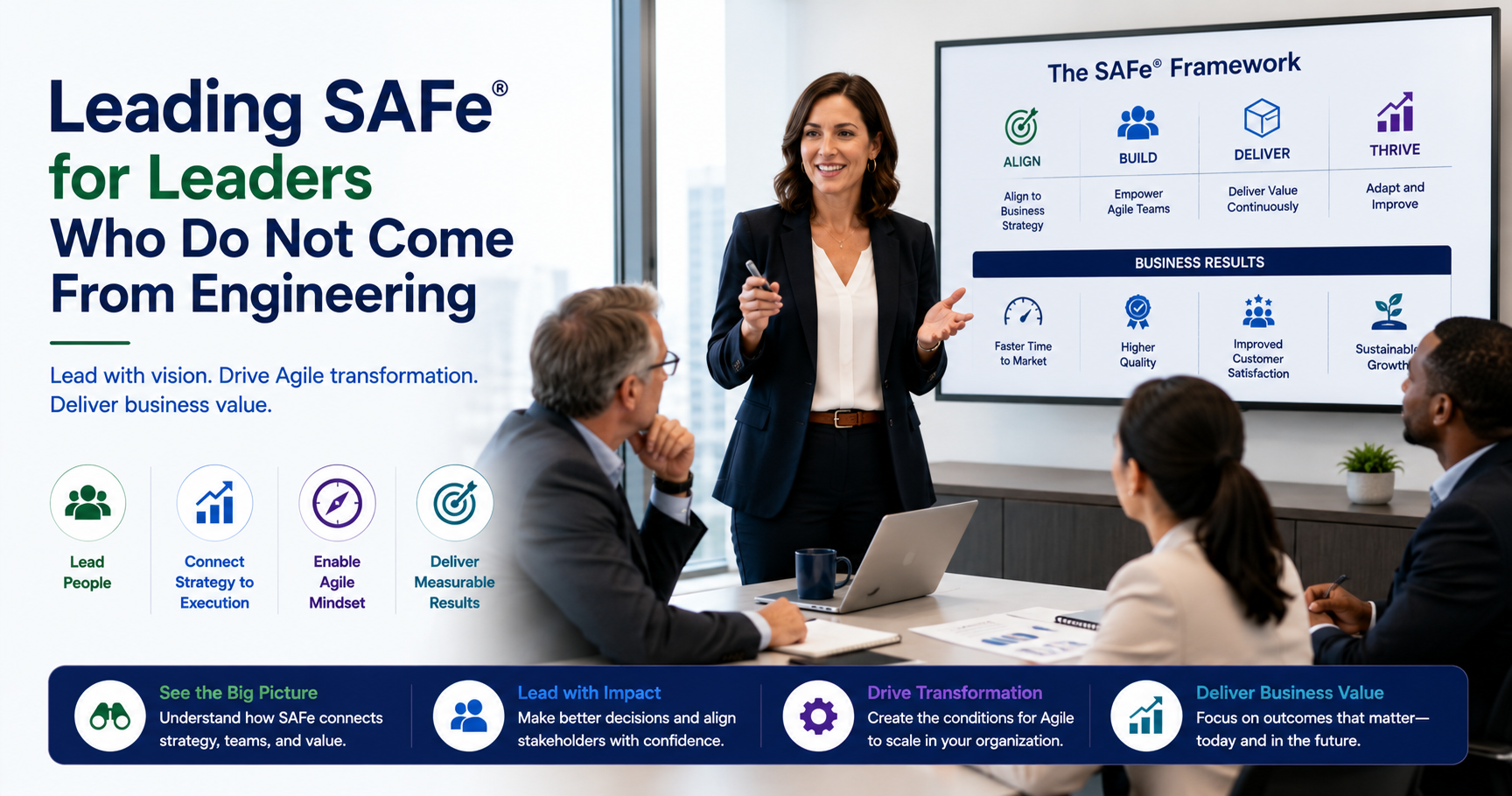
Leading SAFe certification training covers the full syllabus across two days and includes the SAFe Agilist exam attempt. Check current Leading SAFe certification costs before booking, or start with the Leading SAFe practice test to see where you actually stand.







 Lowest-Price Challenge











 Personalized Path


.webp)


 USA
USA  Canada
  India
India  UK
UK  Australia
  Singapore


