


 Call Us



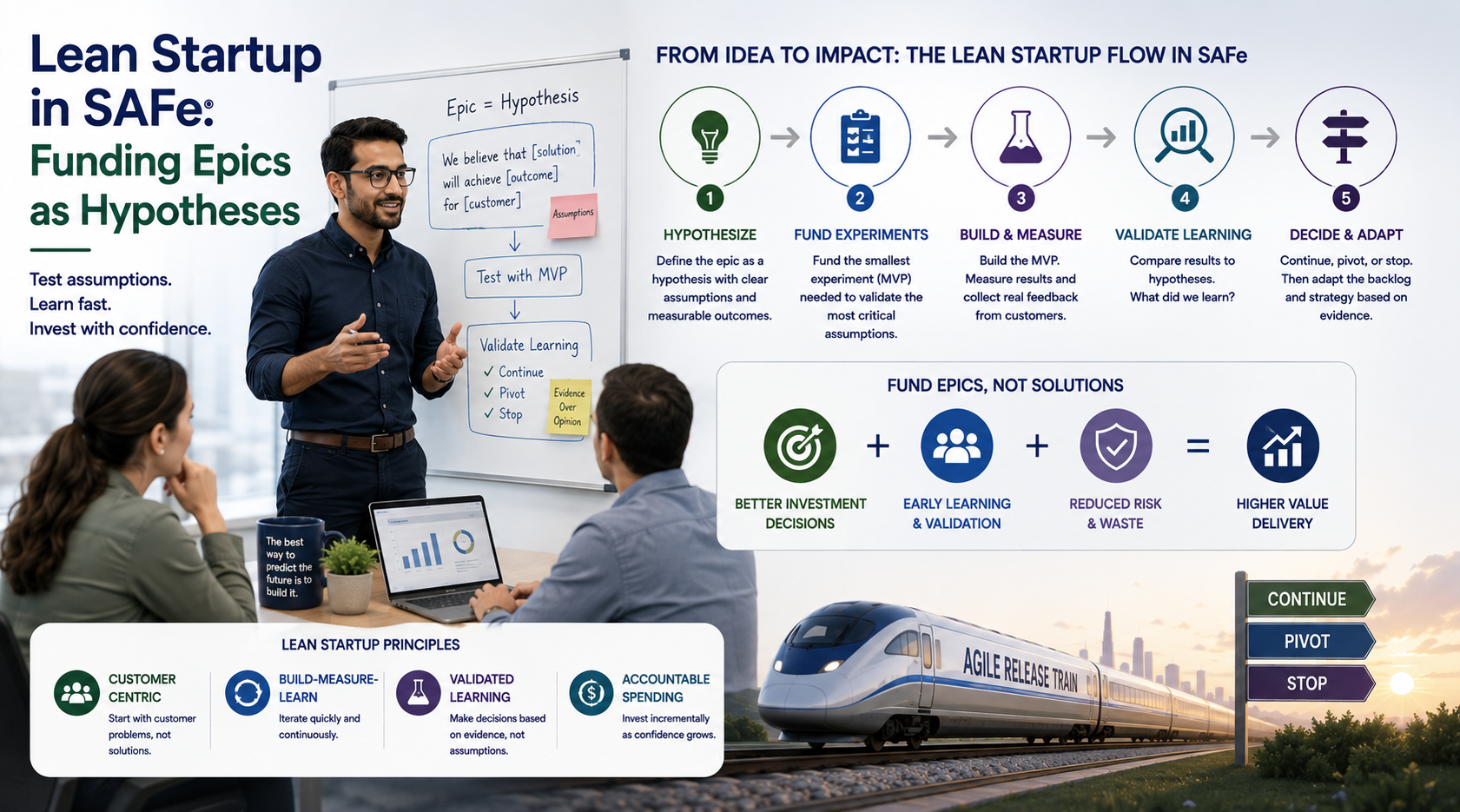
Scaled Agile describes the Lean Startup Cycle as an iterative build-measure-learn cycle used to optimise the economic value of strategic investments, and it defines an MVP as an early, minimal version of a solution sufficient to prove or disprove an Epic hypothesis. That second definition is the one that changes how an organisation behaves. An Epic stops being a thing you have decided to build and becomes a proposition you have decided to test, which means it can be stopped.
Key Highlights
- Scaled Agile defines the Lean Startup Cycle as an iterative build-measure-learn cycle for optimising the economic value of strategic investments.
- An MVP is defined as an early and minimal version of a solution sufficient to prove or disprove an Epic hypothesis, not as a small first release.
- An Epic is a significant solution development initiative, and in this model it carries a hypothesis rather than a specification.
- The mechanism only works if stopping an Epic after the MVP is a genuine, expected outcome rather than a failure.
- Most organisations adopt the vocabulary and keep committing the full budget up front, which removes everything the approach was for.
- The decision point after the MVP belongs to the portfolio, which is why this depends on Lean Portfolio Management existing.
What the cycle actually is
Build, measure, learn, repeated, with the explicit purpose of improving the economics of a strategic investment.
The word doing the work there is economic. This is not framed as a way to build better products in the abstract. It is framed as a way to avoid spending the full cost of an initiative before knowing whether it was worth building, which is a funding argument rather than a delivery one.
Traditional investment governance approves a business case, allocates a budget, and reviews against delivery of the plan. The question at each checkpoint is whether the plan is on track. The Lean Startup approach changes the question to whether the underlying assumption still looks true.
Those two governance models produce different behaviour under bad news. In the first, a struggling initiative gets more oversight and often more money, because stopping means admitting the original case was wrong. In the second, a disproved hypothesis is a successful outcome, because it was cheap and it prevented a larger commitment.
That difference is the entire point, and it lives in finance rather than in engineering, which is why Leading SAFe certification training treats it as portfolio material rather than delivery practice.
The MVP definition is stricter than the industry's
Worth pausing on, because the term has been diluted almost beyond use outside SAFe.
Commonly, MVP means a small first release: the cut-down version you ship to get something out. Scaled Agile's definition is narrower and more demanding. An MVP is sufficient to prove or disprove an Epic hypothesis.
That phrasing imposes two conditions most so-called MVPs fail. There has to be a hypothesis, stated in advance, specific enough to be wrong. And the thing built has to be capable of testing it, which sometimes means building something quite different from a reduced version of the final product.
If a team cannot say what result would cause them to stop, they are not building an MVP. They are building release one and calling it something else, which is the most common misuse of the term in organisations that have adopted the vocabulary without the mechanism.
The practical test is a single question: what would we see that would make us abandon this. If there is no answer, there is no hypothesis.
Epics as propositions
An Epic is a significant solution development initiative. In this model it carries a hypothesis statement rather than a specification.
A hypothesis names the assumption, the audience it applies to, the outcome expected and the measure that would confirm it. Something of the form: we believe that giving this group this capability will move this number by roughly this much, and we will know within this period.
Writing that is harder than writing a business case, which is why organisations resist it. A business case can be persuasive without being falsifiable. A hypothesis has to be specific enough that it could turn out to be wrong in a way everyone would recognise.
The discipline pays off at the decision point. When the MVP is delivered, the conversation is not about whether the team performed well or whether the roadmap should shift. It is about whether the number moved. That is a far shorter meeting and a far more honest one.
Epics move through the Lean Portfolio Management certification, which is where this decision physically happens.
The three outcomes after an MVP
Once the MVP is delivered and measured, there are three legitimate results and organisations only tolerate one of them.
Persevere. The hypothesis held. Fund the remaining implementation and build it out.
Pivot. The hypothesis was wrong in an informative way. The problem is real, the proposed solution was not, and a modified approach is worth testing.
Stop. The hypothesis was wrong and the opportunity is not there. Release the remaining budget to something else.
The third outcome is the one that makes the model work and the one most organisations cannot execute. Stopping an initiative is read as failure by everyone whose name is attached to it, so initiatives continue on momentum long after the evidence has turned.
An organisation that has never stopped an Epic after an MVP is not running this model. It is running conventional delivery with a new vocabulary layered over it.
Why this needs the portfolio layer
The decision to persevere, pivot or stop is a funding decision, and funding decisions belong to the portfolio.
That is why Lean Startup in SAFe is inseparable from Lean Budgets and guardrails. If money is committed annually to a named project, the budget for the full Epic was allocated before the MVP existed, and stopping means handing money back, which almost nothing in a conventional organisation incentivises.
Where value streams are funded rather than projects, the calculation changes. Stopping an Epic does not return money to a central pot; it frees capacity within the value stream for the next Epic in the portfolio Kanban. That is a much easier decision because nobody loses budget by making it.
This connection is the single most important thing to understand about the topic, and it is why the material sits in the Lean Portfolio Management domain rather than in delivery. Without the funding model, the practice is theatre.
What a good hypothesis looks like
Concrete, because the abstract version is easy to agree with and hard to apply.
A weak hypothesis: we believe improving the onboarding experience will increase customer satisfaction. It is unfalsifiable, the audience is undefined, and no result would ever cause anyone to stop.
A workable one: we believe that removing the manual verification step for customers who already hold an account will increase completed applications from that group by a meaningful margin within one quarter, and we will measure completion rate for that segment specifically.
The differences are that the audience is named, the change is specific, the measure exists already or can be built, and there is a period after which the answer is known.
Note what is not required: precision about the exact percentage. Organisations get stuck arguing about whether the target should be twelve percent or eighteen, which is a distraction. What matters is that everyone would agree afterwards whether it moved or did not.
The measure has to exist before you build
The most common practical failure, and it is entirely avoidable.
An Epic is approved with a hypothesis attached. The MVP gets built. At the decision point, somebody asks what happened to the number, and it emerges that the number was never instrumented, or that the baseline was never captured, so there is nothing to compare against.
At that stage the only available decision is to continue, because there is no evidence for anything else. The organisation has paid for the MVP and gained none of the option value it was buying.
The fix is procedural rather than technical: instrumenting the measure is part of the MVP, not a follow-up. If the measure cannot be captured, the hypothesis cannot be tested, and the Epic should be reconsidered before any build starts.
This is worth making an explicit gate in the portfolio Kanban, because it is cheap to enforce at approval and expensive to discover at the decision point.
Where this conflicts with how organisations plan
Three tensions worth anticipating, because they arrive reliably.
Annual planning wants certainty. A budget cycle asks what will be delivered next year. Answering that we will test four hypotheses and expect roughly half to be disproved is accurate and lands badly in a room expecting a roadmap.
Stakeholders hear commitment. When an Epic is approved, the people who wanted it hear that it is happening. Communicating that it has been approved for testing rather than for delivery requires deliberate and repeated effort, and skipping it produces bad feeling later.
Teams dislike building things that get stopped. Working on something abandoned after the MVP feels like wasted effort unless the framing is established up front. Where teams understand they are producing evidence rather than product, the reaction is entirely different.
All three are communication problems rather than mechanism problems, and all three are worse when addressed after the first Epic is stopped rather than before.
The relationship with Features and the ART Backlog
A structural point that gets muddled in practice.
An Epic is portfolio-level. Its MVP is delivered by one or more Agile Release Trains, decomposed into Features that enter the SAFe Scrum Master certification and then into stories at team level.
That means the trains do not usually experience an Epic as a hypothesis. They experience it as a set of Features to build in a Program Increment. The hypothesis framing lives above them.
This creates a specific risk. If the trains do not know which Features constitute the MVP and which are the full build, they will scope and sequence as though the whole thing is committed. The MVP then arrives late, bundled with work that was only justified if the hypothesis held.
Naming the MVP boundary explicitly, in terms the train can act on, is a small piece of communication that determines whether the mechanism functions at all.
What it looks like when it is working
Four observable signs, useful whether you are assessing an organisation or your own.
Epics carry hypotheses that someone can state from memory. Not buried in a document. Known.
Something has been stopped. At least one Epic in the last year was abandoned after its MVP, and people can name it without embarrassment.
MVPs are smaller than the teams initially proposed. The negotiation about what is genuinely sufficient to test the hypothesis is happening, which means the definition is being taken seriously. Our free Leading SAFe practice test covers the MVP definition in the form the exam uses, since the framework's version is stricter than common usage. The negotiation about what is genuinely sufficient to test the hypothesis is happening, which means the definition is being taken seriously.
The decision meeting is short. Where the measure was agreed in advance and instrumented, the persevere, pivot or stop conversation takes minutes rather than an afternoon of interpretation.
If none of the four is present, the organisation has adopted the language. If the second is absent but the others are present, it is close and the first stop will be the hard one.
The cultural precondition
Underneath the mechanism there is a behavioural requirement, and it is the same one that underpins most of the framework.
Stopping an Epic has to be safe for the person who proposed it. Where it is read as a failed initiative attached to a named sponsor, nobody will propose a genuinely uncertain Epic, and the portfolio will fill with safe, incremental work that did not need a hypothesis in the first place.
The organisations that get this right tend to do one deliberate thing early: they celebrate the first stop publicly, framed as money saved rather than an initiative failed. That single act does more than any amount of process design, because everyone watching learns what the organisation actually rewards.
It is the same dynamic as early bad news in PI Planning, and it fails for the same reason when handled badly. Our piece on SAFe certification requirements covers the broader pattern.
Sizing the MVP without gutting it
The recurring practical argument, and it goes wrong in both directions.
Build too much and the MVP stops being an option and becomes the commitment. By the time it ships, so much has been invested that stopping is politically impossible regardless of what the measure says. The organisation has bought certainty it did not need at the price of the flexibility it did.
Build too little and the result is uninterpretable. A version so reduced that customers cannot realistically use it produces a measure that says nothing, and the honest conclusion is that the test was inconclusive. That is worse than not running it, because it consumes the budget and settles nothing.
The workable question is not how small can this be. It is what is the smallest version that would genuinely change our minds. Those sound similar and produce very different answers. The second forces a conversation about what evidence would actually be persuasive, which is exactly the conversation worth having before anyone builds.
Where a team and a sponsor disagree on MVP scope, the disagreement is almost always about that question rather than about effort, and surfacing it directly resolves it faster than negotiating scope line by line. Framing it that way is part of what Leading SAFe certification training equips leaders to do in a portfolio conversation.
What to do if your organisation cannot stop things
Common, and worth addressing rather than treating as a precondition you either have or do not.
Start with one Epic. Not the portfolio. Pick something genuinely uncertain, modest in size, with a sponsor willing to state a hypothesis and accept the answer. Run it properly, instrument the measure, and hold the decision meeting.
If it stops, that is the demonstration. If it continues, you have still established the mechanism and the next one is easier.
What does not work is announcing that the organisation now funds by hypothesis. That produces hypotheses written to be unfalsifiable, because everyone involved understands what is actually being protected. The practice spreads by example rather than by policy, and the first example matters far more than the announcement would have.
Lean Startup sits within the Lean Portfolio Management domain, which carries 25 to 28 percent of the SAFe Agilist paper and is jointly the largest.
Expect definitional questions on the MVP, particularly on the distinction between an MVP and a first release, since the framework's definition is stricter than common usage. Expect the Epic to appear, and expect at least one question on where the persevere, pivot or stop decision sits.
The material is conceptually straightforward and it is unfamiliar to most delivery-side candidates, which is the combination that produces lost marks. Our breakdown of the the SAFe Agilist certification process covers why portfolio content deserves more revision time than delivery-side candidates instinctively give it, and the free Leading SAFe practice test will show you quickly whether this area is solid.
The short version
The mechanism is simple and the precondition is not. Fund an Epic to test a hypothesis, build the smallest thing that answers it, measure, then decide.
What makes it work is that stopping has to be a real option, and that requires both a funding model where stopping does not cost the sponsor anything and a culture where it does not cost them credibility. Organisations that install the vocabulary without those two conditions get all the overhead of writing hypotheses and none of the option value.
If you are leading or advising on an adoption, Leading SAFe certification training covers the Lean Startup approach alongside the portfolio funding it depends on, across two days including the exam attempt. Current certification costs are listed separately.






 Lowest-Price Challenge











 Personalized Path


.webp)


 USA
USA  Canada
  India
India  UK
UK  Australia
  Singapore


