


 Call Us



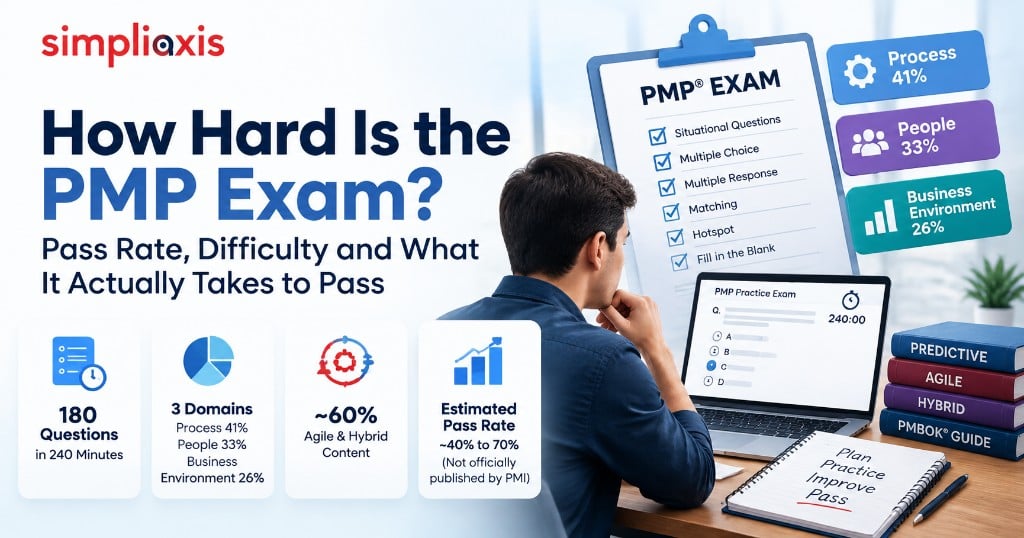
How hard is the PMP exam? It is genuinely difficult, but not because it demands rote memorisation of facts. It is hard because almost every question is a situational judgement call, drawn from a syllabus that now leans heavily on agile and hybrid delivery as well as traditional predictive project management, inside a tight 240-minute window. PMI has never published an official pass rate, so any specific percentage you read online, including the ones in this article, is an estimate from training providers or community surveys, not a confirmed PMI figure. What is confirmed, and far more useful for deciding how to prepare, is exactly how the exam is built and where candidates consistently lose marks.
Key Highlights: How Hard Is the PMP Exam?
- The PMP exam is 180 questions across 240 minutes, split into three untimed sections of 60 questions each, with two optional 10-minute breaks.
- Under the Examination Content Outline that took effect in July 2026, the three domains are weighted Process 41%, People 33% and Business Environment 26%, a significant shift from the 2021 weighting.
- Roughly 60% of scored questions now draw on agile or hybrid ways of working, with the remaining 40% reflecting predictive approaches, so waterfall-only preparation leaves real gaps.
- PMI does not release an official pass rate. Estimates quoted by training providers as of September 2026 range from around 40% to as high as 65% to 70% on the first attempt, and the wide spread itself is a sign that no single number should be treated as fact.
- The exam's real difficulty driver is situational question design, where several answer choices sound plausible and only one reflects "the PMI way" of approaching the scenario.
- Experienced project managers often underperform relative to their real-world competence because their workplace habits do not always match PMI's process language and sequencing.
- Structured practice with full-length mock exams, scored against the current domain weightings, is the single most consistently cited factor in raising first-attempt pass odds.
How Hard Is the PMP Exam? What the Format Looks Like and Why It Drives the Difficulty
The exam's format, not any single topic, is what makes it hard for most candidates. You sit 180 multiple-choice, multiple-response, matching, hotspot and fill-in-the-blank questions in 240 minutes, of which 170 are scored and 10 are unscored pretest items you cannot identify during the test. The 180 questions are grouped into three sections of 60 questions each, but PMI does not time each section separately, so you can move faster through a section you find comfortable and slow down on one you do not. Two optional 10-minute breaks are built in, but once you leave a section you cannot return to it, which adds a layer of pacing strategy on top of the content itself. At roughly 80 seconds per question on average, there is enough time to think, but not enough to deliberate over every option the way you might in an open-book workplace decision.
What makes this format demanding is not the arithmetic or the terminology in isolation, it is that the large majority of questions are situational. A typical item describes a project scenario, often mid-crisis, and asks what the project manager should do next. Several answer options are usually defensible actions a real project manager might take, and the exam is testing whether you can identify the one PMI considers correct given its own process model and sequencing.
Candidates who prepare for a PMP certification training course built specifically around this question style tend to adjust to that logic faster than those studying from theory alone, simply because they see hundreds of scenario questions before exam day rather than a handful.
It is worth being specific about the question types themselves, because "multiple choice" undersells how varied the format actually is. Some items are traditional single-answer multiple choice. Others are multiple-response, where you must select two or more correct actions from a longer list, and partial credit is not given, so getting three out of four right still counts as wrong. Matching questions ask you to pair project management terms or roles with the correct definition or responsibility.
Hotspot questions ask you to click the correct area of a diagram, such as a network diagram or a stakeholder chart. Fill-in-the-blank items, often used for formula-based questions like earned value calculations, remove the safety net of recognising a plausible-looking wrong answer among multiple choices. Each format tests the same underlying situational judgement in a slightly different way, which is part of why question variety, not just question volume, matters in preparation.
Domain Weightings: Where the Exam's Difficulty Is Concentrated
The exam is organised into three performance domains, and PMI reweights them periodically based on a global Job Task Analysis of working project managers. The table below reflects the Examination Content Outline that came into effect on 9 July 2026, which is the version current as of this writing.
| Domain | Current Weighting | What It Covers | Why Candidates Find It Hard |
| Process | 41% | Planning, scheduling, executing, monitoring and delivering the work of a project across predictive, agile and hybrid approaches | The largest domain by far, and the one where predictive and agile terminology most often get confused with each other |
| People | 33% | Leading teams, resolving conflict, coaching, stakeholder engagement and building a collaborative team environment | Answers depend on interpersonal judgement, so candidates with strong technical backgrounds but limited people-leadership exposure often struggle here |
| Business Environment | 26% | Governance, compliance, benefits realisation, organisational strategy, risk oversight and value delivery, several of which moved into this domain from Process | This domain grew the most in the 2026 update, and many candidates preparing from older materials under-study it |
The direction of travel matters more than the exact percentages. Business Environment rose from 8% under the 2021 outline to 26% under the 2026 outline, while Process fell from 50% to 41% and People fell slightly from 42% to 33%. According to training-provider analysis of the 2026 exam update, four topic areas that used to sit inside Process, namely risk planning, change control, project governance and issue management, moved into Business Environment, which is the main reason that domain's weighting jumped so sharply.
PMI is not making the exam easier or harder overall by doing this, it is rebalancing it to match how project managers actually spend their time today, with more emphasis on governance, strategic alignment and value delivery. Because PMI has changed these weightings before and will very likely change them again in a future cycle, the specific numbers in this table should be treated as a dated snapshot rather than a permanent fact. What has stayed constant since 2021 is the underlying structure, three domains, scenario-based questions, and a blend of predictive and adaptive approaches, and that structure is what you are really preparing for.
The exam also grew slightly in raw length as part of the same update. Alongside the reweighting, PMI extended the total sitting time from 230 to 240 minutes and doubled the number of unscored pretest questions from five to ten. Neither change affects how many questions count toward your result, but the longer clock and the higher proportion of unscored, unidentifiable items mean pacing discipline matters at least as much under the current outline as it did before.
PMP Pass Rate: What the Estimates Say and Why PMI Does Not Publish a Real Number
Nobody outside PMI knows the actual PMP pass rate, because PMI stopped disclosing one. In 2005 PMI published a required passing score of 61%, and it has not published a passing score or a pass rate since 2007. Since then, PMI has scored the exam psychometrically, weighting each question by its measured difficulty rather than counting raw correct answers, and candidates receive a proficiency breakdown of below target, target, above target or needs improvement per domain rather than a percentage score.
That gap in official data is exactly why the internet is full of different pass rate claims. As of September 2026, training providers and community sources quote first-attempt pass rate estimates anywhere from around 40% to 45% on the more conservative end, up to 60% to 70% on more optimistic estimates, a range that one widely cited training-provider analysis also acknowledges is drawn from provider data and forum surveys rather than any figure PMI has confirmed.
The wide range exists because each figure is calculated differently, some are pulled from small self-reported alumni cohorts of a single training provider, others are informal polls on project management forums, and a few are extrapolated from outdated pre-2021 data that predates the current domain structure entirely.
Treat any specific percentage, including the ones cited here, as an attributed estimate rather than a verified statistic, and focus your preparation on the mechanics that are actually knowable, the exam format, the domain weightings and question style, rather than chasing a number PMI has chosen not to release.
One thing the estimates do agree on directionally is that the PMP is not a rubber-stamp credential. Even the more generous 60% to 70% estimates imply that roughly a third of first-time candidates do not pass, which is a meaningfully higher failure rate than many professional certifications that rely on straightforward recall.
Is the PMP Exam Hard? The Mechanics Behind the PMP Exam Difficulty
Four mechanics, more than any single body of knowledge, explain why candidates find the PMP exam difficult.
Situational judgement, not recall
The large majority of scored questions present a scenario and ask what you should do, rather than asking you to define a term. Several answer choices are typically things a competent project manager could genuinely do, and the exam is testing whether you can identify PMI's preferred sequence and reasoning, not just a plausible real-world action.
Answer options designed to be close
Exam writers deliberately include distractors that are almost, but not quite, correct, often differing from the right answer by sequencing, by which stakeholder should act first, or by whether a step belongs in planning versus execution. This is a different skill from memorising definitions, and it rewards candidates who have practised distinguishing near-identical options under timed conditions.
The shift toward agile and hybrid content
Under the current outline, roughly 60% of scored content spans agile and hybrid approaches, with the remaining 40% reflecting predictive, plan-driven project management. Candidates whose real-world experience is entirely predictive, or entirely agile, often find the unfamiliar half of the exam disproportionately hard, because it tests a working style they have not practised on the job.
Time pressure across three untimed-within, but bounded, sections
With around 80 seconds per question on average and no ability to revisit a section once you move on, candidates who over-invest time on early questions frequently find themselves rushing through the final section, which increases careless errors independent of actual knowledge gaps.
Who Struggles Most: Career Changers vs Experienced Project Managers
Difficulty on the PMP exam does not track cleanly with years of experience, and two quite different groups tend to struggle for opposite reasons.
Career changers and less experienced candidates
Candidates newer to formal project management, including those transitioning from a technical or coordination role, often find the sheer breadth of the syllabus overwhelming, spanning scope, schedule, cost, quality, risk, resource, communication and stakeholder management across three delivery approaches. Without on-the-job pattern recognition to fall back on, every scenario question has to be reasoned from first principles, which is slower and more error-prone under time pressure.
Experienced practitioners
Counterintuitively, seasoned project managers sometimes underperform relative to their real competence, because their instinctive workplace answer does not always match PMI's process model. Their organisation's actual terminology often differs from PMBOK terminology, and years of working around process gaps in the real world can make it harder to select the textbook-correct answer over the pragmatic one they would actually choose on the job. On community forums, it is common to see candidates with a decade or more of hands-on delivery experience describe the exam as harder than they expected, precisely because they kept defaulting to what has worked for them in practice rather than what PMI's model prescribes. Success for this group usually depends less on learning new content and more on relearning how PMI expects a scenario to be reasoned through, and unlearning some habitual shortcuts along the way.
Where the two groups meet
Both groups tend to converge on the same fix once they identify the problem, deliberate exposure to scenario questions scored against the current outline, rather than more passive reading. Career changers use that exposure to build the pattern recognition they have not yet had time to develop on the job, while experienced practitioners use it to recalibrate away from workplace habits toward PMI's specific reasoning.
This is also why a single generic study timeline rarely fits everyone, someone new to formal project management may need more time on foundational process sequencing, while an experienced practitioner may need comparatively less content review but more targeted drilling on the questions they keep getting wrong for the same underlying reason.
How to Prepare for the PMP Exam: What Meaningfully Improves Your Odds of Passing
Preparation quality, not raw study hours, is what most consistently separates first-attempt passes from retakes. A handful of habits show up repeatedly across candidate feedback and training-provider data.
- Study the current outline, not an old one. Make sure your materials reflect the domain weightings and agile and hybrid emphasis that applies to the version of the exam you are actually sitting, since studying an outdated split wastes effort on the wrong proportions.
- Practise full-length mock exams under timed conditions. Simulating the full 240 minutes, including the section structure and optional breaks, builds the pacing instinct that content review alone cannot.
- Target 80% to 90% on practice tests before sitting the real exam. This buffer accounts for the fact that the real exam's psychometric scoring can feel less forgiving than a simple percentage-correct practice test.
- Learn to spot close-call distractors deliberately. Review wrong answers by asking why the incorrect option was almost right, not just why the correct option was right, since that is the skill the exam is actually testing.
- Use a structured course rather than self-study alone. A PMP certification training programme built around scenario-based practice questions and the current content outline can shorten the gap between where your instincts sit today and where PMI expects them to be.
- Close your weakest domain deliberately. If Business Environment or agile content is unfamiliar from your day job, budget disproportionate study time there rather than defaulting to what already feels comfortable.
Preparation decisions look different again when it is not one person studying alone but a PMO or L&D function deciding whether to fund several staff through the exam at once. Every failed attempt costs a retake fee, lost productivity and a delayed certification date, so for a manager weighing whether structured group preparation is worth the spend, cohort-based corporate and group training is usually the more defensible option financially, since it standardises everyone's preparation against the same current outline and reduces the number of people relying on scattered, possibly outdated, self-study material.
Conclusion
The honest answer to how hard the PMP exam is sits between the two extremes you will find online. It is not a box-ticking exercise, and treating it that way is the most common reason candidates fail, but it is also not an impossible bar for someone who prepares against the actual exam structure rather than against vague impressions of difficulty.
The exam is hard because it is situational rather than factual, because it now blends predictive, agile and hybrid content in roughly a 40:60 split, and because 240 minutes of sustained scenario reasoning across three domains is a genuinely different skill from workplace project management, even for people who are good at their jobs. PMI's decision not to publish a pass rate means every specific percentage in circulation, including the estimates in this article, should be read as an attributed snapshot, not a verified fact, and that uncertainty is itself a reason to prepare on fundamentals rather than chase a number.
Whether you are studying independently, enrolling in a structured PMP certification training course, or evaluating options through Simpliaxis's broader catalogue of PMI-accredited certifications, the preparation that reliably works is the same, study the current domain weightings, practise under real time pressure, and learn to reason the way PMI's scenarios expect rather than the way your own workplace happens to operate.






 Lowest-Price Challenge











 Personalized Path


.webp)


 USA
USA  Canada
 India
India UK
UK Australia
 Singapore


