


 Call Us



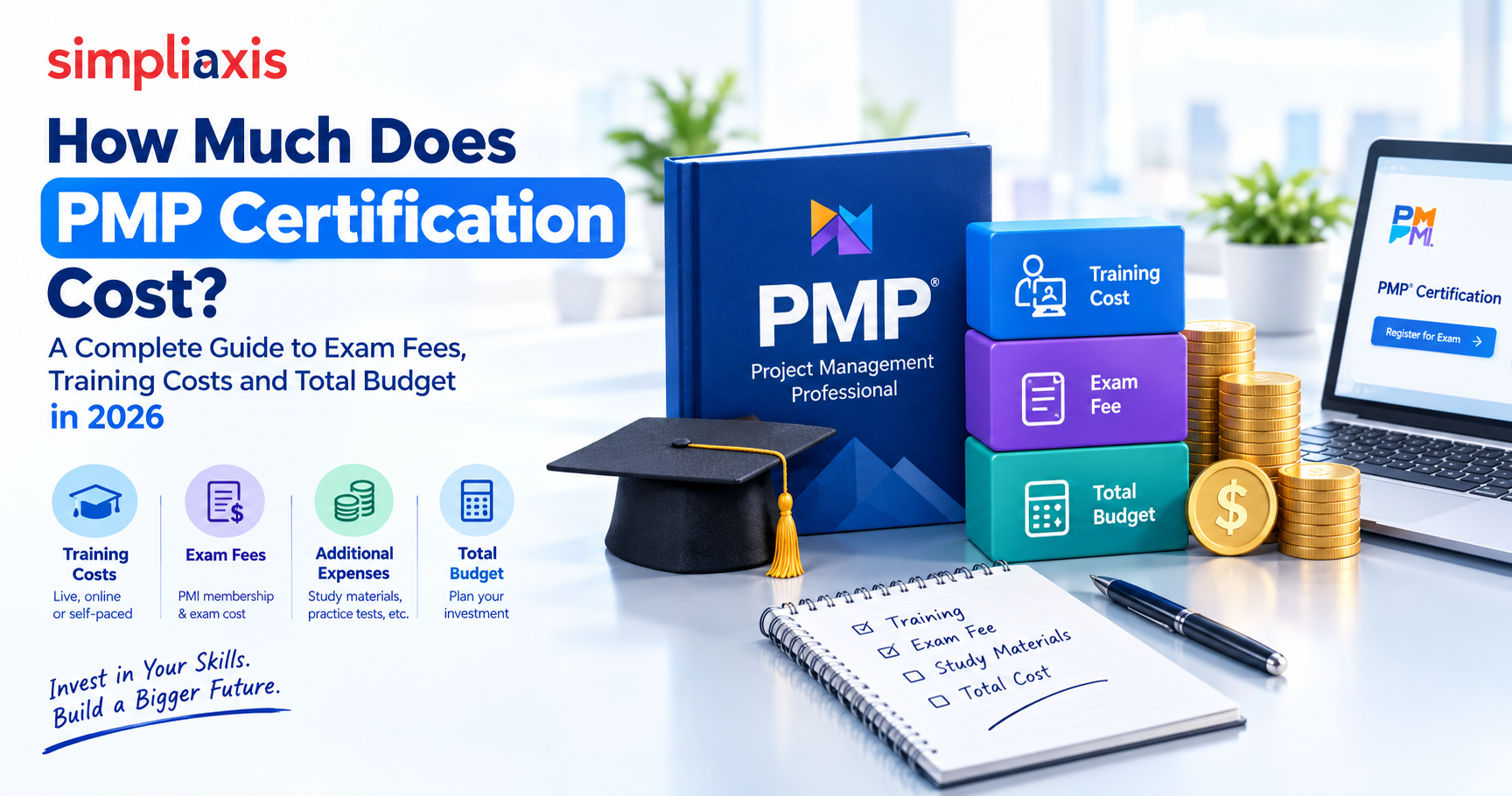
How much does PMP certification cost? It typically costs between USD 700 and USD 4,000 in total, depending on whether you join PMI, which training format you choose and whether you need a retake. As of September 2026, PMI lists the PMP exam fee itself as USD 405 for PMI members and USD 555 for non-members on pmi.org, and that is before training, study materials, PDUs and renewal are added in.
Most candidates who study through a structured online or live virtual course land somewhere between USD 1,000 and USD 2,500 all in, while those who pay for premium classroom bootcamps or skip PMI membership altogether can spend well over USD 3,000. The exact figure depends far more on your training choice than on the exam fee itself, which is why the breakdown below matters more than the headline number.
Key Highlights: How Much Does PMP Certification Cost
- As of September 2026, PMI's published fee schedule on pmi.org lists the PMP exam fee at USD 405 for PMI members and USD 555 for non-members, a gap of USD 150.
- PMI individual membership costs USD 129 a year plus a one time USD 10 application fee, and it usually pays for itself the first time you sit the exam.
- Training cost is the biggest swing factor: self-study materials can cost as little as USD 75 to USD 300, while multi-day classroom bootcamps run USD 1,500 to USD 4,000 or more.
- A failed attempt is not free. PMI charges USD 275 for members and USD 375 for non-members to retake the exam, on top of whatever you already spent on training.
- Keeping the credential alive costs money too: every three years you need 60 PDUs and must pay a renewal fee of USD 60 for members or USD 150 for non-members.
- A realistic, no-surprises first-attempt budget for most candidates sits between USD 900 and USD 2,600, depending on training format and membership status.
- Employers frequently cover some or all of PMP costs through tuition reimbursement or corporate group training arrangements, which can bring the out-of-pocket cost close to zero.
How Much Does PMP Certification Cost? What Counts Toward the Total
PMP certification cost is not a single number, it is a stack of separate charges that arrive at different points in your journey. Four components make up almost every candidate's total spend: the PMI exam fee itself, optional but often cost-saving PMI membership, the training or study materials needed to meet PMI's 35 contact hours requirement, and ongoing renewal costs once you pass. A fifth, retake fees, only applies if your first attempt does not succeed, but PMI's own pass-rate data and anecdotal reports from training providers suggest a meaningful share of candidates need it, so it belongs in any honest budget.
Candidates comparing PMP against other credentials also ask about project management certification cost more broadly. Compared with entry-level options like CAPM, PMP sits at a higher price point because it demands more rigorous eligibility documentation, a harder four-hour exam and typically more training hours to prepare for. If you are still deciding which certification fits your career stage, Simpliaxis's guide to top project manager certifications compares cost and difficulty across the main options before you commit budget to any one of them.
How Much Is the PMI Membership Fee, and Is It Worth Paying?
PMI individual membership costs USD 129 per year plus a one time USD 10 application fee, according to PMI's own membership page, which works out to roughly USD 139 in the first year. PMI also runs discounted tiers: a student membership at around USD 32 a year for full-time students, and a retiree membership at around USD 65 a year. For most working professionals planning to sit the PMP exam, the standard individual tier is the relevant one.
The membership decision usually comes down to simple arithmetic. Joining PMI before registering for the exam saves USD 150 on the exam fee itself (USD 555 minus USD 405), against a membership cost of about USD 139. That means membership pays for itself on the exam fee alone, before counting the free digital PMBOK Guide, discounted retake pricing and reduced renewal fees that come with it.
The only scenario where skipping membership makes sense is if you are certain you will never use PMI's other resources and you object to the ongoing annual commitment, since membership auto-renews unless cancelled.
| Cost Item | PMI Member | Non-Member |
| Annual membership fee | USD 129/year | Not applicable |
| One-time application fee | USD 10 | Not applicable |
| PMP exam fee | USD 405 | USD 555 |
| PMP retake (re-examination) fee | USD 275 | USD 375 |
| Renewal fee (every 3 years) | USD 60 | USD 150 |
Figures above reflect PMI's published fee schedule as cited across PMI-authorised training providers as of September 2026. PMI periodically adjusts pricing, so always confirm the live figure on pmi.org before paying.
What Is the PMP Exam Fee in 2026?
The PMP exam fee is USD 405 for PMI members and USD 555 for non-members as of September 2026, according to PMI's official PMP certification page, payable directly to PMI when you schedule your computer-based test through Pearson VUE. This fee covers a single sitting of the 180-question, four-hour exam and is separate from anything you pay a training provider. It applies globally in US dollars, though PMI does offer purchasing-power-adjusted pricing in some lower-income countries, so candidates outside North America, Western Europe and similar high-income markets should check their local fee on pmi.org rather than assuming the standard US dollar figure applies.
Beyond the headline exam fee, PMI charges smaller administrative fees that candidates often overlook. Rescheduling your exam appointment more than 30 days before your scheduled date costs USD 70. Rescheduling or cancelling within 30 days of the exam costs more, and cancelling within 30 days forfeits a larger portion of your fee for non-members than for members. Because these fees are avoidable with basic planning, the practical lesson is simple: do not book your exam date until your study plan and work schedule are firm.
How Does the PMP Exam Fee Compare With Other PMI Certifications?
PMP sits in the middle of PMI's certification pricing ladder. CAPM, the entry-level credential aimed at those without the experience to qualify for PMP, costs less to sit but still requires 23 contact hours of training. PgMP, the program management credential aimed at senior practitioners, costs more than PMP and demands considerably more verified experience. For most project professionals comparing pmp certification cost against alternatives, PMP remains the credential with the strongest name recognition relative to its price, which is part of why it stays the default choice for mid-career project managers.
How Much Does PMP Training Cost? Comparing Every Format
PMP training cost ranges from under USD 100 for bare-bones study materials to over USD 4,000 for premium in-person bootcamps, and the format you choose is the single biggest lever on your total spend. PMI requires 35 contact hours of project management education before you can even apply, regardless of which eligibility path you take, so this is not an optional expense, it is a fixed requirement that different providers price very differently.
| Training Format | Typical Cost Range (USD) | Best Suited To |
| Self-study materials only (book, question bank, flashcards) | 75 to 300 | Highly disciplined self-learners with prior PM experience |
| Full online, self-paced course (meets the 35-hour requirement) | 300 to 900 | Candidates who want structure but control their own schedule |
| Live virtual instructor-led training | 800 to 2,500 | Candidates who want live interaction and accountability without travel |
| In-person classroom bootcamp | 1,500 to 4,000+ | Candidates who learn best face to face or whose employer is funding it |
| Corporate/group enrolment (per person, bulk pricing) | Negotiated, often 15 to 40 percent below individual list price | Teams of 5 or more sitting the exam together |
Self-study is the cheapest route on paper, but it demands the most discipline and carries the highest risk of an unfocused study plan, which can lead to a failed first attempt and the retake fee that comes with it. A structured online course, such as Simpliaxis's self-paced PMP e-learning course, sits in the middle of the market and is built specifically to satisfy PMI's 35 contact hours requirement while giving candidates a fixed curriculum, practice questions and a study plan rather than a stack of disconnected resources.
Live virtual instructor-led training costs more than self-paced options because you are paying for a trainer's time and real-time doubt resolution, not just content. For candidates who have struggled with self-study before, or who are preparing alongside a full-time job and need the accountability of a scheduled class, this format often produces a better return on investment even though the sticker price is higher, since it reduces the odds of paying a second time for a retake. Simpliaxis's live online PMP certification training is an example of this format, combining instructor-led sessions with practice questions and post-training support aimed at reducing the chance of a first-attempt fail.
In-person classroom bootcamps sit at the top of the price range because they bundle venue costs, multi-day instructor time and often travel-friendly scheduling into the price. Unless your employer is paying or you specifically need the in-room networking and hands-on facilitation, most candidates get equivalent exam results from live virtual training at a fraction of the cost.
What Actually Drives PMP Training Costs Up or Down?
Four factors explain almost all of the price variation you will see between PMP training providers, and understanding them lets you avoid overpaying without sacrificing quality. Course duration is the first: a condensed 4-day bootcamp costs less in absolute terms than an 8-day one, but per-hour pricing can actually be higher because fixed instructor and venue costs get spread over fewer days. Delivery format is the second and largest factor, as the table above shows, with in-person classroom training consistently the most expensive way to hit the same 35-hour requirement.
The third factor is what is bundled into the price. A course quoted at USD 400 that includes only video lectures is not necessarily cheaper than one quoted at USD 700 that includes a full practice exam simulator, application-assistance support and unlimited access to retake the class if you do not pass the first time, since the second option reduces your odds of paying a USD 275 to USD 375 retake fee. The fourth factor is geography and currency. Training priced in Indian rupees, for example, is frequently a fraction of the US dollar price for broadly similar content, because instructor costs and market positioning differ by region, which is worth knowing if you have flexibility in which provider's regional pricing you use.
Hidden PMP Costs Candidates Often Miss
Beyond the exam fee and training cost, several smaller expenses catch first-time candidates off guard. The first is the cost of documenting your 35 contact hours and project management experience for PMI's application, which is free to submit but can cost real time if your records are disorganised, and occasionally requires paid help if you are relying on a training provider's application-assistance service. The second is PMI's application audit process: a percentage of applications are selected randomly for audit, requiring signed verification from supervisors, and while the audit itself carries no fee, delays can force you to push back an exam date you already paid a non-refundable deposit to hold.
The third hidden cost is practice exam access. Many candidates underestimate how many full-length practice tests they need and end up buying a second question bank partway through their prep, typically adding USD 50 to USD 150. The fourth is currency conversion and card fees if you are paying PMI or an international training provider in a currency different from your home currency, which can quietly add 2 to 4 percent to your total spend. None of these costs are large individually, but together they can add USD 150 to USD 400 to a budget that only accounted for the headline exam and training fees.
How Much Does It Cost to Renew PMP Certification Every Three Years?
PMP certification does not expire after your exam, but keeping it active costs money and effort every three years through PMI's Continuing Certification Requirements, commonly called CCR. To renew, you must earn 60 Professional Development Units, log them through PMI's CCR renewal portal, agree to PMI's Code of Ethics, and pay a renewal fee. That renewal fee is USD 60 for PMI members and USD 150 for non-members, a gap that on its own makes maintaining PMI membership worthwhile for anyone planning to hold the credential long term.
The 60 PDUs themselves do not have to cost anything extra. PMI offers free ways to earn PDUs, including its own webinars and certain volunteer or mentoring activities logged through the CCR system, so a disciplined PMP holder can renew for close to just the USD 60 or USD 150 fee. That said, many professionals choose to pay for structured PDU courses anyway, either because they want fresh technical content or because it is easier to log hours from a single paid course than assemble 60 hours from scattered free activities. Budgeting USD 0 to USD 200 a year for PDU-earning activities, on top of the renewal fee due every third year, is a realistic range depending on how much you rely on free options.
Miss the renewal deadline and the certification enters a one-year suspension rather than expiring immediately, but if you do not reinstate within that window, PMI requires you to retake the full exam to get certified again, which resets your cost clock back to the exam fee and training cost you originally paid. Treating renewal as a fixed, recurring line item rather than an afterthought avoids that expensive mistake.
Realistic Total Budget Scenarios: What Does PMP Certification Actually Cost From Start to Finish?
Three budget scenarios cover most PMP candidates, depending on training format and membership choice, and all three assume a first-attempt pass with no retake needed.
| Scenario | Membership | Training Format | Estimated Total (USD) |
| Lean self-study | PMI member | Self-study materials (USD 75 to 300) | 900 to 1,150 |
| Mid-range structured course | PMI member | Online or live virtual (USD 300 to 2,500) | 1,050 to 3,050 |
| Premium classroom, no membership | Non-member | In-person classroom (USD 1,500 to 4,000+) | 2,550 to 4,700+ |
The lean scenario adds the USD 139 membership cost, the USD 405 member exam fee and USD 75 to USD 300 in self-study materials, landing around USD 900 to USD 1,150 for candidates with enough discipline to study independently.
The mid-range scenario is where most candidates actually end up, combining membership savings with a structured online or live virtual course, typically totalling USD 1,050 to USD 3,050 depending on how much live instruction is included. The premium scenario, a non-member paying full classroom bootcamp prices, can exceed USD 4,700 even with a first-attempt pass, which is precisely why understanding these trade-offs before enrolling matters more than fixating on the exam fee alone.
Every scenario above should also carry a contingency line. Adding a single retake (USD 275 for members, USD 375 for non-members) to any of these scenarios is the realistic worst case most candidates should plan for rather than be surprised by.
How Can You Avoid Overpaying for PMP Certification?
You can meaningfully cut PMP certification cost without cutting corners on exam readiness by making a handful of deliberate choices before you spend anything.
- Join PMI before registering for the exam. The USD 150 exam discount alone outweighs the roughly USD 139 first-year membership cost.
- Choose a training format that matches your actual study habits, not the one that looks most impressive. Paying for a classroom bootcamp when you have never finished a self-paced course before just moves risk, it does not remove it.
- Prioritise providers who bundle a genuine practice-question bank and structured study plan into the course price, since the real cost of a cheap course with no practice exams is often a second, paid one purchased later.
- Do not book your exam date until you have a realistic study timeline, since rescheduling and late-cancellation fees are entirely avoidable with basic planning.
- Ask your employer before you pay out of pocket. Many organisations already have a tuition or certification reimbursement policy that candidates simply never ask about.
- If you are studying alongside colleagues, look into group or corporate enrolment pricing rather than each person registering individually at full list price.
Can Your Employer Pay for PMP Certification? Corporate and Group Funding Options
Employer funding is one of the most underused ways to reduce your out-of-pocket PMP certification cost, and it is worth asking about before you assume you have to pay the full amount yourself. Many organisations budget for professional certifications as part of learning and development spending, but the process usually requires the employee to request it, often with a short business case showing how the certification benefits the team's project delivery.
For organisations sending multiple employees through PMP training at once, group and corporate enrolment usually costs meaningfully less per person than individual registrations, since training providers can spread instructor and scheduling costs across a cohort.
Simpliaxis's corporate and group training programme is built around exactly this scenario, offering tailored PMP cohorts for teams with volume-based pricing, which is typically the most cost-efficient route for any organisation certifying five or more project managers in the same cycle. For an individual asking a manager to cover the cost, pointing to a corporate or group training option rather than a single-seat price can also make the request an easier yes, since it reframes the ask from an individual perk into a team capability investment.
Conclusion
PMP certification cost is really three decisions stacked on top of each other: whether to join PMI, which training format fits how you actually study, and how much contingency you build in for a possible retake. The exam fee itself, USD 405 for members and USD 555 for non-members as of September 2026, is the one number PMI controls directly and the one most likely to change over time, so treat it as a snapshot rather than a permanent figure and confirm the live price on pmi.org before you pay.
Everything else, training format, PDU strategy, renewal planning and whether your employer contributes, is within your control, and that is where the real difference between a USD 900 certification and a USD 4,000 one gets decided. Candidates who plan for the full lifecycle, not just the exam day, consistently spend less and are less likely to be caught out by a fee they did not budget for.





 Lowest-Price Challenge











 Personalized Path


.webp)


 USA
USA  Canada
 India
India UK
UK Australia
 Singapore


