


 Call Us



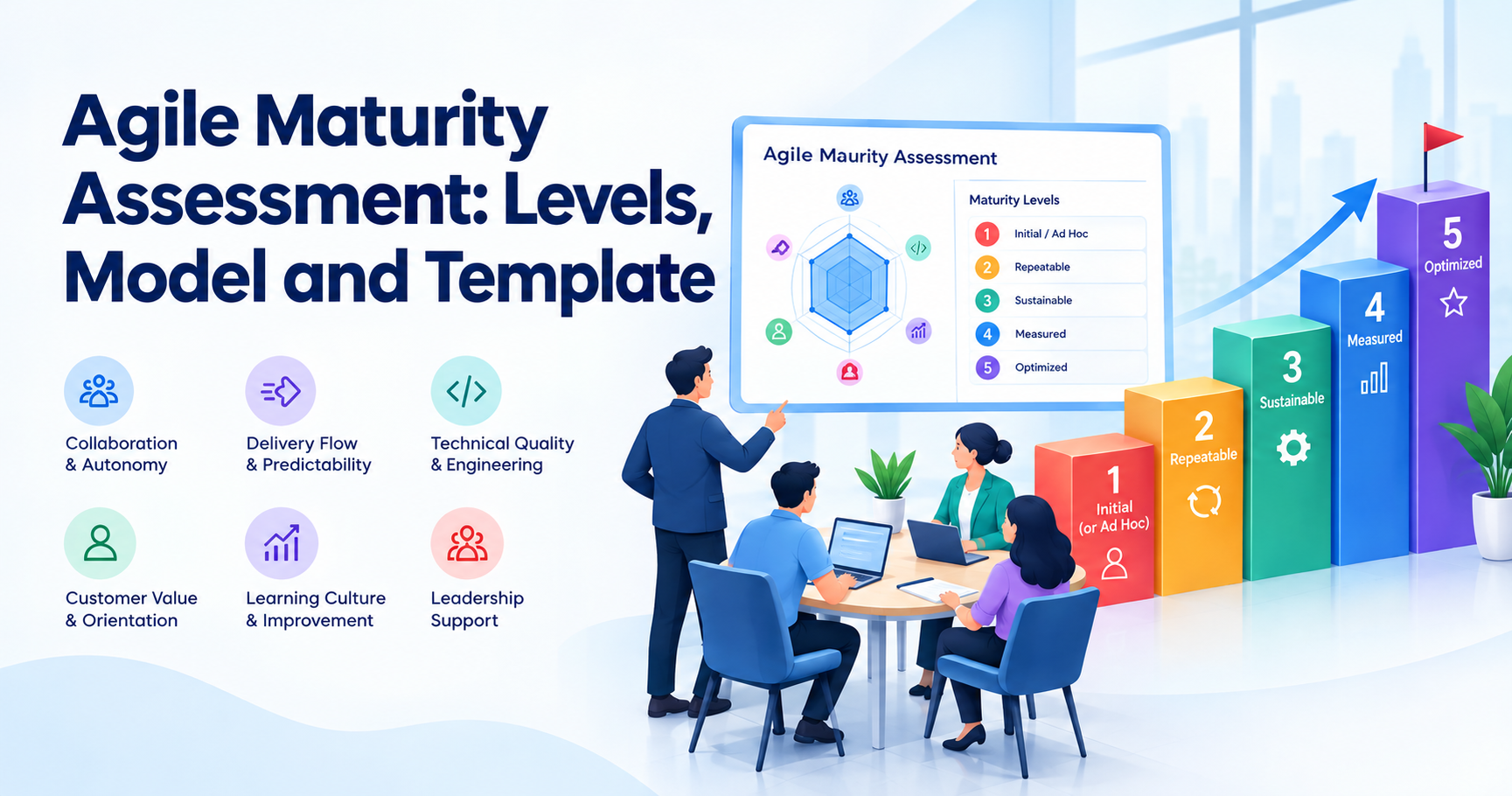
An agile maturity assessment evaluates how consistently a team or organization applies agile principles and whether its practices improve delivery, quality, collaboration, and customer value. It typically uses a maturity scale and dimensions such as delivery flow, technical quality, team autonomy, and continuous improvement. An agile maturity model defines the behaviors or capabilities expected at different stages of maturity. Teams combine self-assessment scores with delivery evidence to identify capability gaps, prioritize improvements, and track progress over time. A useful assessment ends with a focused improvement plan, not just a maturity score.
Key Highlights of Agile Maturity Assessment
- It measures capability and outcomes, not how many meetings you hold.
- The agile maturitymodel uses five levels, from initial to optimized.
- Six dimensions cover most needs: collaboration, delivery flow, technical quality, customer value, learning culture, and leadership.
- Anonymous self-assessment plus delivery data gives the most honest picture.
- The assessment only pays off if it ends in two or three owned actions.
- Re-run it every quarter to see trends, not just snapshots.
Introduction
Your team runs sprints, keeps a backlog, and holds retrospectives. On paper, everything looks agile. Yet releases still slip, the same retro themes keep returning, and nobody can answer one simple question: how agile are we, really?
That gap between looking agile and being agile is exactly what an agile assessment exposes. It gives you a shared, honest picture of where the team stands, so improvement efforts target real gaps instead of hunches.
This guide explains what an agile maturity assessment is, the five maturity levels, and the dimensions teams can measure. It also outlines an agile maturity assessment framework for evaluating current practices, assessing gaps, and planning improvements. You will find a practical template, a worked example, common mistakes to avoid, and the Scrum Master rolein the process.
What Is an Agile Maturity Assessment?
An agile maturity assessment is a structured evaluation of how effectively a team or organization applies agile principles in daily work. It rates practices against a defined scale and highlights strengths, gaps, and next steps. Teams use it to set a baseline and track improvement over time.
Definition and Purpose
Think of it as a diagnostic, not a grade. SAFe practitioners describe an assessment as a snapshot that compares the current organization with an accepted framework, showing what works and what needs to change.
The purpose is practical. You learn where you are, decide where to go next, and measure whether the changes worked.
Maturity vs Simply Doing Ceremonies
Holding a daily standup does not make a team mature. Maturity asks whether the practice produces the outcome it was designed for.
| Doing the ceremony | Showing maturity |
| Standup happens daily | Standup surfaces blockers, and someone acts on them the same day |
| Retro is held every sprint | Retro actions get owners and are completed |
| Backlog exists | Backlog is ordered by value and refined ahead of planning |
| Definition of done is written | Definition of done is applied, including automated tests |
Why It Beats Vanity Agile Metrics
Counts of sprints, meetings, or story points completed are easy to collect and easy to game. They tell you activity happened, not whether it helped.
A maturity assessment looks underneath. It asks whether work flows predictably, quality is built in, and customers see value sooner. Pair it with delivery data such as throughput in agile terms, meaning the number of items finished per period, and you get both perception and evidence.
The 5 Levels of Agile Maturity
Agile maturity levels describe how consistently a team applies agile principles, responds to feedback, and improves its way of working. Different frameworks use different scales and labels. Some use staged maturity models influenced by capability maturity approaches, while others assess specific practices, outcomes, or team health. There is no single five-level scale used universally across agile frameworks. The following five levels provide a practical way to assess progress from inconsistent practices to continuous improvement. The labels are specific to this guide and may differ from those used by other frameworks.

For a deeper breakdown of each stage, the guide toagile maturity levels is a useful companion.
Level 1: Initial or Ad Hoc
Work depends on individual heroics. Agile terms appear in conversation, but practices are inconsistent or missing. Releases are unpredictable, and nobody tracks why.
Level 2: Repeatable
Some practices work: the team runs sprints and holds events. However, success depends on specific people, and discipline slips under pressure. Results repeat only when the same individuals are present.
Level 3: Sustainable
Practices are standard, and the team knows why it follows them. A new hire can learn the team's way of working, not just one person's. Most teams that are "doing agile well" sit around here.
Level 4: Measured
The team uses data to guide decisions. Cycle time, throughput, defect rates, and customer feedback inform planning. Feedback loops are short, so problems surface early.
Level 5: Optimized
Improvement is routine. The team experiments with its own practices, retires what no longer helps, and consistently delivers customer value. Not every team needs Level 5 everywhere. What matters is knowing where you stand and having a deliberate plan for the next step.
The Dimensions to Assess
A maturity model is only as useful as the dimensions it rates. The six below cover most teams, though you should adjust them to your context. When applying an agile maturity assessment framework, choose dimensions that reflect the team's goals, delivery environment, and improvement priorities.
Dimension | Key question | Example evidence |
| Collaboration and team autonomy | Does the team make decisions and resolve conflicts effectively? | Working agreements, decision delays |
| Delivery flow and predictability | Does work move steadily from start to completion? | Throughput, cycle time, forecast accuracy |
| Technical quality and engineering practices | Is quality built into the development process? | Automated test coverage, escaped defects, technical debt |
| Customer orientation and value | Does delivered work solve customer problems? | Feedback frequency, outcome measures |
| Learning culture and continuous improvement | Does the team act on lessons learned? | Retrospective actions completed, experiments evaluated |
| Leadership support | Do leaders remove organizational obstacles? | Impediments resolved, time taken to make decisions |
Collaboration and Team Autonomy
This dimension covers how the team communicates, decides, and handles disagreement. Mature teams make most decisions without escalating, a hallmark ofself-organizing teams. An agile team charter helps here, because it records the working agreements that autonomy depends on.
Delivery Flow and Predictability
Flow shows whether work moves steadily or stalls. Look at throughput, cycle time, and how often forecasts match reality. Predictability matters more than raw speed, since stakeholders plan around it.
Technical Quality and Engineering Practices
A team can follow every agile ritual and still ship fragile software. Check automated testing, continuous integration, code review habits, and how deliberately the team manages technical debt.
Customer Orientation and Value
This dimension asks whether the team measures outcomes or just output. Mature teams talk to users regularly, test assumptions early, and can explain which customer problem each release solves.
Learning Culture and Continuous Improvement
Psychological safety sits at the core. When people can raise problems without fear of blame, retrospectives drive real change. Count how many improvement actions actually get finished.
Leadership Support
Leaders shape the system the team works in. Mature organizations fund stable teams, respect team decisions, and clear impediments quickly;Agile for managers training helps leaders build these habits. . Weak leadership support caps every other dimension.
How to Run an Agile Maturity Assessment Step by Step?
The agile maturity assessment process is simple on paper. The discipline lies in finishing it. If you are wondering how to do an agile maturity assessment without a consultant, these five steps work for a single team.
Step 1: Choose the Dimensions and Model
Define what each maturity level means before collecting scores. If you use an established framework, follow its assessment criteria and guidance. If you build a custom model, document the expected behaviors and evidence for each level. An external benchmark can help with comparison, but consistent criteria and relevant evidence are essential even when assessing a single team.
Step 2: Establish a Baseline
Decide scope: one team, a group of teams, or a whole program. Choose the mode too. SAFe guidance lists three: self-assessment, peer assessment, and full assessment. Self-assessment suits a first pass, while peer or full assessments add objectivity.
Step 3: Gather Self-Assessment and Metrics
Collect individual ratings anonymously, so people rate honestly. Anonymous responses before any group discussion reduce pressure to say what leaders want to hear.
Then add data: throughput, cycle time, defect escapes, deployment frequency. Where perception and data disagree, you have found something worth discussing.
Step 4: Reflect in a Retrospective
Share the results with the team, ideally as a radar chart or heatmap. Start with the dimensions that scored lowest or showed the widest spread in opinion. A facilitator, not a manager, should walk the group through them. Treat the session as a dedicated sprint retrospective, not an add-on to the last five minutes of another meeting.
Step 5: Derive Actions and Re-measure
Choose two or three high-impact improvements, and assign each an owner and a date before anyone leaves. Rerun the same assessment each quarter or at major milestones to see whether dimensions are improving, static, or slipping. One finished change beats five half-started ones.
Agile Maturity Assessment Template
A good agile maturity assessment template has two parts: a questionnaire and a scoring method. You can build it in a spreadsheet, a Miro board, or a dedicated tool.
What to Include in the Questionnaire
An agile maturity assessment questionnaire works best when each question describes behaviors at every level. Then a "3" means the same thing to everyone. Here are sample agile maturity assessment questions and answers, shown at the extremes:
| Dimension | Sample question | Level 1 answer | Level 5 answer |
| Collaboration | How does the team make decisions? | A manager decides | The team decides and owns the outcome |
| Delivery flow | How predictable are releases? | Dates slip regularly | Forecasts are accurate within a narrow range |
| Technical quality | How is quality checked? | Manual testing near the end | Automated checks run on every change |
| Customer value | How do we know a release helped? | We do not measure | Outcome metrics reviewed each sprint |
| Learning culture | What happens after a retro? | Notes get filed | Actions finish, and effects are measured |
| Leadership | How are obstacles handled? | They linger for weeks | Leaders clear them within days |
Use this quick agile maturity assessment checklist before you launch:
- Dimensions and scale agreed in advance
- Written descriptions for all five levels
- Anonymous collection switched on
- Delivery metrics pulled for the same period
- Facilitator chosen, ideally not the line manager
- Time booked to agree actions in the same session
Scoring and Visualizing Results
Score each dimension from 1 to 5 using the agreed behavioral descriptions, then calculate the average rating for each dimension. Record the range or distribution of responses as well, because an average can hide significant differences in team members' experiences. The following bands are illustrative guidelines for this article's assessment model, not universal agile maturity standards.
| Average Score | Typical Reading |
| 1.0 to 1.9 | Foundational gaps; start with basics |
| 2.0 to 2.9 | Practices exist but are inconsistent |
| 3.0 to 3.9 | Solid base; focus on measurement |
| 4.0 to 5.0 | Strong; protect it and experiment |
Show results on a radar chart or a heatmap, so the shape of the team's maturity is visible at a glance. Spreadsheets handle this well, and agile maturity assessment tools such as Miro templates, Smartsheet templates, or health-check platforms add trend lines across sessions.
Agile Maturity Assessment Example (Worked)
Here is a hypothetical example. A six-person Scrum team builds a payments app. They run the assessment in a quarter's first week, using the six dimensions above. Similar agile maturity assessment examples can help other teams understand how baseline scores translate into practical improvement actions.
Dimension | Baseline | After one quarter |
| Collaboration and autonomy | 3.4 | 3.5 |
| Delivery flow | 2.2 | 2.9 |
| Technical quality | 2.6 | 3 |
| Customer orientation | 2 | 2.4 |
| Learning culture | 3 | 3.3 |
| Leadership support | 3.2 | 3.2 |
What the baseline showed: Collaboration and leadership were healthy. Delivery flow and customer orientation were the weakest, and the team's throughput data backed up the low flow score: work sat half-finished for weeks.
Actions they chose: The team picked three. First, limit work in progress and track throughput weekly. Second, add automated tests to the definition of done. Third, run two customer interviews each month.
The result: After one quarter, delivery flow improved from 2.2 to 2.9, while technical quality rose from 2.6 to 3.0. These changes suggest progress, but the team should also review its delivery metrics to understand whether work is flowing more smoothly and fewer defects are escaping. Leadership support remained at 3.2, indicating that the persistent impediment still needed management attention. The team carried that issue into its next improvement cycle instead of trying to fix every dimension at once.
Common Mistakes to Avoid
Even well-meant assessments fail. Understanding why agile transformations failoften comes down to measuring without acting. Watch for these three mistakes.
Using Maturity Scores to Rank or Punish Teams
The moment scores feed performance reviews or league tables, honesty disappears. Teams start gaming the numbers. Keep results confidential to the team, and aggregate any cross-team view. SAFe guidance stresses that findings should be non-attributed, owned by the organization, and framed as collaboration, not audit.
Assessing Once and Never Again
A single assessment is a snapshot. The value sits in the trend. Teams that run it once and file the report cannot tell whether anything improved. Put the next session in the calendar before closing the first.
Measuring Activity Instead of Outcomes
Counting retros, standups, or story points rewards busyness. Ask whether the practice changed a result: fewer escaped defects, shorter cycle time, happier customers. If a higher score does not trace back to a better outcome, the question is measuring the wrong thing.
Best Practices for Agile Maturity Assessments
- Start with a clear purpose: Say why you are assessing, and what decision the results will inform.
- Keep it lightweight: Once you have a baseline, short periodic self-assessments beat large, rare reviews.
- Rate independently first: Collect scores before any discussion to avoid anchoring.
- Combine perception with data: Use delivery metrics to test what people believe.
- Use a neutral facilitator: The assessor's skill matters more than the tool.
- Link it to other rituals: A team health check measures sentiment and happiness, so running a team health checkbetween assessments keeps the conversation going.
- Revisit working agreements: Update the team charter when the results show a collaboration gap.
- Celebrate progress: Share improvements, not just problems.
The Scrum Master's Role in Maturity Assessment
An agile maturity assessment in Scrum usually sits with the Scrum Master, because the role centers on improving how the team works. However, the Scrum Master facilitates. The team owns the answers.
In practice, a Scrum Master does five things:
- Prepares the ground: Picks the model, explains the purpose, and builds trust that results are safe.
- Facilitates the session: Keeps discussion on the data and makes sure quiet voices are heard.
- Brings evidence: Adds throughput, cycle time, and quality data to test perceptions.
- Turns insight into action: Helps the team pick two or three improvements and tracks them in retrospectives.
- Escalates systemic issues: Takes impediments beyond the team's control, such as unclear priorities, to leadership.
Scrum Masters who want to build these facilitation and coaching skills at scale can exploreSAFe Scrum Master Certification Training, which covers team improvement within a Release Train.
Conclusion
An agile maturity assessment replaces guesswork with a shared, honest picture of how a team really works. Its strength is focus: instead of fixing everything, you pick the dimensions where improvement matters most.
Keep the practical rules in mind. Choose a model and describe every level clearly. Collect ratings anonymously, then add delivery data. Reflect as a team, commit to two or three actions with owners, and re-measure each quarter. Above all, never use the scores to rank or punish people.
Run your first assessment on one team with a simple spreadsheet. A small, finished cycle teaches more than a large plan that never starts.







 Lowest-Price Challenge











 Personalized Path


.webp)


 USA
USA  Canada
 India
India UK
UK Australia
 Singapore


