


 Call Us



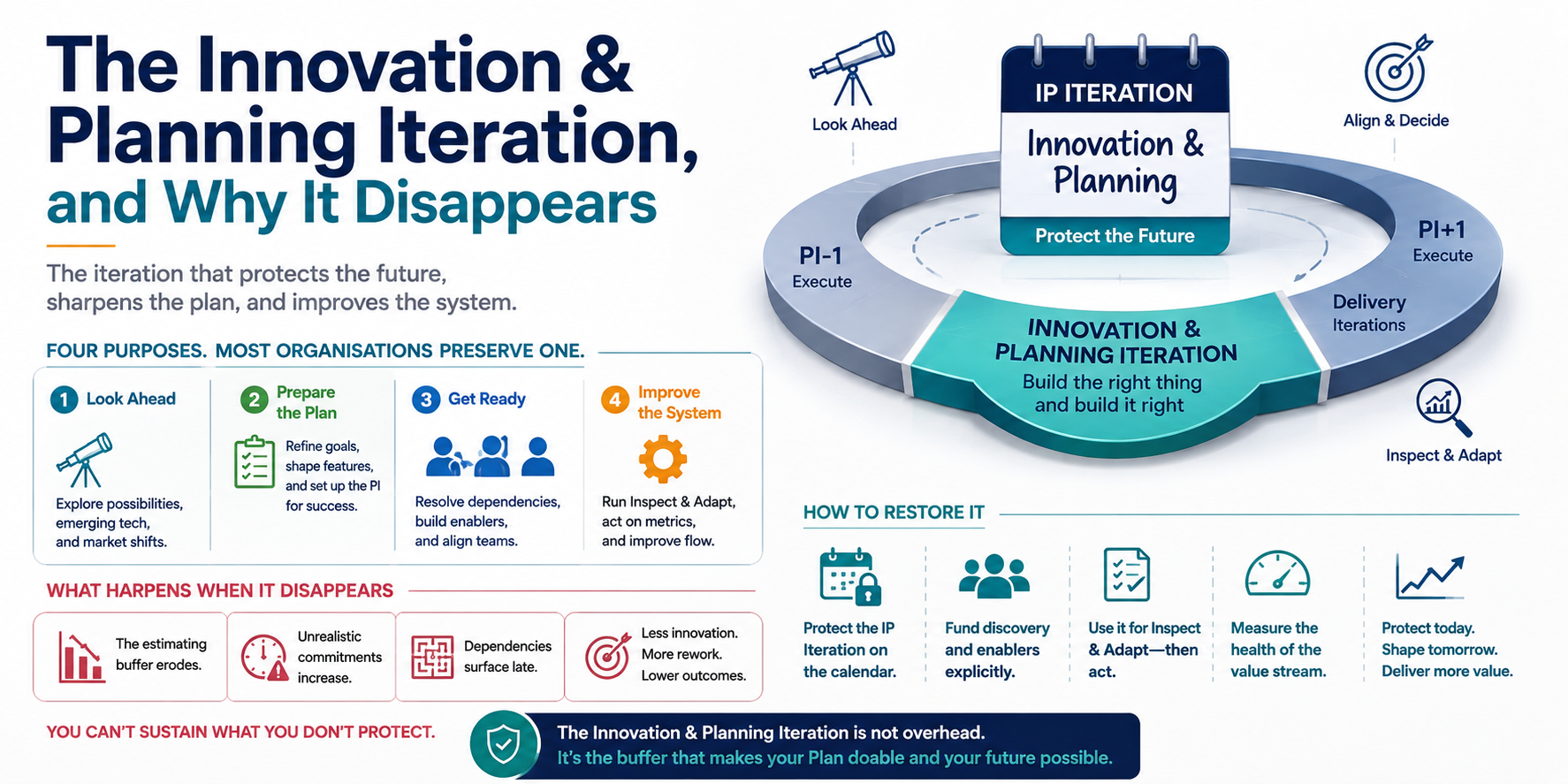
Scaled Agile defines the Innovation and Planning Iteration as a unique, dedicated iteration occurring every Program Increment, providing an estimating buffer for meeting PI Objectives and dedicated time for innovation, continuing education, PI Planning and Inspect and Adapt. Read that definition carefully and it contains four distinct purposes. Most organisations preserve the fourth, quietly consume the first, and lose the middle two entirely, then wonder why predictability never improves.
Key Highlights
- The IP Iteration serves four purposes: an estimating buffer, innovation time, continuing education, and the container for PI Planning and Inspect and Adapt.
- It occurs every Program Increment and is dedicated, meaning it is not a normal iteration with events attached.
- Using it routinely to finish carryover work removes the buffer that made the PI commitment credible, which is why predictability then stops improving.
- Teams do not plan Feature work into it, which is what allows the estimating buffer to function.
- It is the most commonly misused construct in the framework, and the misuse is almost always well-intentioned.
- Its disappearance is a leading indicator that the organisation is under sustained delivery pressure and has stopped protecting anything.
The four purposes, separated
Worth taking apart, because they are usually collapsed into one and treated as slack.
The estimating buffer. Teams commit to PI Objectives across a Program Increment, and estimation over that horizon is imprecise. Without slack, every overrun becomes a missed commitment, and teams respond rationally by committing to less. The buffer is what allows a team to commit to a realistic amount rather than a defensive one.
Innovation time. Dedicated space to try things that are not on the backlog. This is the purpose most obviously lost first, because its absence produces no immediate symptom.
Continuing education. Time for people to learn, which in a framework requiring specific competencies is not optional if the competencies are to exist. This is also where certification renewal work sits for anyone maintaining a SAFe credential, since the annual Continuing Education Unit requirement has to be met somewhere and expecting people to meet it entirely in their own time is a decision an organisation is making whether or not it says so.
The container for the events. PI Planning and Inspect and Adapt physically happen here. This is the purpose organisations always preserve, because the events are scheduled and visible.
The distinction matters because an organisation can honestly say it has an IP Iteration while only the fourth purpose survives. The calendar entry exists and the mechanism does not.
Why the buffer is the important one
Of the four, the estimating buffer is the one whose loss causes measurable damage, and the causal chain is worth following.
A team plans a Program Increment. Some work will take longer than estimated, because estimation across twelve weeks is imprecise by nature. With a buffer, the team absorbs that variance and still meets its committed objectives.
Remove the buffer, and any overrun becomes a missed commitment. Predictability falls. Leadership responds to falling predictability with pressure. Teams respond to pressure by committing to less, so that they can be confident. Capacity is now under-used and predictability looks better while less is being delivered.
That sequence is common and it is almost never diagnosed correctly, because the visible symptom is a team committing conservatively and the cause is three steps upstream. Our piece on Lean Portfolio Management training covers why predictability improving while throughput falls is a warning rather than a success.
How it gets consumed
Nobody decides to abolish the IP Iteration. It erodes through a sequence of individually defensible decisions.
A Program Increment runs slightly over. There is work outstanding and an iteration coming up with nothing formally planned into it. Moving the carryover there is obviously sensible, and it is done once.
The next increment, the same thing happens, and now there is precedent. Within three or four Program Increments the IP Iteration is understood as the place carryover goes, which means it is being planned into implicitly, which means the buffer no longer exists.
The tell is in how people talk about it. Where an organisation describes the IP Iteration as spare capacity, catch-up time or slack, it has already gone. Those descriptions are accurate about how it is being used and wrong about what it is for.
The innovation purpose, and why it goes first
Innovation time is the first casualty and it is the hardest to defend, because it is the only purpose with no immediate consequence when removed.
Skip the estimating buffer and predictability suffers within two Program Increments. Skip continuing education and competence erodes over a year. Skip the events and everything stops immediately.
Skip innovation time and nothing happens at all, for a long while. Then the organisation notices it has not produced a genuinely new idea in two years and commissions an innovation initiative, which is an expensive way to buy back something it gave away for free.
The argument that works with leadership is not about creativity. It is that the people closest to the product and the customer have ideas that never reach a backlog, because backlogs are populated by stakeholders rather than by engineers, and this is the only mechanism in the framework that surfaces them.
What teams should actually do with it
Practical, since one common failure is protecting the iteration and then wasting it.
Innovation work that is genuinely exploratory. Prototypes, spikes into technologies the team is considering, improvements to their own tooling. Not backlog items in disguise.
Improvement items from Inspect and Adapt. This is a legitimate and underused option. The workshop produces improvement items, and here is capacity that is not committed to Features. Organisations that connect these two get a working improvement loop; those that do not produce improvement lists that go nowhere.
Learning. Training, certification study, deliberate skill development. This is the category most easily justified to a sceptical stakeholder, because the output is visible and the connection to future capability is easy to state.
The events themselves. PI Planning and Inspect and Adapt consume real time, and that time has to come from somewhere. Treating it as though it were free is how the iteration ends up over-subscribed before anyone has planned anything into it deliberately.
What should not go in it is planned Feature work. The moment Features are planned into the IP Iteration, the buffer is gone, and it is gone whether or not anyone announced it.
Protecting it
Four approaches, in ascending order of durability.
Ask people not to plan into it. Works while nothing is under pressure, which is not when it matters.
Make consumption visible. Track how much of each IP Iteration went to carryover. The number itself changes behaviour, because the erosion depends on nobody noticing.
Require a decision. Using the IP Iteration for carryover is permitted but requires someone named to authorise it, in the open. Not a prohibition, a visible exception. Most erosion happens through drift rather than decision, and forcing a decision stops most of it.
Plan less. The underlying cause of chronic carryover is over-commitment at planning. A train that regularly needs the IP Iteration to finish its increment did not have a buffer problem, it had a planning problem, and the confidence vote at PI Planning was probably not honest.
The fourth is the only one that addresses the cause. The other three manage the symptom, which is still worth doing.
What its disappearance tells you
Treat this as a diagnostic rather than as a problem in itself, because it is a reliable indicator of something larger.
An organisation that has lost its IP Iteration is under sustained delivery pressure and has stopped protecting anything that does not produce visible output. That will show up elsewhere: improvement items unfunded, Enabler work deferred, quality standards suspended under deadline.
All four are the same behaviour. Work that is important and not urgent losing to work that is urgent, repeatedly, until the important work stops happening entirely. Our piece on SAFe certification requirements covers the pattern across the framework.
The useful consequence is that the IP Iteration is easy to check. Ask what was in the last one. If the answer is carryover, you have learned something about the whole organisation in one question, and you have learned it faster than any assessment would have told you.
The regulated-industry exception
Worth noting, because it is the one context where this construct is usually protected properly.
In regulated environments, compliance work, audit evidence and validation activity have to happen and cannot be deferred indefinitely. Organisations in those sectors frequently use the IP Iteration for that work, which is a legitimate use, and the external deadline does the protecting that internal discipline usually fails to provide.
The instructive part is what that reveals. The IP Iteration survives where something external enforces it, and erodes where only internal commitment protects it. Organisations struggling to hold it might reasonably ask what would have to be true for it to be as protected as a regulatory obligation.
Our piece on SAFe DevOps certification covers the broader pattern of compliance pressure producing better framework discipline than good intentions do.
What it is not
Three things it is frequently mistaken for, and each mistake produces a different failure.
Not a sprint. It is a dedicated iteration with a specific set of purposes, not a normal iteration with the events attached. Teams do not commit to Feature delivery in it, which is what distinguishes it.
Not slack in the general sense. Slack implies unallocated time that could be used for anything. The IP Iteration has four defined purposes and using it for a fifth is what erodes it.
Not optional. It occurs every Program Increment. A train that skips it in a busy increment has removed the buffer for that increment and will discover the consequence at the objectives review.
The reason these distinctions matter is that each mistaken framing licenses a different erosion. Calling it a sprint invites Feature planning. Calling it slack invites carryover. Calling it optional invites skipping it entirely under pressure, which is exactly when the buffer was most needed.
The connection to Inspect and Adapt
Worth drawing out, because these two constructs support each other and organisations tend to break both together.
Inspect and Adapt produces improvement backlog items through a structured problem-solving workshop. Those items then need capacity to be delivered, and they compete with Feature work in the next Program Increment.
The IP Iteration is the obvious place for them. It has capacity not committed to Features, it occurs every increment, and improvement work is exactly the kind of thing that otherwise loses every prioritisation argument.
Organisations that connect the two get a working improvement loop: problems identified, capacity available, changes delivered, next increment better. Organisations that break the connection produce improvement lists nobody actions, which within three increments teaches everyone that the workshop does not lead anywhere.
That is the same failure our piece on SAFe anti-patterns describes, and the IP Iteration is the specific mechanism whose absence causes it. Understanding how the two connect is part of the framework reasoning Leading SAFe certification training develops, and the free Leading SAFe practice test covers both constructs in the form the exam uses.
How to explain it to an executive
The conversation is predictable, since an iteration with no committed output looks like waste to anyone reading a capacity plan.
Do not call it slack. The word invites removal.
Frame it as the reason the commitment is credible. Teams can commit to a realistic amount because there is capacity to absorb estimation variance. Remove it and they will commit to less, which costs more.
Use the predictability number. If predictability has fallen while the IP Iteration has been absorbing carryover, that is evidence rather than argument.
Name what it contains. It holds PI Planning and Inspect and Adapt, which are not optional. Presenting it as an empty iteration is inaccurate and invites the wrong decision.
Making that case is the kind of translation from framework mechanics to business consequence that Leading SAFe certification training is built to develop in leaders.
What the exam asks
The IP Iteration appears reliably and the questions target its purposes.
Expect a definitional question on what it provides, where the correct answer includes the estimating buffer and the dedicated time for innovation, continuing education, PI Planning and Inspect and Adapt. Expect at least one option offering it as spare capacity or a catch-up sprint, which is the distractor.
Expect the connection to Inspect and Adapt and PI Planning, since it is where both occur.
This is straightforward recall and it is worth learning precisely, because the four purposes are easy to half-remember. Our free Leading SAFe practice test covers it in the form the exam uses, and our guide to the Leading SAFe curriculum places it alongside the rest of the Program Increment.
Restoring one that has already gone
Practical, since most organisations reading this have already lost it.
Stop planning into it, once. One Program Increment where no Feature work is scheduled into the IP Iteration. That single increment tells you how much carryover the train genuinely has, which is information nobody currently holds.
Expect the first one to be consumed anyway. There will be outstanding work and it will land there. That is fine and it is data.
Reduce commitment at the next planning event. The cause of chronic carryover is over-commitment, so restoring the buffer requires planning less rather than protecting harder.
Then protect it visibly. With the commitment adjusted, the IP Iteration has a chance of surviving, and tracking what goes into it keeps the erosion from restarting quietly.
The sequence matters. Protecting the iteration without reducing commitment simply moves the overflow somewhere less visible, usually into unrecorded overtime, which is worse because it is invisible in every metric the organisation looks at.
The uncomfortable arithmetic
Worth stating plainly for anyone weighing whether the buffer is affordable.
An organisation running four Program Increments a year, each containing five iterations, is allocating one iteration in five to the IP Iteration. That is twenty percent of the calendar, and stated that way it sounds enormous.
Two things reduce the apparent cost. PI Planning and Inspect and Adapt happen inside it, and those events would consume time regardless of where they sat, so a meaningful portion is not additional. And the estimating buffer is not idle capacity; it is capacity that would otherwise be consumed by overrun, invisibly and at worse cost.
What remains genuinely additional is the innovation and learning time, which is the part with no immediate return and the part organisations resent. The honest position is that this is a real investment rather than a free one, and that it is small relative to the cost of a workforce whose skills stop developing and a product with no source of ideas beyond the backlog.
Making that argument requires being straight about the number rather than presenting the whole iteration as costless, which is what invites the challenge in the first place.
The short version
The Innovation and Planning Iteration is the clearest example in SAFe of something that erodes through reasonable decisions and is expensive to restore.
Nobody removes it. It gets used for carryover once, then again, and within a few Program Increments the buffer that made commitments credible has gone, predictability falls, and the response is pressure that makes the whole thing worse.
The single most useful intervention is visibility. Track what goes into it and require someone to say so when it is consumed. Erosion that has to be announced mostly stops happening.
For the wider framing of how the IP Iteration connects to planning, improvement and the cadence, Leading SAFe certification training covers it across two days including the exam attempt, and current certification costs are listed separately.

-in-2025_1742466148.jpg)


Tools_1713861068.jpg)




 Lowest-Price Challenge











 Personalized Path


.webp)


 USA
USA  Canada
  India
India  UK
UK  Australia
  Singapore


