


 Call Us



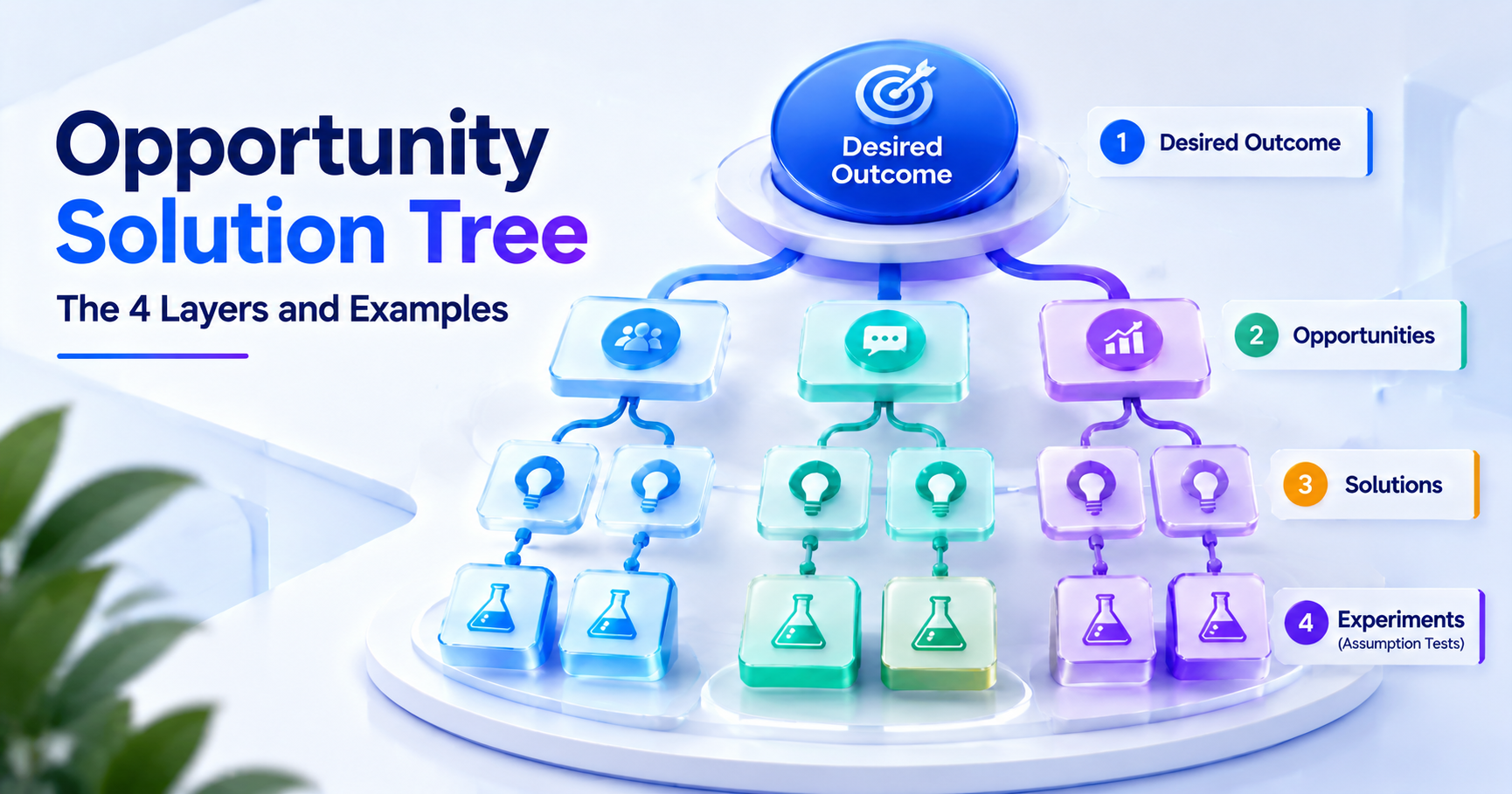
An opportunity solution tree is a visual framework that links one desired outcome to customer opportunities, solution ideas, and small experiments. Teresa Torres created it and described it in her book Continuous Discovery Habits. It has four layers: the desired outcome, opportunities (customer needs and pain points), solutions, and experiments that test risky assumptions.
Key Highlights of Opportunity Solution Tree:
- An opportunity solution tree is a visual framework that links a business outcome to customer needs, solution ideas, and experiments.
- Teresa Torres created it and shared it in her book Continuous Discovery Habits.
- The tree has four layers: the desired outcome, opportunities, solutions, and experiments or assumption tests.
- It keeps teams from jumping straight to features without understanding customer problems.
- You can build one in four steps: define the outcome, map opportunities, brainstorm solutions, and test assumptions.
- It works well in Agile and SAFe, where Product Owners and Product Managers need a clear link between outcomes, the backlog, and the roadmap.
- Simple tools like a whiteboard, Miro, or a spreadsheet are enough to get started.
Introduction
Most product teams do not lack ideas. They lack a clear way to choose between them.
A stakeholder asks for a feature. A competitor launches something new. A loud customer sends an urgent request. Soon the backlog is full, and no one can explain why an item is on it.
The opportunity solution tree solves this problem. It gives your team a single picture that shows what you want to achieve, what customers need, what you might build, and how you will test it.
In this guide, you will learn what an opportunity solution tree is, how its four layers work, and how to create one step by step. You will also see a worked example, common mistakes, and ways to use the tree in Agile and SAFe.
This Opportunity Solution Tree explained guide is written for product managers, Product Owners, and anyone who wants to practice better product discovery.
What is an Opportunity Solution Tree?
An opportunity solution tree is a simple way to organize your thinking. It starts with one goal at the top. It then branches into customer needs, then into ideas, and finally into small tests.
Think of it as a map. It shows the path from a business goal to the work your team should do next.
Opportunity Solution Tree Definition
An opportunity solution tree is a visual framework that connects a desired outcome to customer opportunities, solutions, and experiments. Each layer feeds the next one. Each branch shows why a choice was made.
The word "opportunity" here means a customer need, pain point, or desire. It does not mean a business opportunity or a sales lead. This distinction matters, and we will return to it later.
You will often hear people call it an opportunity solution tree framework. Some teams also use an opportunity solution tree canvas, which is a structured layout for drawing the tree. Both terms point to the same idea: a visual way to link goals to evidence-based work.
Where It Came From (Teresa Torres)
Teresa Torres, a product discovery coach and author, introduced the opportunity solution tree. She described it in her book Continuous Discovery Habits. She built it from years of coaching product teams. You can read the original write-up of the opportunity solution tree by Teresa Torres on her Product Talk blog.
Torres noticed a pattern. Teams often jumped from a goal straight to a solution. They skipped the step where they understood the customer. As a result, they built features that did not move the metric.
Her tree adds the missing middle layer. It puts customer opportunities between the outcome and the solution. This small change shifts the team from "what should we build?" to "what does the customer need?"
The tree is also a core tool for continuous discovery. Continuous discovery means talking to customers and testing ideas every week, not only at the start of a project. The tree gives that habit a place to live.
Why Use an Opportunity Solution Tree?
The tree offers several clear benefits. Here are the main ones:
- Focus. It keeps the team tied to one outcome at a time.
- Clarity. Everyone can see how an idea connects to a customer's needs.
- Better choices. You compare solutions for the same opportunity, not random ideas.
- Less risk. Small experiments test ideas before you spend months building them.
- Shared understanding. Stakeholders can follow the logic and challenge it with evidence.
The tree also helps you say no. When a request does not fit any opportunity on the tree, you can explain why it is not a priority. That conversation is easier when the reasoning is visible.
Finally, the tree supports your wider product strategy. It turns high-level goals into daily discovery work. If you want to see how goals turn into shipped work, read this guide to the product management workflow.
The Four Layers of an Opportunity Solution Tree
The tree has four layers. Each layer sits below the previous one. You read it from top to bottom, and you build it in the same order.
Here is a quick view of the layers:
| Layer | What it holds | Key question |
| Desired outcome | One measurable goal | What do we want to change? |
| Opportunities | Customer needs and pain points | What do customers struggle with? |
| Solutions | Ideas that address an opportunity | What could we build? |
| Experiments | Tests of risky assumptions | What must be true for this to work? |
Let us look at each layer in detail.
The Desired Outcome (Root)
The root of the tree is the desired outcome. It is the single result your team wants to achieve. It should be measurable and tied to customer behavior.
A good outcome describes a behavior change, not a feature launch. "Increase weekly active users" is an outcome. "Launch a new dashboard" is an output.
Keep the outcome within your team's control. A product trio can influence activation or retention. It cannot directly control company revenue. Pick a metric your team can move through its own work.
Many teams draw the outcome from their product strategy or from Agile OKRs. If the goal is too broad, break it into a smaller one. One clear outcome per tree is the rule.
Opportunities (Customer Needs and Pain Points)
The second layer holds opportunities. These are the needs, pain points, and desires that customers have. They come from interviews, support tickets, and usage data.
Write each opportunity from the customer's point of view. Say "I forget to log my workouts," not "Add a reminder feature." The first is a need. The second is a solution in disguise.
Opportunities are often grouped as a tree of their own. A big opportunity, such as "I cannot find what I need," can split into smaller ones. This helps you tackle problems in pieces.
The jobs to be done approach is a useful lens here. It asks what "job" a customer is hiring your product to do. You can learn more aboutJobs to Be Done theoryfrom the Christensen Institute.
Solutions
The third layer holds solutions. These are the ideas your team could build to address a chosen opportunity. A solution can be a feature, a design change, a process tweak, or even a policy update.
Always generate more than one solution per opportunity. Teams that only consider one idea tend to fall in love with it. A few options let you compare cost, effort, and impact.
Solutions should link to a single opportunity. If an idea does not solve a real customer need on your tree, it may not be worth building.
Experiments and Assumption Tests
The bottom layer holds experiments. Each solution rests on assumptions. An assumption test checks whether those assumptions are true before you commit to a build.
Ask, "What must be true for this idea to work?" Then list the riskiest answers. Test those first.
Experiments can be light. Examples include common product discovery techniques such as a prototype test, a fake door test, a survey, or a concierge trial. The goal is to learn fast and cheaply.
The results decide what happens next. You can keep the idea, change it, or drop it. Then you move to the next solution on the tree.
How to Build an Opportunity Solution Tree Step by Step?
Now let us walk through how to create an opportunity solution tree. These opportunity solution tree steps work for a new product or an existing one. Plan for a short working session at first. You will refine the tree over time.
Step 1: Define the Outcome
Start with the outcome at the top. Talk with your manager or product leader to confirm it. Make sure it is clear, measurable, and within your team's influence.
Write it as a change in customer behavior. For example, "Increase the share of new users who complete setup within three days."
Check the outcome with a simple test. Can your team affect it in a quarter? Can you measure it weekly? If the answer is no, narrow it down.
Step 2: Map Opportunities From Research
Next, gather what you know about customers. Use interviews, surveys, support tickets, sales calls, and analytics. Look for repeated needs and frustrations.
Turn each finding into an opportunity statement. Write it in the customer's words. Then group similar ones under a parent opportunity.
Interview customers often. Torres recommends weekly conversations. A steady flow of insight keeps the tree alive. For a deeper look at research methods, see this resource onproduct discovery.
Then pick one opportunity to focus on. Do not try to solve them all at once. Choose the one that best supports your outcome, based on size, market impact, and fit with your strategy.
Step 3: Brainstorm Solutions
Now generate ideas for your chosen opportunity. Involve your product manager, designer, and engineer. This group is often called the product trio.
Aim for at least three solutions. Include a small idea, a medium idea, and a bold one. Variety helps you compare.
Do not judge ideas too early. Add them to the tree first. You will assess them in the next step.
Then compare the options. Look at how well each one addresses the opportunity, how hard it is to build, and how risky it is. Pick the solution to test first.
Step 4: Design Experiments to Validate
Finally, list the assumptions behind your top solution. Focus on the riskiest ones. These often fall into four groups: desirability, usability, feasibility, and viability.
For each risky assumption, design a small test. Set a clear success threshold before you run it. For example, "At least 30 per cent of users click the fake door button."
Run the test, then review the results. Update the tree with what you learned. Then repeat the cycle with the next assumption, solution, or opportunity.
Opportunity Solution Tree Example
A short example makes the tree easier to picture. Imagine a meal-planning app called FreshPlate. The team wants to grow subscriber retention.
Desired outcome: Increase the 90-day retention rate of new subscribers from 35 per cent to 45 per cent.
The team interviews churned users and reviews support tickets. They find several opportunities:
- "I run out of ideas for what to cook."
- "Shopping for the ingredients takes too long."
- "My family members have different diets."
The team picks the second one: "Shopping for the ingredients takes too long." It seems to have the biggest link to churn.
Solutions for that opportunity:
- Add a one-tap grocery list export to popular delivery apps.
- Group the shopping list by store aisle.
- Offer a partner delivery option inside the app.
The team compares the three ideas. The grocery export looks simple and valuable. They choose it.
Assumptions to test:
- Users actually shop at stores that support the export.
- Users will trust the app to send their list to another service.
- The export saves enough time to change their habits.
Experiments:
- Show a fake "Send to delivery app" button to 500 users and measure clicks.
- Run five prototype sessions to watch how users react.
- Ask ten users to try a manual version through email for two weeks.
The fake door test shows that 38 per cent of users click the button. The prototype sessions reveal that users worry about privacy. The team adds a clear permission screen and tests again.
This is the tree at work. Each decision has evidence. Each idea links back to a customer need and to the retention outcome.
Opportunity Solution Tree Tools and Templates
You do not need special software to start. The best tool is the one your team will actually update.
Here are common options:
- Whiteboard or sticky notes. Great for workshops and quick drafts.
- Miro or Mural. Good for remote teams that want to build together.
- Spreadsheets. Useful for tracking opportunities, solutions, and test results in rows.
- Notion or Confluence. Helpful when you want to link the tree to research notes.
- Dedicated discovery tools. Some products are built for continuous discovery and store the tree alongside interviews.
An opportunity solution tree template usually has four rows, one for each layer. The outcome sits at the top. Opportunities branch below it, followed by solutions and experiments. An opportunity solution tree canvas adds space for notes, metrics, and owners.
When you pick a template, keep it simple. A tree that is easy to read is a tree that people will use. Add detail only when the team needs it.
Also, treat the tree as a living document. Update it after each interview and each experiment. A tree that never changes is a sign that discovery has stopped.
Opportunity Solution Tree vs Mind Map
People often ask about the opportunity solution tree vs mind map. Both are visual and both branch out. However, they serve different purposes.
A mind map is free-form. It captures any idea that comes to mind, and it has no fixed structure. It is great for brainstorming.
An opportunity solution tree has strict layers and a clear purpose. Every branch connects to one outcome. Every idea links to a customer need and a test. This structure supports decisions, not just ideas.
Use a mind map to explore. Use an opportunity solution tree to decide and to prove.
Common Mistakes to Avoid
Even good teams make errors when they start. Watch out for these common ones:
- Confusing opportunities with solutions. "Add a search bar" is a solution. "I cannot find items quickly" is an opportunity.
- Choosing an output as the outcome. A feature launch is not a result. A behavior change is.
- Skipping customer research. A tree built from guesses is only a fancy opinion map.
- Testing only one idea. Without options, you cannot compare. You only defend.
- Making the tree too big. Focus on one outcome and a few opportunities at a time.
- Never updating it. A stale tree loses trust. Refresh it every week.
- Building alone. The product trio should build and review the tree together.
- Ignoring assumptions. Many failures come from untested beliefs, not bad code.
A good habit is to review the tree in a short weekly meeting. Ask what you learned, what changed, and what to test next. This keeps the tree honest and useful.
Using the Opportunity Solution Tree in Agile and SAFe
The opportunity solution tree fits well with Agile product development and Agile ways of working. Agile teams value learning, feedback, and small steps. The tree adds a structured way to decide what to learn next.
Using the opportunity solution tree in Agile helps teams avoid a common trap. Many teams run sprints well but still build the wrong things. The tree ensures that sprint work traces back to a real customer need.
It also works in scaled frameworks like SAFe. Product Owners and Product Managers need to balance strategy, customers, and delivery. The tree offers a shared view that supports all three. To see how SAFe frames this work, read aboutProduct Management in SAFe.
Connecting Outcomes to the Backlog and Roadmap
The tree bridges strategy and delivery. The outcome links to your goals. The solutions that pass testing become backlog items.
Here is a simple flow:
- Set the outcome from your product strategy or OKRs.
- Use research to find and rank opportunities.
- Test solutions through small experiments.
- Move validated solutions into the product backlogas epics, features, or stories.
- Reflect the chosen opportunities in your roadmap as themes.
This makes the roadmap outcome-based. Instead of a list of features with dates, you show the problems you plan to solve. That gives you room to adjust as you learn.
This approach also improves stakeholder talks and supports stakeholder analysis in product management. You can show the evidence behind each roadmap theme. Debates move from opinions to data.
Continuous Discovery for Product Owners
Product Owners are close to both the team and the customer. That makes them well placed to lead discovery. The tree gives them a clear routine.
A Product Owner can use the tree in several ways:
- Keep the outcome visible during planning and refinement.
- Use product backlog refinement to link each item to an opportunity.
- Bring fresh interview insights into the tree each week.
- Run small tests during a sprint to reduce risk for the next one.
- Share tree updates in reviews to show progress and learning.
In SAFe, these habits support the responsibilities of the Product Owner and Product Manager roles. You can read more about them in this guide toSAFe POPM roles and responsibilities.
If you want to build these skills formally, consider theSAFe POPM Certification Training. It covers how to connect strategy, discovery, and delivery at scale. The opportunity solution tree pairs well with those lessons.
Conclusion
The opportunity solution tree helps teams move from guesswork to evidence. It links one clear outcome to customer opportunities, solution ideas, and small experiments. Each layer has a job, and each branch tells a story.
To start, pick one outcome. Talk to a few customers this week. Add what you hear to a simple tree. Then run one small test.
Keep the tree alive with weekly updates. Over time, you will build a habit of continuous discovery. Your backlog will get sharper, your roadmap will get clearer, and your team will build things that matter.




_1738229034.jpg)





 Lowest-Price Challenge











 Personalized Path


.webp)


 USA
USA  Canada
  India
India  UK
UK  Australia
  Singapore


