


 Call Us



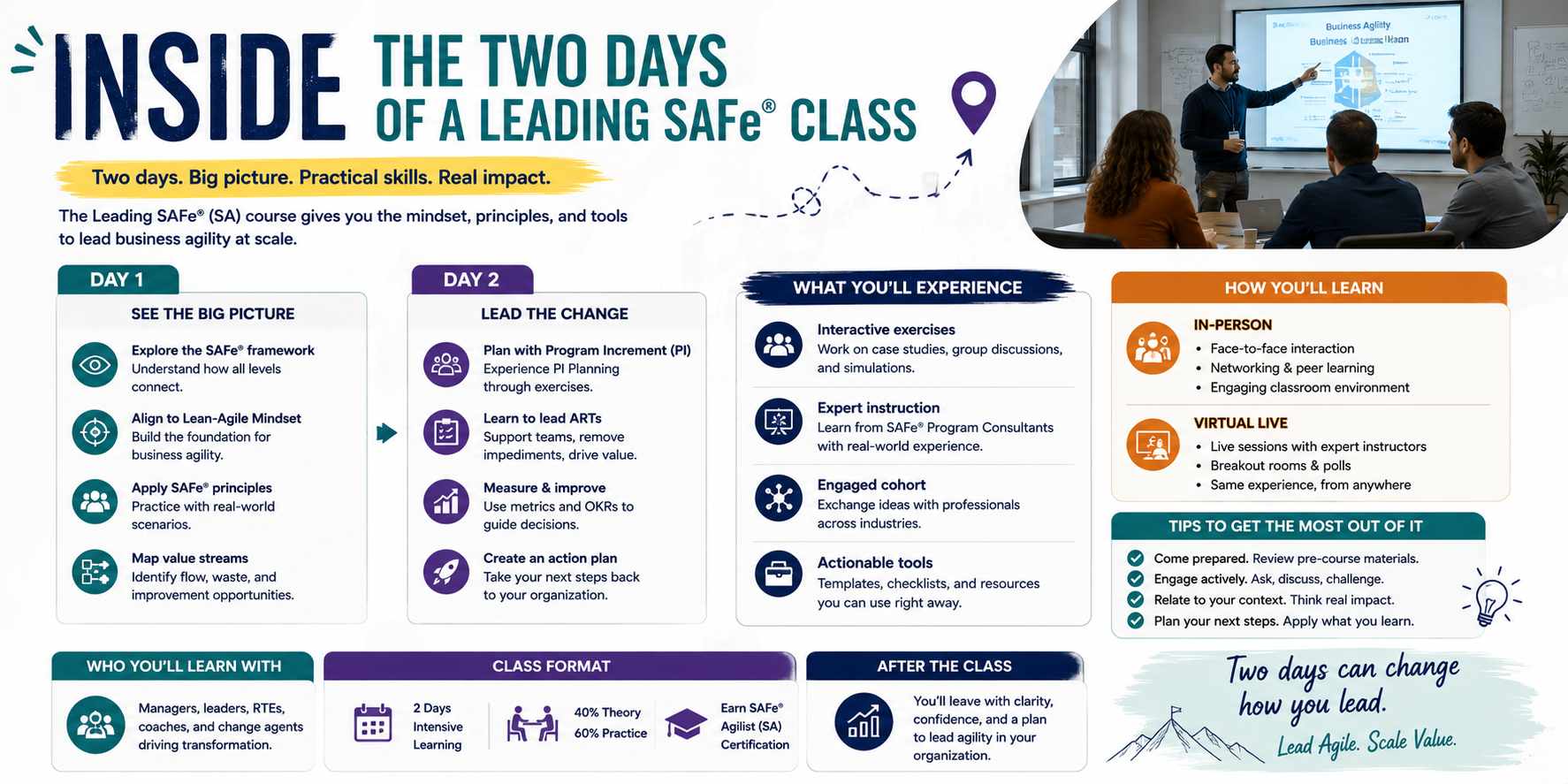
Leading SAFe runs as a two-day class that moves from why business agility matters, through how the framework is structured, to what a leader does to make an adoption stick. The exam attempt is included and most people sit it within a few days of finishing. What surprises attendees is how little of it is process instruction and how much is about changing leadership behaviour, which is the part that decides whether an adoption works.
Key Highlights
- The class runs two days and includes the SAFe Agilist exam attempt, which is 45 questions in 90 minutes at an 80 percent pass mark.
- Scaled Agile lists no prerequisites, and the course is not technically required in order to sit the exam.
- Day one is largely structural: business agility, the Lean-Agile mindset, the principles, and how an Agile Release Train is organised.
- Day two shifts to application: portfolio-level funding, and leading the change itself.
- The credential renews annually with a minimum of 12 Continuing Education Units.
- The most common attendee reaction is that the framework content was expected and the leadership content was not.
What this article is and is not
This is about the experience of the two days: the room, the exercises, the cohort, and how to get value from it. If you want the module-by-module syllabus, that is published separately as the Leading SAFe course curriculum and there is no point repeating it here.
The short version of the shape: it opens on why business agility matters, moves through the Lean-Agile mindset and the principles, spends the structural core on how an Agile Release Train operates across a Program Increment, and closes on portfolio funding and leading the change. Why, then what, then how.
What that syllabus does not convey, and what people actually ask about before booking, is what the two days feel like and whether they are worth the diary time. That is the rest of this piece.
How the two days are shaped
Day one establishes the framework. Business agility, the leadership mindset, the principles, and the structure of a train. It is heavier on concepts and lighter on application, and by the end of it you can follow a SAFe conversation without necessarily being able to lead one.
Day two applies it. Portfolio thinking, funding, and the change itself. This is where the room usually gets more interactive, because the questions stop being about definitions and start being about the attendees' own organisations.
The exam attempt is included, and there is a practical reason not to leave a long gap before sitting it. The definitional content, particularly the sizing hierarchy and the event outputs, fades faster than the leadership material. Most people who struggle sat the exam weeks later after the detail had gone.
Hour by hour, roughly
Every provider paces it slightly differently and the sequence is broadly consistent, because the material builds.
Morning of day one. Framing. Why business agility matters, what problem the framework claims to solve, and the competencies it organises itself around. This is the section most likely to feel abstract if you arrive impatient for mechanics, and it is the section that makes the rest cohere. People who skim it tend to struggle later with the scenario reasoning.
Afternoon of day one. The Lean-Agile mindset, Lean-Agile leadership, and the principles. Heavier on discussion than on slides. Expect to be asked what your organisation does and why, and expect the honest answers to be uncomfortable.
Morning of day two. The structural core. How an Agile Release Train is formed, what happens across a Program Increment, how PI Planning runs, and how the events connect. This is the densest content of the two days and the part most directly examined.
Afternoon of day two. Portfolio and change. How funding moves to value streams, how governance shifts, and what leaders actually do to move an organisation. It closes on the implementation roadmap.
The shape is deliberate. It opens with why, spends the middle on what, and ends on how, which means the most actionable material lands when you are most tired. Worth knowing so you can pace your attention rather than spending it all on day one.
Virtual against in person
Both formats are widely available and the difference is real, though not in the direction people assume.
The content is identical and the exam is identical. What changes is the interaction. In-person cohorts produce more incidental conversation, which is where a lot of the value sits, and the breaks are where people describe the problem they actually came to solve. Virtual delivery is more convenient, more affordable in travel terms, and easier to fit around a job.
The genuine risk with virtual attendance is not the format. It is attending from your desk while still doing your job. A two-day class taken with one eye on email delivers considerably less than the same class taken properly, and this is the single most common reason people report getting little from it.
If you attend virtually, block the diary as though you were away. That one decision matters more than the format choice.
What the format is like
Expect a workshop rather than a lecture. Group exercises, discussion, and a fair amount of applying the material to the attendees' own situations. The framework content could be read from a website; the value of the room is the practice at applying it and the questions other attendees ask.
Class composition varies more than for most certifications, and this genuinely affects the experience. A cohort of delivery managers from one organisation mid-adoption runs very differently from a mixed public class of consultants, product people and engineering leaders. Neither is better, but the mixed cohort tends to produce more useful discussion and the single-organisation cohort tends to produce more concrete outcomes.
Attendees who get the most from it usually arrive with a specific problem in mind. The people who get the least treat it as a certification to collect.
What people say afterwards
The consistent reactions, which are worth knowing because they are not what the course description leads you to expect.
The leadership content lands harder than the framework content. People book expecting to learn how SAFe works and leave talking about what they need to stop doing. That reaction is common enough to be the defining one, and it is why attendees who came purely for the credential often report the most surprise.
The value stream exercise is the moment it becomes real. Repeatedly named as the most useful hour. Sketching how work actually travels through your own organisation makes the handoffs visible in a way no diagram in a deck does.
The portfolio section is uncomfortable for the right reasons. Delivery-side attendees frequently arrive believing their problem is engineering capacity and leave suspecting it is the funding cycle. That reframe is worth the two days on its own for anyone in a position to act on it.
The exam feels like an afterthought and then is not. Because the class is discussion-led and the paper is definitional, people leave confident and underestimate the revision. This is the most common gap between the class experience and the exam result.
The cohort matters more than expected. In a good room, the questions other attendees ask are worth as much as the material. In a flat room, it is two days of slides. That variance is real and it is worth asking a provider about cohort composition before booking.
Who is actually in the room
The audience is wider than the title suggests. Programme and project managers whose organisation has adopted SAFe. Product managers and product owners. Engineering and delivery managers. Scrum Masters moving beyond a single team. Consultants who need the credential to work with clients. And genuine executives, though fewer than the marketing implies.
You do not need a technical background. A large share of attendees come from the business side rather than engineering, and the course does not assume you can read code. Our breakdown of the course target audience covers whether your role is in scope.
What does help is having seen delivery at scale go wrong at least once. The course explains why coordination breaks down, and that lands very differently for someone who has watched it happen.
What the two days will not do
Worth being direct about the limits, because the gap between expectation and outcome is where dissatisfaction comes from.
It will not make you a Release Train Engineer. That is a distinct role with its own RTE certification and its own skill set.
It will not give you implementation experience. You will understand the roadmap without having walked it, which is a real difference and one interviewers probe.
It will not resolve whether SAFe suits your organisation. The course teaches the framework as designed. Whether your context warrants it is a judgement you still have to make.
And it will not, on its own, change anything at work. The attendees who see a return are the ones who arrive with a decision they need to make and leave with a way to make it. That is worth saying plainly before you book Leading SAFe certification training: the two days reward preparation more than most classes, and the difference between the best and worst outcomes in a cohort is usually what people brought rather than what they were taught.
Getting the most out of it
Four things that separate a useful two days from an expensive one.
Bring a real problem. A specific coordination failure, a stalled adoption, a governance bottleneck. Every module becomes more useful when you are testing it against something concrete.
Ask about your own context, not the ideal case. The instructor has almost certainly seen your situation. The ideal-state version is in the material already.
Sit the exam quickly. Within a week while the definitions are still sharp.
Decide your next step before you leave. The credential opens several directions and they reward different experience. Choosing early is worth more than the certificate.
If you want to check your framework grounding before booking, the free Leading SAFe practice test takes a few minutes and will show whether the class will be revision or genuinely new material.
The exercises you will actually do
The class is built around group work rather than lecture, and knowing the shape of it in advance helps.
Mapping your own value stream. Usually early, and usually the moment the abstract content becomes concrete. Groups sketch how work actually travels from idea to customer in their organisation, and the handoffs nobody had counted become visible. Attendees frequently describe this as the most useful hour of the two days.
Sizing work items. Applying the Epic, Capability, Feature and Story distinctions to real examples. Dull-sounding and directly examined, since sizing is the single most tested area on the paper.
Planning a Program Increment. A compressed simulation of PI Planning. It is nothing like the real event in scale and it does convey why the room is structured the way it is, and why dependencies surface where they do.
Identifying your own obstacles. Toward the end, tied to the change module. Groups name what would actually stop an adoption in their organisation, and the answers are almost always structural rather than technical: funding cycles, approval gates, incentives that reward local optimisation.
The pattern across all four is that they take framework content and force it against reality. That is the argument for attending rather than reading, and it only works if you bring a real organisation to test it against.
What to do before you arrive
Preparation is not required and about two hours of it changes the experience considerably.
Read the Agile Manifesto once. The course assumes it rather than teaching it, and the principles section builds directly on top.
Learn six terms. Agile Release Train, Program Increment, PI Planning, value stream, Feature, Epic. Arriving with these already meaning something frees your attention for the reasoning rather than the vocabulary, and the class does not slow down for people who are still decoding the words.
Write down your actual problem. One sentence. The dependency that keeps biting, the planning event that produces nothing, the funding cycle that fights the delivery cycle. Bring it.
Check where your organisation already sits. If an adoption is underway, find out which configuration and how many trains. If one is being considered, find out who is sponsoring it. Either turns abstract content into something you can test.
Sitting the free Leading SAFe practice test beforehand is also worth ten minutes, because it tells you whether the class will be revision or new material, and those are quite different two days.
The week after
The class ends and most people do nothing for a month, which is where the value leaks out.
Sit the exam within a week. The definitional content fades fastest and it is what the exam concentrates on.
Write one page for your own team. Not a summary of the course. A specific proposal for what you would change and why, framed in the language your organisation already uses. This is the single most effective way to convert two days into something that outlasts the certificate.
Book yourself into the next PI Planning event in whatever capacity is available. Reading about it and sitting in it are genuinely different things, and the gap between them is where most of the remaining learning is.
Decide your direction. The credential opens several routes and they reward different experience. Choosing within a few weeks beats drifting for a year.
The people who report the best return from the two days almost all did the second of these. Writing a proposal forces you to translate the framework into your own organisation's language, and that translation is the actual skill the course is trying to build. A certificate on a profile does nothing on its own; a one-page argument your director can act on is what gets you into the next conversation about how delivery is organised.
Choosing where to take it
The content is standardised by Scaled Agile, so the syllabus does not vary between providers. What varies is everything around it, and three things are worth checking.
Who is teaching it. Every Leading SAFe class is delivered by a certified SAFe Program Consultant, and the difference between one who has actually launched Agile Release Trains and one who has mostly taught the material is substantial. The examples they reach for when a question goes beyond the deck are where it shows. Ask what they have implemented, not how long they have taught.
What the cohort looks like. A public class puts you with people from other organisations and other sectors, which produces broader discussion. A private class for your own organisation produces narrower discussion and more concrete outcomes, because everyone is describing the same problem. If your organisation is mid-adoption and can fill a room, private is usually the better investment.
What is included. The exam attempt should be included, and the course materials and membership access alongside it. Check rather than assume, because the difference shows up in the total cost rather than the headline price.
Leading SAFe certification training covers the standard two-day syllabus with the exam attempt included, and current Leading SAFe certification costs are listed separately so you can compare like for like.
Booking it
The two days are worth more to people who arrive with something specific to solve, which is worth planning for rather than discovering on the morning.
If your organisation is mid-adoption, bring the part that is not working. If you are considering a move into a SAFe environment, bring the role you are aiming at. Either gives the material something to attach to, and both beat attending to collect a credential.
Leading SAFe certification training covers the full syllabus and includes the exam attempt. Current Leading SAFe certification costs are listed separately, and if you are weighing this against the team-level route, our comparison of SAFe Agilist and SAFe Scrum Master is the right place to start.


_1738229179.jpg)



 Lowest-Price Challenge










 Personalized Path


.webp)


 USA
USA  Canada
  India
India  UK
UK  Australia
  Singapore


