


 Call Us



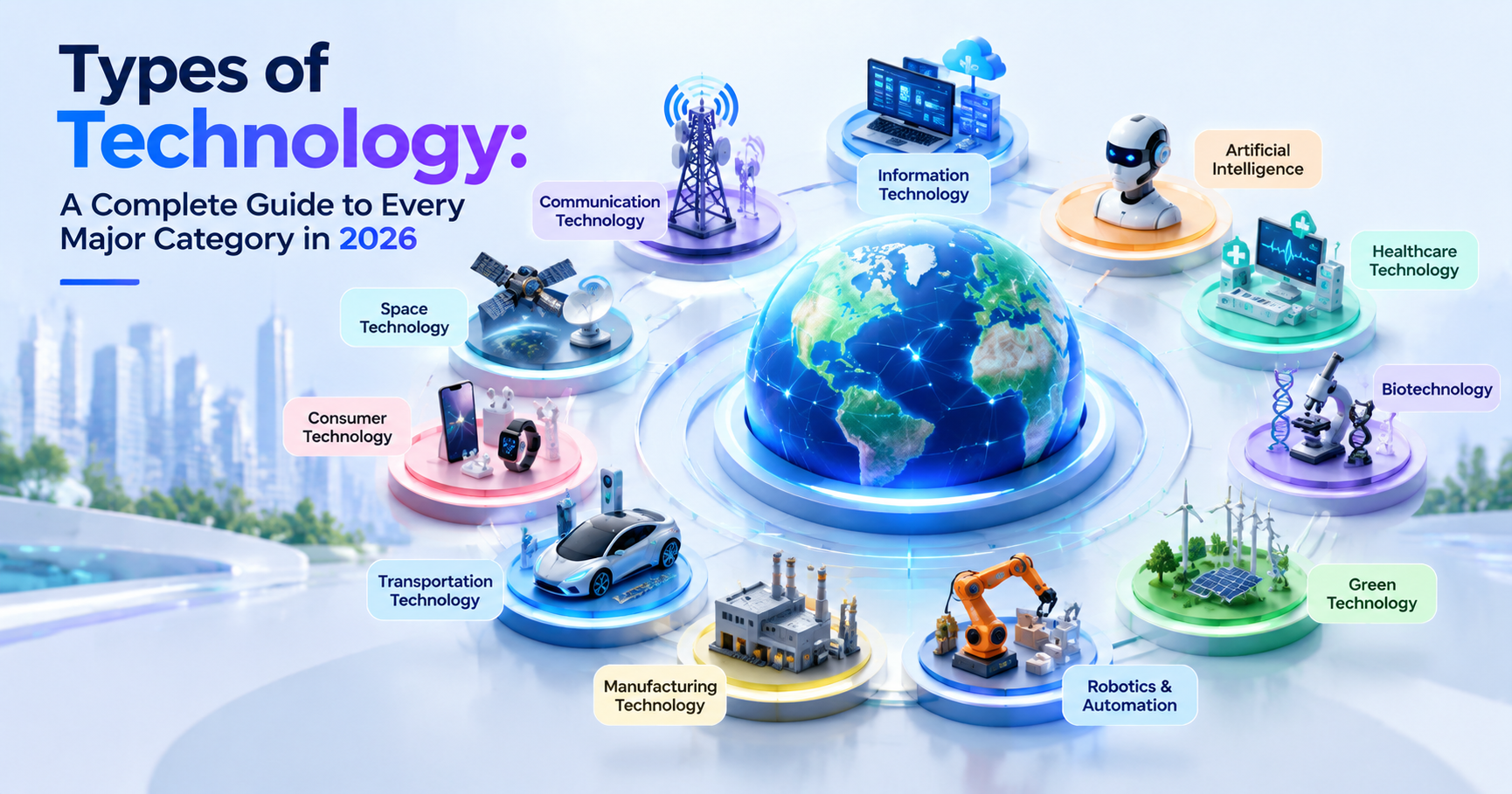
Technology is generally grouped into categories based on the problem it solves and the discipline that produces it, including information technology, communication technology, medical and health technology, biotechnology, artificial intelligence, robotics and manufacturing technology, energy technology, transportation technology, space technology, agricultural technology, construction technology, educational technology, assistive technology, and quantum and nanotechnology. Each category overlaps with others in practice (a hospital robot is medical technology and robotics at once), so the classification is a way of organizing knowledge, not a strict fence. Understanding these categories helps professionals, students, and businesses pick the right skills, tools, and certifications to invest in as each field evolves.
Key Highlights of Types of Technology
- Global IT spending is forecast to reach roughly $6.31 to $6.37 trillion in 2026, according to Gartner, with data center systems and AI infrastructure driving the fastest growth.
- Global 5G connections passed 2 billion in 2024 and are expected to overtake 4G by 2028, per GSMA Intelligence, showing how fast communication technology is shifting.
- The FDA approved Casgevy, the first CRISPR based gene-editing therapy, for sickle cell disease in December 2023 and for beta thalassemia in January 2024, a landmark for biotechnology.
- Corporate AI investment hit $252.3 billion in 2024 and 78 percent of organizations now use AI in at least one business function, according to the Stanford HAI AI Index Report 2025.
- The world's operational stock of industrial robots passed 4.6 million units in 2024, more than double the count from a decade earlier, according to the International Federation of Robotics.
- NIST finalized the world's first three post-quantum cryptography standards (FIPS 203, 204, 205) in August 2024, marking a turning point for how information technology will secure data against future quantum computers.
What Is Technology, and How Do We Classify It
Technology is the practical application of scientific knowledge and engineering to solve a specific problem or extend human capability. The word covers everything from a simple lever to a large language model, which is why most explainers group technology into categories based on the domain it serves: information, communication, health, industry, energy, transportation, and so on. These categories are not mutually exclusive. A modern hospital MRI machine depends on information technology (image processing), electronics (sensors), and medical technology (clinical protocols) simultaneously.
For professionals planning a career or a company deciding where to invest, the categories below are the ones that show up most consistently across labor market data, government technology assessments, and industry research. Each section explains the core idea, lists the concrete tools and systems inside it, and cites current, verifiable data so you can see where the category stands today rather than relying on generic descriptions.
Information Technology
Information technology (IT) covers the computers, networks, software, and data systems used to create, store, process, and transmit digital information. It is the backbone underneath almost every other technology category on this list, since AI models, medical devices, and factory robots all run on IT infrastructure.
- Core components: hardware (servers, laptops, storage arrays), software (operating systems, enterprise applications, databases), networking (routers, switches, fiber and wireless links), and cloud platforms (AWS, Microsoft Azure, Google Cloud).
- Cybersecurity has become an inseparable sub-discipline of IT rather than an add-on, covering identity and access management, encryption, and threat detection. Professionals pursuing this path often study toward credentials like CISSP certification training, which certifies expertise in designing and managing enterprise security programs.
- Cloud computing has shifted IT spending away from owned data centers toward pay-as-you-go infrastructure. Gartner's most recent 2026 forecast puts total worldwide IT spending at $6.31 to $6.37 trillion, with data center systems spending growing by more than 50 percent year over year as organizations build out AI capacity.
- Post-quantum cryptography is the newest frontier inside IT security. In August 2024, the U.S. National Institute of Standards and Technology (NIST) finalized FIPS 203 (ML-KEM, for key exchange), FIPS 204 (ML-DSA, for digital signatures), and FIPS 205 (SLH-DSA, a hash-based signature scheme), the first federal standards designed to resist attacks from future quantum computers. NIST is now urging system administrators to begin migrating from RSA and ECDH toward these quantum-resistant algorithms.
Professionals wanting a broad, structured entry point into this category can start with a DevOps certification course, since DevOps practices now sit at the center of how modern IT teams build, secure, and ship software.
Communication Technology
Communication technology encompasses the tools and networks that let people and machines exchange information: mobile networks, the internet, satellite links, video conferencing, and messaging platforms.
- Mobile and 5G networks: according to GSMA Intelligence's Mobile Economy 2025 report, global 5G connections surpassed 2 billion in 2024, with 305 operators across 121 markets offering commercial 5G service, and mobile technologies and services now contribute around 5.8 percent of global GDP, equivalent to $6.5 trillion in economic value.
- Cellular IoT connectivity is a growing communication sub-category in its own right. Ericsson's November 2025 Mobility Report puts total cellular IoT connections at roughly 4.5 billion by the end of 2025, projected to approach 8 billion by 2031, with North East Asia accounting for about 70 percent of current connections.
- Satellite communication has expanded rapidly with low-earth-orbit constellations providing broadband to regions unreachable by fiber or cellular towers, a shift that is changing how remote healthcare, education, and disaster response operate.
- Unified communications platforms (video conferencing, team chat, VoIP) became core business infrastructure after 2020 and remain a standard expectation in distributed and hybrid workplaces.
Medical and Health Technology
Medical technology (medtech) includes the devices, diagnostics, and digital tools used to prevent, diagnose, monitor, and treat illness and injury.
- Diagnostic imaging: MRI, CT, and ultrasound systems that increasingly incorporate AI-assisted image analysis to flag anomalies faster than manual review alone.
- Telemedicine and remote monitoring: wearable sensors and connected devices that track vitals and transmit data to clinicians, reducing the need for in-person visits for routine monitoring.
- Robotic-assisted surgery: systems that give surgeons greater precision and smaller incision sizes for complex procedures.
- Regulatory and safety oversight for medical technology sits with agencies such as the U.S. Food and Drug Administration (FDA), which evaluates and approves new devices and therapies before they reach patients, a process discussed further in the biotechnology section below since many of the newest medical breakthroughs are genetic therapies rather than devices.
Biotechnology
Biotechnology applies biological systems and living organisms to develop products and processes, spanning agriculture, medicine, and industrial manufacturing.
- Gene editing: the clearest recent milestone is Casgevy (exagamglogene autotemcel), a CRISPR/Cas9 genome-edited cell therapy developed by Vertex Pharmaceuticals and CRISPR Therapeutics. The FDA approved it for sickle cell disease in patients aged 12 and older in December 2023, then for transfusion-dependent beta thalassemia in January 2024, making it the first FDA-approved treatment built on CRISPR gene-editing technology.
- Cell and gene therapies more broadly represent one of the fastest-growing areas of biotech, moving from experimental treatments to approved, reimbursable therapies for genetic diseases within roughly a decade of CRISPR's discovery.
- Industrial and agricultural biotechnology uses engineered enzymes and microorganisms for everything from biofuel production to pest-resistant crops, discussed further in the agricultural technology section.
Artificial Intelligence and Machine Learning
Artificial intelligence (AI) refers to systems that perform tasks normally requiring human intelligence, such as recognizing images, understanding language, or making predictions from data. Machine learning, the subset of AI where systems improve from data rather than explicit programming, underlies most current AI products.
- Investment scale: the Stanford HAI AI Index Report 2025 found total corporate AI investment reached $252.3 billion in 2024, with U.S. private AI investment alone hitting $109.1 billion and generative AI drawing $33.9 billion globally, an 18.7 percent increase from 2023.
- Adoption: the same report found 78 percent of organizations reported using AI in at least one business function in 2024, up sharply from 55 percent the year before, while inference costs for comparable AI performance dropped roughly 280-fold in 18 months, making deployment far cheaper.
- Reinforcement learning is a specific machine learning method where an agent learns by trial and error, receiving rewards or penalties for its actions, and it underpins many advances in robotics, gaming, and autonomous systems; a deeper walkthrough is available in this guide to reinforcement learning, its key types, and examples.
- Intelligent agents, AI systems that can plan and execute multi-step tasks with limited human supervision, are the newest evolution beyond single-response chatbots; the mechanics and architecture are covered in this guide to intelligent agents in AI.
- Regulation is catching up fast: the AI Index reports that U.S. federal agencies introduced 59 AI-related regulations in 2024, more than double the number introduced in 2023.
Anyone planning a career shift into this category can start with a structured artificial intelligence certification course that covers the full landscape from foundational machine learning to applied generative AI.
Robotics, Industrial, and Manufacturing Technology
Industrial and manufacturing technology covers the machines, robotics, and automation systems used to design, build, and assemble physical products at scale.
- Industrial robot deployment: the International Federation of Robotics' World Robotics 2025 report found 542,076 industrial robots were installed globally in 2024, more than double the figure from a decade earlier, and the world's operational stock of industrial robots passed 4.6 million units for the first time. Asia accounted for 74 percent of new installations, Europe 16 percent, and the Americas 9 percent, with China alone representing 54 percent of global deployments.
- Growth outlook: the IFR projects installations will grow 6 percent to 575,000 units in 2025 and surpass 700,000 units annually by 2028.
- Industry 4.0 describes the integration of sensors, real-time data, and AI-driven analytics directly onto factory floors, turning manufacturing lines into connected systems that can predict maintenance needs and adjust output automatically.
- Additive manufacturing (3D printing) has moved from prototyping into production of end-use parts in aerospace, medical devices, and automotive manufacturing.
Energy and Environmental Technology
Energy technology covers the systems used to generate, store, and distribute power, with environmental technology overlapping heavily as the industry shifts toward lower-emission sources.
- Renewable capacity growth: the International Energy Agency's Renewables 2025 report projects global renewable power capacity will grow by almost 4,600 GW between 2025 and 2030, double the pace of the previous five years, with solar photovoltaic accounting for nearly 80 percent of that expansion.
- Market share shift: the IEA expects renewables to become the largest global source of electricity generation by the end of the decade, supplying 43 percent of generation by 2030, with solar overtaking hydropower as the single largest renewable source.
- Regional variation matters: the IEA also flagged that its 2025-2030 renewable growth forecast is 5 percent lower than the prior year's estimate, driven largely by U.S. policy changes including the earlier phase-out of federal tax credits and new restrictions on federal-land permitting, a reminder that policy, not just technology, shapes deployment speed.
- Battery storage and grid technology are the connective tissue that makes intermittent renewable sources reliable at scale, and remain one of the fastest-evolving sub-fields inside energy technology.
Transportation and Mobility Technology
Transportation technology includes the vehicles, infrastructure, and control systems that move people and goods, an area being reshaped by electrification and automation.
- Electric vehicle adoption: the IEA's Global EV Outlook 2025 reports worldwide EV sales reached roughly 20.7 million passenger and light-duty units for the year, with global EV share of new car sales exceeding 25 percent for the first time. China is projected to reach around 60 percent EV share of car sales in 2025, moving toward 80 percent by 2030, while Europe is expected to reach a 25 percent EV sales share in 2025.
- Emerging markets are catching up: Southeast Asia's EV sales grew nearly 50 percent to reach 9 percent of all car sales in the region, while Brazil's EV sales more than doubled to 125,000 units in 2024.
- Long-term trajectory: the IEA projects global EV sales share will rise from 25 percent in 2025 to over 50 percent by 2035 under its Stated Policies Scenario.
- Autonomous and connected vehicle systems rely on the same sensor, AI, and IoT technologies covered elsewhere in this guide, illustrating how transportation technology increasingly overlaps with information technology and robotics.
Space Technology
Space technology covers the spacecraft, launch systems, satellites, and exploration hardware used beyond Earth's atmosphere.
- Human exploration: NASA's Artemis 2 mission, a crewed test flight around the Moon carrying Commander Reid Wiseman, Pilot Victor Glover, Mission Specialist Christina Koch, and Canadian Space Agency Mission Specialist Jeremy Hansen, concluded on April 10, 2026, taking its crew the farthest into space humans have traveled. Artemis III is now planned for mid-2027 to demonstrate a Human Landing System in low Earth orbit, with Artemis IV targeting the first Artemis lunar landing in early 2028.
- Commercial partnerships: NASA selected SpaceX (a Starship variant) and Blue Origin (the Blue Moon lander) as its two Human Landing System providers, alongside its Commercial Lunar Payload Services (CLPS) program, which contracts private companies to deliver robotic missions and test new technologies ahead of crewed landings.
- Satellite technology underpins GPS navigation, weather forecasting, broadband connectivity, and Earth observation for climate and agricultural monitoring, making it one of the most economically significant space technology categories even though it rarely makes headlines the way crewed missions do.
Agricultural Technology
Agricultural technology (agtech) applies sensors, data, robotics, and biotechnology to farming, aiming to raise yields while reducing input waste.
- Adoption is uneven but rising: USDA Economic Research Service data show that as of 2023, only about 27 percent of U.S. farms and ranches used precision agriculture practices, but adoption climbs sharply with farm size: guidance autosteering systems were used by 52 percent of midsize farms and 70 percent of large-scale crop farms, and 68 percent of large-scale farms used yield monitors, yield maps, or soil maps.
- Market momentum: sales of precision-enabled farm equipment, including GPS-guided tractors, autonomous planters, and smart irrigation controllers, grew 9.4 percent in a single year according to the same USDA-linked research.
- Core technologies in this category include GPS-guided machinery, drone-based crop monitoring, soil and moisture sensors, and biotech-engineered seed varieties, several of which trace directly back to the biotechnology innovations described earlier in this guide.
Construction and Architectural Technology
Construction technology covers the tools, materials, and digital systems used to design and build physical structures, from residential housing to large infrastructure.
- Building Information Modeling (BIM) lets architects, engineers, and contractors collaborate on a single digital model of a structure before ground is broken, reducing costly design conflicts during construction.
- Prefabrication and modular construction shift portions of the building process into factory settings, cutting on-site labor time and weather-related delays.
- Construction robotics, including bricklaying robots and autonomous site-surveying drones, are early-stage but growing, borrowing directly from the robotics advances covered in the manufacturing section above.
Educational Technology
Educational technology (edtech) includes the digital tools, platforms, and content systems used to deliver and support learning.
- Learning management systems centralize course content, assessments, and progress tracking for both classroom and remote learners.
- Adaptive learning platforms use data on individual student performance to adjust content difficulty and pacing in real time.
- Professional upskilling platforms, including certification training providers, have become a distinct edtech category in their own right as employers increasingly hire for verified skills and credentials rather than degrees alone.
Assistive Technology
Assistive technology includes any device, software, or system designed to help people with disabilities or age-related limitations perform daily tasks more independently.
- Scale of need: the WHO-UNICEF Global Report on Assistive Technology found more than 2.5 billion people worldwide need one or more assistive products, such as wheelchairs, hearing aids, or communication-support apps, yet nearly one billion of them are denied access, with availability in low-income countries as low as 3 percent of need compared with up to 90 percent in wealthy nations.
- Future demand: the same report projects that an estimated 3.5 billion people will need assistive technology by 2050 as the global population ages and rates of noncommunicable disease rise.
- Examples range from low-tech mobility aids to screen readers, voice-controlled smart home systems, and AI-powered captioning and translation tools that lower communication barriers in real time.
Quantum Computing and Nanotechnology
These two frontier categories sit at the smallest physical scale of any technology on this list, one working with subatomic quantum states and the other with materials engineered at the scale of individual atoms and molecules.
- Quantum computing uses quantum bits (qubits) that can represent multiple states simultaneously, in theory allowing certain calculations to run far faster than classical computers. Its most immediate real-world impact so far has been forcing a security overhaul: NIST's August 2024 finalization of FIPS 203, 204, and 205 exists specifically because a sufficiently powerful quantum computer could eventually break the RSA and elliptic-curve encryption that currently protects most internet traffic. Readers exploring how this connects to everyday cloud services can see a practical breakdown in this piece on Quantum Computing as a Service (QCaaS).
- Nanotechnology engineers materials and devices at the nanometer scale (roughly 1 to 100 nanometers), enabling applications like targeted drug delivery in medicine, stronger and lighter materials in manufacturing, and higher-density chip components in electronics.
Technology Types at a Glance: Comparison Table
| Category | Core Focus | Representative Data Point | Primary Source |
|---|---|---|---|
| Information Technology | Computing, networks, data, cybersecurity | $6.31 to $6.37 trillion global IT spend forecast for 2026 | Gartner |
| Communication Technology | Mobile, internet, satellite networks | 2+ billion global 5G connections in 2024 | GSMA Intelligence |
| Medical Technology | Diagnostics, devices, telemedicine | Robotic surgery and AI-assisted imaging in routine clinical use | FDA oversight |
| Biotechnology | Gene editing, cell therapies, bio-engineering | First CRISPR therapy (Casgevy) approved December 2023 | U.S. FDA |
| Artificial Intelligence | Machine learning, generative AI, agents | $252.3 billion corporate AI investment in 2024 | Stanford HAI AI Index 2025 |
| Robotics and Manufacturing | Industrial automation, Industry 4.0 | 4.6 million operational industrial robots in 2024 | International Federation of Robotics |
| Energy Technology | Renewables, storage, grid systems | ~4,600 GW renewable capacity growth projected 2025 to 2030 | International Energy Agency |
| Transportation Technology | EVs, autonomous systems, mobility | 25%+ global new-car sales share for EVs in 2025 | IEA Global EV Outlook 2025 |
| Space Technology | Launch systems, satellites, exploration | Artemis II crewed lunar flyby completed April 2026 | NASA |
| Agricultural Technology | Precision farming, agri-biotech | 27% of U.S. farms use precision agriculture (2023) | USDA Economic Research Service |
| Assistive Technology | Accessibility devices and software | 2.5 billion people worldwide need assistive products | WHO and UNICEF |
| Quantum Computing | Qubit-based computation, PQC security | NIST finalized FIPS 203/204/205 in August 2024 | NIST |
How to Build a Career Across These Technology Types
Most professionals do not need to master every category above, they need to pick the one or two that intersect with their existing skills and industry. Someone in IT operations building toward cybersecurity will benefit from a credential like CISSP certification training, while someone moving toward automation-heavy software delivery is better served by a DevOps certification course. Anyone entering the fastest-growing category on this list, artificial intelligence, can start broad with a general artificial intelligence certification course before specializing into machine learning, reinforcement learning, or agentic AI. The full catalog of certification paths across these domains is browsable on the Simpliaxis professional certification and training courses page.
Key Takeaways
- Technology categories are organizational tools, not strict boundaries, and most modern systems draw on multiple categories at once.
- Information technology remains the foundational category, with global IT spending forecast at $6.31 to $6.37 trillion for 2026 according to Gartner.
- Artificial intelligence is currently the fastest-growing category by investment, with corporate AI spending reaching $252.3 billion in 2024.
- Biotechnology has moved from lab research to approved treatment with CRISPR-based therapies like Casgevy, first approved by the FDA in December 2023.
- Robotics and manufacturing technology has more than doubled its operational scale in a decade, passing 4.6 million industrial robots worldwide in 2024.
- Energy and transportation technology are shifting together, with renewable capacity and EV adoption both on track to roughly double or more by 2030.
- Assistive technology remains one of the most under-resourced categories relative to need, with roughly 1 billion of the 2.5 billion people who need it currently unable to access it.
- Choosing where to build career skills across these categories works best by matching a category to existing experience and pursuing a focused certification rather than trying to cover every category at once.









 Lowest-Price Challenge











 Personalized Path


.webp)


 USA
USA  Canada
  India
India  UK
UK  Australia
  Singapore


