


 Call Us



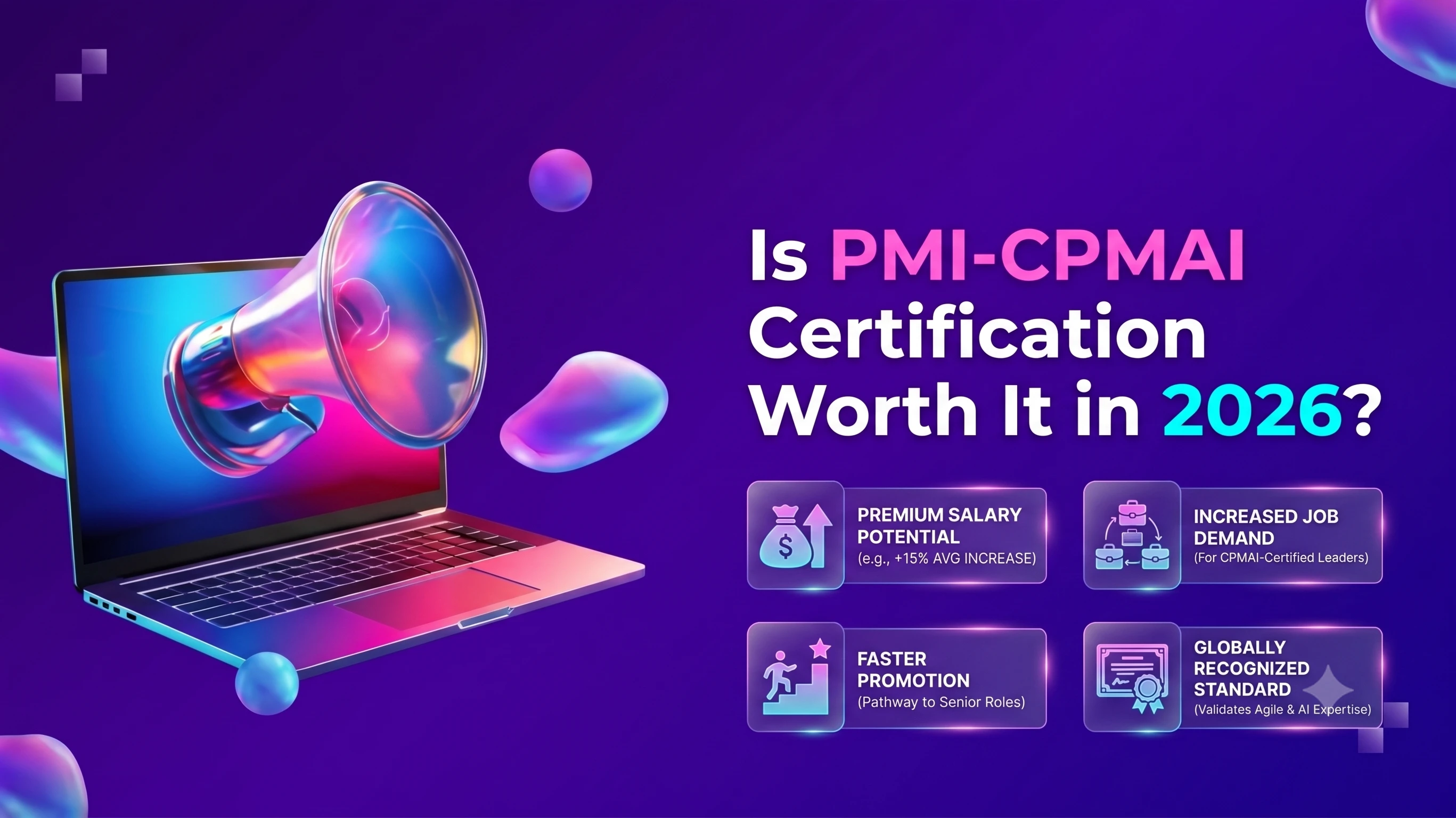
Short answer: For most working project managers, yes, but with real conditions attached. PMI-CPMAI is worth it if you already manage, or want to manage, projects that involve AI, machine learning or data initiatives, and you need a structured, PMI-backed way to prove that on a CV or in front of a hiring panel. It is not worth it if your role has no AI-adjacent work in sight, or if a free two-hour primer would answer your actual question. The rest of this article sets out exactly why, with sourced figures rather than marketing claims.
Key Highlights
- PMI-CPMAI validates the ability to manage AI and data-driven projects using a CRISP-DM-based methodology, not hands-on technical AI or ML skills.
- PMI acquired the credential from Cognilytica in September 2024 and folded it into its own certification portfolio, complete with PDU renewal requirements.
- Only around 20% of project managers rate their own AI skills as extensive or good, even though over 70% of organisations are already using or exploring AI in project management, per PMI's 2025 Pulse of the Profession report.
- The exam runs 120 questions (100 scored, 20 unscored pretest) across 160 minutes, with no formal prerequisite tied to prior project management experience.
- It is worth pursuing for PMs already handling, or moving into, AI or ML-adjacent project work; it is not a substitute for a foundational credential like PMP or CAPM.
- Typical total cost runs roughly $699 to $899 for the exam bundle plus a required prep course, commonly priced between $500 and $1,500.
- As PMOs shift from isolated AI pilots toward embedded AI governance functions, the credential's differentiating value is moving toward portfolio-level AI risk oversight rather than basic AI-project literacy.
What PMI-CPMAI Actually Is
PMI-CPMAI stands for PMI Certified Professional in Managing AI. The credential did not start life inside PMI. It was originally developed by Cognilytica as CPMAI (Cognitive Project Management for AI), built on the established CRISP-DM data-mining methodology combined with Agile practices. PMI acquired Cognilytica in September 2024 and folded the credential into its own certification portfolio, which is why you now see it marketed under the PMI-CPMAI name with PMI's governance and PDU system behind it.
According to PMI's own certification page, the exam has no formal prerequisite in terms of years of project management experience or a specific educational background. However, most routes to sitting the exam, including Simpliaxis's PMI-CPMAI training course, require candidates to complete an approved exam-prep course first, since PMI does not currently allow pure self-study registration for this particular exam the way it does for PMP.
The exam itself runs to 120 multiple-choice questions (100 scored plus 20 unscored pretest items), completed in 160 minutes, closed-book, delivered through Pearson VUE at a test centre or via online proctoring. PMI has not published an exact passing percentage; training providers who track pass-rate feedback estimate it sits somewhere around 70 to 75 percent, though treat that as an informed estimate rather than an official figure. Once earned, the certification requires 30 PDUs every three years to maintain, spread across PMI's Talent Triangle categories of Ways of Working, Power Skills and Business Acumen.
The Honest Case For Getting It
The case for PMI-CPMAI rests on a real, documented gap rather than hype. PMI's own 2025 Pulse of the Profession report, based on a global survey of 2,841 project professionals, found that only around 20 percent of project managers rate their own practical AI skills as extensive or good, even though more than 70 percent of organisations say they are already using or actively exploring AI within project management. The same report links AI-enhanced project management to 25 to 35 percent higher project success rates. That gap between what organisations are attempting and what most project managers can actually demonstrate is precisely the space PMI-CPMAI is built to close.
It is worth being equally clear about what this does for pay and hiring, because most of what circulates online overstates the certainty of the numbers. Several training providers, drawing on US job-board postings from 2025 and 2026, report senior AI project manager roles advertised in the region of $120,000 to $155,000. Treat that as a description of what AI-heavy project roles pay in the current market, not as a proven salary premium caused by holding CPMAI specifically. The credential only became a PMI offering after the September 2024 Cognilytica acquisition, so there simply has not been time for an independent, methodologically transparent study to isolate its salary effect the way older certifications like PMP have been studied for years. Anyone telling you a precise percentage salary uplift tied specifically to CPMAI is extrapolating, not reporting.
Who genuinely benefits: project managers and product owners who already hold PMP, CAPM or PMI-ACP and are being asked, or want to be asked, to run AI, machine learning or intelligent-automation initiatives; digital transformation leads who need a shared vocabulary with data science teams; and PMOs standing up AI governance functions who need staff who can speak to data readiness and AI risk in the same breath as scope and schedule. If you already work in one of these situations, or a hiring manager has told you it would help, the practical route is a structured CPMAI training course followed by an exam-readiness check before booking the real thing.
Who Should Not Bother, at Least Not Yet
PMI-CPMAI is not automatically worth it just because AI is in the news. Skip it, or at least delay it, if any of the following describe you:
- Your current and near-future project work has no AI, ML or advanced-data component at all, and there is no indication that will change.
- You need deep technical skill, such as building or tuning models, rather than the ability to manage the project wrapped around that work. CPMAI is explicitly a project management credential, not a data science one.
- You have not yet earned a foundational project management credential. If you have no PMP, CAPM or equivalent, building that base first is usually the better sequence; Simpliaxis's own analysis of whether PMP is worth it is a reasonable place to check that logic before adding a specialised layer on top.
- You only need enough AI literacy to hold a sensible conversation in meetings, not to run a project's AI lifecycle end to end. A short, free primer will genuinely cover that need.
- Budget and time are both extremely tight this year. The prep-course requirement and exam fee are real costs, and a lighter option exists (see the comparison below) that may satisfy your actual, current need.
PMI-CPMAI Versus the Realistic Alternatives
"Worth it" only means something relative to what else you could do instead. Here is how PMI-CPMAI compares with the two most common alternatives people actually consider.
| Option | What it proves | Typical cost | Typical time | Best fit |
| PMI-CPMAI certification | Structured ability to run an AI or data project end to end, including data readiness, iterative delivery and AI governance basics | Roughly $699 to $899 for the exam bundle depending on PMI membership, plus a prep course, commonly cited in the $500 to $1,500 range | Several weeks of prep alongside a 160-minute exam | PMs already handling, or about to handle, real AI/ML project work |
| PMI's free Generative AI Overview course | Basic literacy in generative AI concepts and prompt use for project work | Free | An afternoon | Anyone who just needs a working vocabulary, not a credential |
| A dedicated short course such as Generative AI for Project Managers | Practical, hands-on use of generative AI tools inside everyday PM workflows | A fraction of the CPMAI bundle, priced as a standard short course | Roughly 16 hours of live instruction | PMs who want applied AI tool skills fast, without a formal exam |
| PMP plus informal on-the-job AI exposure | General project management competence; AI exposure is unverified and inconsistent | PMP cost only | No additional time if PMP already held | PMs whose AI work is occasional and does not need formal proof |
In practice, many candidates do not choose one path exclusively. A common and sensible sequence is PMP first (or PMI-ACP for those in agile-heavy environments), a short applied AI tools course for immediate workplace use, and PMI-CPMAI when a specific role or project genuinely calls for the deeper, certifiable methodology. Simpliaxis's PMI-ACP training is a relevant staging point for agile teams edging toward AI delivery work before they are ready to commit to a full AI-specific credential.
What PMI-CPMAI Actually Validates in an AI-Shifted PMO, and What It Does Not
This certification exists precisely because of the 2026 shift toward AI-assisted and AI-governed project delivery, so it is worth being specific rather than vague about what it does and does not certify.
What it genuinely signals:
- A structured AI-project methodology. The CRISP-DM-derived lifecycle it teaches gives a repeatable way to move an AI or data initiative from business understanding through data preparation, modelling, evaluation and deployment, rather than forcing a traditional waterfall or generic Agile template onto work that does not fit either.
- Data readiness assessment. It trains project managers to ask the right questions about whether data is actually fit for an AI use case before a team commits budget and time to building on top of it, which is one of the most common places AI projects quietly fail.
- AI risk and governance awareness. It gives PMs a working framework for responsible AI considerations, bias, explainability and compliance touchpoints, so those conversations happen at the project level rather than being left entirely to legal or data science teams after the fact.
- A shared vocabulary with technical teams. It equips a PM to translate between business stakeholders and data scientists or ML engineers without needing to do either job.
What it does not make you:
- It does not make you a data scientist, ML engineer or AI developer. You will not come out able to build, train or debug a model.
- It does not replace deep technical judgement on model selection, architecture or algorithm choice; that remains squarely with technical specialists.
- It does not automate away the human calls that still sit with the project manager regardless of certification: reading whether a stakeholder actually trusts an AI recommendation, making an ethical trade-off in an ambiguous situation, managing the organisational change that comes with automating someone's previous job, and deciding when an AI system genuinely is not ready for production no matter what the dashboard says.
Looking ahead, the credential's relevance is likely to keep moving rather than sit still. As PMOs shift over the next two to three years from running isolated AI pilots to operating embedded, portfolio-level AI governance functions, expect PMI-CPMAI's differentiating value to move away from proving basic AI-project literacy, which more PMs will simply pick up on the job, and toward proving the ability to run AI governance and risk oversight at scale across a whole portfolio rather than a single project.


_1738223266.jpg)




 Lowest-Price Challenge











 Personalized Path


.webp)


 USA
USA  Canada
  India
India  UK
UK  Australia
  Singapore


