


 Call Us



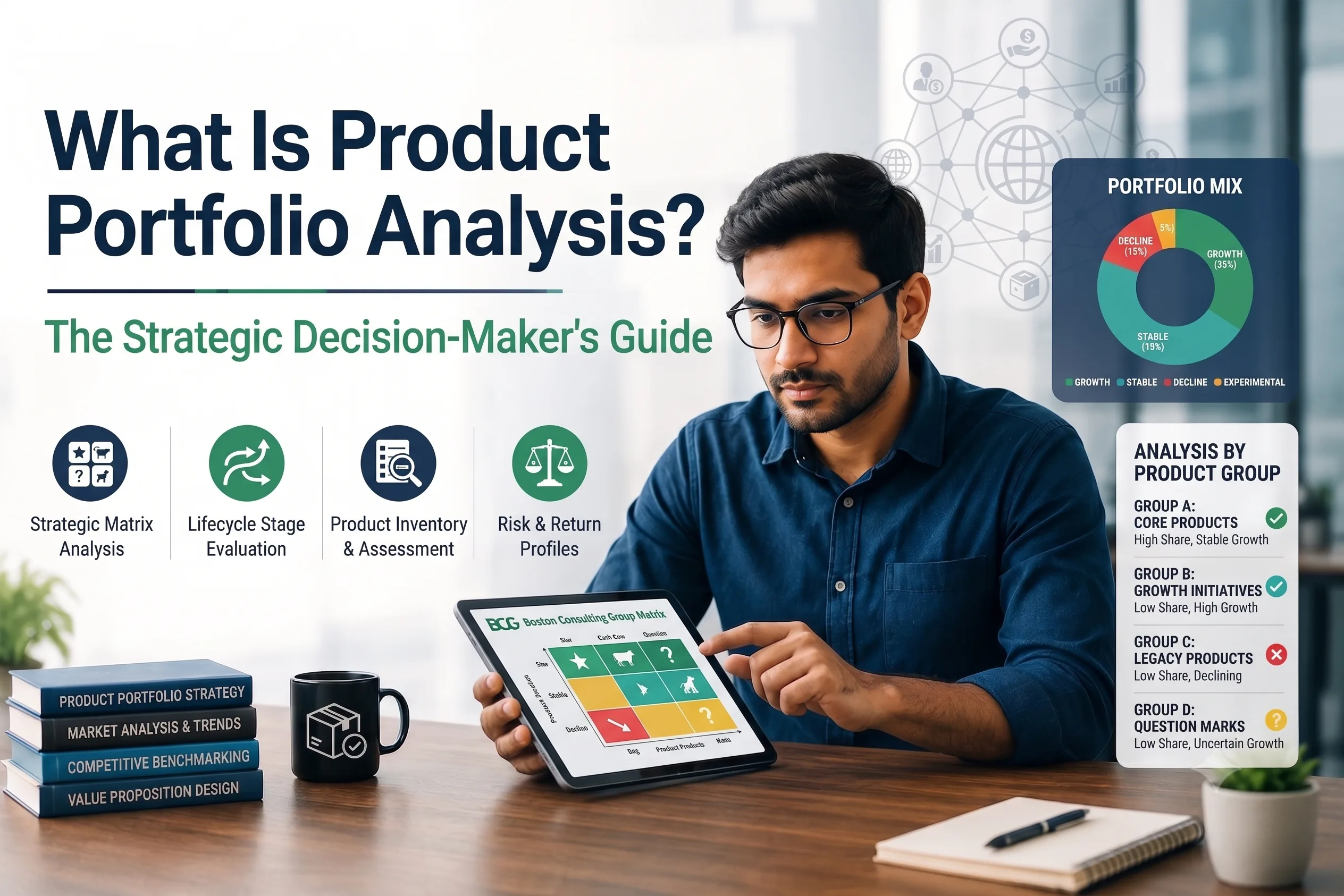
Product portfolio analysis is a systematic technique for examining all of a business's products, their performance, market fit, stage, and required attention or investment. The objective is not to locate just the top-selling product. The objective is to understand how the items function together and whether the total portfolio supports the company’s strategic goals.
Imagine a corporation that has 10 items. Three are expanding fast, two have good sales but limited market growth, three are new and still being tested, and two have been losing clients for years. Giving the same money and personnel to all 10 items does not have much purpose.
Portfolio analysis assists decision-makers in recognizing these disparities.
It can answer practical problems like:
- What products should we spend more on?
- Which products are always providing returns?
- What products have promising future potential?
- What products are gobbling up resources without delivering enough value?
- What holes are there in the portfolio?
- Are there numerous items that meet almost the same client need?
- Which products will have to adjust their price, placement, or features?
- When should a product be maintained, altered, merged, or retired?
The analysis may employ financial data, customer data, market data, product use, competitive data, product lifecycle stage, development cost, and strategic fit. The measures will be tailored to the company.
It is worth noting that a portfolio analysis is not a one-time rating activity. Markets move. Customer requirements evolve. Variation in product performance. The product that seems unimportant now could matter as the market changes, and the product that formerly delivered significant revenue may become less relevant over time.
The standard BCG Growth-Share matrix is one of the most well-known Product Portfolio tools for portfolio analysis. It categorizes products or business units into four quadrants based on market growth and relative market share: stars, cash cows, question marks, and dogs (often referred to as pets in BCG’s original study). The framework was created to assist organizations in thinking about how to invest and allocate assets across a portfolio. But a matrix does not make a wise portfolio choice.
A product may have a low market share because it is new and not because it is a terrible product. Another product may have strong sales yet have very high support/maintenance expenses. A product with little revenue may be strategically beneficial if it provides an up-access to a key consumer category.
A successful product portfolio analysis is thus a combination of a basic framework, solid business judgment, and dependable data.
Why Product Portfolio Analysis Matters for Scaling Companies
Scaling impacts how a firm has to make product choices. When companies are tiny, a founder or small executive team may know practically every product, client, cost, and issue. Companies often make decisions through direct conversation.
It becomes tougher as the business gets bigger. There are more products and more teams. More teams imply more roadmaps, more budgets, more client groups, more technological demands, and more conflicting goals. Without a comprehensive portfolio picture, each product team might concentrate on making their particular product successful without recognizing the impact on the broader company. Such an approach may lead to some difficulties.
A firm could continue to subsidize things only because they have always been there. It may continue to add features to a product that has limited room for development. It may offer new items that serve the same market as its present products. It may also overextend its best staff across too many initiatives.
McKinsey says increasing product portfolios may lead to complexity. The purpose of portfolio management is not always to limit the number of products. Instead, firms need to differentiate complexity that generates consumer value from complexity that increases expense without commensurate return. Product portfolio analysis provides executives with a more structured manner of making these selections.
It improves resource allocation.
People, money, engineering time, marketing capacity, and managerial attention all face constraints.
A portfolio evaluation allows items to be compared based on common criteria. This helps to identify where extra resources are likely to have the most impact.
For example, let's say a corporation has 4 products:
- Product A has good income and consistent demand.
- Product B is growing quickly in customers but requires additional investment.
- Product C is having diminishing sales and significant maintenance expenses.
- Product D is new and has not yet developed demand.
These products should not get the same investment by default.
The study may suggest that Product A requires ongoing maintenance, Product B needs additional investment, Product C needs a clear exit or repositioning strategy, and Product D needs a modest test budget rather than a big commitment.
It’s not about making blanket cuts to spending. It is to allocate resources where they are needed for a clear rationale.
It keeps product strategy connected to business strategy.
A product might be a good performer but a bad strategic match. For example, a product might make money yet be in a market that the corporation no longer wishes to concentrate on. Another product may generate low income today but be aligned with a large future business aim.
Portfolio analysis adds this broader perspective to the topic. For instance, Atlassian defines product portfolio management as “considering products as a connected group, not as isolated products.” This allows organizations to see gaps, redundancy, resource conflicts, and items that may need to be terminated.
It reduces product clutter.
More products are not always better. All new products require work in progress, testing, sales, marketing, support, documentation, compliance, infrastructure, customer service, etc.
This phenomenon is particularly the case in the software sector. Even if products have distinct names, they may share many of the same systems and staff. Both may consequently be more costly to maintain than the income figures imply. A portfolio review might reveal this hidden expense.
It creates room for future products.
A strong portfolio has to support today’s company and provide space for tomorrow’s growth. When most of the resources are engaged in established products, the corporation can find it difficult to finance fresh chances.
But the corporation might undermine its existing income base if it pours too many resources into unproven initiatives. The portfolio perspective allows leaders to balance the two. It makes it simpler to address hard choices
It makes difficult decisions easier to discuss.
Teams may have spent years building it up. Customers could still utilize it. Sales teams may have connections to it. Some leaders may have a personal motivation to maintain it. Structured analysis doesn’t eradicate emotion, but it provides a shared basis for debate. Instead of replying, “I think we should keep it,” the team may ask:
- What is the revenue trend?
- What does it take to keep pace?
- How many active clients are using it?
- Is the market expanding?
- Does it support the corporate strategy?
- If we retire it, what happens?
- Are there better products to offer these customers?
That makes the discourse more valuable.
Explore NowWho Uses Product Portfolios?
Organizations with more than one product, product line, service offering, or major product endeavor use product portfolios. What the process involves depends on the size and structure of the business.
Product Managers
Product managers tend to know a lot about particular products. They know client demands, product performance, feature demand, and product issues. In portfolio analysis, they provide information at the product level and assist in explaining the story behind certain data.
Product Leaders
Product leaders and product operations leaders typically require the broader portfolio perspective. They could evaluate product performance, roadmaps, customer groups, investment requirements, and product strategy across teams. They don’t just improve each product. They have to find out how the products should function together.
Business & Executive Leaders
Senior executives worry about the overall influence on the company. They may concentrate on revenue, profit, market position, risk, strategy fit, investment requirements, and long-term growth. Portfolio analysis enables them to relate product selections to wider company decisions.
Finance Teams
Finance teams may share key information on revenue, expenses, margins, budgets, and investment. A highly lucrative product may not generate significant income. Likewise, a product with smaller revenues may have great profits. Financial data prevents portfolio choices from relying solely on sales statistics.
Sales and Marketing Teams
Marketing and sales teams may share insights on customer demand, market trends, price, win rates, client segments, and competitive pressure. They may also notice situations when two items are confusing consumers or fighting for the same buyer.
Engineering & Technology Teams
Technical cost and risk identification advice is provided by engineering teams. Two products with equal revenues might have quite different technological demands. One may operate on a basic platform, whereas another could rely on outdated technologies and need a huge engineering effort to keep it going. This information is crucial in calculating the actual cost of a product.
Customer Support & Operations Teams
Support data may tell you whether a product causes a significant volume of tickets, needs manual effort, or has repeat customer concerns. Firms frequently overlook this when they focus just on revenue.
Product Portfolio Managers.
In larger firms, there could be staff who work especially on portfolio planning or product operations. Their roles might include keeping portfolio data, organizing reviews, comparing investments, monitoring product performance, and supporting strategic choices. The basic premise is that portfolio analysis should not be the domain of one department. A productive analysis is to juxtapose multiple perspectives on the same things.
Portfolio Analysis and the Product Lifecycle
A product does not remain in the same state for eternity. Most products go through numerous phases; however, the course and duration might vary. A typical product life cycle comprises introduction, growth, maturity, and decline. The examination of the portfolio is more relevant if combined with the lifecycle stage of the products.
Introduction
This is the early phase. It may have few clients, little income, and significant development or marketing expenditures. This doesn't imply that the product is inevitably weak.
At this phase, teams should search for indicators like:
- Customer uptake
- Keep early
- How products are used
- Customer reviews
- Sales funnel
- Market size
- Customer acquisition cost (CAC)
- Proof of a genuine customer complaint
- Product differentiation
New products should not be measured on the same basis as mature products.
Development
As you scale, consumer adoption and income may snowball. The firm may have to spend on engineering, sales, customer service, infrastructure, and marketing. Portfolio analysis may assist in answering the question of whether the product is worth growing and if the growth is strong enough to warrant the investment needed. A product that is fast-growing and that the firm can sell well against competitors might become one of the company's key products in the future.
Maturity
Growth frequently decreases in adulthood. The product could have a loyal consumer base and dependable income. The focus might move from quick growth to retention, profitability, efficiency, and targeted improvements. That’s not to say mature items should be disregarded. A mature product may support investment in fresh items. It also may maintain its strategic value because of its consumer base.
Decline
The clients change, the technology changes, the rules change, or a better solution comes along. Demand may taper off.
At this time, the corporation has to determine whether to:
- Product refresh
- Alter its target market
- Cut investment
- Mix it with another product.
- Save it for a lesser set of clients
- Transfer consumers to another product
It should be an evidence-based choice, not an age-based decision.
Lifecycle and Portfolio Analysis Are Not the Same
A typical error is to think that the lifecycle stage represents the complete story. It doesn’t. Both may be mature, but one can be very lucrative; the other has diminishing demand and hefty operational expenses. And two new products might have quite different prospects, too. The product lifetime provides context. Portfolio analysis gives you a broader comparison.
Portfolio management studies also provide an explanation for the relevance of life cycle issues for firms' choices on the makeup of their portfolio, launch timing, marketing, inventory, and resource allocation.
Product Portfolio Analysis Methods & Models
There’s no one-size-fits-all model for every firm. The selection of the proper product portfolio methods relies on the kind of products, the data available, the market, and the choice the organization has to make.
BCG Growth-Share Matrix
One of the most famous portfolio models is the BCG Growth-Share Matrix.
It looks at two key elements:
- Growth of the market
- Relative market share
This metric gives four categories:
Stars
Stars have a high relative market share and rapid market growth. The market is increasing; thus, they may need continual investment, yet they may have tremendous future potential. The objective is to assist products with a strong position in attractive markets.
Cash Cow
They are markets with high relative market share and low growth. They may earn cash consistently and need less expenditure to expand than items in rapidly rising areas. The cash might be of use to other portions of the portfolio.
Question Marks
Question marks function in marketplaces that are growing fast, but the relative market share is low. These products warrant a closer look. Some may become powerful items if investment helps their standing. Others may continue using resources without becoming leaders.
Dogs
Dogs have low market share and limited market growth. The original BCG model referred to them as "pets," although the term “dogs” is more commonly used now for the group.
Products in this category may need to be moved, maintained for a reason, sold, or discontinued. BCG’s own approach is to look at whether such companies can be repositioned or whether the corporation should abandon them. The BCG Matrix is an easy-to-understand tool, which is why it is valuable. But it doesn’t last forever.
Market share and market growth do not measure all that counts. They also have to be precisely measured. Academic research has highlighted concerns such as the definition of the relevant market, the measurement of market share and growth, and the consideration of linkages between products. Hence, the BCG matrix should be used as a decision support tool rather than an automated response.
GE-McKinsey Nine-Box Matrix
It breaks them down into a nine-box grid. This means that teams may account for a broader set of circumstances. Industry attractiveness may include elements such as market growth, profitability, competitiveness, regulation, and other external considerations.
Competitive strength may be market position, capabilities, brand strength, product quality, cost position, or other internal considerations. This methodology is frequently more versatile than the BCG Matrix since organizations may create various metrics for each dimension.
Ansoff Matrix
The Ansoff Matrix considers growth options in terms of products and markets.
Usually, four choices are split:
- Market penetration
- product design
- Diversification of market growth
This approach is helpful when the portfolio issue relates to the path of growth. For example, a firm may have a good product for an established market. It can choose to build additional features or a new version for the same clients instead of a whole new product.
The Ansoff approach is less about assessing current items and more about thinking through routes of expansion.
SWOT Analysis
SWOT considers:
- Strength
- Weaknesses
- Opportunities
- Threat
It may be used at the product or portfolio level. So, for example, a product might have high customer loyalty as a strength, an old technological basis as a weakness, an increasing market as an opportunity, and new rivals as a threat.
SWOT is most effective when backed by evidence. A collection of thoughts without data does not constitute a good portfolio analysis.
Scoring Models
A scoring model is used for each product to assign a score to chosen variables.
For instance, a corporation might rate items on:
- Turnover
- Higher earnings
- Margins
- Customer loyalty
- Market development
- Strategic fit
- Customer value
- Technical health
- Investment required
The corporation may then balance these aspects as per its plan. This approach is versatile, but the criteria for scoring must be explicit. Otherwise, teams may game the results to back judgments they previously wanted to make.
Profitability and Financial Analysis
Some portfolio selections need a broader financial perspective.
Teams could consider:
- Revenues
- Gross profit margin
- Margin of contribution
- Cost of development
- Cost of support
- Cost of customer acquisition
- Lifetime value
- Operating costs
- Required investment
This kind of study is very helpful when two items sell about the same, but their expenses are considerably different.
Customer Value Evaluations
Revenue alone cannot tell the complete story.
A product may have low revenue because it targets a small but important consumer group. Or maybe another product is making a lot of money but losing customers fast and getting a lot of complaints.
Customer measurements may include:
- Student persistence
- Churn
- How to use the product:
- Customer satisfaction.
- Renewal rate
- Volume of support
- Use Features
- Customer Reviews
Technical Portfolio Analysis
Technical health may be a big aspect of portfolio analysis for digital products.
Teams can assess:
- Debt (Technical Debt)
- Cost of infrastructure
- Security hazard
- Dependability
- Age of architecture
- Risk of addiction
- Capacity for engineering
- Incorporating complexity
This phenomenon may also show why a seemingly successful product on paper can become costly to maintain. The best portfolio assessments frequently use a combination of these approaches rather than a single framework.
Learn MoreWhat Are the Benefits of Product Portfolio Analysis for Business Strategy
A product portfolio study may help enhance corporate strategy in a number of ways.
Make Smarter Investment Decisions
The most immediate advantage is more transparent resource allocation. Instead of merely spreading resources equally, corporations may determine where to put their investment dollars for best effect. This may imply increasing investment in a rising product, supporting a mature product, experimenting with a new product on a lesser budget, or decreasing investment in a declining product.
A Better Portfolio Balance
A corporation requires items of varied functions. Some may provide present income. Others may make future progress. Some may diversify risk by servicing diverse consumer groups or markets. Portfolio analysis lets executives know whether the mix is balanced.
Early Detection of Poor Products
Retiring a product doesn’t make it an issue overnight. There are generally warning indications. Early warning signs might include declining utilization, reduced profits, increased support expenses, lower retention, or declining market demand. By tracking often, teams may take action before an issue becomes worse.
More Focused Strategy
The approach may be confusing when managing a large portfolio. If a corporation claims everything is a priority, then nothing is a priority. Portfolio analysis is about choice. This may make product roadmaps simpler to manage, since teams know better where to focus their efforts.
Less Duplication
Two products may be targeting similar clients or solving similar challenges. Portfolio reviews might identify possibilities to consolidate products, share technology, streamline services, or eliminate redundant features.
Enhanced Risk Management
There are several sources of risk to a portfolio. A corporation might become excessively dependent on one product. It may have too many product lines in diminishing markets. It may have numerous products that depend on the same outdated system. Looking at the complete portfolio reveals these risks.
More Disciplined Innovation
Innovation requires freedom to grow, but not every concept should get infinite financing. Portfolio analysis may assist organizations in defining the limits of new items. A fresh concept might start with a small amount of financing. If it yields good proof, the corporation can invest more. This approach has the effect of reducing the likelihood of heavy investment before demand is known.
Better Communication
Different teams tend to measure things differently. Revenue may be sales. Some products may concentrate on adoption. Engineering may be about the dangers of technology. Finance may be driven by margin. Portfolio analysis integrates them into one debate. That may make talking about leadership sharper.
Real-World Product Portfolio Examples
It's simpler to grasp portfolio analysis when you see it in practical terms. Below are some of the product portfolio examples for reference:
Example 1: A software firm with 6 items
Consider a software corporation that has 6 products.
Two products are generating high revenues and reliable client bases. One has strong client growth yet still spends big. The other has stagnant revenues but hefty support expenses. The latter two are new products with little data.
- A basic evaluation of the portfolio might lead to distinct actions for each group.
- Mature products may continue to get maintenance money and targeted enhancements.
- The fast-growing product may get greater engineering and sales help.
For products with significant support costs, a cost evaluation and technical assessment may be conducted. Both new products might be kept under controlled testing until enough information is available to make a bigger investment choice. The fundamental lesson is that portfolio analysis is not about “keeping the winners and cutting the losers.” Every product has a place and has to be proven or disproven.
Example 2: Company with overlapping products
Let us imagine a corporation that offers three items to small enterprises.
- Product A is a simple solution.
- Product B has almost the same key functionality, plus reporting.
- Product C is a more sophisticated product for bigger customers.
The distance between A and B has been becoming less over time.
Sales teams have a challenging time explaining the difference. Customers can't decide which one to select. Engineering has different code and features for both products.
A portfolio assessment might reveal the problem is not only product performance. The difficulty is portfolio design. The corporation may opt to merge A and B, reposition them, or establish a sharper distinction between the two offers.
Example 3. Financing a new product with a mature product
A corporation may have one well-established product that provides steady income. Meanwhile, it has a new product in a rising market. The mature product isn’t expected to develop rapidly, but it still brings the firm revenue and customers. To increase its position, the new product requires investment. The portfolio approach enables leadership to look at these products as a whole, rather than seeing the mature product as a problem because it is slowly growing.
The new product may be evaluated, while the mature product can support the company’s larger investment strategy. This approach is very much the original thinking behind the BCG portfolio idea, where established cash-generating enterprises may support higher-growth possibilities.
Example 4: A declining legacy product
Take a digital product that has been around for many years. Revenue is dropping, but a few of the clients still rely on it. The product employs ancient technology as well and needs engineers who might be working on newer items to maintain it. A simple choice to “retire the product” might spell trouble for the consumer.
An improved portfolio analysis would consider:
- Existing customers
- Obligations under contract
- Earnings
- Cost of maintenance
- Technical risk
- Migration choices
- Spare parts
- Customer support cost during relocation
Retirement may be the outcome, but the corporation may make a transition strategy rather than just shutting down the offering.
What Are the Steps to Execute a Data-Driven Product Portfolio Analysis?
A competent portfolio analysis does not begin with a matrix. It begins with a choice.
Step 1. Know the purpose.
Is the firm attempting to:
- Cut product prices?
- Next year's investment decision?
- Identify development opportunities?
- Check the health of the product?
- Cut down on product overlap?
- Plan for product end-of-life?
- Balance innovation with current revenue?
The goal dictates the important data.
Step 2: Set up the portfolio.
Make a full list of the products under evaluation. Define what constitutes a product. In certain firms, any software application could be a product. For others, product families, programs, platforms, or business lines could be the suitable level. Do not mix levels without a reason.
Step 3: Gather the data.
Gather information from the teams that know each piece of the product.
Useful data may include:
- Earnings
- Growth rate
- Profits
- Number of customers
- Retention rate
- Usage Churn
- Growth of the market
- Share in the market
- Customer satisfaction
- Cost of development
- Cost of Support
- Technical risk
- Strategic alignment
- Stage in product lifecycle
Not all businesses need to track all product portfolio metrics. The aim is to gather enough solid facts to support the conclusion.
Step 4. Data quality check.
Incompetent data means poor portfolio choices. See whether the same definitions are being used by various teams. For example, if the number is being compared, “active customer” should imply the same thing across products. Also verify the time period. Comparing the yearly sales of a product to the monthly income of another product is misleading.
Step 5: Select an analysis technique.
Select a model depending on the choice.
A BCG-type study may be effective in looking at market position and growth.
A GE-McKinsey-style model may be helpful when industry attractiveness and competitive strength are influenced by several variables.
- If the organization has its own strategic criteria, a scoring model may perform better.
- If you are mostly concerned with cost and profitability, financial analysis may be the most essential technique.
Stage 6: Review all products.
Compare each product against the criteria you have chosen. Try to retain the same procedure. For example, if strategic fit is evaluated on a one-to-five scale, clarify what one, two, three, four, and five imply. This way, it’s less likely one team rates their product a five just because it seems significant.
Step 7: See the portfolio as a whole.
This is commonly overlooked. Don’t stop at rating products. Watch for trends.
Ask:
- Are there too many products targeting the same market?
- Are we overly reliant on one product?
- Do we have enough items to expand going forward?
- Are we over-investing in mature products?
- Are new products getting adequate testing?
- Are there numerous products employing the same restricted resources?
- What are the technological dependencies between products?
- Do you have holes in your core customer segments?
This is when the portfolio view starts to be more informative than looking at individual product reviews.
Step 8: Define Strategic Actions.
Convert results into decisions.
Typical activities are:
- Less Investment
- Hold
- Test
- Polish
- Transfer
- Mix
- Customer Migration
- Retirement
Step 9: Modeling the effect.
Before you make a big choice, consider what comes next.
- What’s the impact on the consumers if a product is retired?
- What team members are required if the investment goes up?
- What is the technical work to be done when two products are combined?
- If a new product is funded, what previous work will be postponed?
Portfolio choices are always trade-offs.
Step 10: Owners of catalogs.
You need an owner for big decisions.
- If a product is being repositioned, somebody has to own the task.
- If there's a product that is going away, someone has to help customers migrate.
- If investment is rising, someone must know what the projected result is.
Step 11: Schedule review dates.
The analysis shouldn't sit in a presentation for a year. • Establish a review cadence that is in tune with the company. Fast-changing digital portfolios may need more frequent assessments than steady portfolios. The following discussion of the Growth-Share Matrix by BCG also makes the case for more frequent portfolio assessment as markets move more quickly.
Step 12: Watch the selections.
Finally, document what was determined and why. This is a valuable history. When the portfolio is evaluated, executives may determine whether the prior assumptions were true.
What Are the Best Product Portfolio Tools?
Spreadsheets
For a modest portfolio, a spreadsheet may suffice.
Teams may use it to gather:
- Product names
- Revenue
- Growth
- Number of customers
- Costings
- Stage of life
- Match the strategy
- Grades
- Investment options
Useful because they are adaptable and well-known. They are difficult to handle when many of the teams are updating the same data or when the portfolio is changing regularly.
Product Management Tools
Product management systems may put product concepts, roadmaps, objectives, and product information into a single system. For example, Productboard talks about portfolio management around a broader perspective of products and associated product development, including links to delivery systems. These solutions might be effective when the portfolio is large, and teams distribute product information.
Jira Product Discovery
Jira Product Discovery is a tool for product prioritizing and roadmapping. Its roadmap capabilities may integrate ideas and efforts into a common perspective, while integrations with Jira help tie product choices to delivery activities. This might be helpful if product teams already use Jira for development.
The biggest advantage is linking product choices to execution. For leaders, it’s more valuable to know what teams are really working on in a portfolio review, not just what was selected.”
Product Analytics Tools
Product analysis tools can tell us about how consumers utilize digital items.
Depending on the tool, teams may track:
- Active members
- Features usage
- Customer travels
- Stay-in
- Convert
- Return by drop-off
- Product use
This information may help question assumptions about product performance. A product may have numerous registered users but little active usage. Another may have less consumers but far more involvement.
Business Intelligence Tools
BI systems may incorporate data from financial, sales, product, and customer systems. This is important for bigger businesses that require a common picture of portfolio performance.
Roadmapping Tools
Roadmapping tools may assist in seeing how products and initiatives relate to each other over time. For example, Atlassian’s Jira Product Discovery provides both board and timeline views and lets teams tailor views for various stakeholders. The roadmap must support the portfolio selection, not be the decision.
Financial Planning Tools
Financial planning systems may assist in comparing the revenue, cost, margin, and investment of products. In particular, finance data is crucial for portfolio analysis when product and finance teams need to agree on their statistics.
Five items do not need a sophisticated portfolio platform. A corporation with fifty products, several teams, multiple markets, and common technology could require considerably more organization. The key is to have one trusted view of the portfolio, keeping the underlying data updated.
Product Portfolio Analysis vs. Product Portfolio Management
The two words are interrelated but not interchangeable. Product portfolio analysis is essentially an evaluation process. Product portfolio management is the wider, continuing process of decision-making and execution throughout the portfolio.
Analysis questions:
- How are our products doing?
- What items are trending?
- Which ones are falling?
- What are the risks?
- Where to invest?
- Where are the gaps?
Management takes such discoveries and translates them into action, including:
- Planning the portfolio
- Investment options
- Roadmapping
- Allocation of resources
- Administration
- User reviews
- Life-cycle choices
- Portfolio optimization
Smartsheet product portfolio analysis is a component of product portfolio management. Product portfolio analysis entails analyzing products across their lifespan and measuring them against short- and long-term organizational objectives.
One quick method to see the difference is portfolio analysis, which can inform you what’s going on and what may require changing. Portfolio management is the continuous process of decision-making, action, and assessment of those choices.
You need both of them. A report without action is just an analysis. Management without analysis might become a guessing effort.
How Do Product Portfolios Help Businesses?
A product portfolio enables a company to manage a collection of products as part of a bigger system. Instead of asking whether each product is excellent on its own, the firm might question if the whole group of products serves its aims.
Spread Business Risk
If a corporation is heavily reliant on one product, it might be in significant trouble if client demand changes.
A larger portfolio might lessen reliance on one income stream; however, too much diversity can have its issues.
Support Different Stages of Growth
- Some products could be new.
- Some could be growing.
- Some may be adults.
- Others may be falling.
Having a portfolio means you may have items at various lifecycle stages, allowing the firm to cater to current income and prepare for the future.
Improve Customer Coverage
Other products may be wanted by certain clients. A corporation could sell a simple product to smaller clients and a more complex product to bigger customers. Having a defined portfolio makes these discrepancies simpler to handle.
Create Cross-Product Opportunities
Some products might complement each other. A customer of one product might be a customer of another. Shared technology lowers development effort. A good product may build trust, which can lead to a newer product launch. It is easier to notice these relationships when viewing items together.
Help Control Complexity
A large number of items doesn't inevitably mean a robust portfolio. Every product brings a little expense and complication. McKinsey’s study on product portfolio management identifies the need to balance customer value with the costs of product diversity and complexity.
Make Strategic Trade-Offs Visible
There is always a trade-off between doing more and doing the right things. A product portfolio makes such trade-offs evident. If a corporation pays for a new product, it may have less money for another product.
Engineers engaged for six months to rebuild a legacy product may not be available for a fresh growth opportunity. A portfolio view gives executives a chance to see these options before they commit resources.
Conclusion
Product portfolio analysis allows organizations to take a step back from individual items and see the wider picture. It reveals which items are expanding, which are steady, which require more investment, which need to be tested, and which may no longer be worth the expense. The value is in making better decisions with the resources you do have.
A robust portfolio is not merely many successful products. It is a suite of solutions that integrates to support the company’s customers, financial objectives, market position, and future orientation.
Frameworks such as the BCG Growth-Share Matrix and the GE-McKinsey Matrix might be good starting points, but they are not automatic decision-makers. Real portfolio choices include financial facts, customer knowledge, market context, technological expertise, and business judgment.
The same goes for tools. A small portfolio could be OK with a spreadsheet, but a bigger corporation may require product management, analytics, roadmapping, and business intelligence solutions tied together.
Most significantly, portfolio analysis should result in action. If a product requires a greater expenditure, the organization should understand why. The team knows what to change when a product requires modification. If a product is decommissioned, the organization should have a clear transition strategy for customers and internal organizations.
Regular product portfolio analysis may assist expanding firms in avoiding spreading resources too thin, removing unneeded complexity, enabling new growth, and maintaining product choices aligned to company strategy.








 Lowest-Price Challenge











 Personalized Path


.webp)


 USA
USA  Canada
  India
India  UK
UK  Australia
  Singapore


