


 Call Us



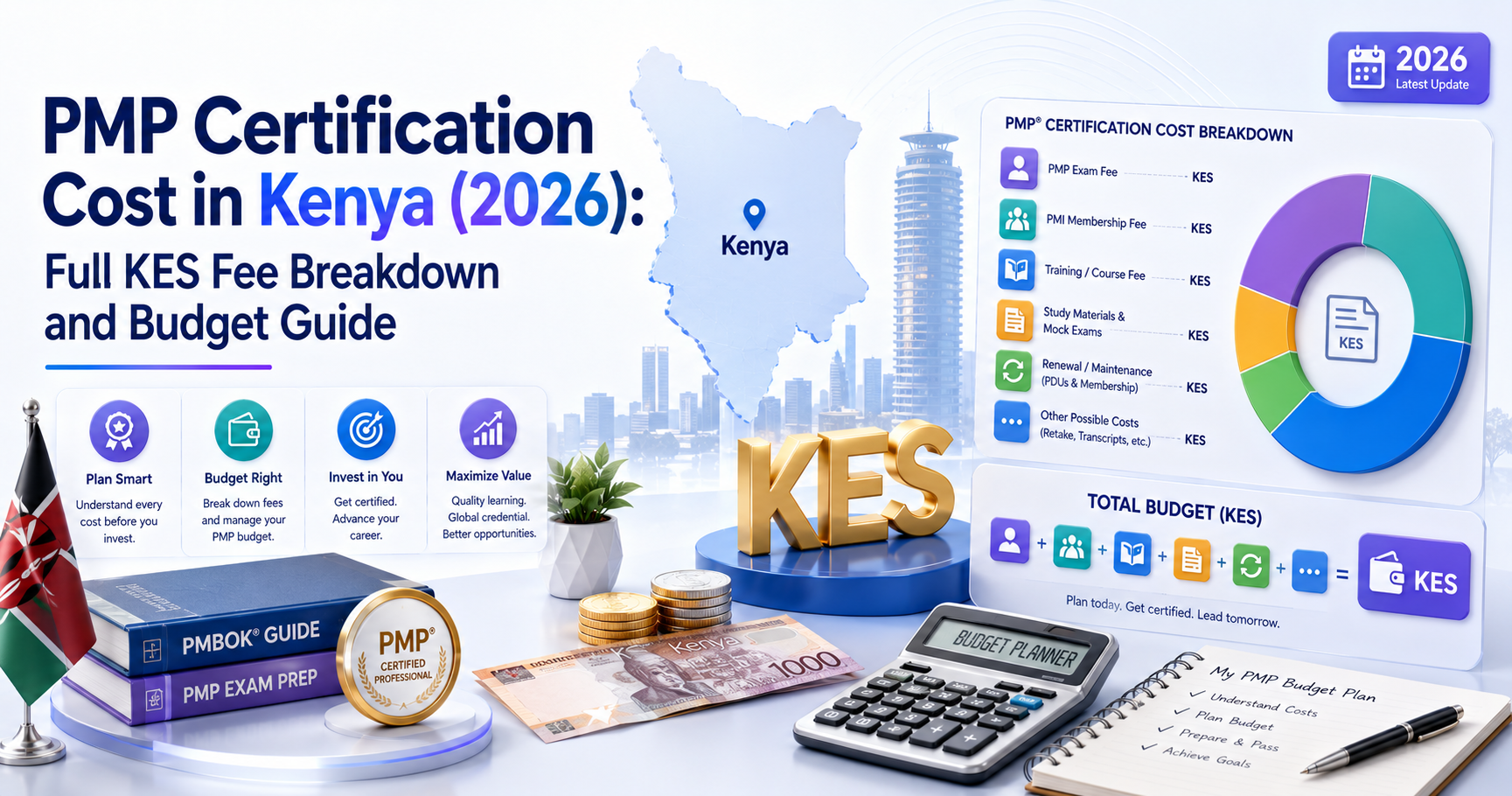
A PMP certification in Kenya typically costs between KES 95,000 and KES 160,000 all-in for most candidates who join PMI as a member, sit the exam once, and train with a local or regional provider, though the figure can climb past KES 300,000 if you choose a premium international in-person bootcamp or need a retake. The two fixed costs everyone pays are the PMI exam fee, roughly KES 55,000 for members and KES 88,000 for non-members at current exchange rates, and PMI membership itself, about KES 21,000 in year one. On top of that sits training, which ranges from under KES 15,000 for a bare-bones online course to well over KES 150,000 for a NITA-registered or internationally branded Nairobi classroom programme. Because PMI bills in US dollars and fees changed on 6 August 2026, every shilling figure in this guide is an approximate conversion that will move with the exchange rate.
Key Highlights of PMP Certification Cost in Kenya
- PMI's own exam fee is USD 425 for members and USD 675 for non-members following the fee revision PMI applied on 6 August 2026, which works out to roughly KES 55,000 and KES 88,000 at a rate of about 130 KES to the dollar.
- Local Nairobi and countrywide training providers commonly charge KES 30,000 to KES 80,000 for a NITA-registered live virtual or classroom course, while internationally branded providers charge from around USD 1,000 upwards, often KES 150,000 to KES 320,000.
- PMI membership costs about USD 164 in the first year (USD 154 plus a USD 10 application fee) and around USD 149 to renew, but it often pays for itself immediately because the member exam discount alone is worth more than the membership fee.
- A realistic total budget for a Kenyan candidate sits in three tiers: roughly KES 95,000 to 105,000 on the low end, KES 135,000 to 160,000 for a typical path, and KES 300,000 or more for a premium or retake-inclusive scenario.
- Not every provider advertising PMP training in Kenya is NITA registered or a genuine PMI Authorized Training Partner, so verifying accreditation before paying is essential to avoid wasted fees.
- Banks, telecoms, NGOs and construction firms in Kenya frequently sponsor PMP training for project leads and PMOs, which is worth raising with your employer before paying out of pocket.
- The PMP exam itself changed on 9 July 2026, with a new Examination Content Outline reweighting the three domains, which affects how you should prepare but does not directly change the fee structure.
How much is the PMI exam fee in Kenya, in USD and KES?
The PMP exam fee is set globally by the Project Management Institute in US dollars and paid directly to PMI regardless of where in Kenya you sit the test. According to multiple PMI-authorised training providers that track PMI's published fee schedule, PMI revised its pricing on 6 August 2026, raising the member fee from USD 405 to USD 425 and the non-member fee from USD 555 to USD 675.
Candidates who registered and paid before that date kept the older, lower price, which is one reason you will still see slightly different figures quoted across different training websites depending on when they last updated their page.
There is no separate "Kenya price" for the PMP exam; PMI does not offer country-specific discounting for Kenya the way it does for a small number of lower-income economies. What changes for a Kenyan candidate is simply the shilling equivalent, since your bank or card issuer converts the dollar charge at the prevailing rate on the day you pay. At an approximate September 2026 rate of around 130 KES to the US dollar, based on rates reported by currency trackers including Xe and Wise, the exam fee converts as shown below. Treat every KES figure in this table as an estimate that will shift with the exchange rate and with your card provider's own conversion margin.
| Fee type | PMI member (USD) | Approx. KES | Non-member (USD) | Approx. KES |
| First-attempt exam fee | 445 | 58,000 | 675 | 88,000 |
| Retake fee (second or third attempt) | 275 | 36,000 | 375 | 49,000 |
| Renewal / CCR fee (every 3-year cycle) | 60 | 8,000 | 150 | 19,500 |
Two things are worth budgeting for beyond the headline number. First, PMI allows only three exam attempts within a 12-month eligibility window before you must reapply from scratch, including a fresh application, so a candidate who is not adequately prepared can end up paying the retake fee on top of everything else. Second, if your PMP eligibility application is selected for PMI's random audit, there is no extra fee, but you will need to gather signed documentation from supervisors, which can add weeks to your timeline even though it adds nothing to the cost.
Do you actually need PMI membership, and what does it add to the bill?
PMI membership is optional, but for almost every Kenyan candidate it is worth the outlay because the exam-fee discount alone exceeds the membership cost. New members currently pay USD 154 plus a one-off USD 10 application fee, a first-year total of about USD 164, which converts to roughly KES 21,000. Renewal in subsequent years costs about USD 149, or close to KES 19,500. Compare that to the USD 250 gap between the member and non-member exam fee (USD 425 versus USD 675), and the arithmetic is straightforward: joining PMI before you register for the exam saves you money even before counting the other member benefits.
Beyond the exam discount, PMI membership includes a free digital copy of the PMBOK Guide and other standards, access to templates and toolkits, and member pricing on PMI's own PDU-earning webinars, all of which reduce what you would otherwise spend on study materials and later on renewal. For a Kenyan professional trying to keep the total certification cost down, joining PMI is one of the few decisions in this whole process that is both cheaper and more useful at the same time.
What do PMP training courses cost in Nairobi and the rest of Kenya?
Training cost in Kenya varies more than any other line item in this budget because it depends entirely on the format and the provider you choose, not on any fixed PMI rate. At the affordable end, Corporate Staffing Services, a Nairobi-based recruitment and training firm, advertises a NITA-accredited PMP exam course at around KES 30,000, with international candidates quoted roughly USD 272 and an option to split payment into two instalments.
The Kenya Institute of Project Management lists a PMP tuition fee of about KES 78,368, equivalent to roughly USD 496. At the other end of the market, Invensis Learning's Nairobi-focused PMP programme is priced at around KES 154,780, and internationally branded providers such as The Knowledge Academy quote in-person or premium instructor-led packages starting from about USD 2,495, which is well over KES 300,000 at current rates
Simpliaxis's own PMP certification training course follows PMI's Authorized Training Partner curriculum and is delivered live online, which is the format most Kenyan working professionals choose because it fits around a job without the travel cost of an in-person Nairobi classroom. Simpliaxis also runs a dedicated Kenya training hub for candidates who want locally scheduled batches and instructors familiar with the East African market rather than a generic global timetable.
The table below groups the market into the four formats a Kenyan candidate is likely to be comparing.
| Training format | Typical price range (USD) | Approx. KES | Notes |
| Online self-paced (recorded videos, no live instructor) | 30 to 800 | 4,000 to 104,000 | Widest price spread; confirm the 35 contact hours certificate is actually included |
| Live virtual, Kenya-based or regional provider | 230 to 600 | 30,000 to 80,000 | Most common choice for Kenyan professionals; check NITA registration |
| Live virtual, international brand | 1,000 to 2,000 | 130,000 to 260,000 | Often includes global cohorts and PMI ATP materials |
| In-person classroom, Nairobi or Mombasa | 1,000 to 2,500+ | 130,000 to 325,000+ | Highest cost; typically shortest, most intensive format |
Whichever format you pick, remember that training cost and exam cost are two separate invoices. Every training provider search result for Kenya makes the same point: the course fee covers materials, instruction and, in most cases, the 35 contact hours you need to apply for the exam, but it rarely includes the PMI exam fee itself, which you pay directly to PMI when you schedule your test.
What is the realistic total PMP certification budget in Kenya?
Pulling the exam fee, membership and training cost together gives three realistic scenarios rather than one single number, because the honest answer to "how much does PMP cost in Kenya" depends heavily on which training route you choose. Simpliaxis's global PMP certification cost breakdown frames the same three-tier logic for other markets, and the same structure holds for Kenya once you convert to shillings.
| Scenario | What it includes | Approx. total (KES) |
| Low budget | Cheap self-paced online course, PMI membership, member exam fee, no retake | 95,000 to 105,000 |
| Typical | Kenya-based NITA-registered live virtual course, PMI membership, member exam fee, study aids and mock exams | 135,000 to 160,000 |
| Premium or with a retake | International brand or in-person bootcamp, membership, member exam fee, one retake buffer | 300,000 to 350,000+ |
The single biggest lever you control in this budget is the training format, not the exam fee, since PMI's pricing is fixed regardless of who you are. A candidate who is disciplined about self-study and only needs a course to satisfy the 35 contact hours requirement can legitimately land in the low-budget tier, while someone who wants a classroom experience with an instructor, peer cohort and multiple mock exams will naturally sit in the typical or premium tier.
How do you know a Nairobi training provider is actually legitimate?
Checking accreditation before you pay is the single most important consumer-protection step in this entire process, because the PMP training market in Kenya includes everything from PMI Authorized Training Partners to informal operators whose certificates carry little weight. Two separate accreditation questions matter here, and they are not the same thing.
- NITA registration: this confirms the provider is a legitimate, registered training body under Kenya's National Industrial Training Authority, which matters for local recognition, employer reimbursement and, in some cases, NITA levy claims. You can ask any provider for their NITA registration number and cross-check it against NITA's published list of valid training providers, which the authority updates periodically on its own website.
- PMI Authorized Training Partner (ATP) status: this is a separate, PMI-specific accreditation that confirms the provider has exclusive access to PMI-developed course content and that its instructors completed PMI's own train-the-trainer programme. A provider can be NITA registered without being a PMI ATP, and vice versa, so check both if PMI-aligned content quality matters to you.
- Cross-reference reviews and outcomes: ask how many candidates the provider has actually put through the exam and, ideally, speak to a recent graduate rather than relying only on testimonials on the provider's own site.
Simpliaxis has published a dedicatedcomparison of PMP training providers that walks through exactly these accreditation checks in more depth, which is a useful second reference before you commit funds to any single provider operating in the Kenyan market.
Can your employer pay for PMP certification in Kenya?
Employer sponsorship is common enough in Kenya's project management market that it is worth raising before you commit your own money. Banks and telecoms racing to digitise their operations need certified project leads to run agile and hybrid delivery programmes, Nairobi's large NGO and donor sector needs managers who can report milestones and prove value to funders, and construction and energy firms increasingly list PMP as a preferred qualification for site and programme managers. All four sectors have existing training budgets that a PMO manager or L&D lead can allocate to a certification cohort rather than a single individual.
If you are the one requesting sponsorship, the business case is straightforward: cite the exam fee and training cost figures in this guide, note that PMP is recognised by PMI globally rather than tied to one country's qualifications framework, and point to the salary uplift that certified project managers in Kenya typically command over uncertified peers. If you are the one approving the budget, a PMO or L&D manager at a Kenyan bank, telecom or NGO sponsoring several project leads at once will usually get a better per-head rate than paying individually, and Simpliaxis's corporate and group training programme is built around exactly this scenario, with bulk enrolment pricing for organisations certifying a cohort rather than one person at a time.
Where do you actually sit the PMP exam in Kenya?
PMI delivers the PMP exam exclusively through Pearson VUE, and Kenyan candidates have two options: an in-person test centre or online proctoring from home. Pearson VUE opened a dedicated Pearson Professional Center in Nairobi's Westlands area, built to handle a minimum of 3,000 candidates a year across all the professional and licensure exams it delivers, not PMP alone. Several other Pearson VUE authorised centres also operate in Nairobi, including providers based on Kenyatta Avenue and Muindi Mbingu Street in the city centre. Not every Pearson VUE location delivers every PMI exam, so the safest step is to check live seat availability directly through Pearson VUE's own PMI exam locator rather than assuming any nearby centre offers PMP specifically.
The alternative is PMI's online proctored exam, taken from a private room on your own computer with a live remote proctor watching via webcam. This option removes any travel cost to a Nairobi test centre, which matters if you live outside the capital, but it comes with its own strict requirements around room setup, a stable internet connection and total privacy for the full four-hour exam window, so factor in a trial run of your equipment before exam day regardless of which option you choose.
What changed in the 2026 PMP exam, and does it affect the cost?
PMI rolled out a new Examination Content Outline (ECO) globally on 9 July 2026, alongside content aligned to an eighth edition of its PMBOK guidance. The headline change is a significant reweighting of the three exam domains: Business Environment rose from around 8 per cent of the exam to 26 per cent, People dropped from about 42 per cent to 33 per cent, and Process dropped from around 50 per cent to 41 per cent. PMI also consolidated the previous 35 exam tasks down to 26, largely by grouping related tasks together, and added new focus areas around artificial intelligence, sustainability and value delivery.
None of this changes the exam fee directly, and the fee increase that took effect on 6 August 2026 was announced separately from the content update, though the two arriving within a month of each other have understandably caused some confusion among candidates comparing older and newer cost guides. The practical cost implication for a Kenyan candidate is indirect: if your study materials or a training provider's course content still reflect the old domain weightings, you may need to supplement with updated materials or a refreshed course, which is an argument for confirming with any provider that their syllabus has been updated to the 2026 ECO before you pay for training.
How do you keep PMP renewal costs low after you certify?
PMP certification is not a one-off achievement; it must be renewed every three years by earning 60 Professional Development Units (PDUs) and paying the CCR renewal fee, which is about USD 60 for PMI members and USD 150 for non-members, roughly KES 8,000 and KES 19,500 respectively. The good news for cost-conscious Kenyan professionals is that a large share of PDUs can be earned free through PMI's own webinars, volunteering with a local PMI chapter, or structured on-the-job project work, so the renewal cycle need not become a recurring training expense if you plan ahead rather than scrambling for paid PDU courses in the final month of your cycle. Simpliaxis's guide to PMP PDU requirements sets out exactly which activity categories count and how many PDUs each one earns, which is worth bookmarking well before your three-year cycle ends rather than after.
Conclusion
For a Kenyan professional close to enrolling, the honest total is not a single figure but a band shaped by one decision more than any other: which training format you choose. The PMI exam fee itself is fixed and identical for every Kenyan candidate, roughly KES 55,000 for members and KES 88,000 for non-members after the August 2026 fee revision, and PMI membership at around KES 21,000 is close to a free decision given the exam discount it unlocks.
Training is where the real budgeting choice sits, from a NITA-registered Nairobi live virtual course at KES 30,000 to 80,000 through to an international in-person bootcamp well past KES 300,000, and neither extreme is automatically the right answer for every candidate. What does matter, regardless of budget tier, is verifying NITA registration and, where relevant, genuine PMI Authorized Training Partner status before paying anyone; checking whether your employer already has a training budget that could cover some or all of the cost; and building in a realistic study timeline against the reweighted 2026 exam content so that the retake fee never becomes a line item in your budget at all.







 Lowest-Price Challenge











 Personalized Path


.webp)


 USA
USA  Canada
  India
India  UK
UK  Australia
  Singapore


