


 Call Us



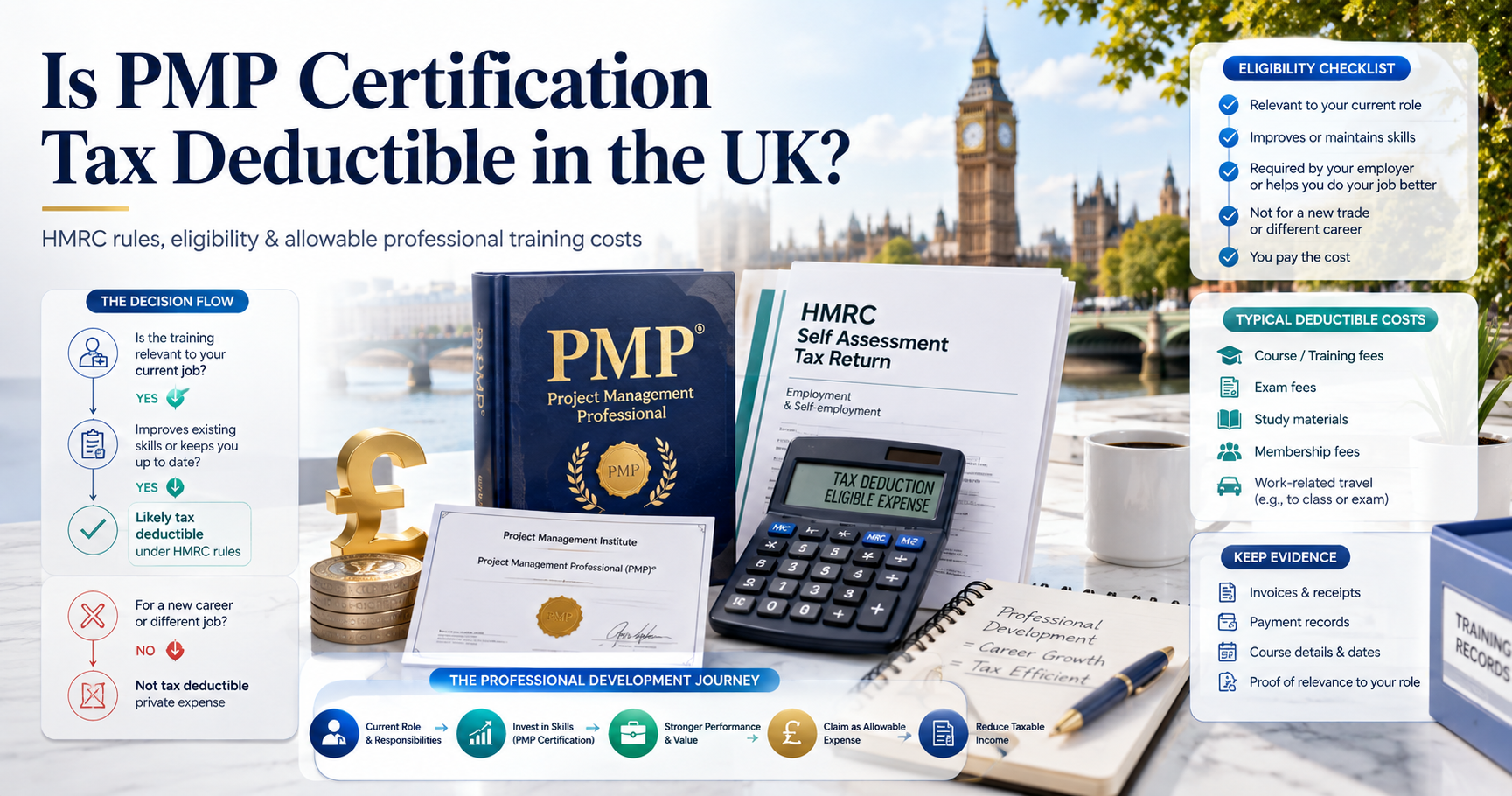
In most cases, yes, but it depends entirely on who is paying and what your current work already involves. If your employer pays for your PMP training directly, it is normally a tax-free benefit under HMRC's work-related training exemption. If you are self-employed and already working in project management, HMRC's own guidance, clarified in March 2024 and reported by the ICAEW, generally allows the cost as a deduction against your trading profit because it updates an existing skill rather than creating a new trade.
Employees who fund the training themselves have a much narrower route to relief, and limited company contractors sit in a position that is usually favourable but not free of genuine debate among accountants. There is no single yes-or-no answer that applies to everyone, which is exactly why the distinction below matters.
Key Highlights: Is PMP Certification Tax Deductible in the UK?
- Self-employed project managers can generally deduct PMP training costs against trading profit when the training updates skills within their existing trade, per HMRC's Business Income Manual and the March 2024 clarification covered by the ICAEW.
- The critical HMRC test for the self-employed is not cost or relevance in a general sense, it is whether the training is "wholly and exclusively" for the existing trade rather than a route into a new one.
- Employer-paid PMP training is normally exempt from tax and National Insurance for employees under the work-related training rules in section 250 ITEPA 2003, as set out on gov.uk.
- Employees who pay for their own PMP training out of pocket face a narrow, four-condition test under HMRC's EIM32535 guidance, and most self-funded professional development does not meet it.
- A P87 or self-assessment claim is only the correct route once those conditions are actually satisfied, not simply because the training relates to your job.
- Limited company contractors can usually treat PMP training as an allowable company expense against corporation tax, but the "new trade or new qualification" question that trips up sole traders has not been definitively settled for personal service companies either, so this remains an area of genuine professional disagreement.
- An employer funding PMP training for several staff through one arrangement is often a cleaner tax and administrative position than each employee separately trying to claim relief on self-funded training after the fact.
Why HMRC's "Wholly and Exclusively" Rule Is the Starting Point for Everyone Except Employees
Every UK tax question about training cost deductibility for the self-employed and for limited companies comes back to one statutory test: was the expenditure incurred wholly and exclusively for the purposes of the trade. This phrase, and the case law and HMRC manuals built around it, decide whether a PMP course, exam fee, or renewal cost reduces your taxable profit or not. HMRC's Business Income Manual at BIM42526 confirms that training costs are treated as revenue expenditure, and are therefore deductible, where the intention is to update current skills or knowledge, or to provide new skills or knowledge, within the trade the person is already carrying on. The manual is explicit that this includes training to keep pace with changes in technology and practice in the person's existing business area.
The dividing line HMRC draws is not between "useful" and "not useful" training, and it is not about whether the certification is well known or expensive. It is between training that deepens what you already do for a living and training that equips you to do something genuinely different. A qualified accountant who takes a project management course to run their own client engagements better is updating an existing skill.
Someone with no project management background who trains as a project manager in order to leave their current trade altogether is, in HMRC's terms, acquiring a new trade, and the cost of that transition is generally treated as capital expenditure rather than a deductible trading expense. This distinction runs through every category discussed below, and it is why a generic answer to "is PMP tax deductible in the UK" is not possible without first asking what the person already does.
Are PMP Training Costs Tax Deductible for Self-Employed and Sole Trader Project Managers?
For most sole traders who are already working as project managers, project coordinators, or in a role where project delivery is a core part of the trade, PMP training costs are generally deductible against trading profit, because the course updates existing project management competence rather than creating a new one. This follows directly from HMRC's clarified guidance and is the single most useful fact for a self-employed project manager weighing up the cost of the PMP certification training route.
What the March 2024 HMRC Clarification Actually Changed
In March 2024, HMRC updated its Business Income Manual guidance on training costs for the self-employed, and the ICAEW summarised the change for its members in an article titled "HMRC clarifies tax treatment of sole traders' training costs". Before this update, HMRC's informal position had been read by many advisers as more restrictive, treating some training that added new skills as inherently capital in nature.
The clarified guidance confirmed that training which provides new skills or knowledge within the person's existing business area is revenue expenditure, and therefore deductible, in the same way that training which merely updates existing skills is. The ICAEW noted this represented a genuine widening of what HMRC would accept, moving the practical test away from "is this skill new to me" and firmly onto "is this skill within the trade I already carry on."
What did not change is the other side of the line. HMRC's guidance, and the case of Dass v Special Commissioner, both support the position that training undertaken to enter a completely different trade or specialism, one unrelated to the existing business, remains capital expenditure and is not deductible. For a PMP candidate, this means the deciding question is not "does this course teach me something new" but "am I already operating in a trade where project management is a recognised part of the work."
Where PMP Training Sits on the Existing Skill vs New Trade Line
Applied to PMP specifically, three broad situations tend to come up:
- A self-employed project manager, programme consultant, or freelance delivery lead who takes the PMP to formalise skills they already use day to day is very likely on the "updating an existing trade" side of the line, and the training cost, exam fee, and study materials should generally be deductible.
- A self-employed consultant in an adjacent field, such as a business analyst, IT contractor, or operations consultant, whose work already includes running or coordinating projects, has a reasonable case that PMP training updates and extends an existing part of their trade, though the strength of that case depends on how central project delivery already is to their invoiced work.
- Someone with no project management background in their existing trade, for example a self-employed graphic designer or tradesperson, who takes the PMP specifically to pivot into project management as a new line of work, is in the territory HMRC treats as a new trade, where the cost is generally not an allowable deduction against the old trade's profits.
None of this is unique to PMP as a brand of certification. HMRC does not rule on individual qualifications by name, so the same reasoning would apply to a PRINCE2 course or an APM qualification. What matters is the applicant's existing trade, documented through their invoices, client contracts, and self-assessment history, not the reputation of the credential. Anyone weighing this up alongside the wider PMP certification cost in the UK should keep records that show what their trade already involved before enrolling, since that evidence is what would support a deduction if HMRC ever queried it.
Other Costs Sole Traders Sometimes Overlook
Where the training cost itself is deductible, related costs generally follow the same treatment. This can include PMI membership fees for the year the exam is taken, the cost of PDUs required to maintain the credential, travel to an in-person course or exam centre, and study materials, provided each cost is itself wholly and exclusively for the trade. Renewal costs for an existing, already-held PMP credential sit more comfortably on the "updating an existing skill" side of the line than the original qualification did, since by definition the person is already practising in the trade the credential supports.
How Does HMRC Treat Employer-Paid vs Self-Funded PMP Training for Employees?
For an employed project manager, the tax treatment depends almost entirely on who actually pays. Training that the employer pays for directly, or reimburses, is normally exempt from Income Tax and National Insurance as a work-related training benefit. Training the employee funds themselves and is never reimbursed is a different matter, and only qualifies for personal tax relief in a narrow set of circumstances.
Employer-Paid PMP Training as a Tax-Free Benefit
Gov.uk's overview page on expenses and benefits for training payments confirms that employers do not need to report or pay tax and National Insurance on training costs for an employee, provided the training is work-related. HMRC's underlying manual describes this exemption, set out in section 250 of the Income Tax (Earnings and Pensions) Act 2003, as covering course fees, related books, and reasonable travel and subsistence, as long as the training is intended to improve skills or knowledge that are, or will be, used in the employee's current job, and is not disguised reward.
A PMP course paid for directly by an employer, or booked and invoiced to the company, will normally fall squarely within this exemption for a project manager, programme officer, or anyone whose role involves running or supporting projects, because the qualification is directly relevant to the duties already being performed.
This is also the point at which the cost calculation looks most different depending on how many people are being trained. An employer sending one project manager on a course faces a single, fairly small administrative step. An employer wanting to build project management capability across a wider team, however, is usually better served by arranging that training as a single funded programme rather than leaving each employee to seek personal tax relief afterwards, since employer-funded training keeps the whole cost outside each individual's tax return and avoids the narrower self-funded relief rules described below.
Simpliaxis's corporate and group training option is built for exactly this scenario, letting an employer fund PMP or related project management training for multiple staff under one arrangement rather than several separate personal claims.
Claiming Tax Relief on Self-Funded PMP Training
Where an employee pays for their own PMP training and it is genuinely not reimbursed, HMRC's Employment Income Manual at EIM32535 sets out a narrow test for when tax relief is available, built around whether the training is an intrinsic, contractual part of the employee's current duties. In practice, HMRC requires all of the following to be true before self-funded training qualifies for relief:
- Contractual necessity: the training must be an intrinsic part of the employee's contractual duties, not simply useful or encouraged by the employer.
- Mandatory external requirement: the employer must genuinely require the external training as part of the role, not merely permit or support it.
- Integration with the role: the employee's other day-to-day duties must effectively form the practical counterpart to the external, theoretical training.
- Consequence of not completing it: failing to finish the training and gain the qualification must mean the employee cannot continue in that specific role.
Most employees taking a PMP course voluntarily, even where it clearly helps their career, will not meet all four conditions, because the qualification is rarely a strict contractual requirement to continue in post. Where an employee genuinely believes their situation meets this bar, claims under £2,500 can currently be made online, by post using form P87, or by phone, while larger claims, or those already required to file a return, go through self-assessment. HMRC's own guidance on tax relief for employment expenses sets out this process, which changed in October 2024 to require supporting evidence to be submitted alongside a P87 claim rather than afterwards. Given how narrow this route is, most employed project managers will find that asking their employer to fund or reimburse the training directly, rather than paying personally and attempting a claim later, is the more reliable path to a tax-efficient outcome.
Can a Limited Company Contractor Claim PMP Training as a Business Expense?
A limited company contractor operating their own personal service company can usually have the company pay for PMP training and claim it as an allowable expense against corporation tax, provided the same wholly and exclusively test applies to the company's trade rather than to the individual director personally. This tends to work in the contractor's favour more often than the equivalent sole trader position, but it is not a settled area, and different accountants read the "new qualification" question differently.
Why the Position Is Usually Favourable, But Not Guaranteed
Where a limited company's stated business is providing project management, programme delivery, or IT consultancy services, and the director already delivers that kind of work through the company, PMP training clearly relates to a trade the company is already carrying on, which supports treating the cost as a normal allowable business expense rather than a benefit in kind on the director personally.
Several UK contractor accountancy commentators note that limited companies have historically had somewhat more flexibility than sole traders here, partly because a company can more easily argue that training which helps it deliver its existing contracted services, even where it introduces a formal qualification the director did not previously hold, is revenue expenditure rather than the acquisition of a new personal trade. That said, HMRC has not issued company-specific guidance as detailed as the March 2024 clarification aimed at sole traders, and the underlying "does this create a new qualification or trade" question has not been fully resolved for personal service companies either, which is why this area still carries genuine uncertainty rather than a clean rule.
Contractors working inside IR35 face an additional constraint regardless of how the training question is resolved, since the deemed employment calculation restricts what the intermediary can deduct before tax, so the practical benefit of an allowable training expense is smaller than for a contractor operating outside IR35. Anyone assessing eligibility and cost before committing to a course, including the exam eligibility and experience hours set out on Simpliaxis's PMP certification prerequisites page, should factor in their IR35 status alongside the training cost itself, since it changes the real, after-tax cost of the qualification.
Employed, Self-Employed or Limited Company: How the Tax Treatment Compares
The table below summarises how the same PMP training cost is typically treated depending on who is paying and under what structure, based on the HMRC sources cited throughout this article.
Status | Typical Funding Route | Tax Treatment | Mechanism | Key Condition to Satisfy |
| Employed, employer pays | Employer pays the provider directly or reimburses the employee | Generally tax-free to the employee | Work-related training exemption, section 250 ITEPA 2003 | Training must be genuinely work-related, not a reward |
| Employed, self-funded | Employee pays personally, no reimbursement | Relief only in narrow cases | P87 or self-assessment claim under EIM32535 | Training must be a strict contractual requirement of the current role |
| Self-employed sole trader | Trader pays from business funds | Generally deductible if within existing trade | Deduction against trading profit | Wholly and exclusively for the existing trade, not a new one |
| Limited company contractor | Company pays as a business cost | Usually an allowable company expense | Deduction against corporation tax | Wholly and exclusively for the company's existing trade; some interpretive uncertainty remains |
Do Renewal Fees, PMI Membership and Resit Costs Follow the Same Rules?
Ongoing PMP-related costs, such as PMI membership renewal, the PDUs needed to maintain the credential, and exam resit fees, generally follow the same status-based rules as the original training cost rather than a separate set of rules of their own. For an employer, renewal costs paid on an employee's behalf typically fall within the same work-related training exemption as the original course, since maintaining a credential the employee already uses in their job is squarely work-related.
For a self-employed project manager, renewal and continuing education costs on an already-held credential arguably sit even more comfortably within the "updating an existing skill" side of HMRC's test than the original qualification did, precisely because the person is by then unambiguously operating in the trade the credential supports.
Resit fees for a failed exam attempt are treated as part of the same expenditure as the original attempt for tax purposes, so if the original course and exam fee would have been deductible or exempt, a resit fee incurred for the same purpose should generally follow suit. Where a candidate is comparing overall cost across providers before committing, resources such as Simpliaxis's PMP certification guide can help separate the course fee, the PMI exam fee, and membership costs, which is useful groundwork before working out which of these elements would actually qualify under whichever category above applies.
A Practical Way to Work Out Which Category Applies to You
Before assuming PMP training is or is not deductible, it helps to work through a short sequence of questions, since the answer changes at each branch.
- Who is paying: if an employer is paying the invoice or reimbursing the cost, start with the employer-paid benefit-in-kind exemption, not the self-funded relief route.
- What is your current trade or role: if you are self-employed or run a limited company, identify honestly whether project management is already part of the trade you invoice for, since this decides which side of HMRC's existing-skill line you fall on.
- Is the training updating or creating: ask whether the PMP formalises work you already do, or whether it is the mechanism by which you plan to start doing a different kind of work altogether.
- If self-funded and employed, check the four EIM32535 conditions: only pursue a P87 or self-assessment claim if the training is genuinely a contractual, mandatory requirement of your current role, not simply beneficial to it.
- Keep the paper trail: invoices, the training provider's confirmation of course content, and evidence of your existing trade or job description are what would support any of the above positions if HMRC asked questions later.
Because the wholly and exclusively test and the EIM32535 conditions are both applied to individual facts rather than to a named qualification, the honest answer for many readers will fall somewhere between a clear yes and a clear no. That is the point at which speaking to an accountant who can look at your specific trade, contract, or company structure is worth the modest cost, particularly for limited company contractors sitting in the genuinely uncertain territory described above.
Conclusion
The tax deductibility of PMP certification in the UK is not a single fact but a function of structure. Employer-paid training for employees is the cleanest position of all, sitting outside tax almost entirely under the work-related training exemption, which is exactly why employers who want several staff trained together tend to get more value, and less administrative friction, from funding the training directly rather than leaving each person to chase personal relief afterwards. Self-employed project managers who are already working in the field have a genuinely stronger claim than HMRC's older, more restrictive reputation suggested, following the March 2024 clarification the ICAEW reported on, but that claim depends on the training updating an existing trade rather than opening a new one.
Limited company contractors usually sit in a workable position too, though the same "new qualification" question that HMRC has now clarified for sole traders has not been settled with the same precision for personal service companies, which is a fair reason for caution rather than alarm. Employees funding their own training face the narrowest route of all, and for most, asking an employer to fund the course directly will do more for the after-tax cost than any subsequent claim would. None of this changes what PMP training is worth to a career, only how much of its cost the tax system will absorb, and that answer depends on facts specific to the reader, which is worth confirming with an accountant against HMRC's own guidance before assuming either a deduction or a refusal.









 Lowest-Price Challenge











 Personalized Path


.webp)


 USA
USA  Canada
  India
India  UK
UK  Australia
  Singapore


