


 Call Us



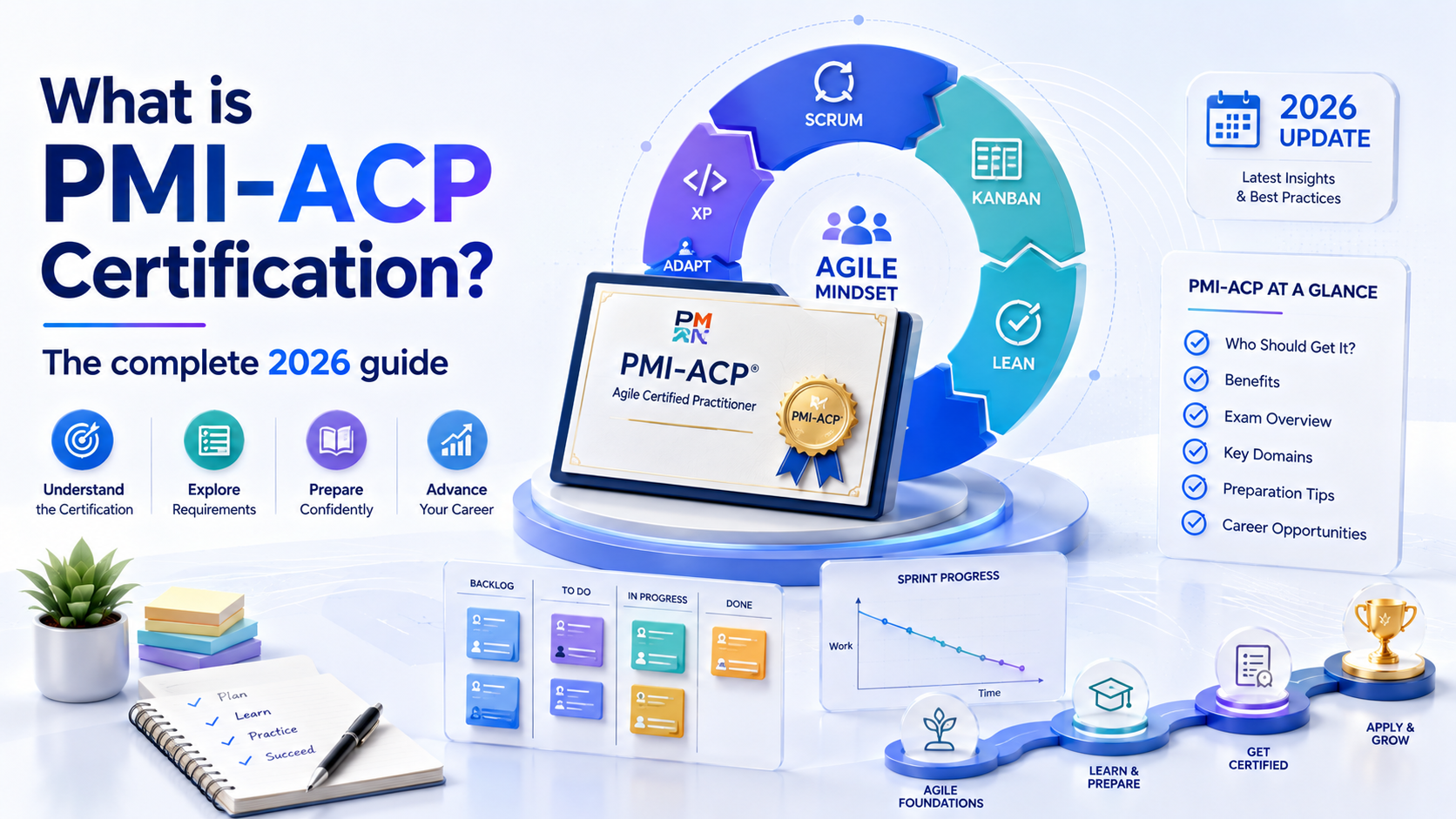
If you are on an agile team, you have surely come across PMI-ACP certification and have evaluated your interest. Is PMI-ACP certification worth it?
Agile Certified Practitioner is a professional development certification offered by the Project Management Institute for professionals adopting agile methodologies. It is distinct from a qualification with a specific focus on Scrum in that it addresses a range of agile approaches, including Scrum, Kanban, and Lean.
The PMI-ACP certification is an excellent choice for people who want to pursue a career in agile or for professionals who want to enhance their skills. It can be useful for people who want to transition into Agile project management, Scrum, product delivery or hybrid project roles, if it fits with their current experience.
Key Highlights: What is the PMI-ACP Certification?
- PMI-ACP certification covers a number of methodologies like Scrum, Kanban, Lean, etc.
- You need to have relevant experience with Agile, a secondary degree or equivalent, and 21 hours of Agile training.
- PMI also offers alternative eligibility criteria for those who have a degree accredited by a GAC, another Agile certification, or are currently holding a PMP certification.
- PMI-ACP certification exam consists of 120 multiple-choice questions and has a time limit of three hours.
- The exam mainly includes four areas: Mindset, Leadership, Product, and Delivery.
- The PMI currently charges $435 for members and $495 for non-members for the exam. However, the final amount that has to be paid in India may be affected by regional pricing and taxes.
- To keep their PMI-ACP certification, holders must earn 30 PDUs over each three-year certification cycle.
- The PMI-ACP qualification is appropriate for Scrum Masters, project managers, delivery managers, product professionals, and other experienced Agile practitioners.
- PMI-ACP is generally more suitable for experienced Agile professionals than for those who have no Agile experience.
Introduction
Agile project delivery has changed how organizations plan and carry out their work.
Teams do not always create a detailed plan at the initial stage and work accordingly to achieve the goals. Now, they deliver half the work, collect feedback, and make the necessary changes as per the requirements.
This approach is now implemented in various organizations such as banking, consulting, healthcare, telecommunications, manufacturing, and digital transformation industries.
With the growth of Agile work, there has been an increasing demand for professionals who know how to manage it.
That's when the PMI-ACP becomes relevant.
The PMI-ACP certification provides experienced practitioners with a means of showing their understanding of Agile principles and practices and includes a wider perspective than one that is based on a single framework.
Yet the PMI-ACP is not the appropriate choice in every case for a project professional. A person who is completely focused on Scrum might prefer the CSM. A project manager who is looking for a general project leadership qualification might prefer the PMP.
The more important question isn’t whether the PMI-ACP is a good certification course. Instead, you should think about whether it aligns with your profession and career goals.
What does PMI-ACP certification mean? What is its Full-Form, Meaning and Overview?
PMI-ACP stands for PMI Agile Certified Practitioner. This globally recognized credential is offered by the Project Management Institute (PMI). It is ideal for the professional looking to enhance their skills and knowledge.
This credential showcases a number of different approaches rather than just focusing on a single framework. The exam content covers agile mindsets, leadership, and product delivery.
That distinction matters.
While Scrum certification places a strong emphasis on Scrum, the PMI-ACP adopts a broader perspective by examining how agile practitioners think, lead teams, generate value, and support delivery in various agile environments.
In simple terms, the PMI-ACP is meant to demonstrate that you are able to apply agile thinking to actual project and product scenarios.
It can be relevant to:
- Agile project managers
- Scrum Masters
- Product Owners
- Delivery managers
- Agile coaches
- Product managers
- Technical leads
- Project managers working in hybrid environments
- Professionals involved in digital transformation
This certification course can also be combined with PMP. The PMP certification course generally covers project management skills, while PMI-ACP covers the core knowledge and skills of agile.
What does the PMI-ACP certification validate?
The current PMI-ACP exam is built around four domains:
| Domain | Weight |
| Mindset | 28% |
| Leadership | 25% |
| Product | 19% |
| Delivery | 28% |
These domain weights come from PMI’s official PMI-ACP Examination Content Outline. These comprehensive covered areas show the knowledge expected from an agile practitioner. This approach understands the way teams work in an adaptive environment as well as involves various concepts such as learning, experimentation, and responding to changes.
The leadership approach mainly focuses on promoting collaboration, building teams, managing conflict, and creating effective environments in which teams can carry out their duties. It covers issues related to value, such as consideration of stakeholders, focus on product vision, and prioritization.
Delivery centers on planning, giving feedback, maintaining a smooth flow, ensuring quality, and achieving outcomes.
These credentials not only provide knowledge of Scrum terminology but also an understanding of why an agile practice might work in one situation and not in others.
What Agile Frameworks Does PMI-ACP Cover?
A major benefit of PMI-ACP is the wide agile perspective it offers.
The certification does not cover just Scrum. It covers the core understanding of PMI's list of Scrum, Lean, and Kanban as agile approaches relevant to the PMI-ACP.
That is important since organizations almost never function in precisely the same manner.
A software development team can apply Scrum, a support team can use Kanban to manage the work that comes in, and a process improvement initiative can make use of Lean principles.
A large organization might even integrate agile and traditional methods within the same program.
The PMI-ACP equips professionals with the ability to understand such an environment.
Scrum
To support product development, Scrum uses well-defined roles, events, and artifacts, and teams generally work in short iterations while regularly checking their progress.
Kanban
Kanban is about visualizing work and improving flow. Teams usually introduce work-in-progress limits to reduce obstruction and make delivery more effective and uniform.
Lean
Lean thinking is defined as providing value at the same time reducing waste. It helps teams to look at the way work progresses through a system and to identify areas where improvements can be made.
The main takeaway is simple enough: Agile isn't a single framework.
To be a good practitioner, one must understand the principles that underlie various approaches and also know when to adapt them.
One of the reasons that PMI-ACP is attractive to professionals who work with a number of teams or organizations is its framework-neutral perspective.
PMI-ACP Certification Eligibility and Requirements
Before you book your exam, make sure that you satisfy the current PMI-ACP certification eligibility requirements.
- PMI currently requires candidates to have:
- A degree at the second level or higher, or one that is equivalent.
- Agile training lasting 21 hours in a formal format.
- Gaining agile experience via one of the pathways accepted by PMI.
- The experience requirement matters.
PMI-ACP is not just a course completion certificate. It showcases your expertise, knowledge, and skills to work effectively.
What Are the PMI-ACP Eligibility Requirements?
There are currently several methods by which candidates can qualify.
The primary route demands that people have had two years' experience in agile roles over the previous five years.
There are also other routes, and a candidate may meet the requirements by:
- A degree accredited by the GAC together with one year's experience in agile.
- A third-party agile certification that qualifies and one year's experience in agile.
- A current PMP certification.
Also, candidates require 21 hours of formal agile training.
It is therefore important to check your background before you pay for exam preparation.
For example, finishing a 21-hour training course does not automatically mean you meet the experience requirement.
You should also keep accurate records of your agile work since PMI may choose to audit certain applications, and therefore your application must give a correct description of your professional experience.
Does CSM or Another Agile Certification Count Toward PMI-ACP Experience?
A PMI eligibility pathway may include a third-party agile certification.
But there is one important condition.
The certificate should be accompanied by one year of practical agile experience obtained through the relevant pathway; merely possessing another agile certificate does not count as satisfying the requirement for experience.
Well, if you already have CSM, then this might assist you with regard to your eligibility for the PMI-ACP. However, you should still verify your experience and training against PMI's current rules.
PMI-ACP Exam Format, Questions, Domains and Duration
The PMI-ACP certification exam helps to check your knowledge and understanding of Agile. Candidates are allocated a time duration to complete the exam. The questions mainly consist of multiple-choice questions. The PMI administers the test through Pearson VUE testing centers and also provides a secure online option.
Here is the following table:
Exam Factor | PMI-ACP |
Number of Questions | 120 |
Question Type | Multiple Choice |
Exam Duration | 180 Minutes |
Break | One 10-minute break |
Mindset | 28% |
Leadership | 25% |
Product | 19% |
Delivery | 28% |
Test Options | Online or Test Center |
The questions help show how you handle agile situations.
- It follows that simply memorizing definitions will not be sufficient.
- For example, you may need to decide how an agile leader should respond when:
- A stakeholder alters their priorities while delivery is underway.
- There is a constant source of conflict within the team.
- Work is currently halted at the stage of delivery.
- The product backlog has among its entries too many competing priorities.
- The group is having difficulty in adjusting to the feedback.
The optimal form of preparation involves combining knowledge with practice based on different scenarios.
The first step is to understand the PMI-ACP certification syllabus, after which you should use practice questions to check if you can apply those ideas.
You have the option of looking at the detailed PMI-ACP exam format prior to booking your exam.
PMI-ACP Certification Cost in India 2026
The amount one has to pay to obtain the PMI-ACP certification varies according to a number of factors.
The budget could cover the fee for the PMI examination, membership, training, study materials, and the possible cost of a retake.
PMI currently publishes the following examination fees:
- PMI member: US$435
- Non-member: US$495
These figures should be treated as the published exam pricing rather than a fixed Indian rupee total. Regional pricing, taxes, and currency conversion can affect what an Indian candidate actually pays. Training is a separate expense.
The training provides flexible learning options with weekend and weekday batches. Before enrolling, gain detailed information about PMI-ACP certification costs and other benefits.
How Much Does PMI-ACP Cost With and Without PMI Membership?
You do not need PMI membership to take the PMI-ACP exam.
Membership can still be useful because PMI members receive discounts on certification fees and access to other PMI resources.
The basic comparison is:
Factor | PMI Member | Non-Member |
| PMI-ACP exam fee | US$435 | US$495 |
| PMI Membership Required | Yes, if choosing member pricing | No |
| Certification Discounts | Yes | No |
| Access to PMI member benefits | Yes | No |
The right choice depends on how much you plan to use PMI membership.
If you only want the exam and do not expect to use PMI's other resources, compare the total cost before joining.
If you plan to use PMI learning resources, networking opportunities, and future certification discounts, membership may provide more value.
Who Should Take PMI-ACP Certification?
PMI-ACP is aimed at professionals who already understand agile work and want to strengthen their credentials.
It can be a good fit for:
- Scrum Masters
- Agile project managers
- Project managers moving into agile delivery
- Product Owners
- Product managers
- Delivery managers
- Agile coaches
- Technical leads
- Transformation professionals
It is really helpful when your work involves more than one agile approach. For example, you are working with a Scrum team now and a Kanban team next. This framework helps more in this situation than a credential focusing on one approach.
Is PMI-ACP Certification Right for Scrum Masters, Project Managers and Agile Practitioners?
For Scrum Masters: PMI-ACP can provide added value to the Scrum know-how by offering a number of additional concepts beyond the Scrum framework, as well as contributing to the overall understanding of the larger agile environment.
For Project Managers: PMI-ACP can catalyze the transition from the predictive project management approach to either agile or hybrid delivery.
For Product Professionals: The product domain offers valuable insight into the concepts of value, prioritization, and stakeholder engagement.
For Agile Practitioners: PMI-ACP can offer a means of showcasing knowledge of diverse agile approaches.
The certificate is further enhanced when one’s work environment is characterized by dynamic priorities, cross-functional teams, and iterative development. Additionally, one can discover various benefits of the PMI-ACP certification course if interested in learning how the credential fits into the larger project-management career.
Who Should Not Choose PMI-ACP?
PMI-ACP may not be your best first choice if you:
- Have no agile work experience.
- Want a beginner-level certification.
- Only need Scrum-specific knowledge.
- Work in an organization where a specific SAFe certification is strongly preferred.
- Want a broad project management credential rather than an agile credential.
A fresher must gain experience first. Similarly, someone who is looking for specialization in Scrum may find CSM more directly aligned with their goal.
Is PMI-ACP Certification Worth It in India?
So, is PMI-ACP worth it? For many experienced agile professionals, it can be.
The certification is most valuable when it supports an existing career path. It can also help make your profile stronger if you are already working in agile delivery and want to step into a more senior or specialized role.
The credential could be especially relevant for Indian professionals working in IT services, software development, consulting, banking and digital transformation, as agile delivery is common in those industries.
However, a certification does not guarantee a promotion or raise.
Your experience still counts. Your technical knowledge, communication skills, leadership ability and industry background should be the same way.
Same goes for PMI-ACP salary numbers. Reported salaries can vary widely based on experience, location, employer, and job title.
A PMI-ACP credential may improve your profile, but it should not be viewed as a fixed salary guarantee.
The strongest case for PMI-ACP is usually one of these:
- You already work on agile projects.
- You want to move into an agile project management role.
- You want broader knowledge beyond Scrum.
- Your organization is adopting hybrid or agile delivery.
- You want a PMI credential that complements your project management experience.
- You work across different teams and delivery models.
PMI-ACP vs CSM vs PMP: Which Certification Is Better?
There is no universal winner between PMI-ACP, CSM, and PMP.
Each certification has a different purpose.
Factor | PMI-ACP | CSM | PMP |
Primary focus | Agile practices across multiple approaches | Scrum | Project management |
Framework coverage | Scrum, Kanban, Lean, and other agile practices | Scrum | Predictive, agile, and hybrid |
Experience requirement | Yes, through accepted PMI pathways | No prior professional experience required for the course/test pathway | Yes |
Best for | Experienced agile practitioners | Scrum-focused professionals | Experienced project managers |
Choose when | You want broad agile credibility | You want to specialize in Scrum | You want broad project leadership recognition |
PMI-ACP vs CSM
The biggest difference is breadth.
CSM focuses on Scrum and the Scrum Master role. PMI-ACP takes a wider view of agile delivery.
If your goal is to become a Scrum Master and your organization primarily uses Scrum, CSM may be a practical starting point.
If you already have agile experience and want to demonstrate knowledge across different agile approaches, PMI-ACP may be the better fit.
You can read the detailed PMI-ACP vs CSM comparison before making a decision.
PMI-ACP vs PMP
PMP and PMI-ACP overlap in some areas, but they are not the same credential.
PMP focuses on project leadership across predictive, agile, and hybrid approaches. PMI-ACP goes deeper into agile principles and practices.
A project manager who works across traditional and agile environments may eventually find value in both.
The decision comes down to your role.
If you lead projects across different delivery models, PMP may be the stronger first choice.
If agile delivery is already central to your work, PMI-ACP may add more specialized value.
How to Get PMI-ACP Certification: Application and Exam Process
The PMI-ACP process becomes easier when you break it into clear steps.
What Are the Steps to Get PMI-ACP Certified?
1. Check your eligibility
Review your education, agile experience, and training against PMI's current requirements.
2. Complete the required agile training
You need 21 hours of formal agile education.
3. Prepare your application
Collect the information needed to document your agile experience.
4. Submit the application
Complete your PMI application and wait for approval.
5. Prepare for the exam
Study the exam domains and practice scenario-based questions.
6. Pay the examination fee
Choose the applicable member or non-member fee.
7. Schedule your exam
Select an available Pearson VUE test center or the online testing option.
8. Take the exam
Complete the 120 questions within the three-hour time limit.
9. Maintain the certification
Earn the required PDUs during your three-year certification cycle.
The process sounds straightforward, but preparation should start well before the application.
Your experience records should be accurate. Your training should meet PMI's requirements. And your study plan should give you enough time to practice situational questions.
PMI-ACP Certification Validity and Renewal Requirements
PMI-ACP is maintained through PMI's Continuing Certification Requirements (CCR) system.
Certified professionals need to earn 30 PDUs during each three-year certification cycle.
PDUs can come from different types of professional development.
These may include:
- Courses and formal learning.
- Webinars.
- Conferences.
- Reading.
- Professional presentations.
- Teaching or mentoring.
- Volunteering.
- Other qualifying professional activities.
You do not have to wait until the final months of your certification cycle to earn the PDUs.
A better approach is to spread learning across the three years.
For example, you could attend webinars throughout the year, complete relevant courses, and document your professional learning as you go.
This makes PMI-ACP renewal much easier to manage.
You can find the detailed steps in the PMI-ACP certification renewal process guide.
PMI-ACP Certification Training: How Simpliaxis Can Help
Preparing for PMI-ACP is easier when you have a clear study plan.
A PMI-ACP certification training helps you understand the exam domains and connect them with practical agile situations.
A good training program should help you:
- Understand the current exam structure.
- Learn key agile concepts.
- Compare Scrum, Kanban, and Lean practices.
- Work through scenario-based questions.
- Identify weak areas.
- Build an exam preparation schedule.
- Develop confidence before test day.
Training is only one part of the process, though.
The PMI-ACP credential is designed for practitioners with relevant experience. Practical exposure remains important.
Before choosing a course, also review the current PMI-ACP certification syllabus, eligibility requirements, and exam format.
Conclusion
PMI-ACP is a practical choice for professionals who already have experience with agile delivery and want to prove their knowledge across multiple approaches.
The PMI-ACP full form is PMI Agile Certified Practitioner. The credential covers agile mindset, leadership, product, and delivery. It also takes a broader approach than a certification focused only on Scrum.
The current eligibility requirements include qualifying agile experience, a secondary degree or equivalent, and 21 hours of agile training. The exam has 120 multiple-choice questions and a three-hour time limit.
The certification could make sense for Indian professionals only if agile work is already a part of the job. This could be of particular benefit to Scrum Masters, project managers, delivery professionals, product teams and people working in transformation programs.
But PMI-ACP is not the correct answer for everyone.
Choose CSM if you want a strong Scrum emphasis. PMP is a good choice if you want to lead projects on a broader scale. Focus on SAFe certifications, such as the Leading SAFe certification, if your employer does a lot of business in the Scaled Agile Framework.
Ultimately, the value of the PMI-ACP is the synergy of experience, knowledge, and application. While the certificate can enhance your profile, your ability to apply agile practices effectively gives the credential enduring career value.


_1738223263.jpg)



 Lowest-Price Challenge











 Personalized Path


.webp)


 USA
USA  Canada
  India
India  UK
UK  Australia
  Singapore


