


 Call Us




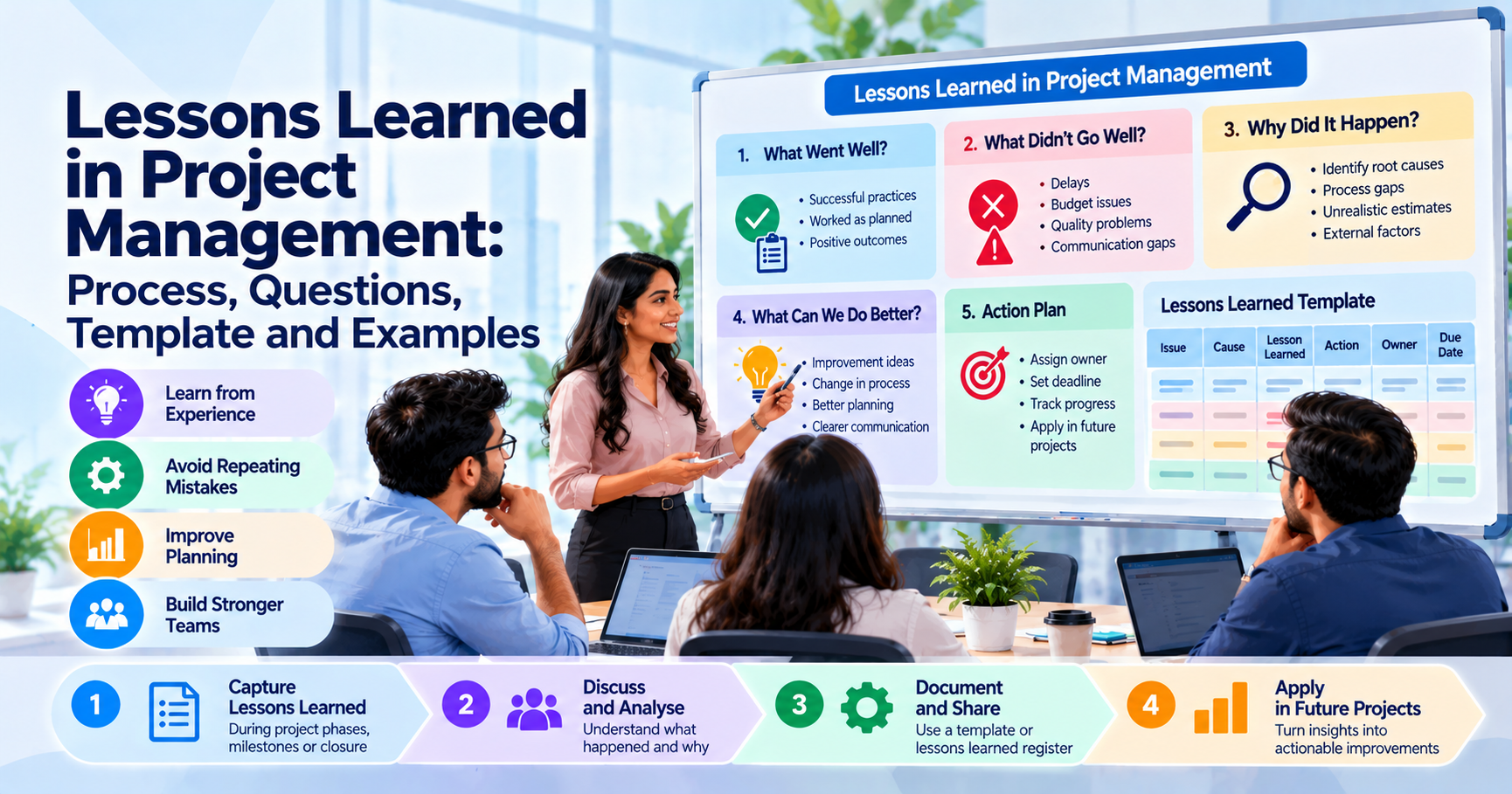
Project management lessons learned are what a team learns as they do a project. Some lessons are learned from success; others are learned from missed deadlines, confusing instructions, unforeseen costs, or work that must be redone.
The idea is to look back at what happened, understand why it happened, and decide what could be done better next time. These learnings can be recorded by teams in project reviews, after major issues, or at the end of a project.
A lessons learned template makes this easier. It gives everyone one place to record the problem, its cause, the lesson, and the action that needs to follow.
Key Highlights of Lessons Learned in Project Management
- Record lessons while the work is still fresh in everyone's mind.
- Discuss mistakes without turning the review into a blame session.
- Use a lessons learned register to keep findings organised.
- Record successful practices, not just problems.
- Give important actions an owner and a deadline.
- Check previous lessons before planning a similar project.
Introduction
Think about a project that finished two weeks late. The team worked hard, tasks were done, and finally the deliverables were handed over to the client. Everyone was ready to move on.
But nobody stopped to ask why the project was late.
Perhaps the client took too long to approve the work. Maybe the original deadline was unrealistic. Or perhaps the team did not realise how much time testing would take.
If nobody records what happened, the next project may face the same problems.
This is where project management lessons come into play. They help teams to reflect on their experiences instead of just going from one deadline to another.
It doesn’t have to be a long meeting or a complicated report. Sometimes, a short discussion and a few clear notes are enough to identify what needs to change.
What matters is what happens after the discussion. If the team agrees that approvals caused delays, someone should make sure approval deadlines are included in the next project plan. Otherwise, the lesson has been recorded but not really used.
What Are Lessons Learned in Project Management?
Lessons learned are the lessons a team learned from the decisions it made, the problems it faced, and the work it did.
These lessons can come from just about any part of a project. A team may find that their estimates were too optimistic, that there needed to be better communication with the client, or that a certain review process saved time.
For example, imagine a team preparing a website for a client. The pages look good on a computer, but several problems appear when the website is opened on a mobile phone. The team has to spend extra time fixing the layouts.
The problem is clear, but what is the lesson?
It could be that mobile testing needs to happen before the website is approved for launch. The team can then add mobile checks to its standard testing process.
That is more useful than simply writing, "Mobile problems occurred."
A good lesson explains what happened, why it happened, and what the team can do differently. Project lessons learned can also include successful practices that are worth repeating.
Why Capturing Lessons Learned Matters
Most teams learn something during a project. The trouble is that useful information can disappear when the work ends, especially if nobody writes it down.
Here are a few reasons to make lessons learned part of the project.
It saves teams from repeating the same mistakes. If late approvals were an issue last time round, then the next project can have clear approval dates built in from the beginning.
It makes the planning more real.” Historical projects can give you a sense of how long things actually take. This is useful for estimating costs, setting deadlines, and assigning people. Teams can also review project management best practices when improving their approach.
It helps with risk management. A problem that appeared in one project may appear again. Recording it gives the next team a chance to prepare. Relevant information can be added to a risk register.
It improves teamwork. A review may reveal that two people thought the other person was responsible for a task. Recording this finding can help the team define responsibilities more clearly.
It protects useful knowledge. People move between teams and organisations. Written lessons allow others to learn from earlier projects instead of relying on someone's memory.
The purpose is not to create more documents. It is to make the next project a little easier to manage.
When to Capture Lessons Learned
Waiting until the last day of a project is not always a good idea. By then, people may have forgotten the details of a problem or moved on to other work.
There are three useful times to capture lessons.
At Phase Gates and Milestones
Milestones give the team a natural point to stop and review what has happened so far.
For example, after completing the design phase, the team might discuss whether the requirements were clear, whether approvals arrived on time, and whether any changes caused extra work.
There is still time to use these findings during the next phase. Knowing the five phases of project management can help project managers decide when these reviews make sense.
At Project Closure
When the project ends, the team can look at the complete picture. Did the work meet its goals? Was the budget enough? Were the deadlines realistic? What did the client think of the final result?
Lessons learned: Project closure reviews should cover good results as well as problems. If weekly meetings helped the team stay on track, record that. If late testing caused a delay, record that too.
After Incidents and Failures
Some events should be reviewed as soon as the situation is under control.
A system failure, a missed delivery, an unexpected cost, or a major requirement change can reveal something important. The team should deal with the immediate issue first, then look at what caused it.
Recording the details soon after the event makes it easier to remember what actually happened.
The Lessons Learned Process Step by Step
The lessons learned process can be simple. The team has to get the facts, talk them through frankly and agree on what to do next.
Step 1: Decide what to review.
Choose the subject you want to discuss. It may be the whole project or some specific issue, like changes that keep coming or deadlines that get missed.
Step 2: Collect information.
Ask the parties concerned what they think. Review project schedules, meeting notes, budgets, feedback and change requests as necessary.
Step 3: Talk about what happened.
Compare the actual outcome with the original plan. Ask which decisions helped and which ones created difficulties.
Step 4: Find the reason behind the problem.
Do not stop at the first explanation. If a task was late, find out whether the estimate was wrong, an approval was delayed, or the person responsible had too much work.
Step 5: Write down the lesson.
Explain the situation in plain words. Someone who did not work on the project should still be able to understand the finding.
Step 6: Agree on an action.
Decide what should change and who will take care of it. Give the person a deadline if the action needs to be completed by a certain date.
Step 7: Check whether the action helped.
Review the finding during the next project or planning meeting. If the same problem happens again, the team may need a different solution.
How to Run a Lessons Learned Meeting
A lessons learned meeting should feel like an honest conversation about the work. It should not feel like an examination where people have to defend every decision.
Preparing the Agenda and Participants
Invite the people who understand the project and can explain what happened. This can be team members, the project manager, the clients and other stakeholders.
For a small project, a meeting of around 30 to 60 minutes may be enough.
Keep the agenda straightforward:
- What did the team set out to achieve?
- What went well?
- What caused trouble?
- What should change next time?
- Who will take care of the agreed actions?
Share the agenda before the meeting so people can think about their answers.
Facilitating Without Blame
People are less likely to speak openly if they think they will get into trouble for raising a problem.
The facilitator should focus on the work rather than making the discussion personal. Instead of asking someone why they missed a deadline, ask them if the deadline was realistic, if they had the information and resources they needed.
Hear different points of view. Two people may look at the same situation in very different ways, and both ways of looking at it can help explain what actually happened.
Closing With Owners and Actions
Before ending the meeting, agree on what needs to happen next.
Suppose the team found that client approvals regularly took longer than expected. The project manager could introduce a clear approval schedule and confirm who is responsible for following up.
Write this action in the register, assign an owner, and review its progress later. Without this step, the meeting may produce good ideas that nobody follows.
Lessons Learned Questions to Ask
Good questions help people explain their experiences instead of giving one-word answers. Pick the questions that fit your project.
Planning
- Were the requirements clear before work started?
- Were the budget and deadlines realistic?
- Did everyone know their responsibilities?
- Were the main risks considered?
During the project
- Which tasks took longer than expected?
- What caused the most rework?
- Did the team have the tools and information it needed?
- Were changes handled properly?
Communication
- Did the right people receive updates?
- Were approvals delayed?
- Did stakeholders know what was expected from them?
- What could have made communication easier?
Looking back
- What should we do again?
- What should we stop doing?
- What would we change if we started the project again?
- What should the next project team know?
These lessons learned questions can be used during a meeting or shared in a short feedback form before the discussion.
Lessons Learned Register and Log Template
A lessons learned register keeps findings in one place. It helps the team remember what happened and track the changes it agreed to make.
You can copy this lessons learned template into a spreadsheet or project document.
| ID | Phase | What Happened | Root Cause | Lesson | Recommended Action | Owner | Status |
Here is what each column means:
- ID: A number used to identify the entry.
- Phase: The stage when the event happened.
- What Happened: A short description of the situation.
- Root Cause: The reason behind it.
- Lesson: What the team learned.
- Recommended Action: What should be done differently.
- Owner: The person responsible for the action.
- Status: Whether the action is open, in progress, or completed.
For example, a delayed task might have been caused by an estimate that left out review time. The lesson would be to include reviews in future estimates, and the recommended action would be to update the scheduling process.
A lessons learned log often refers to the running list where findings are recorded as they occur. A register may also track their owners and status. The names are often used interchangeably, so the format matters more than the label.
Lessons Learned Examples
Example: Scope and Requirements
What happened: A client requested several changes after development had started.
Why it happened: The team had discussed the requirements but had not received final approval.
Lesson: Requirements should be agreed before the main work starts.
Action: Document the requirements, get approval, and record later changes through a clear change control process.
Example: Estimate and Schedule
What occurred: A marketing campaign launched a week late.
What went wrong: The schedule accounted for writing and design but not review and revision.
Lesson: Estimates of work need to allow for approval time.
Action: Add review deadlines to the schedule, and confirm approver for each deliverable.
Example: Communication involving Stakeholders
What went wrong: A client rejected a deliverable the team thought was complete.
What went wrong: The client had not checked the work at critical stages.
Lesson: Status updates are not sufficient when decision approval is required from stakeholders.
Action: Arrange reviews at key milestones and record feedback in writing.
These lessons learned examples show how a specific problem can lead to a change that is easy to understand and apply.
Lessons Learned Report Format
A lessons learned report brings the main findings together so other teams can use them.
It does not need to be long. Include the information that explains the project experience and helps people make better decisions.
A practical report can contain:
- Project overview: The goals, timeline, team, and final result.
- Review scope: What the team looked at.
- Successes: What worked and should be repeated.
- Problems: The main difficulties and delays.
- Root causes: Why the important problems occurred.
- Lessons: What the team learned.
- Actions: The changes, owners, and deadlines.
- Supporting records: Links to relevant project documents.
Store the report in a shared location and use a clear file name. A useful report should be easy to find when someone starts a similar project.
Lessons Learned in Agile Projects
Agile teams often discuss lessons during retrospectives at the end of a sprint. The team looks at what went well, what caused problems, and what it wants to change in the next cycle.
For example, a team may notice that work keeps getting delayed because tasks enter a sprint without clear acceptance criteria. The team can agree to check those criteria before accepting future tasks.
This is a practical way to use lessons learned in Agile practices throughout the project.
Traditional projects may hold reviews at major milestones and closure, while Agile teams often review their working methods more frequently. Both approaches help teams learn from experience.
How to Make Sure Lessons Are Actually Used
A lesson has little value if it stays in a spreadsheet that nobody opens.
Before starting a new project, review earlier findings that relate to the work. If unclear requirements caused trouble before, add a requirement review step to the new project management plan.
Give each important action an owner. Check whether the change has helped, rather than assuming it worked.
It also helps to keep records in a shared folder or knowledge base with clear titles. If a previous project faced a major risk, include the relevant finding in the next project risk management plan.
Small steps like these make lessons part of everyday project work rather than another task to complete at closure.
Lessons Learned in the PMP Exam Context
For the PMP exam, understand that lessons learned help project teams capture and use knowledge from their experiences. They are not limited to the final project review.
An issue describes something that happened. A lesson explains what the team learned and how future work can improve.
Project managers should also be aware of the importance of sharing knowledge, keeping records up-to-date and discussing problems without the blame game.
If you are preparing for the exam, PMP certification training can help you study project management concepts. Check current PMI resources for the latest exam outline.
Common Mistakes With Lessons Learned
A few simple mistakes can make the whole exercise less useful.
Waiting until the end: People may forget details. Record important findings throughout the project.
Blaming people: This discourages honest feedback. Focus on what caused the problem and what can change.
Writing unclear lessons: A statement like "communication needs improvement" does not give the next team much help. Explain what went wrong.
Recording only failures: Successful practices are worth keeping too.
Making the register complicated: Use only the fields that help people understand and act on a lesson.
Ignoring actions: Assign an owner and check progress.
Hiding the findings: Keep the records somewhere future teams can access.
Never reviewing the results: Check whether the changes worked and adjust them when needed.
Summary
Project management lessons learned allow teams to gain more value from the work they’ve already completed. They make it easier to understand why a project succeeded, where it struggled, and what the next team should know.
The process need not be complicated. Ask the right questions, record the important findings and agree on practical action. Use a simple register to keep everything together.
Most importantly, do not stop after writing the report. Bring relevant lessons into the next project's planning and check whether the changes make a difference. That is when the team's experience starts helping future projects.








 Lowest-Price Challenge












 Personalized Path



.webp)


 USA
 Canada
 India
 UK
 Australia
 Singapore


