


 Call Us



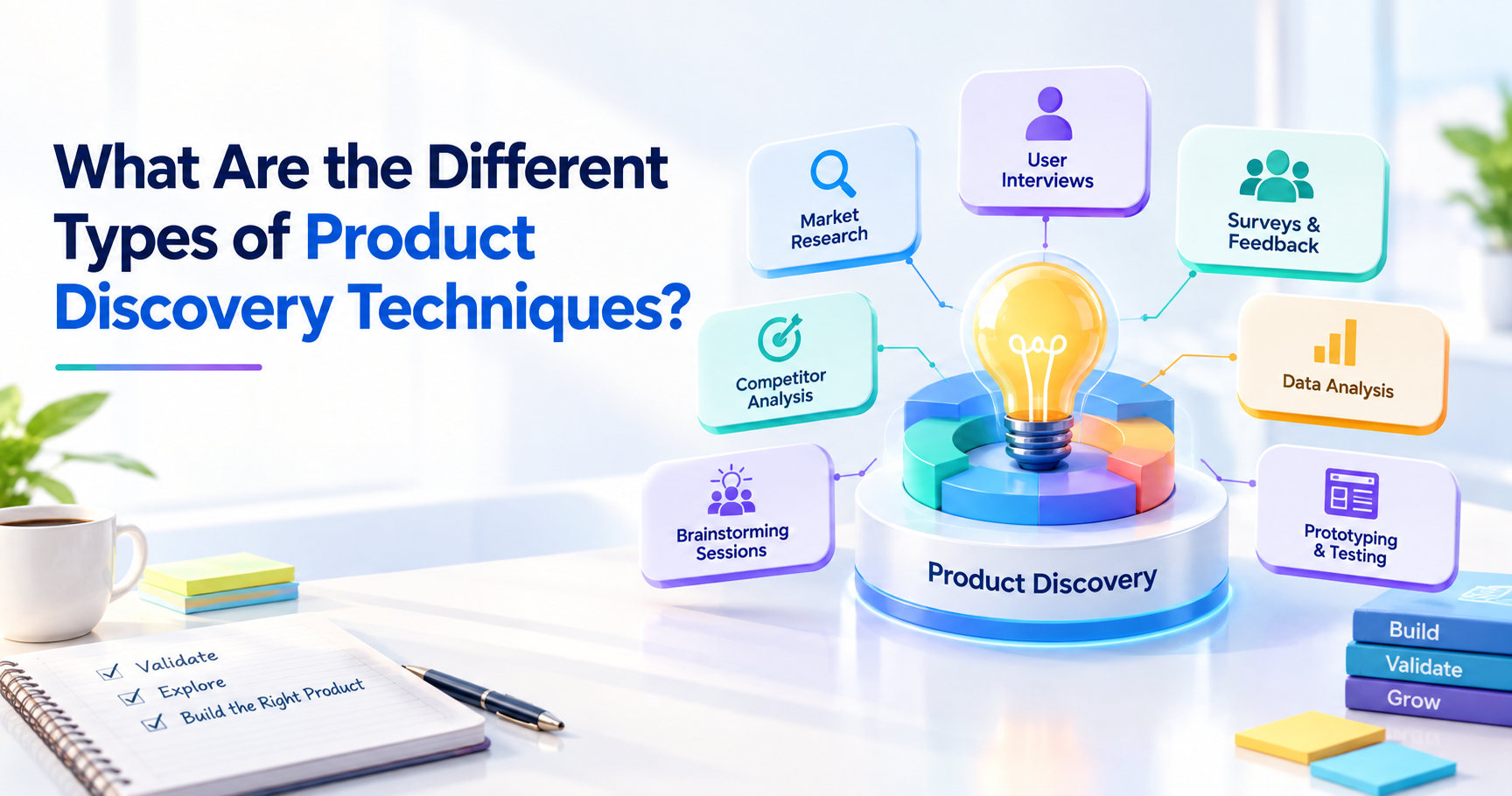
The teams who use structured research and validation techniques in order to get clarity on user problems prior to building a solution are called product discovery techniques. A product owner uses surveys, user interviews, opportunity mapping, usability testing, and data analysis. These are aimed at reducing risks effectively.
Key Highlights:
- Six out of 10 new products fail to meet business objectives, and the real problem is not skipping product discovery, it is running it backward by starting with solutions instead of customer problems.
- Product discovery works best when teams gather requirements first, identify measurable outcomes, and only then move to building solutions.
- Marty Cagan's framework identifies four risks every discovery process should address: value risk, usability risk, feasibility risk, and business viability risk.
- Discovery and delivery serve different goals. Discovery finds the right problem and solution, while delivery focuses on releasing that solution with quality and speed.
- Seven technique categories cover the full discovery toolkit, from user interviews and data analysis to prioritization frameworks and continuous feedback loops.
- Discovery works at both a tactical level, through techniques like interviews and prototyping, and a strategic level, through strategy, business, product, market, and growth discovery.
Introduction
The majority of product managers feel stuck during product discovery. Surveys are done, interviews are conducted with customers, and trade shows are attended as well. Despite all this effort, their hit rate on new products depends on industry average: 6 / 10 fail to meet business objectives.
Here, the challenge isn’t to skip discovery; it is considering the discovery process as backward. Usually, product managers begin with solutions and then look at the problems. Customers are asked what they want instead of what they are trying to achieve. In product discovery, we follow the opposite. We start with gathering customer requirements, identify measurable outcomes, quantify the outcomes which are underserved, and then look at the solution development process. In this blog, we will understand what is product discovery, types, techniques, and tools that support the technique. Then, learn about the common mistakes to avoid in product discovery.
What Is Product Discovery?
The process of knowing customer requirements’ and validating product opportunities to build a product is called product discovery. It is considered as the first step in the project management process as it helps product managers to find customer needs, seize growth opportunities, and understand market growth.
According to Marty Cagan, a product management specialist, product discovery should aim to mitigate 4 key risks.
- Value risk.
- Usability risk.
- Feasibility risk.
- Business viability risk.
The above-mentioned risks can be identified and mitigated by product leaders by integrating product discovery into the project management workflow. This will create a competitive edge in the market.
Product Discovery vs. Product Delivery
Some of the key product discovery vs product delivery differences include the following
| Parameter | Product Discovery | Product Delivery |
| Goal | Looks at finding the right problem and its solution | Release the right solution |
| Primary Risks | Building low value features | Defects, delays, poor execution, and scope issues |
| Level of Uncertainty | Higher | Lower |
| Key Stakeholders | Designers, product managers, and business teams | QA, operations, and stakeholders. |
| Focus | Customer needs, validation, and opportunities | Quality, execution, and development |
| Core Activities | Ideation, research, prototyping, interviews, and testing | Testing, planning, development, and monitoring |
| Customer Involvement | Frequent | Focused on validation and feedback |
| Typical Outputs | Prototypes, insights, validated problems, and concepts. | Releases, working features, and product improvements. |
What Is the Product Discovery Process at a Glance?
The product discovery process has a systematic approach to project management.
1. Learn and understand the user’s need:
The first step in the product discovery process begins with finding broad challenges which you’re trying to solve. During this phase, your product team needs to look at the big picture - high level objectives.
The goal here is to gather quality information about your user’s requirements and pain points. Prior to strategizing about your next product roadmap, you must spend time communicating with the users. Be it running customer interviews or creating journey maps; forming a close relationship with users is very important.
Performing market research will be useful at this stage. Looking at the competitive landscape is yet another good way to find new product opportunities.
2. Define direction and decide on priorities
Once data and feedback is collected, your team can look at some of the crucial problems which the users might be facing. You might start noticing patterns in your research. In different user stories, one or two problems can appear.
Post identification, the next step is to refine it into hypotheses accordingly. Form a broad hypothesis that can be the foundation of the solutions you develop. This can be a question, covering the main problem and other problems which you are looking to solve for your users.
3. Ideate and prioritize
Now, it’s time to look at what a new product idea can look like. At first, encourage your team to create ideas without limits. Then, narrow down the best ideas. After this task, narrow your ideas to a shortlist. Here, you can apply a prioritization framework which helps assign scores for feasibility and predictability.
4. Create prototype and perform testing
At the final stage of product discovery, you need to create a mockup and also get feedback on the same. To enable teams to demonstrate their ideas, prototypes can be used. The type of prototypes teams choose to build will depend on three factors
- What are they trying to learn?
- What needs to be tested?
- What open questions do they have?
What are the Types of Product Discovery Techniques?
Product discovery is not one single activity. It is a toolkit that solves a number of problems. Below are the seven types of tools that product development teams should learn about.
1. User Research and Qualitative Techniques
This is one of the first areas of focus for a lot of teams during the discovery phase. As the name suggests, qualitative research closes the gap between your team and the actual user of the product, and this closeness brings insights that no dashboard ever could.
Customer interviews are essential to this category. The outcome of interviewing 5-10 users prior to your team making a big decision, is hearing the users describe their problem in their own terminology instead of your team’s terminology. Contextual inquiry is an advanced customer interview that more directly observes a user in their environment instead of asking the user to describe their behavior from memory, which is often inaccurate.
Other qualitative methods to consider incorporating regularly:
- Field studies, where you watch someone perform a task and complete a work activity or use a product without interrupting them
- Diary studies, where a user logs their daily activity for the duration of the diary study (often days or weeks)
- Focus groups, which are useful for quickly gathering a multitude of opinions, but yield limited insights at the individual level
- The five whys, which is useful for digging underneath the stated complaint to determine the actual concern
Qualitative research is tedious and not efficient but reveals the “why” behind the behavior of the user.
2. Quantitative and Data-Driven Techniques
If qualitative research tells you why, quantitative research tells you how many and how often. Product analytics platforms track how users actually move through your product, which features get used, where people drop off, and which paths lead to retention or churn.
A/B testing lets you show two versions of an experience to different user segments and measure which one performs better on a specific metric. Surveys and questionnaires, when designed well, let you validate a qualitative insight at scale by checking whether it holds true across a much larger sample.
Cohort analysis and funnel analysis round out this category, helping teams spot patterns like a sudden drop in activation among users who signed up through a particular channel. The strength of data-driven techniques is objectivity. The weakness is that data tells you what happened, not why it happened, which is why quantitative and qualitative methods work best paired together.
3. Market and Competitor Research Techniques
Understanding the market and competitors before developing a product is vital. Knowing why something doesn't work is qualitative research, and knowing how many and how often is quantitative research. Product analytics provides insights on user flows, product feature usage, usage drop-off, and retention or churn flows.
A/B testing provides the ability to show two different versions of an experience, and then assess which of the two performs better on a given metric. Surveys and questionnaires provide the ability to quickly verify a qualitative assumption on a large sample.
Cohort analysis and funnel analysis also belong to this category, as they can help answer the reason or the 'why' behind a high drop-off in user activation, using data to provide an objective answer. The weakness, as with most data-driven techniques, is that while data can answer 'what,' it cannot answer 'why.' For this reason, a mix of quantitative and qualitative research is necessary.
This category includes:
- Market sizing and trend analysis to determine if the potential opportunity will be worth the investment
- Win-loss analysis reviewing the reasoning behind how customers decide to purchase with you or a competitor
- Customer experience mapping across the entire journey, from the first opportunity awareness to the post-purchase experience, identifying areas where competition has not solved problems.
Market research anchors your work in the real world. It prevents teams from working in a silo and provides teams with contextual framing on why a product should exist.
4. Ideation and Brainstorming Techniques
Once you've understood the problem, you’ll need a myriad of structured ideas. While traditional brainstorming, where a cross-functional team provides ideas, still serves a purpose, to avoid groupthink the best teams add structure.
Design sprints, made popular by Google Ventures, condense the process of ideation, prototyping, and testing in a week. Crazy Eights generates a large quantity of sketches in a very short amount of time, and a “How Might We” statement, helps Change how you think about a problem by reframing it as an open ended question rather than an obvious solution.
This stage focuses on volume and variety of ideas. If teams jump straight to a solution, it's likely that the first idea placed on the table will be the most thought of idea.
5. Prioritization Techniques
Not all validated ideas should be built in the order they’re validated in. The goal of these exercises is to give a clear way of ranking the ideas that will meet the goals of the business in the given constraints.
The RICE framework for ranking ideas measures the ideas' potential Reach, Impact, Confidence, and Effort. This is individually multiplied and then divided by Effort. The result is used to rank ideas. MoSCoW prioritizes features as Must have, Should have, Could have, and Won't have this time.
This is a helpful framework for quickly scoping a release with non-technical stakeholders. The Kano model analyzes features along the lines of satisfaction and determines the difference between the basic expectation and surprise features that provide pleasure to the user.
6. Prototyping and Validation Techniques
Ideas are abundant, but concept validation prior to building an idea requires prototyping. Low-fidelity prototypes and clickable wireframes are some of the fastest ways to determine whether or not your idea is worthwhile. High-fidelity prototypes allow users to perform tasks in a prototype and simulate real interactions. Frustrations and hang-ups can then be observed and documented.
Fake door tests are a novel way to determine user interest without fully building a feature. You add a clickable button or link to a landing page for an imaginary feature. Then, to see how many people were interested in using that feature, you measure user interaction to determine if you should even build that feature. With minimum viable products, you take the theory and apply it in practice by building a basic version of your product, releasing it, and seeing how much interest it generates.
When you run product tests, you learn how to answer questions before you build. The purpose of validation is to remove the excitement around a product and help you answer tough questions to avoid uncomfortable surprises during and after the product launch.
Validating product assumptions is hard, messy work, but it is worth the risk to avoid unexpected surprises post launch.
7. Continuous Discovery and Feedback Techniques
When some teams ship a product, they don't consider the growth of the product to be over. They are constantly running small research activities, instead of doing a big overall discovery before a large launch. They have small touchpoints with customers as part of their ongoing research.
This research may not stop even after you've launched the product. You should analyze all user touchpoints with the product. This includes bugs, user reports, user reviews, customer feedback, customer advisory sessions, and even measuring how far you have moved along the Opportunity Solution Tree.
The practice of continuously running research and feedback activities is closely related to Teresa Torres, and will help a team remain close to the actual needs of the user.
What are the Types of Product Discovery at the Strategic Level?
Some of the types of product discovery at the strategic level are:
1. Strategy Discovery
Before teams start forming feature ideas or solutions, strategy discovery suggests that teams consider what the organization is reaching for in the long run, what strategic bets the company is making, and how the product and/or initiative will help the company realize that long term strategic goal.
Failure to adopt this discovery layer leads teams to work on isolated issues that do not ultimately result in a unified, comprehensive solution to the product throughout the course of time.
2. Business Discovery
Prior to teams or individuals falling in love with the idea of a new offering, business discovery requires understanding the market, competition, and the overall financial implications of the idea. Business discovery aims to answer critical questions concerning business risk, the unit economics of a given idea, and the overall revenue model.
3. Product Discovery
The layer of product discovery that most people refer to when they say “product discovery” is centered on creating the product that brings the most customer value in the most effective manner, with the methods discussed above (e.g. user research, prototyping, etc.). This discovery layer is complementary and supportive of the overall strategic goals and objectives of the organization.
4. Market Discovery
Finding the right spot for your product amidst the competition and deciding on the best routes to get to your customer is what market discovery is about. It is more about whether someone will notice, understand and buy the product over the alternatives, not whether the product is functional. Here are where positioning, messaging and channels stem from.
5. Growth Discovery
When the Product-Market Fit is established, growth discovery tangents out on ways to scale the product’s impact. This means finding new product-customer segments, product-use case segments, or cross geography segments. It is the discovery that ensues after the initial product-market fit bet is won and the question shifts from “does this work” to “how far can this go”.
They described 5 layers, 3 in the value-chain, 2 in the activities chain to execute a robust product. Depending on where in the chain it is executed, a different type of discovery is needed. A gap in any one of the layers will show up as a product that is stuck.
How to Choose the Right Technique for Each Stage?
There is no universal checklist that tells you exactly which technique to use. But there is a reliable way to think about it: match the technique to the question you are actually trying to answer, not to whatever method is trendy at the moment.
1. Use interviews and contextual inquiry:
When you begin working on a problem, qualitative strategies come in handy. Contextual inquiry and interviews are effective ways to gather information. Because you are just starting to be certain of the problem, you will not be prepared to implement an A/B test.
At this phase of your cumulative investigation, you should define the problem clearly, and your first attempts should use a one-sentence problem statement. Vague problem outlines will undermine the clarity of each subsequent step in the alignment of all involved parties.
2. Market and competitor research
Once you formulate a problem in your mind, market and competitor research will help you understand the extent to which your proposed solution will meet the need of the market, and the extent to which a competing solution will fulfill that need.
3. Ideation techniques
When you come to the point of having many possible solutions, techniques such as design sprints or ‘How Might We’ can be employed to expand the number of possible solutions beyond the idea that is top of mind. After the number of possible solutions is expanded, frameworks such as RICE and MoSCoW can be used to guide the selection of which of the possible solutions to pursue based on the capacity of the team.
4. Prototyping and usability testing
Before you direct engineers to commence work, you should perform prototyping to validate the potential solution at minimal cost. After you have built something, you should employ continuous discovery in order to remain flexible while potential problems and opportunities present themselves.
You can think of qualitative methods in the context of identification of the unknowns, quantitative methods in the context of validation of your hypothesis, and prioritization frameworks after you have actual measurement (as opposed to just your best guess).
What Product Discovery Tools Support These Techniques?
Techniques need tooling to run efficiently, especially as teams scale beyond a handful of interviews a month. Here is how common tools map to the techniques above.
| Technique category | Supporting tools |
| User research and interviews | User interview platforms, survey tools, session recording software |
| Quantitative and analytics | Product analytics platforms, A/B testing software, dashboarding tools |
| Market and competitor research | Competitive intelligence tools, review aggregators, market research platforms |
| Ideation and brainstorming | Digital whiteboards, collaborative sketching tools, workshop facilitation software |
| Prioritization | Roadmapping software with built-in RICE or Kano scoring, spreadsheets for weighted scoring |
| Prototyping and validation | Prototyping and wireframing tools, usability testing platforms |
| Continuous discovery | Feedback widgets, opportunity mapping tools, customer feedback repositories |
Many modern product management platforms bundle several of these functions together, letting teams collect feedback, tag it against an opportunity tree, and score it with a prioritization framework in one workflow.
The tool matters less than the discipline of actually using it consistently. A team with a basic spreadsheet and a weekly interview habit will outperform a team with premium software and no research cadence.
What are the Common Mistakes to Avoid in Product Discovery?
There are certain mistakes which, even with the best of intentions, everyone falls victim to while conducting discovery. It’s imperative to recognize these traps early on to avoid a significant waste of time and resources down the road.
- Misconceptions of discovery as a phase of work that comes and goes results in frameworks and assumptions being developed based on data that is, at best, 6 months out of date.
- Saying discovery is a continuous process of refining and expanding insights because talking with easy to reach customers or friendly has a strong negative impact on the type of insights you gather.
- Rushing to build a solution before precisely identifying and articulating the problem results in teams misdirecting their efforts and building with great confidence in the wrong direction.
- Using one and only one data source, whether interviews or analytics, instead of using a combination of the two, results in blind spots in all other data.
- Confusing feature requests for solutions with the actual underlying problem. A user asking for a specific feature is describing their best guess at a solution, not the underlying problem.
- The perception that validating a solution through prototypes is “slow,” when in fact the opposite is true.
- The results of a prioritization matrix result in an even worse outcome when those results are used to justify a stakeholder's opinion.
- Using a prioritization matrix results in unnecessary work. Its purpose is to organize evidence, not to evaluate and make a call.
Avoiding these mistakes is less about adopting fancier tools and more about protecting the discipline of asking "do we actually know this, or are we assuming it."
Conclusion:
Product discovery is not a task to finish before the development process starts. Discovery is the methodology that dictates whether your team's efforts of many months solves a legitimate issue faced by real users.
Teams who utilize discovery on a more consistent basis (and at the right time), backed by the correct combination of qualitative research, defined metrics, and a structured approach, are more likely to successfully deliver products that users will actually use.
Whether you are a product manager looking to elevate your discovery practices, or someone trying to enter the product management field, knowledge of these techniques, and how to utilize them to their full potential, is the difference between great and good product managers.
Are you ready to make this knowledge official?
Simpliaxis offers accredited training for Product Management, Agile, and SAFe. These courses provide practical insights for discovery, prioritization of work, and confidence to lead the involved teams.
Explore Simpliaxis product management certification courses and take the next step toward becoming a product leader who builds things people actually want.



_1738228440.jpg)



 Lowest-Price Challenge











 Personalized Path


.webp)


 USA
USA  Canada
 India
India UK
UK Australia
 Singapore


