


 Call Us
_1788785133.jpeg)


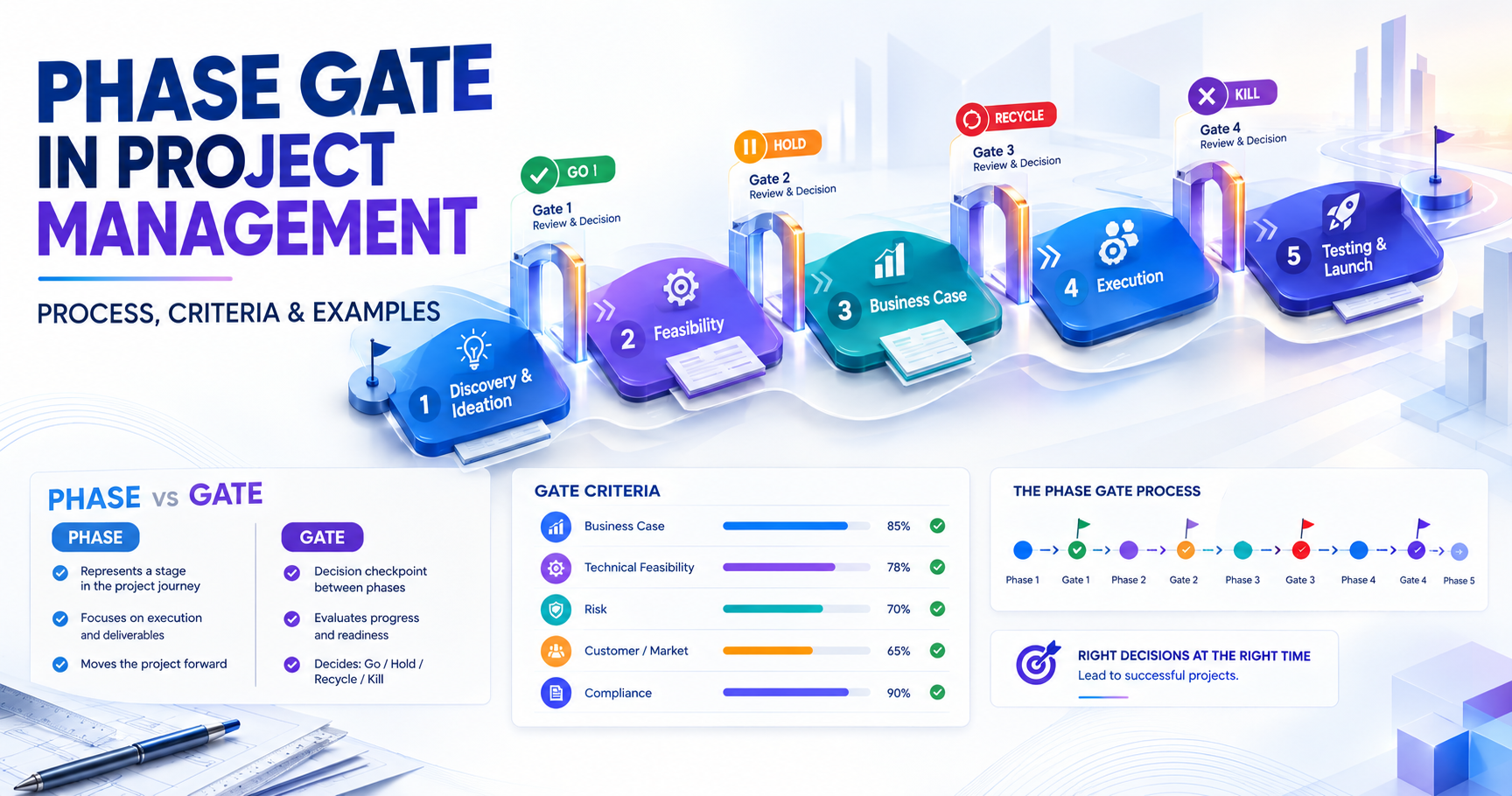
According to the Project Management Institute, companies waste $122 million for every $1 billion that’s invested in projects which is due to poor performance. As a solution, having the support of a phase gate methodology can be very helpful. Keep in mind, Phase Gate and Stage-Gate are exactly the same methodology that’s used for managing projects via structured decision points.
Key Highlights of Phase Gate in Project Management:
- A phase gate is a formal checkpoint at the end of each project phase where a sponsor, reviewer, or committee evaluates deliverables against risk, cost, and business rationale before deciding to Go, Kill, Hold, or Recycle the project.
- The methodology traces back to NASA's phased review process in the 1960s and was later formalized by Dr. Robert G. Cooper in the 1980s and 1990s as the Stage-Gate framework for managing innovation pipelines across industries like pharma, construction, IT, and marketing
- Gate reviews follow a structured process covering deliverable review, risk and dependency assessment, schedule and budget evaluation, business case validation, quality checks, stakeholder alignment, and a final readiness decision.
- Gate criteria split into must-meet items (non-negotiable, pass or fail, such as regulatory compliance) and should-meet items (scored factors like market attractiveness or financial metrics), which together keep reviews fast and objective.
- Phase gate is a governance model focused on funding and go or no-go decisions, while Agile, Waterfall, and SAFe are delivery or execution approaches, meaning many enterprises run Agile teams inside a phase-gated governance structure as a hybrid model.
- Common implementation problems include rubber-stamping every project as a Go, treating gates as status meetings, setting vague criteria, delaying kill decisions, and over-governing small low-risk projects, each of which has a specific procedural or cultural fix.
With many industrial projects coming up, managing projects becomes critical which requires consistent monitoring, stage-wise, so that the project progresses effectively. Nowadays, project managers have a number of processes and techniques, helping them to ensure continued project viability and success. One such technique is called the phase gate process.
The model comes as a great tool, helping in optimizing project design. With an organised structure that’s divided into distinct phases; these models provide a systematic approach to project management.
Phase Gate in Project Management: How It Works
A phase gate acts as a formal checkpoint that finds its place at the end of every project phase. This is where a sponsor, reviewer, or a committee on the project's developments. First, the team completes the phase's work, looks into the results, and later presents them at a gate review. Here, the outcome is measured against set criteria. This includes risk, cost, and business rationale.
Based on this review, the person who makes decisions will choose one of the paths. These paths are
- Go ahead to the next phase
- Kill the project entirely
- Put it on hold for later
- Recycle it back for more work
Generally, the majority of the projects run through six phases, including initiation to launch. Teams will be using this structure for the following.
- Quality control
- Identifying risks
- Ensuring resources and budget keep flowing accordingly
What is a Phase Gate in Project Management?
Phase gate in project management is defined as the structured approach that breaks a project down into distinct phases. This is separated by a formal review point which is known as gates. Here, subject matter experts, senior stakeholders, financial analysts, project managers, and team leads take part in decision making.
Speaking about the roots, the phase-gate process came from large-scale engineering. In the 1960s, NASA had developed a phased review process, helping manage the risk of space programs. In their way of working, they thought of dividing missions into discrete phases with formal reviews prior to each progression. This became a foundational model.
During the 1980s and 1990s, Dr. Robert G. Cooper developed the stage-gate (phase-gate) framework, which formalized it for managing innovation pipelines. From pharmaceutical and construction to IT services and marketing campaign delivery, the stage-gate process is being implemented across industries.
What Happens at a Phase Gate Review?
A formal check point between project phases whereby decision-makers review progress, risks, and the business case to decide whether a project should continue, change direction, or stop is known as a phase gate review.
This review will allow people to come together to evaluate whether the project shall be moving forward. A structured agenda is followed in this meeting, whereby reviewers shall look at the evidence produced during the current phase and identify issues that can affect the next phase.
Let’s look at the process:
1. Reviewing project deliverables:
Once the meeting starts, we will be setting deliverables needed for the current phase. These deliverables can be in the form of test results, designs, prototypes, risk assessments, implementation plans, or approval documents.
The stakeholders will look into each deliverable and notice if they are complete and accurate with the standards as agreed initially. If there are any missing or incomplete outputs, it can lead to performing more tasks before approval is granted.
2. Assessing dependencies and risks
At this stage, the team communicates key risks involved, their impact, and along with suggestions to manage them effectively. Dependencies are being examined by reviewers on vendors and external events. The purpose of undertaking this task is to understand whether unresolved issues can disrupt the next phase.
3. Evaluating schedule and budget performance
Reviewers differentiate actual progress and spending against the approved plan. Forecast changes, delays, resource constraints, and cost variances are looked upon keenly. With respect to challenges, a schedule or budget variance wouldn’t prevent the project’s progress. Stakeholders will check to see if the revised plan stays as it is or identify if any additional funding is required.
4. Validating business objectives
A project’s schedule will remain the same as compared to its original business case that’s less relevant. Hence, we need to look back at the outcomes which the project was made to achieve. Once we project the expected value, the stakeholders will evaluate whether there’s a need for further investment.
5. Reviewing quality requirements
Here, the reviewers will check to see if the work meets project’s quality, compliance, security, and performance standards. Acceptance criteria, test results, defect reports, security assessments, and audit findings are looked upon as evidence. If there are any gaps, they need to be addressed before the project enters an important phase.
6. Stakeholder alignment
At this stage, an opportunity is provided to the delivery teams, sponsors, subject matter experts, and sponsors to confirm if they are on the same page with respect to the project’s progress and next steps.
This process includes agreeing on responsibilities, scope, timelines, trade-offs, and any conditions that are connected with their approval. If there’s any misalignment, it can lead to frequent delays.
7. Determining readiness for the next phase:
All the findings are brought together to check if the project is prepared to proceed. Some of the key things to consider is completeness of deliverables, business value, remaining risks, and the team’s ability to perform the next stage. Once the meeting ends, a formal gate decision is made. This is along with documented actions and approval conditions.
What Are Go, Kill, Hold and Recycle Decisions?
Go, Kill, Hold, and Recycle decisions are the four key evaluation outcomes that’s used at decision check points in project management. At every stage, the decision makers will be reviewing the project’s progress, risks, and financial soundness.
Go:
- Meaning: Here, all the project’s expectations are met and are approved to move forward.
- Action: The team receives the budget, staff, and resources needed for the next phase, along with a clear timeline and list of goal
Kill
- Meaning: Here, the project fails to meet strategic goals, expectations of the project, and it carries too much risk.
- Action: The stakeholders decide to end the project with immediate effect. This step prevents the organization from wasting time, resources, and energy on a failing project.
Hold:
- Meaning: Although the project has the potential to create a positive impact. However, the current conditions like lack of budget or changing market conditions doesn’t allow the project to proceed for the time being.
- Action: The project is paused and put on shelf till next further update.
Recycle:
- Meaning: The project has strong potential, but the current phase is incomplete or contains critical errors that must be fixed first.
- Action: The project is sent back to a previous stage or loop for rework, additional research, or scope adjustment before it can face a gate review again.

Phase Gate Process: From Project Initiation to Delivery
In the phase-gate process, every stage is completed which is then followed by a checkpoint. The number and name of the phases will depend on the sector or project.
Stage 1: Discovery and Ideation
The discovery and ideation phase is where the brainstorming begins. Breakout sessions are created and stakeholders will participate in group brainstorming meetings. Once the idea is formed, the key stakeholders will be discussing the resources needed, the project scope, and the capital required to ensure project’s success.
Stage 2: Scoping and Feasibility
In the scoping phase, the team will take a deeper dive into the project’s viability. Not to mention, a SWOT analysis is performed to look into the strengths, weaknesses, opportunities, and threats associated with the project.
Stage 3: Business Case Development
This phase has similarities to the ideation or the scoping phase. However, you’ll find more concrete plans that come together here. Consider this phase as the project’s backbone. A feasibility study will be designed here.
Stage 4: Project development and execution
This phase is one of the critical phases of the phase gate process. Different teams are assigned with a specific task like writing, designing, and developing. Here, all the project’s details are ironed out.
Stage 5: Testing, Validation and Launch
In this phase, the quality assurance takes place. Some of the activities include removing bugs, making suitable edits to the prototype, and creating the final touches to the design and copy.
Here, you can also perform field testing. Try to find a group of people who aren’t part of your organization and ask them to test out the product’s user experience.
Phase Gate Review Criteria: How Projects Are Evaluated?
A phase gate review is not a status update. It is a formal decision point where a project is measured against pre-agreed standards. If the project does not meet these standards, it does not move forward, regardless of how much effort has already gone into it.
Gate criteria typically fall into a few consistent categories. These categories repeat across most industries, whether the project is building software, launching a financial product, or developing a physical asset.
Must-Meet Criteria vs Should-Meet Criteria
Phase gate criteria are usually split into two types. Understanding this difference is critical for anyone managing or reviewing gate decisions.
Must-meet criteria are non-negotiable. They pass or fail checkpoints. If a project fails even one must-meet criterion, it cannot advance, no matter how well it performs elsewhere.
Common must-meet criteria include:
- Strategic alignment with organizational objectives
- Technical feasibility within current capabilities
- Compliance with legal, regulatory, or safety requirements
- A positive risk-to-return ratio at the current investment level
- Sign-off from the client or key stakeholder on prior deliverables
Should-meet criteria are different. These are scored factors that allow for a more nuanced evaluation. A project does not need a perfect score on every should-meet item. Instead, decision-makers look at the aggregate picture.
Typical should-meet criteria include:
- Market attractiveness or customer value
- Competitive advantage of the product or deliverable
- Operational readiness and team capacity
- Financial metrics such as NPV, IRR, or payback period
- Synergy with other active projects or organizational capabilities
This two-tier structure keeps gate reviews fast and objective. Reviewers do not need to debate every detail. They simply check the must-meet list first, then use the should-meet scorecard to guide judgment.
Financial and Business Case Criteria
Every phase gate eventually comes back to money. Even projects with strong technical merit can fail a gate if the numbers no longer make sense.
Financial criteria typically include projected return on investment, updated cost estimates, and whether the original business case still holds true. As a project moves through phases, cost estimates usually get more precise. A gate review compares the latest estimate against the original approved budget.
If costs have grown significantly or expected benefits have shrunk, the gate reviewers may ask for a revised business case. In some situations, this alone is enough to trigger a kill decision, even if the technical work is going well.
Technical Feasibility and Risk Criteria
Technical criteria assess whether the solution can actually be built and whether it will perform as intended. This includes design maturity, prototype results, integration complexity, and known technical risks.
Risk criteria look at what could go wrong and how severe the impact would be. A gate reviewer wants to know if risks have been identified, assessed, and given to an owner. Unmanaged risk is one of the most common reasons a project gets held at a gate rather than approved outright.
For technology and engineering projects, this section often includes questions about scalability, security, and long-term maintainability. These factors matter more as the project gets closer to launch.
Customer, Market and Compliance Criteria
Some projects fail not because they cannot be built, but because nobody wants them, or because they cannot legally be launched. This is why customer, market, and compliance criteria exist as a separate category.
Market criteria examine demand, competitive positioning, and whether customer needs have shifted since the project started. Compliance criteria check regulatory approvals, industry standards, and internal policy requirements.
For regulated sectors like banking, healthcare, and pharmaceuticals, compliance criteria are often treated as must-meet items. A project cannot proceed past certain gates without documented regulatory sign-off, regardless of how promising the underlying idea is.
Sample Phase Gate Review Scorecard
A scorecard helps structure the gate discussion and reduces bias in decision-making. Below is a simplified example used across many organizations.
| Criterion | Type | Weight | Score (1-5) | Notes |
| Strategic alignment | Must-meet | Pass/Fail | Pass | Confirmed with steering committee |
| Regulatory compliance | Must-meet | Pass/Fail | Pass | Legal review completed |
| Business case validity | Should-meet | 25% | 4 | ROI updated, still positive |
| Technical feasibility | Should-meet | 25% | 4 | Prototype validated |
| Risk profile | Should-meet | 20% | 3 | Two open risks, both owned |
| Market attractiveness | Should-meet | 15% | 4 | Demand confirmed via research |
| Resource readiness | Should-meet | 15% | 3 | Team capacity tight next quarter |
Reviewers use this kind of table to keep discussions grounded in evidence rather than opinion. It also creates a documented record that can be referenced later if the project's direction is questioned.
Phase Gate vs Stage Gate: What Is the Difference?
Many people use "phase gate" and "stage gate" interchangeably, and in most day-to-day conversations, that is fine. However, there is a specific origin story and a technical distinction worth understanding.
Is Phase Gate the Same as Stage-Gate®?
In practical usage, phase gate and stage gate describe the same governance concept: a project is broken into segments, and each segment ends with a formal decision point. Both approaches ask the same core question at every checkpoint. Should this project continue to receive investment?
The difference is mostly about origin and trademark. Stage-Gate® is a specific, trademarked methodology developed for new product development. Phase gate is the more generic project management term, commonly used in PMP terminology, IT governance, and general project management frameworks.
So while the mechanics are nearly identical, Stage-Gate® refers to a proprietary, branded system. Phase gate refers to the broader practice of using gates between phases, applicable to almost any project type.
Where Does the Stage-Gate Model Come From?
The stage-gate model was developed by Dr. Robert G. Cooper in the 1980s as a response to high failure rates in new product development. Cooper studied why so many products failed after launch and found that companies were skipping critical validation steps under time pressure.
His solution was to break product development into distinct stages, each with clearly defined deliverables. Before a project could move from one stage to the next, it had to pass through a gate, where senior leaders, often called gatekeepers, would evaluate business value, readiness, and continued alignment with strategy.
At each gate, the possible outcomes are typically Go, Kill, Hold, or Recycle. This structure gave organizations a repeatable way to manage risk instead of relying on gut feel or political momentum to keep projects alive.
Phase Gate and New Product Development
The stage-gate model remains most closely associated with the new product development process, and for good reason. New product launches are expensive, uncertain, and easy to over-invest in emotionally.
A typical new product development sequence includes discovery, scoping, business case development, development, testing and validation, and launch. Each of these stages ends with a gate review that decides whether the product is worth continued investment.
This structure protects the organization from what practitioners often call "zombie projects." These are initiatives that keep consuming the budget purely because no one formally asked whether they should continue. A well-run gate process forces that question at regular intervals, which is far cheaper than discovering the answer after a full launch.
Phase Gate vs Agile vs Waterfall vs SAFe
Project teams frequently ask how phase gate fits alongside more modern delivery approaches. The honest answer is that phase gate is not really competing with Agile or SAFe. It operates at a different level of the organization.
Phase Gate vs Agile Project Management
Phase gate and Agile solve different problems. Phase gate is a governance model. It answers questions about funding, risk, and strategic fit at a portfolio or project level. Agile is a delivery model. It answers questions about how a team builds and adapts working software or products.
Agile teams work in short cycles, gather feedback quickly, and expect requirements to evolve. Phase gate, by contrast, tries to reduce uncertainty upfront through structured review before committing further resources.
This does not mean the two are incompatible. In fact, many organizations run Agile delivery teams inside a phase-gated governance structure. The gates handle funding and go/no-go decisions. The Agile teams handle the actual building, testing, and iteration between those gates.
The key difference to remember: Agile controls uncertainty through adaptation. Phase gate controls uncertainty through structured checkpoints.
Phase Gate vs Waterfall
Phase gate is often confused with Waterfall, and there is a good reason for that confusion. Waterfall is a sequential methodology where each phase, such as requirements, design, development, and testing, must be completed before the next one begins.
Waterfall projects are almost always phase-gated by design. You cannot move from requirements to design without some form of sign-off. In that sense, Waterfall is one specific implementation of phase-gate thinking.
However, the phase gate itself is broader than Waterfall. You can apply phase-gate governance to Agile projects, hybrid projects, or even portfolios of many small initiatives. Waterfall describes how the work gets executed. Phase gate describes how the decision to keep investing gets made.
A simple way to separate the two: Waterfall is about execution sequence. Phase gate is about governance and investment decisions.
Phase Gate vs SAFe Program Increment Planning
SAFe program increment planning, often called PI planning, operates on a completely different rhythm than traditional phase gates. PI planning is a recurring event, typically every 8 to 12 weeks, where all teams on an Agile Release Train align on a shared plan for the next increment.
During PI planning, teams commit to specific objectives, map dependencies, and vote on their confidence in meeting the plan. This is a forward-looking planning event, not a retrospective gate review.
Phase gates, on the other hand, are usually tied to major, less frequent milestones such as business case approval, design completion, or go-live readiness. They occur at natural points of increased risk and expense, not on a fixed calendar cadence.
Many enterprises now combine both. Portfolio-level phase gates make major investment decisions, while PI planning cycles inside each phase keep delivery teams synchronized and adaptive. This hybrid pairing is becoming increasingly common in large-scale digital transformation programs.
When Should You Use Phase Gate?
Phase gate works best when requirements are relatively stable, when regulatory or contractual obligations require documented sign-offs, or when the cost of failure late in the project is very high. Construction, pharmaceuticals, banking infrastructure, and heavy engineering projects are classic examples.
Agile and SAFe work best when requirements are expected to evolve, when frequent customer feedback improves the outcome, and when the team can ship in small, testable increments.
In practice, most large enterprises need both. Portfolio governance benefits from phase-gate discipline. Delivery teams benefit from Agile flexibility.
Phase Gate Examples in Project Management
Abstract definitions only go so far. Seeing how phase gates apply across different industries makes the concept much easier to apply in real work.
Phase Gate Example for an IT Project
Consider a company replacing its internal HR system. The project might move through gates which include the following
- Gate 1: Concept and Business Case, confirming the problem and expected value.
- Gate 2: Solution Design, confirming architecture and vendor selection.
- Gate 3: Development Readiness, confirming the technical plan and resourcing.
- Gate 4: Pre-Launch Review, confirming testing results and change management readiness.
- Gate 5: Post-Implementation Review, confirming that expected benefits are being realized after go-live.
At each gate, a steering committee reviews evidence, not just a status report. If testing at Gate 4 reveals unresolved defects, the project may be held rather than approved for launch.
Phase Gate Example for a Banking or BFSI Project
Phase gate banking project examples often appear in core banking system implementations or digital transformation initiatives. A typical BFSI phase gate structure includes:
- Gate 0: Scope and Intent, confirms the problem definition, target outcome metrics, and initial risk hypothesis.
- Gate 1: Feasibility and Architecture, confirms whether the proposed technical approach is realistic given legacy system dependencies.
- Gate 2: Control and Implementation Readiness, confirms that control design, testing evidence, and operational support models meet regulatory expectations.
- Gate 3: Launch and Stabilization, confirms go-live readiness, monitoring capability, and incident response plans.
- Gate 4: Value Realization, confirms whether the expected business outcomes, such as reduced turnaround time or improved customer experience, are actually materializing.
Banking projects place heavy emphasis on compliance and control criteria at every gate, since regulators expect documented evidence of risk management before and after major system changes.
A missed control requirement at any gate can delay a launch by months, which is why BFSI organizations tend to run some of the most rigorous gate processes across any industry.
Phase Gate Example for New Product Development
During a new product development process, a packaged food company creating a new snack product might use gates aligned closely with the original Stage-Gate® model:
- Gate 1:Idea Generation
Evaluates whether the concept aligns with brand strategy and has no obvious fatal flaws. Feasibility - Gate 2:Concept and feasibility
This requires early market research and a rough financial model. - Gate 3: Development and Design
We look at product engineering, prototype, and design iterations. The required resources are evaluated once the business case is validated. - Gate 4: Testing and validation
Activities like Quality control are done here before consumer testing. - Gate 5:Launch and commercialization
This confirms manufacturing readiness, packaging, and go-to-market plans.
This example shows how gates become progressively stricter as the project consumes more resources. Early gates ask broad questions. Later gates demand precise, validated answers.
Phase Gate Example for a Large Enterprise Transformation
A multi-year digital transformation program might combine phase gates at the portfolio level with Agile execution underneath.
- Phase 1: Assessment and Strategy, ends with a gate confirming a defensible business case and measurable baseline metrics.
- Phase 2: Foundation Building, ends with a gate confirming integration reliability and control coverage.
- Phase 3: Progressive Build, ends with a gate confirming measurable customer and operational outcomes.
- Phase 4: Scaling and Transition, ends with a gate confirming that migration waves meet stability thresholds before legacy systems are decommissioned.
Each phase in this kind of transformation can run 6 to 24 months, so the gates function more like major investment reviews than weekly checkpoints. This is a clear illustration of governance operating at a much slower cadence than the Agile teams working within each phase.
Hybrid Phase Gate and Agile: How Enterprises Combine Governance and Agility
Most large organizations today do not choose between phase gate and Agile. They use both, applied at different layers of the organization. This is often called a hybrid project management model, and it has become the default approach for enterprise-scale initiatives.
Using Phase Gates for Portfolio-Level Governance
At the portfolio level, leadership needs a consistent way to compare very different projects and decide where to allocate limited funding. Phase gates provide that consistency. A steering committee can use the same scorecard structure to evaluate a marketing campaign, an IT infrastructure upgrade, and a new product launch, even though the underlying work looks completely different.
This portfolio-level gate structure typically focuses on business case validity, strategic fit, and resource allocation. It does not try to dictate how the work gets done inside each phase.
Using Agile Teams Within Project Phases
Inside each phase, delivery teams can operate however suits the work best. A software development team might run two-week sprints. A marketing team might use Kanban boards. A construction team might follow a more traditional sequential plan.
The phase gate does not care about the internal delivery method. It only cares about the evidence presented at the review: is the business case still valid, is the risk profile acceptable, and is the team ready to proceed?
This separation is what makes hybrid models work. Governance stays consistent and predictable. Execution stays flexible and adaptive to the nature of the work.
Benefits of a Hybrid Phase-Gate Model
- Leadership gets clear, comparable decision points across a diverse portfolio.
- Teams get the freedom to use delivery methods suited to their specific work.
- Risk gets caught earlier because gates force periodic, evidence-based review rather than assuming everything is fine until a deadline arrives.
Challenges of a Hybrid Phase-Gate Model
- Gates can become too rigid if applied without adjustment to Agile teams, forcing unnecessary documentation that slows down fast-moving work.
- There is a coordination challenge: someone needs to translate Agile sprint outputs into the kind of evidence a gate committee expects, which requires thoughtful reporting design rather than simply forcing Agile teams to produce Waterfall-style documents.
Common Phase Gate Problems and How to Fix Them
Phase gate governance sounds simple in theory, but many organizations implement it poorly. These are the most common problems, along with practical fixes.
1. Approving Every Project at Every Gate
If every single project always gets a "Go" decision, the gate process has stopped functioning as governance. It has become a formality. This usually happens when gatekeepers feel political pressure to avoid conflict, or when killing a project is seen as a personal failure rather than a sound business decision.
The fix is cultural as much as procedural. Leadership needs to reinforce that stopping a failing project is a governance success, not a failure. Some organizations track their gate "kill rate" as a health metric. A rate near zero across many projects is often a warning sign, not a badge of good planning.
2. Using Gates as Status Meetings
A gate review should not be a project update dressed up as a decision meeting. If the outcome is already known before the room fills up, the gate has lost its purpose.
The fix is separating status reporting from gate decisions. Regular status updates should happen throughout the phase. The gate review itself should focus narrowly on comparing evidence against pre-agreed criteria and making an actual decision, not walking through a slide deck of accomplishments.
3. Setting Unclear Gate Criteria
Vague criteria like "project looks healthy" or "team seems confident" cannot support a defensible decision. When criteria are unclear, gate outcomes become inconsistent and difficult to justify later.
The fix is defining measurable, specific criteria before the project starts, not during the gate meeting itself. Must-meet criteria should be binary and testable. Should-meet criteria should have a clear scoring method. This should be documented in the project charter or plan from day one.
4. Delaying Kill Decisions
Sometimes a project should be stopped, but the decision keeps getting pushed to the next gate "to see how things develop." This is one of the most expensive mistakes in project governance, because every delayed kill decision burns additional budget on a project that was already unlikely to succeed.
The fix requires gatekeepers with the authority and willingness to make a hard call when the evidence supports it. This is also why many frameworks recommend that the gatekeeper not be the project sponsor or project manager, since those roles often have an emotional or career stake in the project continuing.
5. Creating Too Much Governance
The opposite problem also happens. Some organizations add so many gates, checklists, and approval layers that even small, low-risk projects get buried in process. This slows delivery without meaningfully reducing risk.
The fix is scaling gate rigor to project size and risk. A small internal tool does not need the same five-gate process as a multi-year core banking migration. Many organizations use a tiered gate model, with lightweight gates for small projects and full gate reviews reserved for large, high-risk initiatives.
Phase Gate and the PMP Exam
Phase gate PMP exam questions appear regularly, especially in areas related to project life cycles, integration management, and phase transitions.
Phase Gate Concepts PMP Candidates Should Know
The PMBOK Guide describes phase gates, also called phase exits, decision gates, or kill points, as points where a phase's exit criteria are checked before proceeding to the next phase. Exit criteria may relate to deliverable acceptance, contractual obligations, or specific performance targets.
PMP candidates should understand that a phase gate review results in one of a few outcomes: continue to the next phase, continue with modifications, or end the project or program. This maps closely to the Go, Hold, Recycle, or Kill outcomes used in stage-gate terminology.
Candidates preparing for the exam should also understand where phase gates fit within Integration Management, particularly around closing a phase and formally obtaining acceptance before moving forward.
If you want to build confidence on these topics before exam day, working through targetedPMP practice exam questions with detailed explanations is one of the most effective ways to see how these concepts get tested in real scenarios.
Phase Gate vs Project Milestone
The project milestone vs gate distinction shows up often on the PMP exam, and it trips up many candidates.
A milestone is a significant point in time with zero duration. It simply confirms that something has happened, such as "Design Approved" or "Testing Complete." A milestone does not, by itself, require a governance decision.
A phase gate is different. It is a formal decision event. It requires a designated authority to review evidence and decide whether the project should proceed, be modified, or be terminated. A project can pass a milestone without any formal review taking place. A phase gate always requires formal review and a documented decision.
In simple terms: a milestone tracks progress. A phase gate governs investment.
How Phase Gate Scenarios Can Appear in PMP Questions?
PMP exam scenarios often describe a project manager reaching the end of a phase and ask what should happen next. The correct answer is almost always some version of "conduct a phase gate review and obtain formal acceptance" rather than jumping straight into the next phase's activities, such as beginning procurement or releasing resources.
Other common scenario types test whether candidates understand that killing a project at a gate, when the business case no longer holds up, is the correct governance outcome, not a project management failure. Candidates who assume "continuing the project" is always the safer answer often get these questions wrong.
Enroll:Project Management Fundamental Training.
Conclusion: When Should You Use Phase Gate in Project Management?
Phase gate remains one of the most reliable governance tools available to project and portfolio leaders. It forces honest, evidence-based conversations at moments when continued investment decisions matter most.
Use phase gate when requirements are relatively stable, when regulatory or contractual sign-offs are required, or when the cost of discovering a problem late is significantly higher than the cost of a structured pause earlier. Combine it with Agile or SAFe delivery when your teams need flexibility to adapt within each phase, while governance stays consistent at the portfolio level.
The organizations that get the most value from phase gate are the ones that define clear criteria upfront, empower gatekeepers to make hard calls, and scale the rigor of each gate to the size and risk of the project. Done well, phase gate does not slow projects down. It protects them from the much bigger cost of continuing down the wrong path for too long.
If you want to build real command over these governance concepts, whether for PMP certification or Agile scaling with SAFe, structured training makes the difference between knowing the terminology and being able to apply it confidently.







 Lowest-Price Challenge











 Personalized Path


.webp)


 USA
USA  Canada
  India
India  UK
UK  Australia
  Singapore


