


 Call Us



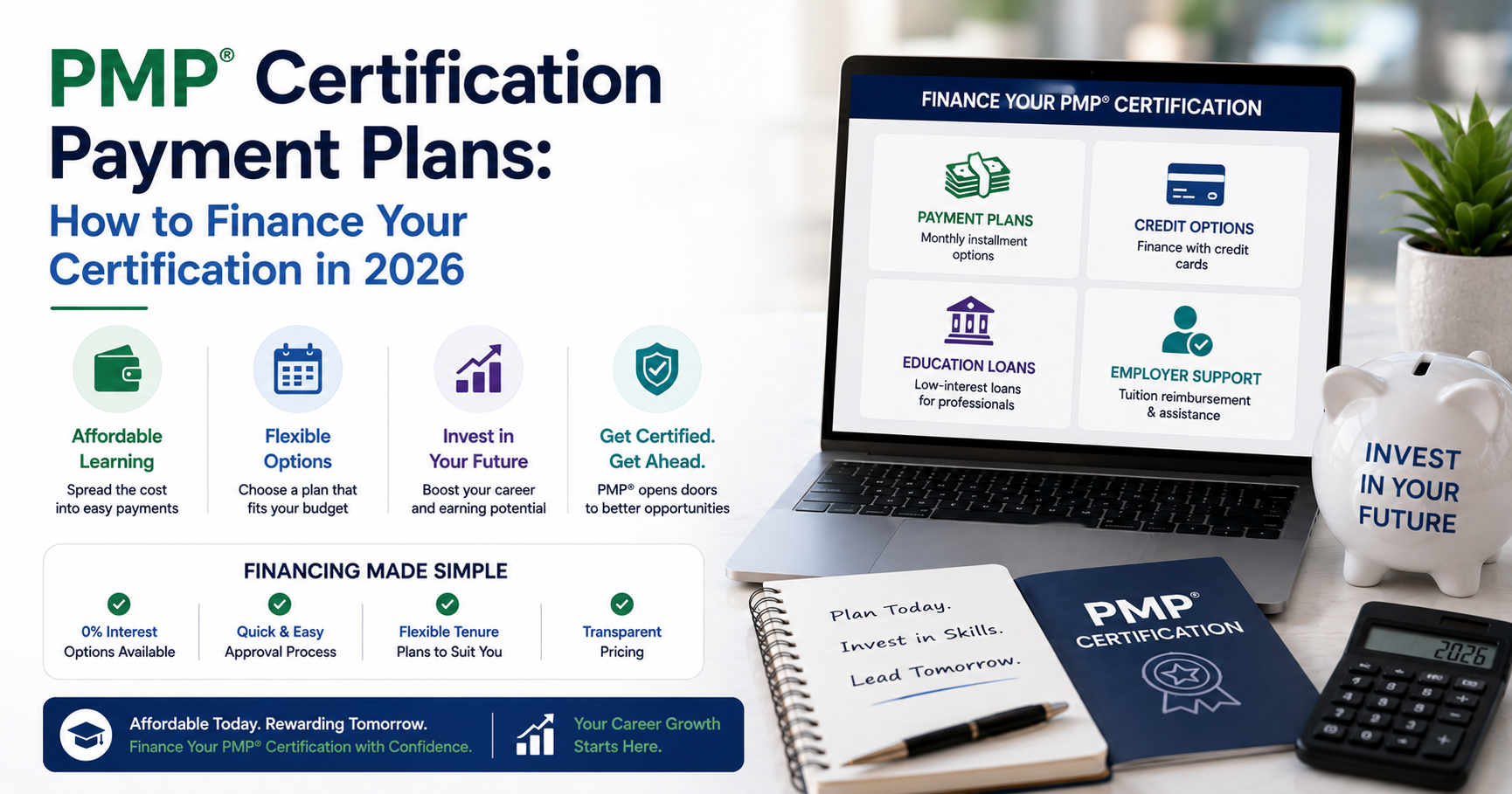
Candidates who cannot pay the full PMP certification cost upfront have several genuine financing routes in 2026: instalment plans offered directly by training providers, buy now pay later services such as Splitit, employer tuition reimbursement, PMI Foundation scholarships and, for teams, negotiated corporate billing.
PMI itself does not offer a payment plan for the exam fee, which must be paid in full through Pearson VUE, but the training portion of the cost, which is usually the largest single line item, is where nearly all the flexibility exists. This guide compares each option on cost, speed and who it actually suits, so you can pick a route that fits your budget rather than delaying your certification.
Key Highlights of PMP Certification Payment Plan
- PMI requires the exam fee to be paid in full; it does not offer its own instalment plan for exam registration.
- Many training providers, including Simpliaxis, allow candidates to split course fees across several months using services such as Splitit, which uses an existing credit card rather than a new loan.
- US employers can reimburse up to 5,250 US dollars a year in education assistance tax-free under Internal Revenue Code Section 127, which comfortably covers a full PMP certification budget.
- PMI Educational Foundation scholarships and chapter-level awards exist but are competitive, limited in number and rarely cover the full cost on their own.
- Self-employed and 1099 consultants can typically deduct PMP training and renewal costs as a business expense, but W-2 employees generally cannot once the 2017 tax law changes removed the miscellaneous itemised deduction in the United States.
- Organisations certifying more than one employee at a time can usually negotiate a lower effective per-head cost through corporate and group training arrangements rather than paying individual course fees.
- Budgeting only for the exam fee is the most common mistake; the true first-year outlay typically includes PMI membership, training, study materials and the exam fee together.
What Does PMP Certification Actually Cost Before You Look at Financing?
Before comparing payment methods, it helps to know what you are actually financing. PMI's published 2026 exam fee is 425 US dollars for PMI members and 675 US dollars for non-members, following a fee increase PMI implemented earlier in the year; candidates should always confirm the current figure on PMI.org before budgeting, since PMI has changed this fee more than once in recent years. PMI membership itself costs 139 US dollars annually, plus a one-time 10 US dollar application fee, and it pays for itself through the exam fee discount alone for most candidates.
Training costs vary the most of any line item, ranging from a few hundred dollars for self-paced e-learning up to 1,500 US dollars or more for live instructor-led programmes, with study materials typically adding another 50 to 200 US dollars. Put together, a realistic first-year budget for a member sits somewhere between 900 and 2,300 US dollars depending on the training format chosen, before any financing costs are added. Simpliaxis's PMP certification cost breakdown sets out the current fee structure in more detail if you want the full picture before deciding how to pay for it, and PMI's own PMP certification page carries the fee schedule PMI publishes directly.
Does PMI Offer a Payment Plan for the Exam Fee?
No, PMI does not offer an instalment option for the exam registration fee itself. Once you submit your application and it is approved, PMI expects payment in full through its online portal before Pearson VUE will issue a scheduling authorisation. This is worth knowing early, because it means any financing strategy needs to cover the exam fee as a single lump sum, even if the training fee around it is spread out.
Candidates who fail the exam and need to retake it face a separate fee of 275 US dollars for members and 375 US dollars for non-members, payable again in full, for up to two retakes within one year of the first attempt. Because PMI will not finance this cost, building a small buffer into your savings for a possible retake is more realistic budgeting than assuming a first-attempt pass. Simpliaxis's PMP exam fee guide covers the current schedule for both scenarios in more detail.
How Training Providers Structure Instalment and EMI Plans
The flexibility candidates actually experience comes almost entirely from training providers rather than from PMI. Simpliaxis, for example, allows candidates to pay for PMP training in full or across instalments, with payment channels that include credit and debit cards, net banking, direct bank transfer, wire transfer and instalment processing through Stripe and Splitit. This matters because it separates the two costs that make up your total spend: the exam fee, which must be paid at once to PMI, and the training fee, which can be spread across the weeks leading up to your course start date.
A typical instalment structure seen across the training industry splits payment into two parts, with roughly half due before the course begins and the remainder due before the course concludes, though the exact split varies by provider and course format. If a payment plan matters to your decision, ask a training provider directly how many instalments they allow and whether a card processing fee applies, since this detail is rarely standardised across the industry. Simpliaxis lists its current PMP certification training formats and fees directly on its course page, alongside a self-paced PMP prep online course for candidates who want the lowest-cost entry point before committing to a live instalment schedule.
What to Ask a Provider Before Enrolling on an Instalment Plan
- Number of instalments: how many payments are allowed and over what period.
- Processing fees: whether splitting payment adds any surcharge compared with paying in full.
- Access timing: whether course materials and live sessions are released only after each instalment clears.
- Cancellation terms: what happens to instalments already paid if you need to withdraw or reschedule.
Using Buy Now, Pay Later Services for Certification Training
Buy now, pay later platforms have moved beyond retail and are increasingly used for professional training purchases, including certification courses. Splitit is the option most directly relevant here because it lets a candidate use an existing credit card's available limit to fund a instalment schedule, typically over three to twelve months, without a new credit application or interest charge in most configurations.
Affirm operates differently, extending its own point-of-sale credit with terms that can run from six weeks up to thirty-six months depending on the merchant and purchase amount, and it does report payment data to consumer credit bureaus. Klarna's pay-in-four model splits a purchase into four equal, interest-free instalments over four to six weeks, which suits a lower-cost training package more than a full live bootcamp. The table below compares the three at a glance.
Service | Typical Term | Interest | Credit Check | Best Suited To |
| Splitit | 3 to 12 months | Usually none, uses existing card credit | No new credit check | Candidates who already have card headroom |
| Affirm | 6 weeks to 36 months | May apply depending on term | Soft or hard check depending on plan | Larger course fees needing longer terms |
| Klarna Pay in 4 | 4 to 6 weeks | None | Soft check only | Lower-cost or self-paced packages |
Not every PMP training provider integrates every one of these services, so confirm availability before assuming you can use a particular platform. Where a provider does support one of these tools at checkout, it is usually shown directly on the enrolment page rather than requiring a separate application.
Getting Your Employer to Pay: Tuition Reimbursement and the Tax-Free Limit
Employer funding is, in practice, the most financially efficient route for most candidates, and it is worth pursuing before any personal financing option. In the United States, Internal Revenue Code Section 127 allows an employer to provide up to 5,250 US dollars per employee per calendar year in tax-free educational assistance, an amount that comfortably covers a full PMP certification budget including membership, training and the exam fee. For the employer, the cost is generally deductible as an ordinary business expense where the certification maintains or improves skills required for the employee's current role, which a project manager pursuing PMP certification clearly satisfies. The employee, in turn, does not pay income tax on funds received under a qualifying Section 127 plan, and cannot separately claim those same costs as a personal deduction, since claiming both would amount to double counting the same expense. The IRS sets out the qualifying conditions for employer-provided educational assistance on its Publication 970 page, which is worth reviewing alongside whatever policy your own employer has in place.
If you manage a team rather than seeking funding for yourself, the calculation changes. Reimbursing several employees individually through separate approvals is administratively heavier than arranging one negotiated enrolment for the whole group, and most training providers price a multi-seat booking lower per person than the sum of individual course fees. Simpliaxis's corporate and group training programme is built around this exact scenario, allowing a PMO or learning and development manager to enrol anywhere from five to several hundred staff under a single invoice with a customised schedule, which is usually a more cost-effective and easier-to-approve route than processing individual reimbursement claims for the same number of people.
PMI Scholarships, Grants and Reduced-Fee Options
For candidates without access to employer funding, PMI-affiliated scholarship programmes are worth investigating, though expectations should be realistic about how much they typically cover. The PMI Educational Foundation administers named awards, including the Dr Harold Kerzner scholarship and the Matthew H Parry Memorial Award, with individual grant values that have historically ranged from around 2,000 to 10,000 US dollars, aimed primarily at students and early-career professionals pursuing project management education rather than working professionals mid-career.
Many local PMI chapters separately run smaller scholarship or discount programmes for members in their region, and some universities offering project management coursework provide need-based or merit-based aid that can be applied toward PMP-aligned training. None of these routes is guaranteed, and application windows and eligibility criteria change year to year, so treat scholarships as a possible partial offset rather than a primary funding plan, and confirm current details directly with PMI's Educational Foundation or your local chapter before counting on an award.
Is PMP Training Tax-Deductible If You Pay Out of Pocket?
The answer depends heavily on your employment status. Self-employed project managers, freelance consultants and independent contractors operating on a 1099 basis in the United States can generally treat PMP training, exam fees and renewal costs as an ordinary and necessary business expense, deductible against business income, provided the certification maintains or improves skills used in their existing consulting work rather than qualifying them for an entirely new profession.
W-2 employees are in a less favourable position following the Tax Cuts and Jobs Act of 2017, which suspended the miscellaneous itemised deduction that previously allowed unreimbursed employee business expenses, including certification costs, to be claimed on a personal tax return.
This is precisely why pursuing employer reimbursement under Section 127, discussed above, is usually more valuable to a salaried employee than attempting to claim a personal deduction, since the reimbursement route is tax-free at the point of payment rather than a deduction claimed later. Because tax treatment varies by country and by individual circumstances, candidates outside the United States, or with unusual employment arrangements, should confirm the current rule with a qualified tax adviser rather than relying on general guidance.
Comparing the Financing Routes
With several options on the table, the right choice usually comes down to how much control you have over timing and who else benefits from the certification. The comparison below summarises the trade-offs.
Financing Route | Speed to Access | Net Cost | Best For |
| Pay in full | Immediate | Lowest, no processing fees | Candidates with available savings |
| Provider instalment plan | Immediate to a few days | Low, occasional processing fee | Candidates who want to spread training cost only |
| Buy now, pay later | Immediate | Low to moderate depending on term | Candidates without employer support who need short-term flexibility |
| Employer reimbursement | Depends on internal approval | Effectively zero to the employee | Employed candidates whose role uses project management skills |
| Scholarship or grant | Application cycle dependent | Partial offset only | Students and early-career candidates |
| Corporate group enrolment | Negotiated by employer | Lower per-head cost than individual fees | Organisations certifying multiple staff at once |
How to Budget for the Full Three-Year Certification Cycle
Financing the first year is only part of the picture, because PMP certification is not a one-time cost. The credential must be renewed every three years by earning 60 professional development units and paying a renewal fee, which is 60 US dollars for PMI members and 150 US dollars for non-members. Many PDUs can be earned at little or no cost through PMI-approved webinars, volunteering and reading activities, so the recurring cash cost of renewal is usually modest compared with the initial certification spend, but it is still worth setting aside a small annual amount rather than treating year one as the end of your budgeting.
A candidate who plans across the full cycle, rather than focusing only on exam day, is far less likely to be caught off guard by membership renewal, PDU-related course fees or a lapsed certification that requires retaking the exam entirely. Simpliaxis's guide to PMP PDU requirements breaks down exactly which activities count toward the 60-PDU renewal target.
Common Mistakes Candidates Make When Financing Their Certification
Most financing problems trace back to a handful of avoidable errors rather than a lack of available options. Recognising them ahead of time is usually enough to sidestep them entirely.
- Budgeting only for the exam fee and being surprised by training, materials and membership costs that arrive later in the process.
- Enrolling on an instalment plan without confirming whether course access is gated behind each payment, which can delay study time if a payment is late.
- Assuming a buy now, pay later service is available at checkout without checking, then discovering the provider only accepts card or bank transfer.
- Requesting employer reimbursement after paying personally, rather than confirming in advance whether the employer's plan pays the provider directly or reimburses the employee, which changes the paperwork required.
- Treating a scholarship application as a funding plan rather than a possible bonus, and delaying enrolment while waiting on an uncertain award decision.
- Forgetting to budget for the retake fee as a contingency, then facing a second, unplanned cost if the first attempt does not succeed.
None of these mistakes is difficult to avoid once you know to look for them, and doing so upfront tends to save more money and stress than any single financing product on its own.
How Group Bookings Change the Maths for Organisations
Everything above assumes an individual paying for their own certification, but the calculation looks different for a PMO, learning and development team, or department head deciding how to certify several people at once. Financing five, ten or fifty individual course seats separately multiplies both the administrative overhead of tracking payments and, in most cases, the total price paid, because per-seat list pricing rarely reflects the discount a provider is willing to offer for a bulk booking.
Organisations in this position are usually better served asking a training provider for a single group quotation covering the whole cohort, with one invoice, one negotiated schedule and often a lower blended rate per participant than the sum of individual enrolments would cost. This is a different conversation from employer reimbursement for a single employee, and it is worth having separately with whichever training provider you are considering, since group pricing is rarely published openly on a course page and typically requires a direct enquiry.
Conclusion
Financing a PMP certification is rarely an all-or-nothing decision between paying in full or not pursuing certification at all. PMI's own fee must be paid in one instalment, but everything built around it, training cost, study materials and even the framing of who pays, offers real flexibility. Employer reimbursement remains the most efficient route where it is available, both because it is tax-free to the employee and because it removes the need for any personal financing at all, while provider instalment plans and buy now, pay later services give individual candidates a practical middle path when employer funding is not on the table.
For organisations weighing the cost of certifying several team members at once, corporate group enrolment nearly always beats financing each person's course fee separately, both in total cost and in administrative effort. Whichever route fits your situation, the most reliable outcome comes from budgeting for the full certification and renewal cycle upfront rather than reacting to costs as they arrive.







 Lowest-Price Challenge











 Personalized Path


.webp)


 USA
USA  Canada
  India
India  UK
UK  Australia
  Singapore


