


 Call Us



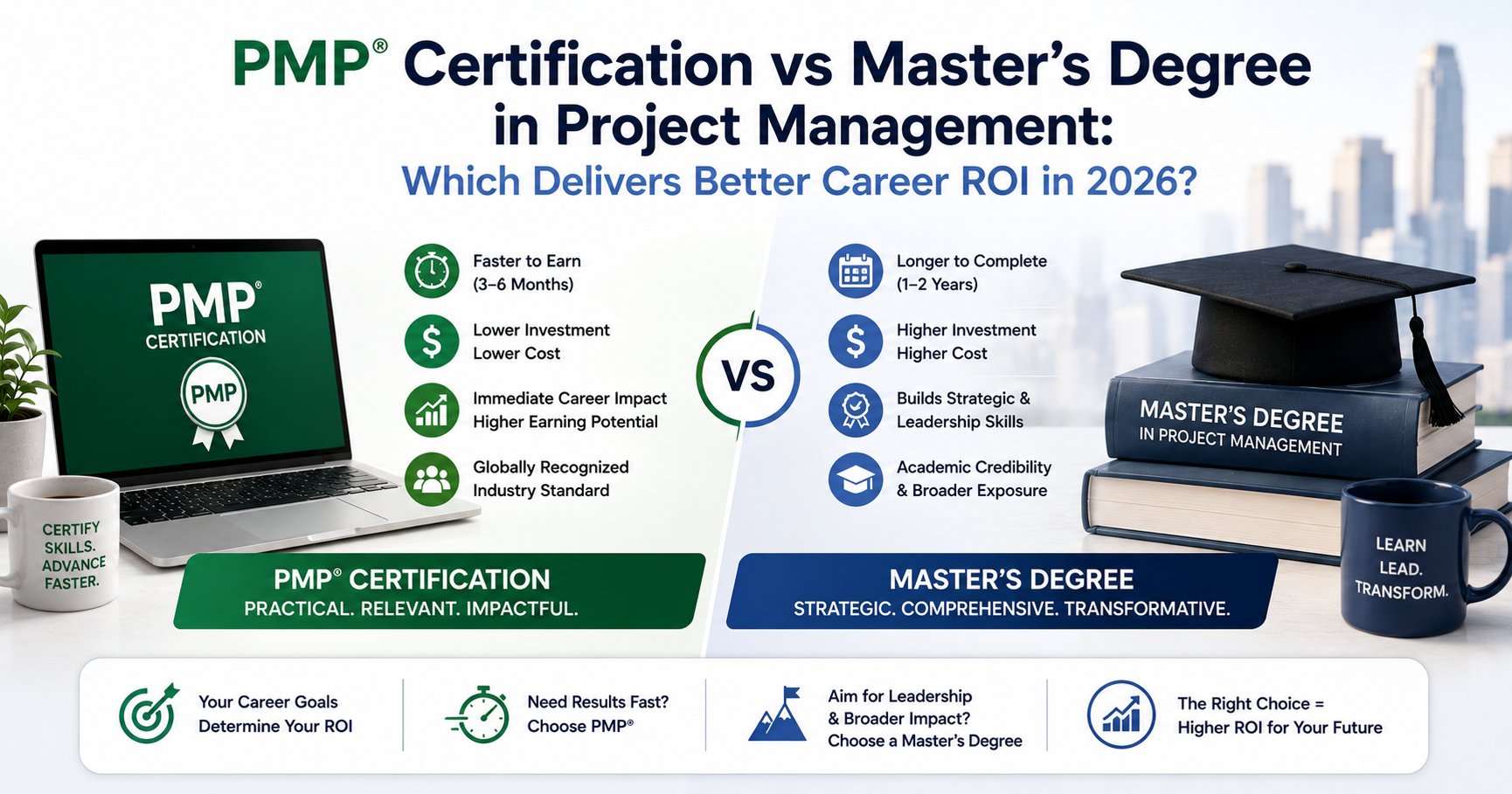
For most working project managers, PMP certification delivers a faster and cheaper route to a documented salary premium, typically costing under 2,500 US dollars and taking two to six months, compared with a master's degree in project management that can cost 20,000 to 120,000 US dollars and take one to four years. A master's degree still has a real place, particularly for candidates who lack the hands-on experience PMP requires or who are aiming for strategic, consulting or academic roles beyond direct project delivery. The two credentials are not strict substitutes for each other, and understanding what each one actually verifies is more useful than treating this as a simple either-or choice.
Key Highlights: PMP Certification vs Master's Degree in Project Management
- PMP certification requires verified project leadership experience before you can sit the exam, while a master's degree in project management generally does not require any prior experience to enrol.
- PMI's Earning Power Salary Survey reports certified professionals earning around a 33 percent higher median salary than non-certified peers across the countries it surveys.
- Total cost for PMP certification typically falls between 900 and 2,500 US dollars, against 20,000 to 120,000 US dollars or more for a full master's degree programme.
- Job postings for project management roles across IT, construction, healthcare and government commonly list PMP certification as required or preferred, while a master's degree is rarely specified in the same postings.
- Reported salary differences between PMP-certified professionals and master's degree holders are often smaller than expected, since the master's degree tends to open different, more strategic roles rather than simply paying more for the same role.
- Combining both is realistic for professionals with a long runway to a leadership role, since a master's degree strengthens strategic and organisational competencies that complement, rather than duplicate, what the PMP exam tests.
- Organisations building an internal project management capability across a team should weigh certification training for the whole group against sponsoring individual staff through a graduate programme, since the two paths scale very differently in cost and timeline.
What Each Credential Actually Verifies
The clearest way to compare PMP certification with a master's degree in project management is to start with what each one is designed to prove, because they are not measuring the same thing. PMP certification, administered by the Project Management Institute, verifies that a candidate has already led and directed projects for a minimum period, typically 36 non-overlapping months for degree holders or 60 months for those without a four-year degree, alongside 35 hours of formal project management education, and has then passed an exam testing applied competency across PMI's People, Process and Business Environment domains.
A master's degree in project management, by contrast, is an academic qualification that builds theoretical and strategic knowledge, covering areas such as organisational behaviour, business strategy, financial management and research methods, generally without requiring any verified project leadership experience to enrol. In practical terms, PMP certifies that you have already done the job successfully; a master's degree certifies that you have studied the subject in depth, which is a meaningfully different signal to an employer reading your resume.
What a Master's Curriculum Typically Covers That the PMP Exam Does Not
A full master's programme usually spends far more time than any certification exam on subjects that sit outside a single project's boundaries. Coursework commonly includes organisational strategy and design, corporate finance and capital budgeting, negotiation theory, applied research methods and a capstone project or thesis that requires original analysis rather than scenario-based questions.
These are genuinely different skills from the ones the PMP exam tests, and they explain why a master's degree tends to open doors into programme, portfolio and general management tracks rather than simply duplicating the individual-project competency PMP already verifies. Candidates who already hold a PMP and are considering a master's degree afterward should weigh whether their target role actually calls for this broader strategic toolkit, rather than assuming the degree will simply reinforce what the certification already covers.
Cost and Time Investment Compared
The gap between the two options is largest on cost and time, and it is worth putting real numbers side by side rather than relying on a general sense that one is more expensive than the other.
Factor | PMP Certification | Master's Degree in Project Management |
| Typical total cost | 900 to 2,500 US dollars | 20,000 to 120,000 US dollars, depending on institution |
| Typical time to complete | 2 to 6 months of preparation | 1 to 2 years full-time, 2 to 4 years part-time |
| Prior experience required | 36 to 60 months of verified project leadership | Generally none required to enrol |
| Renewal or ongoing requirement | 60 PDUs every 3 years | None, the degree does not expire |
| Primary signal to employers | Demonstrated, verified delivery capability | Depth of academic and strategic knowledge |
These figures make clear why PMP is often described as the faster route to a documented return: the certification asks for an investment roughly equivalent to a single week's salary for many project managers, set against a multi-year academic programme that can cost more than a year's income.
That does not automatically make PMP the better choice for every candidate, since the two credentials are frequently aimed at different points in a career, which the next sections unpack in more detail. Simpliaxis's PMP certification cost breakdown sets out the current certification-only pricing if you want to model your own budget before deciding.
Salary and Career Impact: What the Data Actually Shows
Salary comparisons between the two paths are easy to overstate in either direction, so it is worth being precise about what is actually documented. PMI's 14th edition Earning Power Salary Survey reports that PMP-certified professionals earn approximately 33 percent more in median salary than non-certified peers across the 21 countries it surveys, a figure PMI has published consistently across recent survey editions.
The U.S. Bureau of Labor Statistics separately reports a median annual wage for project management specialists broadly, a useful baseline figure to compare against PMI's certified-professional data, since the two datasets measure slightly different populations, one government occupational data and one certification-holder survey data, and are worth reading together rather than in isolation when you are trying to estimate your own realistic salary trajectory. What is less commonly reported is that PMI's own salary survey data has, in some editions, shown professionals holding a master's degree earning a mean salary within a relatively small margin of PMP-certified professionals, sometimes under 1,000 US dollars apart, which suggests the two credentials can converge on similar pay outcomes despite very different costs to obtain.
The more useful distinction is not which credential pays more on average, but which roles each one actually unlocks: PMP certification is consistently listed as a required or preferred qualification in project manager and senior project manager postings across IT, construction, healthcare, finance and government, while project management master's degrees are more commonly associated with programme director, portfolio management, consulting and general management track roles that sit a level above individual project delivery. Simpliaxis's PMP salary guide breaks down current pay ranges by role and region in more detail.
Which Do Employers Actually Prefer for Project Manager Roles?
Employer preference is one of the more consistently answerable questions in this comparison, because it shows up directly in job posting language rather than requiring survey interpretation. Analysis of project manager and senior project manager job postings across IT, construction, healthcare and government sectors shows PMP certification listed as required or strongly preferred with far greater frequency than any master's degree in project management, largely because the certification verifies hands-on delivery capability in a way a purely academic qualification cannot.
A frequently cited industry statistic from PricewaterhouseCoopers found that around 80 percent of high-performing projects were led by credentialed project managers, which is the kind of data point hiring managers use to justify listing PMP as a screening criterion. This does not mean a master's degree carries no weight; it is simply weighted differently, typically valued more for roles with a strategic, cross-portfolio or organisational leadership component than for individual contributor project manager positions where PMP remains the more commonly requested credential.
Where a Master's Degree Tends to Matter More
- Portfolio management, programme director and VP-level project leadership roles that require broader strategic and organisational context.
- Consulting positions where a graduate credential signals depth across business strategy rather than project execution alone.
- Career changers with no prior project leadership experience, since a master's degree does not require the work history PMP certification demands.
- Academic or research-adjacent project management roles, and some public sector postings that specify a graduate qualification directly.
Can You Combine Both, and Does It Make Sense To?
For professionals with a longer time horizon, pursuing both is a genuinely reasonable strategy rather than an either-or decision, and the order usually matters. Earning PMP certification first makes practical sense for most working professionals, since it requires the project leadership experience you are likely already accumulating, costs a fraction of a graduate programme, and can be completed while still employed full-time through a format such as Simpliaxis's PMP certification training.
A master's degree pursued afterward, once PMP has already validated applied competency, tends to work well as a complement rather than a duplication, deepening strategic, financial and organisational knowledge that supports a move into programme or portfolio leadership rather than re-testing skills the PMP exam already covers.
Attempting the reverse order, a master's degree followed by PMP certification, is workable too, though candidates in this position still need to accumulate the required months of verified project leadership experience before they can sit the PMP exam, regardless of how advanced their academic qualification is, since PMI's eligibility criteria are experience-based rather than education-based beyond the minimum degree requirement. Simpliaxis's PMP certification eligibility guide sets out the exact experience thresholds that apply regardless of your academic background.
How the 2026 PMBOK Guide Changes Affect This Comparison
PMI released the PMBOK Guide 8th Edition in November 2025, and a corresponding update to the PMP Examination Content Outline takes effect in mid-2026, with the Business Environment domain weighting reportedly increasing substantially compared with earlier exam versions, alongside greater emphasis on Agile and hybrid delivery approaches and AI-enabled work environments.
This shift narrows one traditional argument in favour of a master's degree, namely that academic programmes cover strategic business context more thoroughly than a certification exam does, since the updated PMP content outline now tests considerably more of that same strategic and business-environment material directly.
It does not eliminate the case for a master's degree, since a graduate programme still goes deeper into topics such as organisational finance, research methodology and change leadership than any single certification exam can, but candidates weighing the two options in 2026 should factor in that the exam itself is moving somewhat closer to testing the strategic judgement a master's degree has traditionally been associated with.
Choosing a Master's Programme If You Go That Route
If a master's degree still makes sense for your goals, the accreditation and format questions that matter are different from the ones you would ask about a certification provider. Programmes accredited by recognised regional or national accreditation bodies, and ideally aligned with PMI's own Global Accreditation Center standards where the university offers that alignment, tend to carry more weight with employers than an unaccredited or loosely affiliated programme.
Format matters too: a full-time residential programme suits candidates able to step away from work entirely, while an online or part-time format, now offered by a large number of accredited universities, allows working project managers to study alongside a full-time role, which is the more common path for professionals who already hold PMP certification and are adding a degree later in their career. Whichever format you choose, verify a programme's accreditation and outcomes data directly with the institution rather than relying solely on its own marketing materials, in the same way you would verify a PMP training provider before enrolling.
A Decision Framework: Which Path Fits Your Situation
Rather than treating this as a single universal answer, the more useful approach is matching the decision to your actual career stage and constraints.
- Already leading projects with three or more years of experience: PMP certification is almost always the faster, lower-cost route to a documented credential employers actively screen for.
- No project leadership experience yet, career switcher or recent graduate: a master's degree, or an entry-level pathway building toward PMP eligibility, may suit you better since you cannot yet meet PMP's experience requirement.
- Targeting programme director, portfolio or VP-level roles: consider PMP first for the near-term credential, then a master's degree for the strategic depth those senior roles increasingly expect.
- Budget-constrained but need a credential quickly for a current role: PMP certification's lower cost and shorter timeline make it the more accessible option in most cases, particularly through a self-paced format such as Simpliaxis's PMP prep online course.
- Employer or organisation building project management capability across a team: certifying multiple staff through group PMP training is typically far faster and less costly than sponsoring several employees through individual graduate programmes, and worth evaluating as a distinct decision from an individual's personal career planning.
What This Means for Organisations Building PM Capability at Scale
The comparison above is framed around an individual's career decision, but the calculation changes when a PMO, learning and development function, or department head is deciding how to build project management capability across a whole team rather than for one person.
Sponsoring a single employee through a master's degree is a multi-year, high-cost commitment that only benefits one individual, whereas the same budget can typically certify a much larger number of staff in PMP within a single year, spreading the organisational capability uplift far more broadly.
Simpliaxis's corporate and group training programme is designed for exactly this scenario, allowing an organisation to enrol a cohort of employees in PMP preparation together, with a schedule and pricing structure built around group rather than individual enrolment, which is generally a more efficient way to raise project management maturity across a department than funding graduate degrees for a handful of people.
Conclusion
PMP certification and a master's degree in project management are answering different questions rather than competing for the same answer. PMP verifies that you can already lead a project successfully and does so quickly and at comparatively low cost, which is why employers screen for it so consistently in individual contributor and mid-level project manager roles.
A master's degree builds broader strategic and organisational depth over a much longer and more expensive commitment, and tends to matter more as candidates move toward portfolio, programme or executive leadership. For most working professionals with existing project experience, PMP certification is the more efficient near-term investment, with a master's degree worth considering later, or in parallel, once a specific strategic leadership goal makes the additional time and cost clearly worthwhile.
Whichever path, or combination of paths, you choose, treat the decision as a function of your current experience, your target role and your realistic budget rather than a generic ranking of one credential over the other, since the two are answering different career questions rather than competing head to head for the same one.



_1785328534.webp)




 Lowest-Price Challenge











 Personalized Path


.webp)


 USA
USA  Canada
  India
India  UK
UK  Australia
  Singapore


