


 Call Us



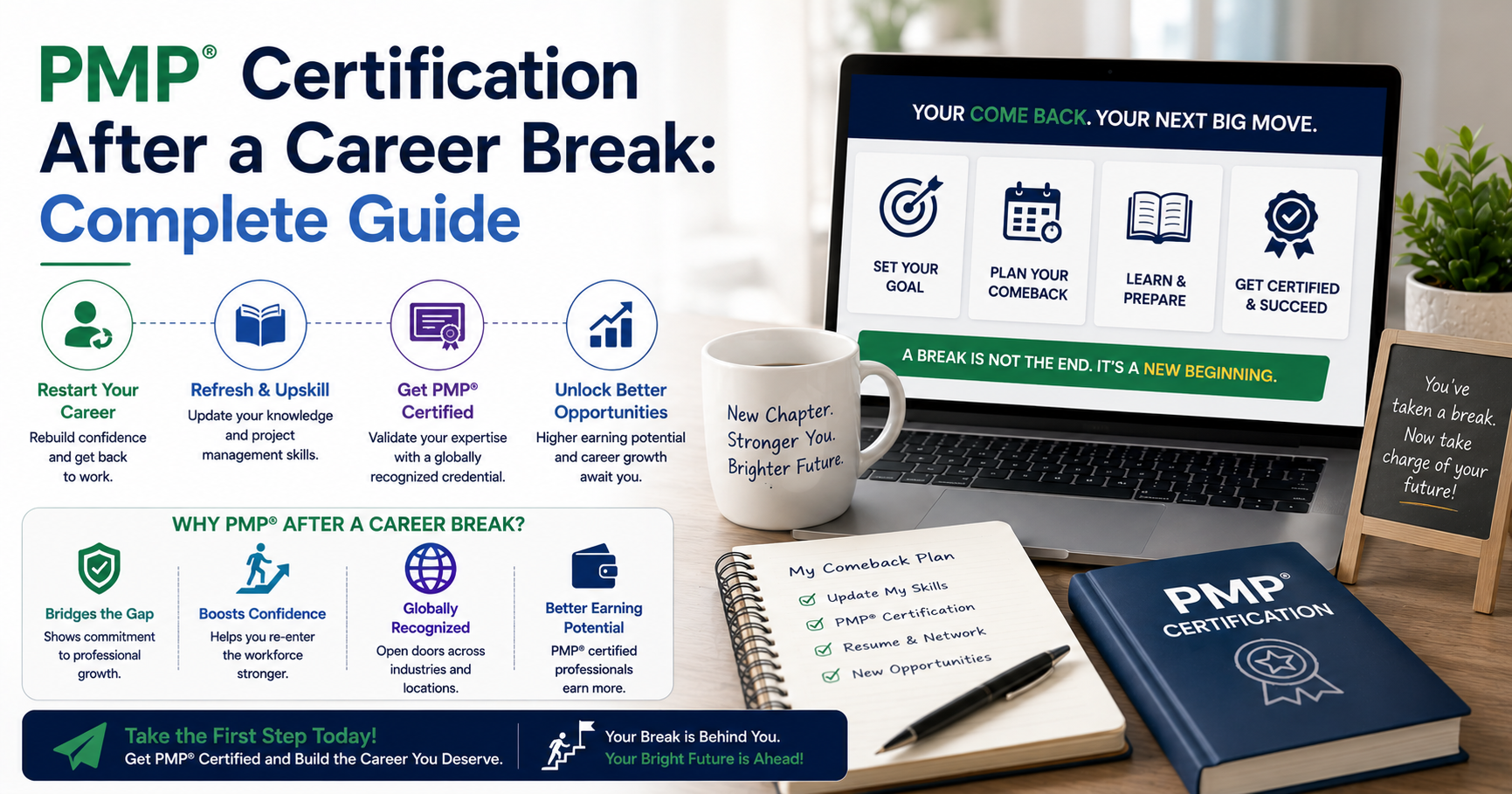
If you took time away from work for parental leave, caregiving, a health issue, a layoff, or a sabbatical, your prior project leadership experience does not automatically disappear from PMP eligibility, but it does have to fall within PMI's qualifying experience window, and a career break changes how you should approach both a fresh application and an existing but lapsed PMP credential.
Whether you are pursuing PMP for the first time or trying to reinstate one you already earned, the practical path depends on how long you were away, what status your certification is in, and how many Professional Development Units you still owe. This guide walks through eligibility, reinstatement, PDU catch-up, and study logistics specifically for someone re-entering the workforce.
Key Highlights of PMP Certification After a Career Break
- PMI's eligibility pathways require your project leadership months to fall within a defined lookback window, so experience from many years ago can still count, but only up to that limit, and PMI counts non-overlapping calendar months, not the number of projects you ran.
- A lapsed PMP certification does not expire the moment your three-year cycle ends. It first moves to a one-year suspended status during which reinstatement is possible without retaking the exam.
- If the suspension period passes without your PDUs and renewal fee being submitted, the certification expires permanently and the only way back is to sit the full PMP exam again.
- Reinstatement fees during suspension differ from standard renewal fees, and PMI members typically pay less than non-members for both.
- PDUs cannot be backdated for time you did not actually spend learning, teaching, or volunteering, so catching up means front-loading genuine activity, not fabricating a paper trail.
- For people considering PMP for the first time as part of a return-to-work plan, the credential can offset a resume gap by signalling current, verifiable project management competence to hiring managers.
- Study logistics for someone re-entering work look different from a first-time student's plan, and pacing, timing the exam around your return date, and choosing a structured course matter more than cramming volume.
Does Your Old Project Leadership Experience Still Count Toward PMP Eligibility?
Yes, older project leadership experience can still count toward PMP eligibility, provided the months you are claiming fall inside PMI's qualifying experience window and add up to the non-overlapping total your education tier requires. PMI does not ask when you stopped working; it asks whether the specific months of leadership experience you are citing sit within the lookback period tied to your application.
How PMI Measures Your Experience Window
PMI's current eligibility framework recognises four education-and-experience pathways, and each one requires that your project leadership months fall within the past 10 years. According to Simpliaxis's PMP certification eligibility guide, the four sets are structured as follows.
Pathway | Education Level | Required Project Leadership Experience | Experience Window |
| Set A | Upper-secondary education (high school diploma or equivalent) | 60 months (5 years), non-overlapping | Past 10 years |
| Set B | Post-secondary or associate-level qualification | 48 months (4 years), non-overlapping | Past 10 years |
| Set C | Bachelor's degree or equivalent advanced qualification | 36 months (3 years), non-overlapping | Past 10 years |
| Set D | Bachelor's or postgraduate degree from a PMI Global Accreditation Center (GAC) programme | 24 months (2 years), non-overlapping | Past 10 years |
Every pathway also requires 35 hours of project management education, which is waived if you already hold PMI's Certified Associate in Project Management. The key point for anyone returning after a break is that PMI measures the calendar span during which you held genuine project leadership responsibility, not the number of projects you managed multiplied by their length. If you led three overlapping projects for the same 12 months, that counts as 12 months, not 36. This is why candidates returning from a break should map out their prior roles by calendar month before assuming they are short of hours.
What If Your Best Project Leadership Experience Falls Outside the Window?
If the bulk of your qualifying experience sits right at the edge of, or just outside, the 10-year window, you have three realistic options: apply now while the older months still count, accumulate fresh experience in a project-adjacent role after returning to work, or combine a shorter stretch of recent leadership experience with older experience that still falls inside the window. A career break itself does not subtract time from the window; it simply means fewer of your working years are recent, so it is worth listing every project role by start and end date before you conclude you are short.
There is also a practical, non-PMI risk worth flagging: the further back your experience sits, the harder it can be to reach a former supervisor for verification if your application is selected for PMI's audit process, which reviews a random sample of applications and asks for documentation and reference contact details. Before you apply, it is worth reconnecting with former managers or colleagues who can confirm your role, even if the project itself was several years ago.
What Happens to a PMP Certification You Already Earned If It Lapses During a Career Break?
A PMP certification that lapses during a career break does not vanish overnight. It moves through a defined sequence, active, then suspended for up to one year, then expired, and where you land in that sequence determines whether you can reinstate it or must retake the exam entirely.
Suspended Versus Expired: Understanding Your Status
PMI's Continuing Certification Requirements programme, described in PMI's certification maintenance guidance and detailed further in PMI's Continuing Certification Requirements Handbook, runs on a three-year cycle that begins the day you pass the PMP exam. Within that cycle you must earn 60 Professional Development Units, a minimum of 35 from the Education category and up to 25 from the Giving Back category, and submit both your PDUs and a renewal fee through PMI's Continuing Certification Requirements System, commonly called CCRS.
If your three-year cycle ends while you are on a career break and you have not met those requirements, your certification status changes to suspended rather than expired. The suspension period lasts one year from your cycle end date. During suspension you cannot use the PMP designation professionally, but you retain the ability to reinstate without sitting the exam again, provided you complete the outstanding PDUs and pay the applicable fee before the suspension window closes.
How to Reinstate a Suspended PMP Certification
Reinstating a suspended certification follows a defined sequence rather than a single application form.
- Check your status in CCRS. Log in to PMI's Continuing Certification Requirements System to see your exact cycle end date, how many PDUs you have already logged, and how many days remain in your suspension window.
- Close the PDU gap. Earn the outstanding PDUs across the Education and Giving Back categories, keeping documentation for each activity in case of an audit.
- Submit your PDUs in CCRS. Record each activity with the provider, date, hours, and a brief description, categorised correctly as Education or Giving Back.
- Pay the reinstatement fee. Fees during suspension run higher than a standard on-time renewal. Multiple sources tracking PMI's published fee schedule, including Infosec Institute's PMP renewal guidance, put the suspension-period reinstatement fee at $85 for PMI members and $150 for non-members, compared with the standard on-time renewal fee of $60 for members and $150 for non-members listed on Simpliaxis's PMP certification renewal fee page.
- Confirm reactivation. Once PMI processes your submission, your certification returns to active status and a new three-year cycle begins.
Status | What It Means | Can You Reinstate Without Retaking the Exam? |
| Active | You are within your three-year cycle and in good standing | Not applicable |
| Suspended | Cycle ended without required PDUs or renewal fee; one-year grace window is running | Yes, if you complete requirements before the window closes |
| Expired | Suspension window closed without reinstatement | No, the full PMP exam must be retaken |
When You Have No Choice But to Retake the Exam
If your suspension period closes before you complete your PDUs and pay the fee, your certification expires permanently, and PMI's stated route back is to reapply for eligibility and sit the full PMP exam again, exam fee included. For someone whose career break stretched well past the one-year suspension window, this is the realistic outcome to plan for rather than an edge case to hope around. If this applies to you, it is worth treating the situation the same way a first-time candidate would, reviewing current eligibility, budgeting for the exam fee, and rebuilding a study plan around the full cost picture, not just the exam itself.
How Do You Catch Up on PDUs After Time Away From Work?
You catch up on PDUs by working backward from your actual cycle end date, identifying exactly how many of the 60 required PDUs you are short, and then filling that gap through a mix of recognised Education activity and Giving Back activity, since PMI does not allow PDUs to be claimed for time during which no qualifying activity actually took place.
Where a Career Break Typically Leaves Your PDU Balance
Most professionals on a career break stop earning PDUs the day they stop working in a PMI-adjacent capacity, which means the gap is usually proportional to how long the break lasted relative to your three-year cycle. According to Simpliaxis's PMP PDUs requirements guide, the 60 PDUs per cycle break down into a minimum of 35 Education PDUs, covering Ways of Working, Power Skills, and Business Acumen content, and up to 25 Giving Back PDUs, which can include working as a practitioner, volunteering, creating content, or mentoring others.
PDU Category | Requirement | Typical Activities |
| Education | Minimum 35 PDUs | Courses, webinars, conference sessions, self-study aligned to the PMI Talent Triangle |
| Giving Back to the Profession | Maximum 25 PDUs | Working as a practitioner, volunteering, mentoring, creating new project management content |
| Total Required | 60 PDUs per 3-year cycle | Combination of the above, recorded in CCRS |
Practical Ways to Rebuild Your PDU Total Quickly
- Prioritise instructor-led or on-demand courses first. A single accredited course can often supply a large block of Education PDUs at once, which is usually faster than assembling many small self-study entries.
- Use your carryover allowance strategically. PMI's CCR framework permits a limited number of PDUs earned in the final months of one cycle to roll into the next, so timing a course near your cycle boundary can work in your favour rather than against it.
- Log Giving Back activity as you re-enter the workforce. Mentoring a junior colleague, contributing to a professional association, or resuming practitioner work all count, and these are often easier to accumulate naturally once you are back in a project environment.
- Document everything as you go. Record the provider, date, and hours for each activity in CCRS immediately rather than reconstructing months of activity right before your deadline, since audit requests ask for exactly this detail.
- Do not backdate or estimate hours you did not actually spend learning. PMI's audit process cross-checks PDU claims, and claiming activity that did not occur risks the certification itself, not just the renewal.
If your gap is large enough that closing it before your suspension window ends looks genuinely unrealistic, it is worth contacting PMI directly to confirm your exact deadline rather than assuming the worst. Reinstatement is possible right up until the suspension period closes, so a career break that ran long does not automatically mean the certification is unrecoverable.
Should You Pursue PMP for the First Time as Part of a Career Relaunch?
Pursuing PMP for the first time during a return-to-work transition can be a genuinely strong move if you already have qualifying project leadership experience, because the credential gives hiring managers a verifiable, recent signal of competence that a resume gap alone cannot provide. It is a weaker move if you do not yet meet the experience threshold, in which case building the hours through re-entry work should come before the exam.
Career and recruitment guidance on returning to work consistently points to certifications as a way to reframe a break as a period of deliberate investment rather than absence. A widely referenced approach from career relaunch guidance is to present the break directly on a resume with a short entry naming the period and what was accomplished during it, for example noting that a certification was completed while away from paid work.
A verifiable, globally recognised credential like PMP does more of that work than a generic course completion, because it involves a proctored exam and an ongoing renewal obligation that signals the holder stays current.
There is also a market case for it. The credential is closely tied to senior and leadership project roles such as project manager, programme manager, and portfolio manager, and PMI's Earning Power Salary Survey findings, cited widely across PMP career resources, point to certified professionals reporting meaningfully higher median salaries than their non-certified peers. For someone rebuilding momentum after time away, that combination, a recognised leadership signal plus a documented salary differential, can matter more than it would for someone who never left the workforce, since it directly counters the assumption that a break equals skill erosion.
If you are undecided, the honest starting point is eligibility, not motivation. Confirm you meet one of the four experience pathways described earlier before committing time and money to exam preparation, since training providers such as Simpliaxis's PMP certification training course are built around candidates who already satisfy PMI's prerequisites.
Study and Logistics Advice for Returning Professionals
Studying for the PMP exam while re-entering the workforce works best when the plan is built around your return date and existing commitments, rather than borrowed from a generic first-time candidate's schedule.
Building a Study Plan Around Re-Entry, Not Around a Fixed Calendar
The single biggest logistics mistake returning professionals make is scheduling the exam for a fixed date without accounting for the ramp-up period a new or resumed job actually demands. A more realistic approach sequences study around three phases.
- Pre-return preparation. If you are still on your break when you begin studying, this is the lowest-friction window for concentrated study, since a structured, PMI-authorized course such as Simpliaxis's PMP certification online training can be paced around childcare, caregiving, or recovery schedules rather than a fixed office day.
- Transition period. In the weeks immediately around your actual return to work, expect study time to shrink sharply. Plan for lighter, spaced review rather than new content during this phase.
- Post-return stabilisation. Once your new routine settles, resume a steady weekly study cadence and set the exam date only after you have a realistic sense of how much time your role actually leaves you.
Practical Logistics Worth Planning For
- Budget for the full cost picture, not just the exam fee. Simpliaxis's PMP certification cost guide breaks down exam fees, PMI membership, training, and study materials together, which matters more when household finances shifted during a break.
- Consider PMI membership before you apply, since it lowers both the exam fee and future renewal fees, and its value compounds over your entire certification lifecycle, not just the first exam.
- Choose a training format that matches your actual availability rather than your ideal availability. Self-paced online formats tend to suit unpredictable caregiving or recovery schedules better than fixed live cohorts.
- Reconnect with former supervisors and project sponsors early, both for eligibility documentation and for references, since this becomes harder the longer you wait after returning to work.
- If you are also job hunting, sequence the certification to land before applications go out where possible, since it is easier to lead with a completed credential than a certification described as in progress.
- Keep expectations realistic about exam readiness. A career break does not lower the difficulty of the exam content, so treat it as a full study commitment rather than something to slot around a job search as an afterthought.
Conclusion
A career break changes the logistics around PMP certification, but it does not automatically disqualify you or erase what you already earned. Your prior project leadership experience still counts as long as it falls within PMI's current eligibility window, a lapsed certification usually has a genuine one-year reinstatement path before it expires for good, and PDU shortfalls are recoverable through real, documented activity rather than anything that needs to be invented.
The professionals who come through a break in the strongest position are the ones who check their actual status first, whether that is an eligibility calculation, a CCRS account, or a PDU balance, and then build a study or reinstatement plan around their real return-to-work timeline rather than a generic one. Used deliberately, PMP certification can be one of the clearest ways to signal that a career break was a pause, not a reset.







 Lowest-Price Challenge











 Personalized Path


.webp)


 USA
USA  Canada
  India
India  UK
UK  Australia
  Singapore


