


 Call Us



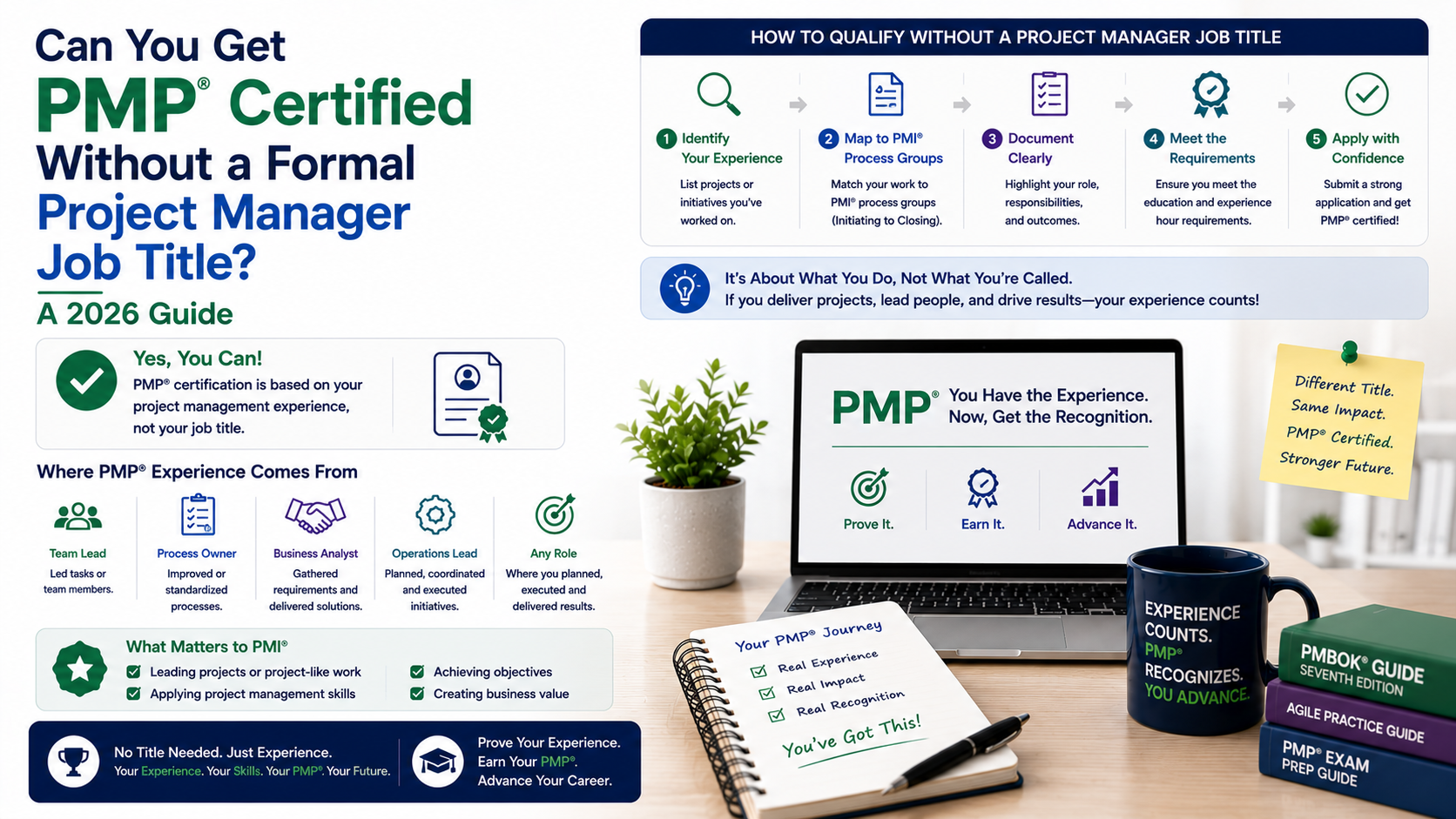
Yes, you can qualify for the PMP exam without ever holding the job title "Project Manager". PMI's own eligibility language asks whether you led and directed project tasks, not what your business card says, so team leads, coordinators, analysts, product owners and engineers who informally ran initiatives can all be eligible once their experience is documented correctly. The catch is not the title, it is proving the months of leadership through the right pathway, the right description language and, if selected, a clean audit trail.
Key Highlights of PMP Certification Without Project Manager Job Title
- PMI's eligibility criteria are written around "leading and directing project tasks", a phrase that appears in the PMP Handbook and deliberately excludes any mention of job title.
- As of 2026, PMI recognises four education-to-experience pathways: secondary diploma plus 60 months, associate degree plus 48 months, bachelor's degree plus 36 months, or a PMI GAC-accredited degree plus 24 months.
- Team leads, coordinators, business analysts, product owners, engineers, operations supervisors and even administrative staff who ran cross-functional initiatives regularly qualify once their role, not their title, is described accurately.
- Volunteer project work and cross-functional assignments inside a non-PM role can count toward the experience requirement, provided you can describe scope, decisions and outcomes.
- A late-2026 change to PMI's Authorized Training Partner (ATP) policy means the 35 contact hours you bank now should come from an ATP to avoid any risk of them being rejected later.
- PMI audits a portion of applications at random, so non-traditional candidates should assemble supervisor contacts, project artefacts and a STAR-style description before submitting, not after being flagged.
- If your months of qualifying leadership experience fall short today, a staged path (build documented experience, consider CAPM as a bridge, then apply for PMP) is usually more reliable than stretching a thin application.
What PMI Actually Checks: Role and Responsibility, Not Job Title
PMI's eligibility criteria for the PMP exam are built around demonstrated responsibility for project outcomes, not around a specific designation on an offer letter. The PMP Handbook published by PMI describes the required experience as time spent "leading and directing projects", a phrase examiners and application reviewers use consistently across every applicant, regardless of what their employer called them. This matters because a large share of people who actually run projects day to day are never given a project management title at all. A retail operations supervisor coordinating a store rollout, a marketing coordinator managing a product launch calendar, and a senior developer who owns a migration timeline can all be doing PMP-eligible work under a completely different job description.
The distinction PMI draws is between leading a project and contributing to one. Someone who wrote code, built a spreadsheet, or executed a task assigned by someone else contributed to a project. Someone who decided the scope, set or defended the schedule, managed the budget or resource trade-offs, resolved risks, and reported outcomes to stakeholders led it. If your daily responsibilities map to the second description, your title is close to irrelevant to your eligibility. What PMI's official PMP certification page and application reviewers are checking for is evidence of that leadership pattern repeated across enough qualifying months.
The Four PMP Eligibility Pathways in 2026
There are four distinct combinations of education and experience that satisfy PMI's eligibility requirement, and none of them reference job title anywhere in their wording.
Education level | Required project experience | Training hours |
| Secondary school diploma or global equivalent | 60 months (5 years) of leading and directing projects, earned within the last 8 years | 35 contact hours |
| Associate degree or global equivalent | 48 months (4 years) of leading and directing projects, earned within the last 8 years | 35 contact hours |
| Bachelor's degree or global equivalent | 36 months (3 years) of leading and directing projects, earned within the last 8 years | 35 contact hours |
| Bachelor's or postgraduate degree from a PMI GAC-accredited programme | 24 months (2 years) of leading and directing projects, earned within the last 8 years | 35 contact hours (GAC coursework may count toward this) |
Every pathway carries the identical 35 hours of formal project management education requirement, which is separate from the experience requirement and cannot substitute for it. This is where the non-traditional candidate has an advantage they often overlook: months of experience can be assembled from more than one job or even more than one type of role, so a career changer who spent two years coordinating operations and a further year running a cross-functional systems rollout in a different department can combine both toward the 36-month bachelor's degree threshold, provided each stretch is separately documented with dates and a named supervisor. Simpliaxis's detailed PMP exam eligibility breakdown is a useful cross-check once you have mapped your own timeline against the table above. If your degree came from outside the country where you now work, note that PMI's Global Accreditation Center page is also the reference point for confirming whether a specific programme carries GAC status, since that status is what unlocks the shorter 24-month pathway rather than the degree level alone.
Where AI and Modern Tooling Fit Into This Picture
One reason the title-versus-role gap has widened is that a growing share of project coordination now happens through shared dashboards, AI-assisted scheduling copilots and automated status reporting tools rather than through a dedicated project management office.
A business analyst who configures and interprets an AI-generated risk register, or a product owner who uses an automation tool to reprioritise a backlog against shifting delivery dates, is still making the scope, schedule and risk decisions PMI is evaluating, the tooling simply changes how the work is captured, not who is accountable for it.
PMI's current Examination Content Outline already weighs business environment and technology-aware decision-making alongside the traditional process domains, which is consistent with this shift: the exam increasingly expects candidates to show judgement in choosing and applying the right method or tool to a situation, not just execute a fixed process. For a non-traditional candidate, this is worth noting mainly because it removes one more excuse for self-disqualification. Using modern collaboration or automation tools to run a piece of work does not weaken your claim to having led it, provided the accountability for the decisions the tooling supports was genuinely yours.
What Does "Leading and Directing" Actually Look Like When You've Never Had the Title?
PMI is not asking whether you supervised staff on an organisational chart, it is asking whether you were accountable for a bounded piece of work with a start, an end, and a measurable result. Five signals consistently separate qualifying experience from work that merely touches a project.
- You owned scope decisions. You decided, or were the primary voice deciding, what was in or out of a piece of work, not just executed a scope someone else finalised.
- You were accountable for schedule or budget. You set, defended or adjusted a timeline or spend, and answered for slippage or overrun, even informally.
- You coordinated other people's work toward the same outcome. You assigned tasks, chased dependencies, or resolved conflicts between contributors, whether or not they reported to you formally.
- You managed risk or problems as they surfaced. You identified issues before they escalated and made or recommended the call on how to handle them.
- You reported status and results to stakeholders. You were the person stakeholders came to for an honest read on where the work stood, and you closed it out with a defined outcome.
A useful self-test: if you removed yourself from the project for two weeks, would it have visibly stalled or gone off track because a decision, an escalation, or a piece of coordination was missing? If the honest answer is yes, that stretch of work is a strong candidate for your PMP application, whatever your title said at the time. Simpliaxis's PMP eligibility prerequisites guide covers the education and hour thresholds in more detail if you want to confirm the numeric side alongside this qualitative test.
Which Non-Traditional Roles Actually Qualify?
Certain job families produce PMP-eligible experience far more often than their titles suggest. The table below maps common non-PM roles to the project management activity PMI is actually evaluating, and how that activity is usually best phrased on the application.
Common job title | PM-equivalent activity to highlight | Typical phrasing shift |
| Team lead or shift supervisor | Assigning work, resolving blockers, reporting output against a target | From "supervised a team" to "directed a defined initiative with scope, schedule and reporting responsibility" |
| Project coordinator or programme coordinator | Tracking schedule, chasing dependencies, consolidating status | From "coordinated meetings" to "managed schedule and stakeholder communication for a bounded deliverable" |
| Business analyst | Defining requirements, scoping change, coordinating implementation with stakeholders | From "gathered requirements" to "owned scope definition and delivery tracking for a transformation initiative" |
| Product owner | Prioritising backlog, owning release scope, managing trade-offs with engineering and stakeholders | From "managed the backlog" to "directed scope, schedule trade-offs and release outcomes for a product initiative" |
| Software engineer or technical lead | Owning a migration, integration or release timeline, coordinating cross-team dependencies | From "led development" to "directed planning, risk management and delivery of a technical initiative" |
| Operations or store supervisor | Running a rollout, process change or seasonal initiative with a defined budget and timeline | From "ran daily operations" to "led a time-bound operational initiative with budget and schedule accountability" |
| Executive or administrative assistant | Running an office move, vendor transition or event with multiple moving parts | From "organised the office move" to "directed planning, vendor coordination and execution of a defined initiative" |
Notice the pattern in every row: the shift is from task-based, passive language to outcome-based, accountable language. This is not embellishment, it is accurate description of work many non-traditional candidates already did, described the way PMI's application actually asks for it.
Does Volunteer or Cross-Functional Work Count Toward the Experience Requirement?
Yes, PMI explicitly accepts non-paid and cross-functional project leadership as qualifying experience, provided the same standard applies: you led and directed a bounded piece of work with a scope, a timeline and a result. This matters enormously for career changers whose paid role never touched formal project ownership. A finance analyst who volunteered to lead a community organisation's fundraising event, a nurse who directed a ward's equipment transition, or an engineer who ran a professional association's annual conference on the side can all count that time, as long as it is documented with the same rigour as paid experience: named contacts, dates, scope and outcome.
The practical implication is that career changers should not restrict their experience audit to their current employer. Look across the last eight years at anything you directed, whether paid, volunteer, or a side initiative squeezed alongside a non-PM day job, and assess each stretch against the five signals above before deciding it does not count.
How to Document Non-Traditional Project Experience for the Application (and Survive an Audit)
PMI's application asks for a written description of each qualifying project, typically 200 to 500 words, and PMI randomly audits a percentage of submitted applications before granting exam eligibility. Candidates without a PM title are not audited more often than anyone else, but they do have less margin for vague language, because a reviewer cannot lean on the title to infer leadership the way they might for someone whose job description already says "Project Manager".
The STAR structure, Situation, Task, Action, Result, works well for this because it forces the description toward accountability and outcome rather than a list of duties.
- State the situation and scope. Name the initiative, its business purpose, and its boundaries in one or two sentences.
- State your specific task or mandate. Say plainly what you were responsible for delivering, not what your team collectively did.
- Describe the actions you led. Use verbs that show direction: decided, prioritised, negotiated, escalated, resolved, approved.
- Close with a measurable result. A date met, a budget held, a defect rate reduced, a rollout completed across a stated number of sites.
Before submitting, assemble the material an audit would require: the names and current contact details of two supervisors or senior colleagues per role who can confirm your account, any project charter, status report, or closure document that shows your name against decisions, and copies of your education certificates. If you are selected for audit, PMI typically gives around 90 days to return this documentation, so gathering it in advance rather than scrambling afterward materially reduces risk. Simpliaxis's guide to preparing for the PMP exam also covers the practical sequencing of application, audit and study once your experience write-ups are ready.
A Realistic Decision Path for Career Changers Without a PM Title
Most non-traditional candidates benefit from working through this sequence rather than jumping straight to an application.
- Audit your last eight years honestly. List every stretch of work, paid or volunteer, where you might have led and directed rather than contributed, and test each against the five signals covered earlier.
- Total your qualifying months against your education pathway. Use the table in the eligibility section above to see whether you meet 24, 36, 48 or 60 months today.
- If you are short, decide whether to wait, seek a stretch assignment, or start with CAPM. The Certified Associate in Project Management has no experience requirement and can serve as a credible interim credential while you accumulate qualifying months, and a CAPM already in hand satisfies the 35-hour training requirement for the later PMP application.
- Bank your 35 contact hours through an Authorized Training Partner now. PMI has communicated to training providers that from late 2026 only hours delivered through an ATP will count toward this requirement, so non-ATP courses completed after that transition risk not being accepted. Structured options such as Simpliaxis's PMP Certification Training, delivered as a PMI Authorized Training Partner, or its US-based live training schedule, cover this requirement in one sitting.
- Write your project descriptions before you open the application. Draft all of them offline using the STAR structure, then paste them in, rather than composing under the pressure of a live form.
- Submit, and prepare in parallel for a possible audit. Keep your supervisor contact list and supporting documents ready during the review window.
- Once accepted, move into structured exam preparation. A free diagnostic such as Simpliaxis's PMP practice test is a reasonable way to gauge your starting point against the current exam content outline before committing to a study plan.
This sequence typically spans anywhere from a few weeks, for someone already sitting on sufficient documented experience, to twelve or eighteen months for a genuine career changer who needs to build the qualifying months first. Neither timeline is a failure, they are simply different starting points against the same fixed bar.
Common Mistakes Non-Traditional Candidates Make on the PMP Application
- Describing tasks instead of decisions, which reads as contribution rather than leadership even when the underlying work was substantial.
- Omitting volunteer or cross-functional experience because it feels informal, when it may be exactly what closes an experience gap.
- Listing a job title without translating the responsibilities behind it, leaving a reviewer to guess at scope.
- Underestimating the audit documentation burden and only starting to track down former supervisors after being selected.
- Assuming any completed course satisfies the 35-hour requirement, rather than confirming it is delivered through a PMI Authorized Training Partner, particularly given the late-2026 policy change.
- Applying with experience that falls a few months short rather than waiting for a genuinely qualifying stretch, which risks a rejected or audited application.
Conclusion
The absence of "Project Manager" on your job title is not a disqualifier for the PMP, and for many career changers it is simply a mismatch between how their employer labelled the role and what PMI is actually assessing: months of documented leadership over scope, schedule, risk and outcome. Team leads, coordinators, analysts, product owners and engineers who have quietly been running initiatives already hold most of the evidence they need, they have rarely been asked to describe it in PMI's terms.
The practical work is threefold: map your real experience honestly against the four education-and-experience pathways, translate that experience into accountable, outcome-based language rather than task lists, and assemble your supporting documentation before you submit rather than after an audit request arrives. Do that, and the certification becomes a question of preparation and timing, not of title.







 Lowest-Price Challenge











 Personalized Path


.webp)


 USA
USA  Canada
 India
India UK
UK Australia
 Singapore


