


 Call Us



Quick Answer
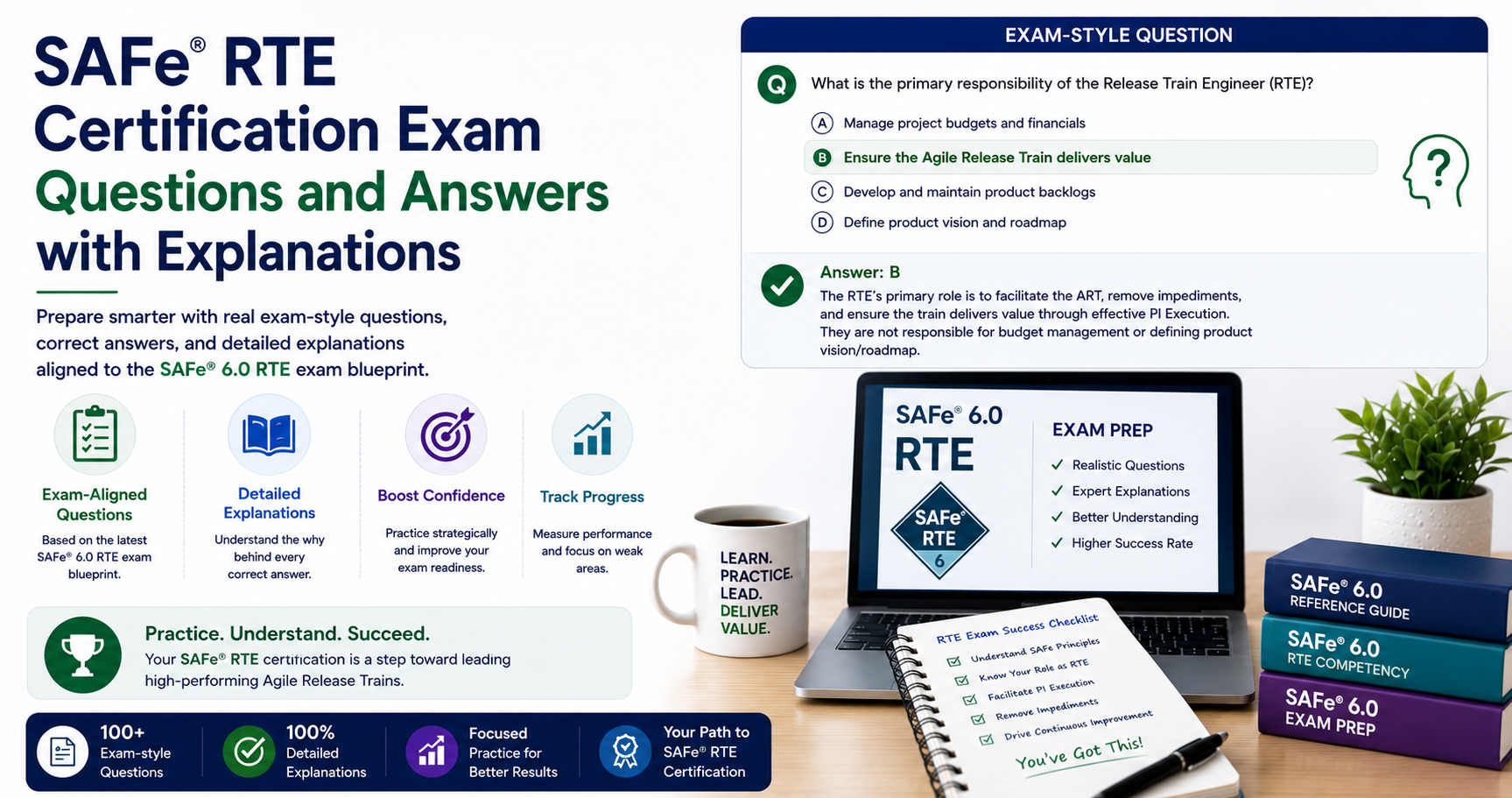
The SAFe RTE exam has 60 multiple choice questions to complete in 120 minutes, and the passing score is 82 percent, or 49 of 60 correct, the figure this content hub has previously confirmed directly against Scaled Agile's own certification page and which also matches the most repeated figure across today's live search results. A minority of sources cite 73 or 78 percent instead, likely stale or third-party estimates, so treat 82 percent as authoritative here. The exam draws from four domains: Exploring the RTE Role, Applying SAFe Principles, Executing the PI, and Serving the ART, according to Scaled Agile's published exam study guide structure. Genuine practice comes from working through scenario based questions that mirror how Release Train Engineers actually make decisions during PI Planning, ART sync, and impediment escalation, not from memorizing leaked "dump" answers. This article gives you real illustrative practice questions with explanations, organized by exam domain, plus the current format facts you need to plan your study time.
Key Highlights
- The SAFe RTE exam includes 60 questions with a 120 minute time limit, a format confirmed across multiple 2026 exam prep sources including CertEmpire and Simpliaxis.
- Passing score is 82 percent, equal to 49 of 60 correct, a figure this content hub previously verified directly against Scaled Agile's own certification page and which also matches the top result in today's live search, though a minority of third-party sites still cite 73 or 78 percent.
- The retake fee is widely reported at 50 USD per additional attempt, with waiting periods of 10 days before a second retake and 30 days before a third, per multiple 2026 exam guide sources.
- Exam domains are commonly listed as Exploring the RTE Role, Applying SAFe Principles, Executing the PI, and Serving the ART, with Serving the ART and Executing the PI together covering roughly 57 to 61 percent of the exam.
- Search results for this keyword are dominated by "dump" style sites (Dumpspedia, PassLeader, Exams4Sure, Killexams) offering hundreds of unverified questions, which is a content gap this article intentionally does not fill by reproducing leaked material.
- Scenario based and context driven questions, not simple recall, make up a large share of the exam according to multiple prep resources, so understanding RTE judgment calls matters more than memorizing terms.
If you are studying for the SAFe RTE exam, you have probably already found dozens of sites offering "real exam dumps." Most of that content is either outdated, unverifiable, or built to farm ad clicks rather than teach you anything. This guide takes a different approach. It gives you original, illustrative practice questions built around the exam's actual domain structure, each with a full explanation of why the correct answer is correct and why the tempting wrong answers are wrong.
You will also get the current, fact checked exam format details, because those numbers change and a stale figure can throw off your study plan. If you have not yet confirmed you meet the prerequisites, review the SAFe RTE certification prerequisites first, and if cost is part of your planning, see the full SAFe RTE certification cost breakdown.
Current SAFe RTE Exam Format at a Glance
Before you practice questions, you need the actual shape of the exam. Here is what current sources report as of this writing.
| Detail | Reported Figure | Source |
| Number of questions | 60 multiple choice questions | Consistent across CertEmpire, Simpliaxis exam details page, and Scaled Agile's own study guide title (2026) |
| Time limit | 120 minutes | Consistent across CertEmpire, ValidExamDumps, and Simpliaxis (2026) |
| Passing score | 82 percent (49 of 60) | Matches the figure this content hub previously verified directly against Scaled Agile's own certification page (see companion article, RTE Certification vs SAFe Agilist) and the most repeated figure in today's live search; a minority of third-party sites cite 73 or 78 percent instead, see note below |
| Delivery | Online, remotely proctored | Multiple 2026 sources describing the exam as web based and completed from any location with a stable connection |
| Retake fee | 50 USD per attempt after included attempts are used | Multiple 2026 exam guide sources |
| Retake wait time | Immediate for first retake, 10 days for second, 30 days for third and beyond | Multiple 2026 exam guide sources |
A note on the passing score conflict: live research for this article turned up at least three different passing score figures in circulation right now, 73 percent, 78 percent, and 82 percent. This same content hub previously verified 82 percent (49 of 60) directly against Scaled Agile's own certification page while researching a companion article (RTE Certification vs SAFe Agilist), and 82 percent was also the figure returned when this run searched specifically within Simpliaxis's own exam pattern content today. This run's own direct fetch of Scaled Agile's exam study guide page was blocked by a network access restriction in this session, so today's figure rests on search-result convergence rather than a fresh direct fetch, but the weight of evidence points to 82 percent as authoritative. Still confirm your exact cut score against the confirmation materials Scaled Agile sends you when you register, since Scaled Agile is the only fully authoritative source for this number.
How the Exam Is Structured by Domain
Multiple current sources describe the SAFe RTE exam blueprint as four domains. Knowing the weighting helps you decide where to spend your study time.
| Domain | Approximate Weight | What It Covers |
| Exploring the RTE Role | 15 to 17 percent | RTE responsibilities, servant leadership, and how the role fits the Agile Release Train, or ART, which is the long lived team of Agile teams that plans and delivers together |
| Applying SAFe Principles | 21 to 24 percent | Lean Agile principles, economic decision making, and how the RTE applies them day to day |
| Executing the PI | 27 to 29 percent | Running a Program Increment, or PI, the 8 to 12 week timebox in which an ART delivers value, including iteration execution and system demos |
| Serving the ART | 30 to 32 percent | Facilitating ART events, resolving impediments, coaching teams, and driving relentless improvement |
Notice that Executing the PI and Serving the ART together account for close to 60 percent of the exam based on current source reporting. If your study time is limited, prioritize these two domains, then circle back to Applying SAFe Principles and Exploring the RTE Role.
Illustrative Practice Questions with Explanations
The questions below are original and written to match the style and difficulty level that current prep sources describe, scenario heavy, judgment focused, and designed to test application rather than pure recall. They are not reproductions of any real exam item, since Scaled Agile does not release its actual bank publicly and doing so would violate the exam's confidentiality terms. Use these to practice the thinking pattern the real exam rewards.
Domain: Exploring the RTE Role
Question 1. A new RTE joins an ART where the previous RTE made most decisions unilaterally to save time. Teams have grown used to waiting for direction. What is the new RTE's best first move?
- A. Continue making decisions the same way to avoid disrupting the ART's rhythm
- B. Gradually shift decision rights back to teams while coaching them on self-management
- C. Escalate the issue to the Business Owners immediately
- D. Wait until the next PI boundary to change anything
Answer: B. The RTE role is a servant leader, not a command and control manager. The correct move rebuilds team ownership without abruptly removing support teams still need. Option A entrenches an unhealthy pattern. Option C skips a step the RTE should own directly. Option D delays a fix that does not need to wait for a PI boundary.
Domain: Applying SAFe Principles
Question 2. Two features are ready for prioritization and the ART has capacity for only one this PI. Feature X has high cost of delay and low job size. Feature Y has low cost of delay and high job size. Which principle should guide the RTE's facilitation of this conversation?
- A. Whichever feature the loudest stakeholder wants
- B. Weighted Shortest Job First, or WSJF, which sequences work by dividing cost of delay by job size
- C. Whichever feature was requested first
- D. Split both features in half and deliver partial versions of each
Answer: B. WSJF is the SAFe prioritization method built for exactly this tradeoff, and it favors Feature X here because a high cost of delay divided by a low job size produces a higher WSJF score. Options A and C ignore economic reasoning entirely. Option D adds delivery risk without solving the sequencing question.
Domain: Executing the PI
Question 3. Midway through a PI, the system demo reveals that two teams have built integrations that do not work together, even though both teams reported green status in their own iterations. What does this most likely indicate?
- A. The teams are underperforming and need a PI reset
- B. Insufficient cross-team synchronization, likely a gap in ART sync or Scrum of Scrums cadence
- C. The Product Owners wrote poor acceptance criteria
- D. The system demo itself is the wrong ceremony to catch this
Answer: B. This is a classic integration risk that ART level sync events exist to surface early. Option A jumps to blame without diagnosis. Option C might be a contributing factor but is not the most likely root cause of an integration mismatch across teams. Option D is incorrect since the system demo is precisely the event designed to catch this kind of gap.
Domain: Serving the ART
Question 4. A Scrum Master flags a cross-team dependency that is at risk of slipping and will affect three other teams if not resolved within a week. What is the RTE's most appropriate action?
- A. Tell the Scrum Master to handle it within their own team
- B. Add it to the ART's dependency board, visualize the risk, and personally facilitate a resolution conversation with the affected teams
- C. Wait for the next Inspect and Adapt, or I&A, workshop to discuss it
- D. Escalate directly to the Business Owners without first attempting team level resolution
Answer: B. Cross-team dependency management sits squarely inside the RTE's remit. Making the risk visible and convening the right people quickly is the expected response. Option A pushes a cross-team problem onto a single team lacking the authority to solve it alone. Option C waits too long for a near-term risk. Option D skips a resolution step the RTE is positioned to lead.
Domain: Serving the ART
Question 5. During Inspect and Adapt, teams identify the same recurring impediment for the third PI in a row. What should the RTE prioritize?
- A. Documenting it again and moving on since it was already raised twice
- B. Treating it as a systemic issue and escalating it through the Lean Agile Center of Excellence, or LACE, the group that guides the organization's Agile transformation
- C. Assigning it to a single team to fix independently
- D. Ignoring it since recurring impediments usually resolve themselves
Answer: B. A three-PI recurrence signals a systemic, organizational level constraint that a single ART cannot fix alone. Routing it to the LACE, which owns transformation-level improvement, is the appropriate escalation. Options A, C, and D all leave a known systemic block unaddressed.
Why "Exam Dump" Sites Are a Risky Study Strategy
The search results for this exact keyword are heavily populated by sites selling "actual exam questions," "dumps," and "verified answers." Several of these sites were visible in current search results for this topic during this article's research. Scaled Agile's exam agreement, like most professional certification bodies, requires candidates not to share or reproduce actual exam content. Relying on leaked or fabricated question banks carries three real risks.
- You may be studying outdated content, since these sites rarely disclose which SAFe version their questions map to.
- You risk a certification integrity issue if Scaled Agile detects reliance on leaked material during any audit process.
- You learn to recognize memorized answer patterns instead of the judgment the real, scenario-heavy exam actually tests.
A stronger strategy combines the official SAFe RTE course material, structured practice like the questions above, and a genuine review of the four exam domains.
A 2-Week Study Plan by Domain Weight
| Week | Focus | Why |
| Week 1, Days 1 to 3 | Serving the ART and Executing the PI | These two domains combine for roughly 57 to 61 percent of exam weight based on current domain breakdowns |
| Week 1, Days 4 to 5 | Applying SAFe Principles | Covers roughly 21 to 24 percent, with heavy focus on WSJF, economic prioritization, and Lean Agile principles |
| Week 2, Days 1 to 2 | Exploring the RTE Role | Smallest domain at roughly 15 to 17 percent, but foundational vocabulary appears throughout other domains too |
| Week 2, Days 3 to 5 | Full-length timed practice and weak-area review | Builds stamina for the 120-minute window and surfaces remaining gaps before exam day |
If you are still deciding between formats for your prep course, our companion piece on SAFe RTE certification online vs classroom training breaks down which format suits different study styles. And if you want to understand exactly what the role demands once you are certified, see our guide to Release Train Engineer roles and responsibilities.

_1773832209.png)






 Lowest-Price Challenge











 Personalized Path


.webp)


 USA
USA  Canada
 India
India UK
UK Australia
 Singapore


