


 Call Us



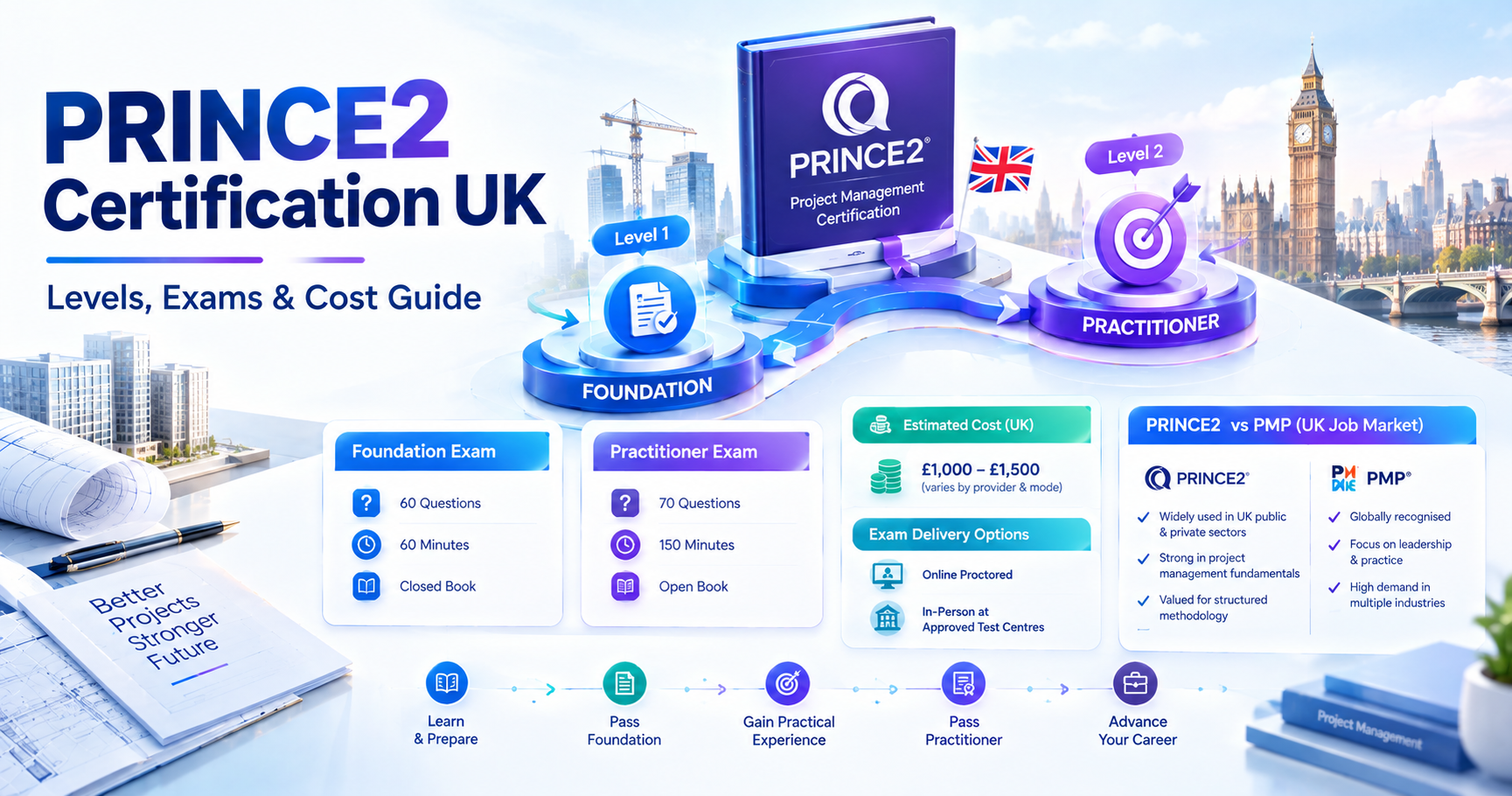
PRINCE2 certification in the UK has two core levels: Foundation and Practitioner, both examined by PeopleCert against the 7th edition manual. Foundation is a 60-question, 60-minute closed-book exam; Practitioner is a 70-question, 150-minute open-book exam. Both are delivered through PeopleCert's online proctoring system, with in-person options through accredited training organisations. UK training and exam costs vary by provider and format, so always confirm current fees before booking.
Key Highlights of PRINCE2 Certification UK
- PRINCE2 originated as a UK government project management standard and is still widely used across UK public sector, government, and infrastructure projects.
- The certification now sits under PeopleCert, which owns AXELOS (the entity historically linked to the UK Cabinet Office) and runs all PRINCE2 exams globally.
- Foundation and Practitioner are the two main levels; PRINCE2 Agile adds a separate Foundation and Practitioner pathway for teams blending PRINCE2 governance with agile delivery.
- UK candidates can sit exams online via remote proctoring or in person through accredited training providers, depending on the training route chosen.
- Exam and training costs in the UK are typically quoted in GBP and vary by provider, format, and whether Foundation, Practitioner, or a combined package is booked.
- PRINCE2 remains especially prominent in UK government, public sector, and construction/infrastructure project roles, while PMP tends to carry more weight in multinational private-sector organisations.
If you are searching for "PRINCE2 certification UK," you are probably trying to answer a fairly specific set of questions: which level should I start with, how is the exam actually delivered here in the UK, what will it cost in pounds, and does it actually matter for the kind of roles I am targeting. Generic overviews of PRINCE2 do not really answer any of that, because PRINCE2's story is tied closely to the UK in a way that other certifications simply are not.
PRINCE2 (Projects IN Controlled Environments) began life as a UK government standard for managing IT projects, developed originally by the Central Computer and Telecommunications Agency. Ownership later passed to AXELOS, a joint venture between the UK Cabinet Office and Capita, before AXELOS itself was acquired by PeopleCert in 2021. That lineage is part of why PRINCE2 still shows up so consistently in UK government, public sector, and infrastructure job postings, and why it is treated differently in the UK job market compared to how it is perceived in, say, North America.
This guide walks through what PRINCE2 certification actually involves today, how the Foundation and Practitioner levels differ, how UK candidates book and sit the exams, what the certification tends to cost in GBP, and how to choose a study route that fits your schedule and budget. Where a fact depends on current pricing or a specific policy that can change, it is flagged clearly so you can verify it before you commit money to a booking.
Why PRINCE2 Matters Specifically in the UK
A UK government and public sector standard
PRINCE2's roots as a UK government methodology are not just historical trivia. Government departments, the NHS, local authorities, and public sector agencies have used PRINCE2 or PRINCE2-derived governance for decades, and that institutional habit persists. Many public sector project management roles in the UK list PRINCE2 as a requirement or a strong preference, partly because the method's structured stage boundaries, defined roles (Project Board, Executive, Senior User, Senior Supplier), and documentation-heavy approach map naturally onto how public bodies need to demonstrate accountability and governance for spend on public money.
This does not mean every government project management role demands PRINCE2, and requirements vary by department, grade, and specific job description, so always check the individual role's person specification rather than assuming a blanket rule.
Construction and infrastructure projects
PRINCE2 also has a strong presence in UK construction and infrastructure project delivery, where projects tend to be run through formal stages with sign-off gates, similar to how PRINCE2 structures a project into a Starting Up, Initiating, and subsequent delivery stages, each requiring board approval before the next begins. Contractors and delivery partners bidding for public infrastructure work often need project managers who can operate comfortably within that kind of staged governance model, which is one reason PRINCE2 certification appears frequently in job specifications for infrastructure and capital works project roles in the UK.
PRINCE2 vs PMP in the UK job market
A common question for UK-based project professionals is whether to pursue PRINCE2, PMP, or both. The honest answer depends on which part of the market you are targeting:
- PRINCE2 tends to dominate in UK government, public sector, NHS, and infrastructure-heavy environments, where the method itself is the established local standard.
- PMP tends to carry more weight in multinational private-sector organisations, management consulting, and industries such as IT, financial services, and engineering where global project management standards from the Project Management Institute are more commonly referenced.
- A meaningful number of UK job adverts list "PMP / PRINCE2 (or equivalent)" rather than insisting on one over the other, and recruiters increasingly note that holding both is seen as complementary rather than redundant, since PRINCE2 supplies a governance framework while PMP is broader on process areas like scope, cost, and stakeholder management.
Exact figures on how many UK postings favour one over the other move over time and vary by source, so treat any specific ratio you see quoted online as directional rather than precise.
If your target roles sit in UK government, public sector, or infrastructure delivery, PRINCE2 is generally the more directly relevant credential to start with. ThePRINCE2 Foundation Certification Trainingcourse is the usual entry point for professionals building toward that market.
PRINCE2 Certification Structure: Foundation vs Practitioner
PRINCE2 certification is built around two core levels, both currently examined against the 7th edition of "Managing Successful Projects with PRINCE2," which places more emphasis on sustainability, digital ways of working, and the people side of project delivery compared to earlier editions.
PRINCE2 Foundation
Foundation is the entry-level certification. It tests your understanding of PRINCE2's principles, practices, processes, and the roles and responsibilities within a PRINCE2 project structure, such as the Project Board, Project Manager, and Team Manager. There is no formal prerequisite to sit Foundation, though most candidates benefit from some general exposure to project management concepts first.
PRINCE2 Practitioner
Practitioner builds on Foundation and tests your ability to apply PRINCE2 to realistic project scenarios rather than just recall definitions. You must hold a valid PRINCE2 Foundation certificate (or an accepted equivalent) before you can sit the Practitioner exam. Because it is scenario-based and open-book, Practitioner tends to be viewed as the more practically useful certification for professionals actually running projects day to day.
Foundation vs Practitioner at a glance
| Feature | PRINCE2 Foundation | PRINCE2 Practitioner |
| Purpose | Tests knowledge of PRINCE2 principles, practices, and processes | Tests ability to apply PRINCE2 to real project scenarios |
| Prerequisite | None | Valid PRINCE2 Foundation certificate |
| Question format | 60 multiple-choice questions | 70 multiple-choice questions |
| Time allowed | 60 minutes (75 minutes for non-native English speakers) | 150 minutes |
| Pass mark | 36 out of 60 (60%) | 42 out of 70 (60%) |
| Book policy | Closed book | Open book (official manual only) |
| Delivery | PeopleCert online proctoring or accredited training centre | PeopleCert online proctoring or accredited training centre |
| Typical next step | Progress to Practitioner | Optional: PRINCE2 Agile Practitioner |
Both exams are administered exclusively by PeopleCert, which is currently the sole body authorised to run PRINCE2 examinations worldwide.
For UK candidates who want both levels covered in one structured programme rather than booking them separately, thePRINCE2 Foundation & Practitioner Certification Trainingcombines both exams into a single course path, which is often more time-efficient and cost-effective than treating them as two entirely separate bookings.
PRINCE2 Agile: a related but distinct pathway
Many UK organisations, particularly in technology and change delivery, now blend PRINCE2's governance structure with agile ways of working. PRINCE2 Agile is a separate qualification family that builds on PRINCE2 knowledge and adds agile concepts such as Scrum and Kanban into the governance framework. If your organisation runs hybrid delivery, the PRINCE2 Agile Foundation Certification Training and PRINCE2 Agile Practitioner Certification Training are worth considering alongside or after standard PRINCE2, and candidates who want to cover both levels together can look at the PRINCE2 Agile Foundation & Practitioner Certification Training.
UK Exam Delivery Options
One of the most practical questions for UK candidates is simply: where and how do I actually sit the exam?
Online proctored exams
PeopleCert delivers PRINCE2 Foundation and Practitioner exams through its own online proctoring platform. This lets UK candidates sit the exam from home or office, with a webcam-monitored session that verifies identity and monitors the room before and during the test. This has become the default route for most individual candidates and is generally the fastest way to book a specific exam slot without needing to travel to a physical test centre.
Before booking, candidates should check their own equipment against PeopleCert's technical requirements (webcam, stable internet connection, a quiet private room), since technical issues on exam day can affect the session.
In-person and classroom-based delivery
Accredited training organisations in the UK also offer classroom-based courses that build in an exam sitting as part of the programme, either at a training venue or through a proctored session scheduled at the end of a live class. This suits candidates who prefer a structured, instructor-led environment and want the exam logistics handled as part of the course booking rather than arranged separately.
Booking through an accredited training organisation vs directly with PeopleCert
Most UK candidates book their exam as part of a course through an Accredited Training Organisation (ATO) rather than purchasing a standalone voucher directly from PeopleCert, particularly when the course bundles study materials, practice tests, and instructor support with the exam fee. This is usually the simpler route if you are also taking training, since the provider handles scheduling on your behalf.
PRINCE2 Certification Cost in the UK
Cost is one of the areas where a genuinely UK-specific answer matters most, since PRINCE2 pricing (like most PeopleCert-accredited certifications) is set in the local currency and varies by training provider, delivery format, and by the specific level booked, Foundation, Practitioner, or a combined package.
As a general shape of what UK candidates typically encounter:
- Foundation-only training bundled with the exam tends to sit in a lower price band than combined Foundation and Practitioner packages.
- Practitioner-only training (for candidates who already hold Foundation) typically costs more than Foundation alone, reflecting the longer exam and more involved preparation.
- Combined Foundation and Practitioner packages are usually priced below the sum of booking each level separately, since providers bundle materials and instructor time across both.
- Exam-only vouchers (for candidates who have already studied independently and just need to book the test) are generally cheaper than full training packages but do not include any tuition, materials, or practice exams.
Because PeopleCert accredits multiple training organisations rather than publishing one single fixed retail price, and because promotional pricing changes frequently, do not treat any specific number you see quoted for PRINCE2 Foundation, Practitioner, or combined training as current without checking directly with the training provider first.
If budget is a significant factor in choosing between Foundation-only, Practitioner-only, or a combined route, request an up-to-date like-for-like quote from the same provider for all three options before deciding, since bundling often changes the per-level cost more than expected.
Practical Guidance: Choosing Your Study Route in the UK
There is no single "best" way to prepare for PRINCE2 in the UK. The right choice depends on how you learn, how much structure you need, and how much time you can realistically commit each week.
| Study route | Best suited for | Trade-offs |
| Self-study | Disciplined learners who can structure their own revision and already have some project management exposure | Cheapest option upfront, but no instructor support if you get stuck on scenario-based questions, and easy to underestimate Practitioner's application-style questions |
| Classroom training | Candidates who want a fixed schedule, in-person interaction, and immediate access to a trainer for questions | Requires travel and fixed attendance dates, which can be harder to fit around a full-time job |
| Live online training | Professionals who want instructor-led structure and real-time Q&A without needing to travel | Needs a reliable internet connection and a quiet space during live sessions, but offers the same structured pacing as classroom training with more schedule flexibility |
For most working professionals in the UK juggling a job alongside exam preparation, live online training tends to offer the best balance: it keeps the structure and accountability of a scheduled course while removing the need to travel to a fixed venue, and it usually still includes access to a trainer for the scenario-based reasoning that trips up self-study candidates on the Practitioner exam.
Whichever route you choose, build in dedicated time to work through Practitioner-style scenario questions specifically, rather than only reviewing definitions. Since Practitioner is open-book, the exam is really testing whether you can navigate the manual quickly and apply the right process or theme to a described situation, which is a different skill from simply recognising correct definitions on Foundation.
Simpliaxis Training Relevance for UK Learners
Simpliaxis offers PRINCE2 training routes that map onto each of the study preferences above, with delivery options suited to UK-based learners studying alongside work commitments.
If you are starting from scratch, the PRINCE2 Foundation Certification Training covers the principles, practices, and processes tested at Foundation level. If you already hold Foundation and want to move directly to application-level skills, thePRINCE2 Practitioner Certification Trainingfocuses on the scenario-based reasoning the Practitioner exam requires. For candidates who want to plan both levels as a single programme rather than two separate bookings, the PRINCE2 Foundation & Practitioner Certification Training bundles both into one structured course path.
For UK professionals working in hybrid or agile-influenced delivery environments, Simpliaxis also runs the PRINCE2 Agile Foundation Certification Training, PRINCE2 Agile Practitioner Certification Training, and combined PRINCE2 Agile Foundation & Practitioner Certification Training, which suit teams pairing PRINCE2 governance with agile execution methods.
Courses are available through live online instructor-led sessions, which UK-based learners can join without travel while still getting real-time access to a trainer, alongside self-paced and classroom-style options depending on the specific course and schedule. If you are certifying a project management team rather than a single individual, the corporate and group training option lets organisations arrange PRINCE2 training for multiple team members together, which is often more practical than booking individual seats separately when several people on the same delivery team need certifying around the same time.
Before booking, confirm current course dates, delivery format, and pricing directly with Simpliaxis, since schedules and fees are updated regularly.
Related Reading
If you are still deciding whether PRINCE2 is the right starting point, or want more detail on a specific part of the certification, these related guides go deeper on individual topics:
- PRINCE2 certification eligibility guidecovers who can sit each exam level and what, if any, prerequisites apply.
- Beginner's guide to PRINCE2 is a useful starting point if you want a broader introduction to PRINCE2 concepts before committing to an exam route.
- PRINCE2 Foundation & Practitioner course curriculum overview breaks down what is actually taught across both levels in more detail.
- Top 10 benefits of PRINCE2 project management methodology looks at the practical benefits of the methodology itself, separate from the certification process.
Conclusion
PRINCE2 certification means something slightly different in the UK than it does elsewhere, because the method's history as a UK government standard still shapes how it is used and valued today, particularly in public sector, government, and infrastructure project roles. Understanding that context matters as much as understanding the exam format itself when you are deciding whether PRINCE2, PMP, or both make sense for your career.
Practically, the path is straightforward: start with Foundation to build the knowledge base, progress to Practitioner to prove you can apply it, choose an exam delivery format (online proctored or in-person through a training provider) that fits your circumstances, and confirm current GBP pricing directly with your chosen provider before booking, since costs and promotions change over time. From there, the choice between self-study, classroom, and live online training comes down to how much structure and schedule flexibility you personally need to get through the material and, especially for Practitioner, to get comfortable applying it under exam conditions.
View PRINCE2 certification training options available for learners in the UK, including PRINCE2 Foundation Certification Training, PRINCE2 Practitioner Certification Training, the combinedPRINCE2 Foundation & Practitioner Certification Training, and the agile-aligned PRINCE2 Agile Foundation & Practitioner Certification Training. For teams certifying multiple project professionals together, see the corporate and group trainingoption to arrange PRINCE2 training across your delivery team.


_1787387289.jpeg)



 Lowest-Price Challenge











 Personalized Path


.webp)


 USA
USA  Canada
 India
India UK
UK Australia
 Singapore


