


 Call Us



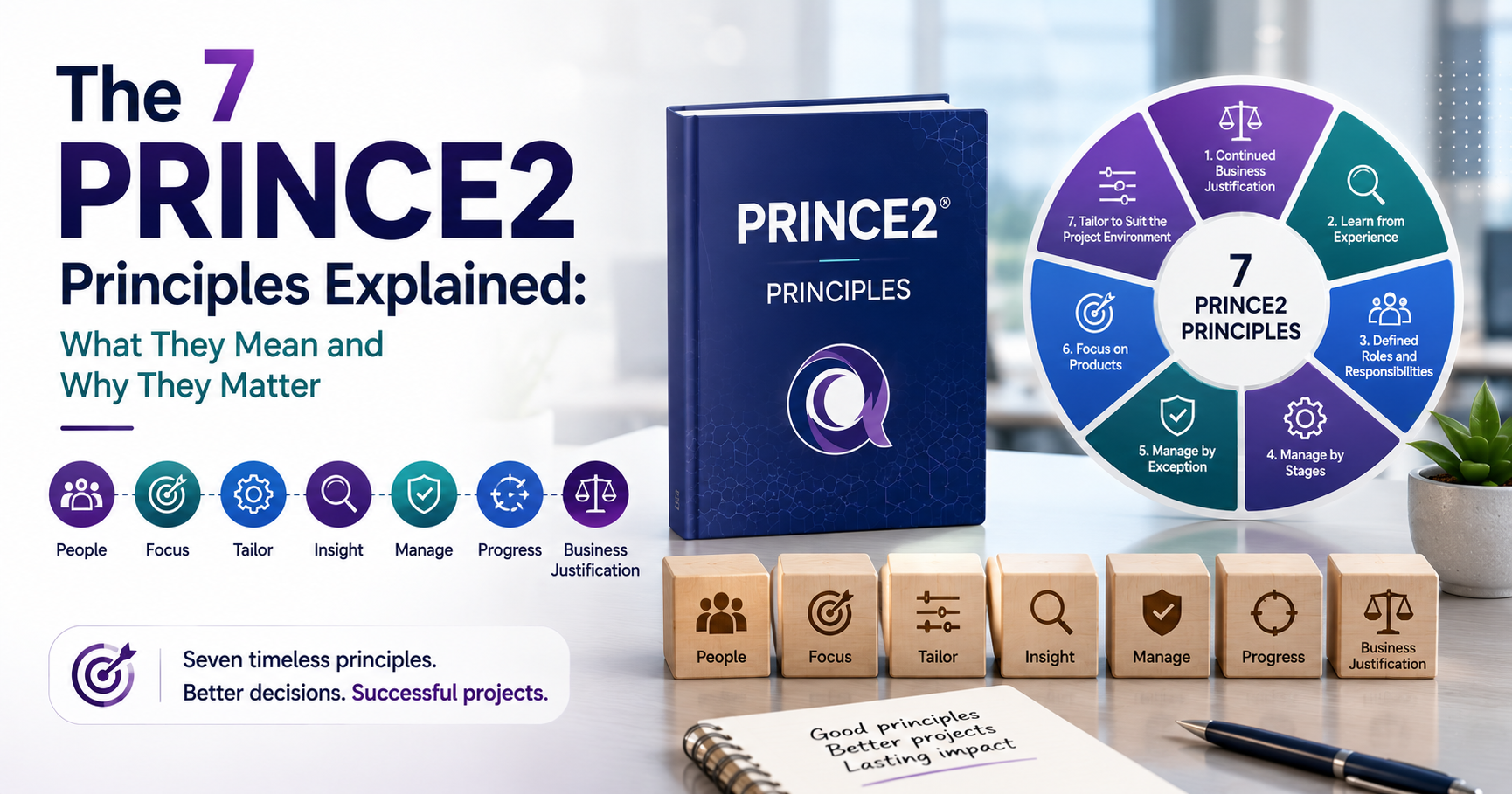
PRINCE2 has 7 principles: continued business justification, learn from experience, define roles and responsibilities, manage by stages, manage by exception, focus on products, and tailor to suit the project. None of them are optional. You can flex the themes and processes to fit a project, but drop even one principle and PeopleCert and Axelos guidance is blunt about it: what you're running isn't PRINCE2 anymore. This guide walks through each principle with a real example, then shows how they connect to the themes and processes underneath them.
Key Highlights
- PRINCE2 defines 7 principles: ensure continued business justification, learn from experience, define roles and responsibilities (and relationships), manage by stages, manage by exception, focus on products, and tailor to suit the project.
- All 7 have to be present for a project to genuinely count as "PRINCE2." Themes and processes flex. Principles don't.
- Each one answers a specific project risk, whether that's unjustified spending, repeated mistakes, unclear accountability, or scope creep.
- Foundation-level training examines the principles directly. Practitioner-level applies them to realistic scenarios.
- Tailoring is itself a principle, which is exactly why PRINCE2 works on a small internal project and a sprawling multi-vendor programme alike.
- These aren't abstract theory. Auditors, project boards, and quality reviewers actually use them as a checklist during project health checks.
Introduction
Ask most project managers what PRINCE2 is, and you'll get some version of "a structured, stage-based method with defined roles and a lot of paperwork." Fair enough. But ask them why it's built that way, and the answers get thinner. That "why" is the 7 principles.
They sit underneath everything else in PRINCE2. The themes, business case, organization, quality, plans, risk, issues, progress, give project managers a set of things to keep thinking about. The processes lay out the path from starting a project to closing it. The principles are what make all of that mean something rather than just being a stack of templates. They're the reason a PRINCE2 project keeps asking whether it's still worth doing, the reason work gets split into stages instead of running as one undifferentiated slog, and the reason a project manager quietly absorbs some problems while escalating others.
AXELOS, and now PeopleCert as the current owner, describe the principles two ways: universal, meaning they apply to any PRINCE2 project regardless of size or industry, and self-validating, meaning they've earned their place through use across thousands of real projects rather than being dreamed up on a whiteboard. That combination is why the principles carry more weight than any single template in the method.
What follows walks through each of the 7 individually, with a real-world example attached to each, then looks at how they connect to the themes and processes, and why PRINCE2 refuses to treat any of them as optional. It closes with some practical guidance on applying them day to day, and where Simpliaxis training fits into learning them properly.
The 7 PRINCE2 Principles
1. Continued Business Justification
Every PRINCE2 project needs a documented, genuinely viable reason to exist, and that reason has to keep holding up all the way through, not just at kickoff. That's what the business case captures: created before the project starts, reviewed at the end of every stage.
The whole point is to stop projects coasting on momentum alone. It happens more often than people admit. A project makes total sense on day one, then quietly stops making sense a year later because the market shifted, a cheaper option appeared, or the original sponsor left. PRINCE2 forces a checkpoint at every stage boundary: does this still justify the time, money, and people going into it? If the honest answer is no, the project gets stopped or re-scoped. It doesn't get to limp along out of habit.
Take a retail company building a custom in-house loyalty platform because nothing suitable exists on the market. Eighteen months in, at a routine stage boundary review, a mainstream vendor launches a product that covers 90% of the requirement for a fraction of the build cost. Because the business case gets reviewed every stage instead of just assumed, the project board actually sees this, updates the case, and decides to buy instead of keep building. Without that habit, the in-house build could easily have run another year before anyone formally questioned it.
2. Learn from Experience
PRINCE2 teams are expected to go looking for lessons at the start of a project, log them as they show up along the way, and hand them over at the end for whoever comes next. This isn't a box-ticking "lessons learned" meeting bolted onto project closure. It's meant to be continuous.
Why bother? Because organizations repeat the same mistakes on new projects constantly, simply because nobody wrote down what went wrong (or right) last time. One team learning from its own experience is useful. An organization that learns systematically across every project is what actually gets better over time.
A construction firm's previous data center fit-out ran late because someone underestimated cabling lead times and it cost a two-week hold on testing. On the next similar project, the project manager pulls the lessons log during startup, orders cabling six weeks earlier than the team's usual assumption, and the delay never happens. That saved time only materialized because the earlier lesson was actually written down, and actually looked up, rather than filed away and forgotten.
3. Define Roles and Responsibilities
Every PRINCE2 project needs an explicit organization structure, with defined roles covering the three interests a project board represents: business, user, and supplier. Everyone on the project should know exactly what they're accountable for and who they answer to, documented, not assumed.
Vague accountability is one of the most common ways projects fail. When "everyone" owns a deliverable, in practice no one does. This principle forces roles into the open, written into the project initiation document and organization chart, rather than sorted out on the fly as issues come up.
Say a dispute breaks out midway through delivery over who actually has authority to approve a scope change, the project manager or the sponsoring executive. Because the organization theme (which grows directly out of this principle) requires decision authority to be documented up front, the project initiation document already spells out that scope changes above a set cost threshold need Executive sign-off. The argument gets settled by checking the document, not by whoever's more senior or louder. It's also why the composition of the project board matters so much in the first place.
4. Manage by Stages
PRINCE2 projects get planned and controlled one stage at a time, never as one continuous block. Each management stage ends at a decision point where the board reviews progress and the business case, then formally greenlights (or doesn't) the next stage.
This gives senior management a natural control point without needing them buried in day-to-day delivery. Instead of finding out eight months in that a project has drifted badly off track, the board gets a built-in moment, at every stage boundary, to check in, ask hard questions, and pull the plug early if it needs to.
A software rollout gets planned across three stages: build, pilot, full rollout. At the end of the pilot, user feedback makes it clear the tool needs serious rework before it's ready company-wide. Because the project is managed in stages, the board simply doesn't authorize the full rollout yet, and instead greenlights a smaller remediation stage first, rather than discovering the problem only after the full rollout is already underway.
5. Manage by Exception
Every level of PRINCE2 management, board, project manager, team manager, gets defined tolerances for time, cost, scope, risk, quality, and benefits. As long as work stays inside those tolerances, that level doesn't need to escalate anything or ask permission. Only when a tolerance is at risk of being breached does it go up a level.
This is what stops senior management from getting dragged into every minor decision, while still guaranteeing they hear about it the moment something material goes wrong. Delegation with an early-warning system built in, basically.
A project manager operates with a cost tolerance of plus or minus 5% at the work package level. A team manager flags that one deliverable will run 3% over due to a supplier price hike. Since that's still inside tolerance, the project manager just absorbs it, no need to go back to the board. Then a separate issue threatens a 12% overrun on a different work package. That breaches tolerance, so the project manager raises an exception report rather than making the call solo.
6. Focus on Products
PRINCE2 plans start by defining what the project actually needs to deliver, the products, and their quality criteria, before anyone works out the activities and schedule needed to produce them. Product descriptions spell out exactly what "done" looks like for each deliverable, quality checks included.
This exists to stop scope drift and fuzzy acceptance criteria before they start. Plan around activities instead of products, and it gets a lot harder to know objectively whether something is actually finished and fit for purpose.
A team building a customer-facing report defines the product description up front: required data fields, refresh frequency, and a specific check that figures must reconcile with the finance system to the penny. The draft report fails to check over a rounding discrepancy. Because the acceptance criteria were baked into the product description rather than left to a subjective "does this look right" glance, the gap gets caught and fixed before it ever goes live.
7. Tailor to Suit the Project
PRINCE2 was never meant to be a one-size-fits-all rulebook. The method expects project managers to adapt how it's applied based on the project's size, complexity, risk profile, and environment, while keeping all 7 principles intact. Tailoring might mean combining roles on a small project, going lighter on documentation, or reshaping management products. It never means dropping a principle.
This is what makes PRINCE2 usable for a six-week internal process fix and a multi-year, multi-vendor infrastructure programme at the same time. Without it, organizations would either write off PRINCE2 as too heavy for small work, or apply it so rigidly that it turns into overhead nobody wants.
A small internal project with a five-person team folds the Team Manager role into the Project Manager role and uses a single-page version of the project initiation document instead of the full template, because the scale simply doesn't justify separate documents and roles. It's still recognizably PRINCE2, because all 7 principles are still doing their job. It's just been scaled to fit a small, low-risk piece of work.
This same principle is the whole reason PRINCE2 Agile exists as its own qualification rather than a rewrite of PRINCE2. Tailoring was already baked in, so the PRINCE2 Agile Foundation Certification Training simply teaches how to point PRINCE2's governance toward agile ways of working like Scrum and Kanban, without dropping any of the 7 principles covered here.
Why PRINCE2 Treats All 7 Principles as Non-Negotiable
PRINCE2's own guidance is direct about this: a project doesn't have to use every theme or process exactly as written, because tailoring exists specifically to adjust those. But drop any one of the 7 principles, and the project isn't being managed to PRINCE2 anymore, no matter how much PRINCE2 terminology or documentation it's dressed up in.
The logic holds up because each principle addresses a specific, well-documented reason projects fail:
- Skip continued business justification, and a project can keep burning money long after it stopped making sense.
- Skip learn from experience, and the same mistakes repeat across projects with nothing improving.
- Skip defined roles and responsibilities, and you get accountability gaps and decision conflicts.
- Skip manage by stages, and you lose the natural checkpoints that let senior management catch problems early.
- Skip manage by exception, and senior management either drowns in decisions that don't need them, or loses the escalation path for the ones that do.
- Skip focus on products, and acceptance criteria turn ambiguous and subjective, which invites scope creep.
- Skip tailor to suit the project, and PRINCE2 becomes rigid bureaucracy that teams quietly route around instead of using.
Pull out any one of these, and you're not left with "PRINCE2 minus one small thing." You're left with a project exposed to exactly the failure mode that principle was built to prevent. This, more than any template, is where most of PRINCE2's documented benefit actually comes from: the discipline the 7 principles impose.
How the Principles Connect to the Themes and Processes
It helps to picture PRINCE2's structure as three connected layers. The principles are the guiding beliefs. The themes, soon to be called practices under PRINCE2 7, covering business case, organization, quality, plans, risk, issues, and progress, are the areas that need ongoing attention. The processes are the actual activities that carry a project from startup through to closure.
The relationship only runs one way: principles shape themes, and themes get put into action through processes. A few examples:
- The continued business justification principle is why the business case theme exists at all, and why the "Directing a Project" process builds in formal authorization points.
- The manage by stages principle is why "Managing a Stage Boundary" exists as its own distinct process rather than getting folded into general progress reporting.
- The define roles and responsibilities principle is why the organization theme insists on named roles, Executive, Senior User, Senior Supplier, Project Manager, Team Manager, rather than a vague “project team.”
- The focus on products principle is why the quality theme is built around product descriptions and quality criteria instead of generic quality statements.
- Themes and processes can be tailored in how they're documented and run. The principles underneath them can't be tailored away.
Summary Table: The 7 PRINCE2 Principles
| # | Principle | What It Prevents | Primarily Connects To |
|---|---|---|---|
| 1 | Continued business justification | Projects continuing after they stop making sense | Business case theme, stage boundary reviews |
| 2 | Learn from experience | Repeating the same mistakes across projects | Lessons log, project closure activities |
| 3 | Define roles and responsibilities | Unclear accountability and decision conflicts | Organization theme, project board structure |
| 4 | Manage by stages | Loss of senior management control over long projects | Managing a Stage Boundary process |
| 5 | Manage by exception | Over-escalation or under-escalation of issues | Progress theme, tolerances at every level |
| 6 | Focus on products | Ambiguous scope and subjective acceptance | Quality theme, product descriptions |
| 7 | Tailor to suit the project | PRINCE2 becoming rigid, unusable bureaucracy | Applies across all themes and processes |
Practical Guidance: Applying the Principles Day to Day
Knowing the definitions is the easy part. Applying them inside a live project, usually under time pressure, is where Practitioner-level training earns its keep. A few habits worth picking up:
| Situation | Principle in Play | Practical Action |
|---|---|---|
| Sponsor wants to skip the stage-end review to "save time" | Continued business justification, manage by stages | Hold the review anyway, politely. Even a short one catches problems early and protects the sponsor from a worse outcome later |
| Team keeps hitting the same type of blocker seen on a past project | Learn from experience | Check the lessons log at project or programme level before planning the current stage's approach |
| A supplier and a business stakeholder disagree on who approves a deliverable | Define roles and responsibilities | Point to the documented organization structure instead of letting seniority settle it informally |
| A work package is trending 4% over budget against a 5% tolerance | Manage by exception | Watch it closely, but don't escalate yet. Raise an exception report only if the tolerance is actually breached |
| Stakeholders keep describing what they want in vague terms | Focus on products | Push for a written product description with explicit quality criteria before work starts |
| A small, low-risk project is being asked to produce the full standard PRINCE2 documentation set | Tailor to suit the project | Scale the documentation and roles down to match the size and risk, while keeping every principle intact |
A useful gut check at any point of doubt: if PeopleCert asked whether this project is still being run to PRINCE2 right now, could you actually show all 7 principles active? If the honest answer is no for even one, that's the gap worth closing first, before piling on more documentation or process.
Deciding which certification level to pursue before building these habits is worth doing early, since Foundation and Practitioner test the principles in genuinely different ways, covered next.
Simpliaxis Training Relevance
The 7 principles get examined directly at Foundation level, then tested through applied, scenario-based questions at Practitioner level, which is why most people study both back to back.
The PRINCE2 Foundation Certification Training builds the base layer: what each of the 7 principles actually means, how they differ from themes and processes, and why PRINCE2 treats them as mandatory. The definitions covered in this guide, continued business justification, learn from experience, define roles and responsibilities, manage by stages, manage by exception, focus on products, tailor to suit the project, get tested directly at this stage.
The PRINCE2 Practitioner Certification Training pushes further, asking candidates to apply the principles to project scenarios: spotting when a tolerance has been breached, when a business case needs re-justifying, or when tailoring is appropriate versus when it would quietly drop a principle altogether. This is the level where the practical table above stops being workplace common sense and becomes an exam-relevant skill.
For anyone who wants both levels without a gap between courses, the PRINCE2 Foundation & Practitioner Certification Training covers the full syllabus, principles through themes, processes, and applied practice, in one structured program.
The tailor to suit the project principle is also the direct bridge between classic PRINCE2 and PRINCE2 Agile. Because PRINCE2 already allows tailoring the method to context, PRINCE2 Agile builds on that same foundation to show how PRINCE2's governance works alongside agile ways of working like Scrum and Kanban. Professionals applying PRINCE2 principles in agile delivery environments typically study the PRINCE2 Agile Foundation Certification Training and PRINCE2 Agile Practitioner Certification Training, or combine both in the PRINCE2 Agile Foundation & Practitioner Certification Training.
Organizations training multiple project managers, business analysts, or PMO staff at once, rather than everyone training separately, often find it more efficient to arrange this through Simpliaxis corporate and group training, which can align session scheduling and course depth to the organization's existing governance model.
Conclusion
The 7 PRINCE2 principles aren't a preamble to skim before getting to the "real" content on themes and processes. They're the reason those themes and processes are shaped the way they are, and they're the test PeopleCert and Axelos guidance actually uses to decide whether a project is genuinely being run to PRINCE2 at all.
Continued business justification, learn from experience, define roles and responsibilities, manage by stages, manage by exception, focus on products, tailor to suit the project, each one addresses a specific, well-known way projects fail. Understanding them individually is useful. Recognizing how they show up together, in a live project, under pressure, is what actually separates someone who's memorized PRINCE2 terminology from someone who can run a PRINCE2 project.
Ready to move from understanding the 7 PRINCE2 principles to actually applying them on real projects? Take a look at the PRINCE2 Foundation & Practitioner Certification Training to cover both levels in one structured program, or the PRINCE2 Agile Foundation & Practitioner Certification Training if your organization blends PRINCE2 governance with agile delivery. Teams training multiple people together can also reach out through Simpliaxis corporate and group training to schedule a program suited to their project environment.


_1788257081.jpeg)




 Lowest-Price Challenge











 Personalized Path


.webp)


 USA
USA  Canada
 India
India UK
UK Australia
 Singapore


