


 Call Us



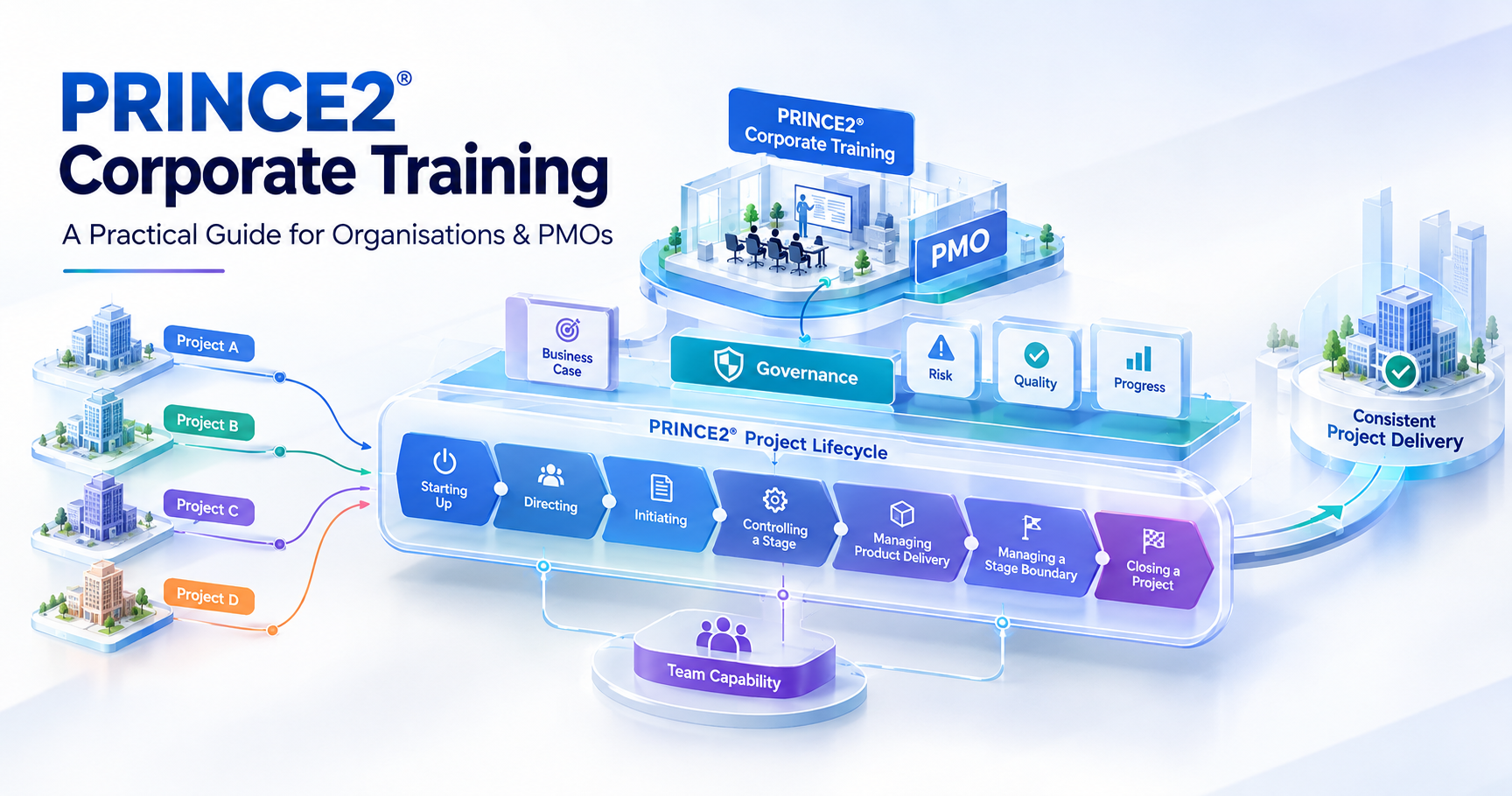
PRINCE2 corporate training certifies a project team, PMO, or department against a single, consistent project management method rather than training individuals ad hoc. Organisations typically mix Foundation and Practitioner certification across roles, choose between public/open courses and in-house delivery, and sequence the rollout by team, seniority, or project pipeline. Simpliaxis supports both formats through its corporate and group training programs.
Key Highlights of PRINCE2 Corporate Training
- Standardising on PRINCE2 across a team creates a shared project vocabulary, consistent governance, and easier stakeholder reporting across departments and business units.
- Team certification programs usually combine Foundation training for broader awareness with Practitioner training for the people who actually run projects.
- Organisations can choose public/open courses, in-house/on-site training, or a blended model depending on team size, budget, and scheduling constraints.
- A rollout plan should start with a skills audit, sequence Foundation before Practitioner, and account for exam scheduling and post-course application time.
- PRINCE2 Agile is increasingly relevant for organisations that run agile delivery teams inside a governance framework that still needs to report to a PMO or steering group.
- Simpliaxis offers both individual program enrolment and corporate/group training so PMOs can plan a rollout that fits their team structure and timeline.
If you are an L&D manager, PMO lead, or department head reading this, you are probably not trying to decide whether PRINCE2 is a good certification. You already know that. What you are trying to work out is how to get a team, a department, or an entire PMO certified in a way that is consistent, affordable, and doesn't derail active projects for weeks at a time.
That is a different problem from the one most PRINCE2 content addresses. Most PRINCE2 guides are written for a single learner deciding whether to sit the Foundation exam. Almost none of them address the practical questions that come up once you are planning training for six people, sixteen people, or an entire PMO: Do we send everyone to the same course? Do some people only need Foundation while others need Practitioner? Is it cheaper and more effective to bring a trainer in-house? How do we sequence this so the team doesn't lose weeks of productive time all at once?
This guide answers those questions directly. It covers why organisations standardise project teams on PRINCE2, how group and team certification programs are typically structured, how to plan a rollout across a team without disrupting delivery, and where PRINCE2 Agile fits for teams that blend agile delivery with formal governance. Throughout, we point to the specific PRINCE2 programs and the corporate training option that make each stage of a rollout practical to execute.
Why Organisations Standardise on PRINCE2
Individual certifications solve an individual problem: one person wants a credential. Organisational training solves a different problem: a group of people who work on the same projects, report to the same stakeholders, and hand off work to each other need to speak the same project management language.
Consistent Project Vocabulary and Method
When a project manager, a business analyst, and a PMO coordinator have all been trained in the same method, terms like "stage boundary," "exception," "business case," and "tolerance" mean the same thing to everyone in the room. That sounds like a small thing until you have sat through a steering group meeting where three people use "milestone," "phase," and "gate" to describe three different concepts. PRINCE2's structured terminology and defined roles (Project Board, Project Manager, Team Manager) give an organisation a common frame of reference that survives staff turnover and project handovers.
Governance That Scales Across Projects
PRINCE2 is built around defined management stages, a business case that is checked at every stage boundary, and clearly assigned accountability through the Project Board. For an organisation running multiple concurrent projects, this matters more than it does for a single practitioner. A PMO that trains its whole portfolio team on the same governance model can apply consistent stage-gate reviews, consistent exception-reporting thresholds, and a consistent tolerance framework across every project in the portfolio, rather than reconciling five different personal styles of "how I manage projects."
Easier Stakeholder and Executive Reporting
One of the most underrated benefits of team-wide certification is what it does to reporting. When every project manager in a portfolio uses the same highlight report format, the same exception process, and the same end-stage report structure, a PMO lead or programme director can compare project health across the portfolio without translating between different reporting styles. Executives get a single, consistent lens into project status regardless of which project manager is reporting.
Faster Onboarding and Lower Dependency on Individuals
Standardising on a documented method also reduces key-person risk. If a certified PRINCE2 project manager leaves or moves to a different project, a replacement who has also been through PRINCE2 training can pick up the existing project documentation, stage plans, and business case without a lengthy handover. This is one of the reasons PMOs prefer to certify a team rather than rely on one or two experienced individuals who “know how we do things here.”
Broader industry research on project management maturity, including PMI's long-running Pulse of the Profession research, consistently links standardised, well-governed practice to better project outcomes and more predictable delivery, which is part of why structured frameworks like PRINCE2 remain popular with PMOs that are accountable for portfolio-level performance rather than a single project.
How Team and Group PRINCE2 Certification Typically Works
Team certification is not the same exercise as sending one person to a public course. It usually involves several decisions that a PMO or L&D lead has to make before anyone books a seat.
Mixed Foundation and Practitioner Cohorts
Not every person on a project team needs the same level of certification. A common and sensible approach is to mix certification levels by role:
• Project managers and senior delivery leads typically need PRINCE2 Practitioner Certification Training, since Practitioner tests the ability to apply and tailor the method to a specific project context, not just recall the terminology.
• Team members, business analysts, coordinators, and stakeholders who need to understand how projects are governed, but who are not running the project themselves, are often better served by PRINCE2 Foundation Certification Training, which covers the principles, themes, and processes at an awareness level.
• Organisations that know from the outset they want a cohort fully qualified at both levels, for example a PMO building a bench of certified project managers, often find it more efficient to enrol that group in the combined PRINCE2 Foundation & Practitioner Certification Training track rather than scheduling two separate training events months apart.
This mixed approach is one of the main reasons organisational PRINCE2 training differs from individual training: the decision about who needs which level is a workforce-planning decision, not a personal career decision.
Public/Open Training vs In-House/Corporate Delivery
Once you know how many people need certification and at what level, the next decision is delivery format. Organisations generally choose between public (open) courses, in-house/corporate training delivered privately to their own team, or a blend of both depending on group size and scheduling needs.
| Factor | Public / Open Training | In-House / Corporate Training |
|---|---|---|
| Group size | Best for 1-4 people at a time | Best for 5+ people, up to a full department or PMO |
| Scheduling | Fixed public dates, learner joins a mixed cohort with other companies | Scheduled around the organisation's own project calendar and resourcing |
| Content focus | Standard curriculum aligned to the certification syllabus | Same accredited syllabus, with examples and exercises that can reference the organisation's own project context where the trainer allows it |
| Cost structure | Priced per seat | Often more cost-effective per head once a group reaches a certain size; [VERIFY current pricing] |
| Confidentiality | Learners are mixed with other organisations' staff | Training is delivered privately to the organisation's own team |
| Best fit | Filling one or two open roles, or topping up an existing certified team | Certifying a whole project team, department, or PMO at once |
Neither format changes what is being tested. Both public and in-house PRINCE2 training lead to the same accredited Foundation or Practitioner certification. The decision is really about group size, scheduling control, and whether the organisation wants training delivered against its own project calendar rather than a public course date. Organisations planning a group rollout can review delivery options directly through Simpliaxis's corporate and group training program, which is built specifically around this kind of team and departmental training need.
PMO Capability Building, Not Just Individual Certification
For a PMO, certifying a team is rarely just about the credential. It is usually part of a broader capability-building effort: standardising templates, aligning stage-gate reviews, and making sure every project manager reporting into the PMO can be assessed against the same governance expectations. A PMO lead planning this kind of rollout is often also thinking about how the certification maps to internal project management competency frameworks, how it will be tracked for continuing professional development, and how newly certified staff will be supported in actually applying PRINCE2 on live projects rather than just passing an exam.
Planning a PRINCE2 Certification Rollout Across a Team
A rollout that is planned properly avoids the two most common failure modes: certifying people faster than they can actually apply the method, and certifying people so slowly that the organisation never reaches a critical mass of shared practice.
Step 1: Assess Current Skill Levels Across the Team
Before booking any training, map where each team member currently sits. Some project managers may already hold PRINCE2 Foundation from a previous employer and only need Practitioner. Others may have years of informal project experience but no formal certification at all. A short skills audit, even an informal one built from CVs, past project roles, and manager input, prevents the common mistake of putting an experienced project lead into the same Foundation-only track as a first-time coordinator.
Step 2: Decide on Certification Levels by Role, Not by Seniority Alone
It is tempting to assume seniority should dictate certification level, but role is a better guide. A senior stakeholder who sits on a Project Board benefits more from Foundation-level awareness of how PRINCE2 governance works than from a full Practitioner qualification. Meanwhile, a mid-level project coordinator who will be running small projects independently may need Practitioner sooner than their title suggests.
Step 3: Sequence Foundation Before Practitioner
PRINCE2 Practitioner assumes and builds on Foundation-level knowledge; that sequencing is set by the certification's own structure. For a team rollout, this has a practical implication: do not schedule Practitioner training for a cohort until Foundation has been completed and, ideally, absorbed for at least a short period. Many organisations run Foundation and Practitioner as a continuous back-to-back program for people who need both, which is exactly what the combined PRINCE2 Foundation & Practitioner Certification Training track is designed to support. Others prefer a gap of a few weeks between the two so that Foundation concepts have time to settle before Practitioner asks learners to apply and tailor them.
Step 4: Build a Realistic Training Timeline
A team rollout timeline needs to account for more than just classroom or virtual session days. Build in time for:
• Exam scheduling, since Foundation and Practitioner exams are typically booked separately and may need to be scheduled around a learner's project workload.
• Study and revision time between the end of a course and the exam date, particularly for Practitioner, which tests application rather than recall.
• A staggered start across the team if the whole department cannot be pulled off active projects simultaneously. Many PMOs certify a first wave of project managers, then bring the wider team through in a second wave once the initial cohort's project documentation and templates have been updated to reflect PRINCE2 practice.
Step 5: Plan for Application, Not Just the Exam
A team is not "certified" in any meaningful sense the day everyone passes their exam. The real payoff comes when certified staff start using PRINCE2's stage boundaries, business case reviews, and exception process on actual projects. PMOs that get the most value from a rollout usually pair the training with a short internal step, such as updating project templates to match PRINCE2 terminology or running one live project as a pilot under the new method, so the certification translates into changed working practice rather than sitting as a line on a CV.
Where PRINCE2 Agile Fits for Organisations
A growing number of organisations run delivery teams that work in agile sprints day-to-day but still answer to a PMO, a steering group, or a business case that needs formal governance. This is exactly the gap PRINCE2 Agile is designed to close, and it is one of the most relevant parts of PRINCE2 corporate training for organisations that have already adopted Scrum, Kanban, or another agile way of working at the team level.
PRINCE2 Agile combines PRINCE2's governance structure (stages, business case, defined roles, tolerances) with agile delivery concepts such as iterative planning, prioritisation, and adapting scope within fixed time and cost constraints. For a PMO, this means project managers and Scrum Masters can keep running sprints the way they already do, while the organisation still gets the stage-gate reporting, business case oversight, and exception handling that a PRINCE2-based PMO depends on.
Organisations considering PRINCE2 Agile for a team rollout generally follow the same role-based logic used for standard PRINCE2. Team members who need general awareness of how agile delivery fits inside PRINCE2 governance are well served by PRINCE2 Agile Foundation Certification Training, while project managers, delivery leads, and Scrum Masters who need to apply and tailor the blended method on live projects typically move on to PRINCE2 Agile Practitioner Certification Training. Where a PMO already knows a cohort needs both levels, for example a delivery leadership group being upskilled together, the combined PRINCE2 Agile Foundation & Practitioner Certification Training track avoids scheduling two separate training cycles.
For organisations that already have staff certified in standard PRINCE2, PRINCE2 Agile is often the more relevant next step for a team rollout than re-running standard PRINCE2 training, since it builds directly on existing PRINCE2 knowledge rather than replacing it.
Practical Guidance: A Rollout Framework for L&D and PMO Leads
Use this framework as a working checklist when planning team or department-wide PRINCE2 certification.
| Stage | What to do | Typical owner |
|---|---|---|
| 1. Audit | List every team member, their current project management background, and any existing certifications | L&D / PMO lead |
| 2. Segment | Group the team by required certification level: Foundation-only, Practitioner, or Foundation & Practitioner | PMO lead, with input from department heads |
| 3. Choose delivery format | Decide between public/open training, in-house/corporate training, or a blend, based on group size and scheduling constraints | L&D manager, with budget sign-off |
| 4. Sequence | Confirm Foundation runs before Practitioner for each individual; decide whether waves are staggered across the team | PMO lead |
| 5. Schedule around delivery | Slot training dates against the project calendar to avoid pulling key staff off active project milestones | Resource / delivery manager |
| 6. Book training | Confirm the specific program pages and, for group bookings, engage the corporate training team for a tailored quote and schedule | L&D manager |
| 7. Support application | Update templates, run a pilot project under the new method, and check in with newly certified staff after 60-90 days | PMO lead |
| 8. Review outcomes | Compare reporting consistency, stage-gate discipline, and project documentation quality before and after the rollout | PMO lead / sponsor |
This framework works for a team of four or an entire PMO. The main variable that changes with scale is Stage 3: smaller groups tend to use public/open courses, while larger groups get more value, and more scheduling control, from in-house corporate training built around their own calendar.
Simpliaxis Training Relevance for Organisations
Simpliaxis supports team and organisational PRINCE2 certification through both individual program enrolment and dedicated corporate training delivery, which means a PMO or L&D team can mix and match based on how a rollout is segmented.
For team members who need foundational awareness of PRINCE2 governance without running projects independently, PRINCE2 Foundation Certification Training covers the principles, themes, and processes at the level most stakeholders and coordinators actually need. For project managers and delivery leads who need to apply and tailor the method on live projects, PRINCE2 Practitioner Certification Training builds directly on that foundation. Where a PMO already knows a cohort needs both levels together, for example a group of project managers being brought up to a consistent standard at the same time, the combined PRINCE2 Foundation & Practitioner Certification Training track avoids the scheduling gap between two separate courses.
For organisations blending agile delivery with formal governance, the same logic applies to the agile track. PRINCE2 Agile Foundation Certification Training suits team members who need to understand how agile delivery sits inside a governed project structure, PRINCE2 Agile Practitioner Certification Training suits project managers and Scrum Masters applying the blended method day to day, and the combined PRINCE2 Agile Foundation & Practitioner Certification Training track suits a delivery leadership group being upskilled together.
For anything beyond a handful of individual bookings, the corporate and group training program is the right starting point. It is built specifically for PMOs, L&D departments, and organisations that need training scheduled around their own project calendar, delivered privately to their own team, and quoted for group size rather than priced per individual public seat. If you are planning to certify more than a few people at once, that is the page to work from when requesting a tailored training plan and quote.
Two further resources are worth reviewing while planning a rollout: the guide to PRINCE2 certification eligibility requirements clarifies who on a team can enrol at each level, and the overview of PRINCE2 certification levels is useful when explaining to stakeholders why some team members are being certified at Foundation and others at Practitioner. The article on the benefits of PRINCE2 certification for organisations is also a useful reference when building an internal business case for training budget, and the PRINCE2 Foundation & Practitioner course curriculum overview helps L&D teams brief hiring managers or department heads on what the combined track actually covers before it is scheduled.
Conclusion
Certifying a team on PRINCE2 is a planning exercise as much as a training purchase. The organisations that get the most value from it treat certification level as a role-based decision, sequence Foundation before Practitioner deliberately, choose a delivery format that matches their group size and scheduling constraints, and follow through with application support once the exams are passed. Done well, it gives a PMO a shared project language, consistent governance across a portfolio, and reporting that an executive team can actually compare across projects. Done as a series of ad hoc individual bookings, it rarely delivers the same consistency.
Wherever your rollout stands today, from still segmenting the team by certification level to being ready to request a schedule and quote, Simpliaxis's corporate and group training program is built to support that planning conversation directly.
View PRINCE2 certification training options available for organisations and start planning a team rollout through Simpliaxis's corporate and group training program. From a quote for an in-house Foundation and Practitioner cohort, to a PRINCE2 Agile track for a blended agile-governance team, to a mix of individual and group enrolments, the corporate training team can help you plan a schedule around your project calendar rather than a fixed public course date.







 Lowest-Price Challenge











 Personalized Path


.webp)


 USA
USA  Canada
 India
India UK
UK Australia
 Singapore


