


 Call Us



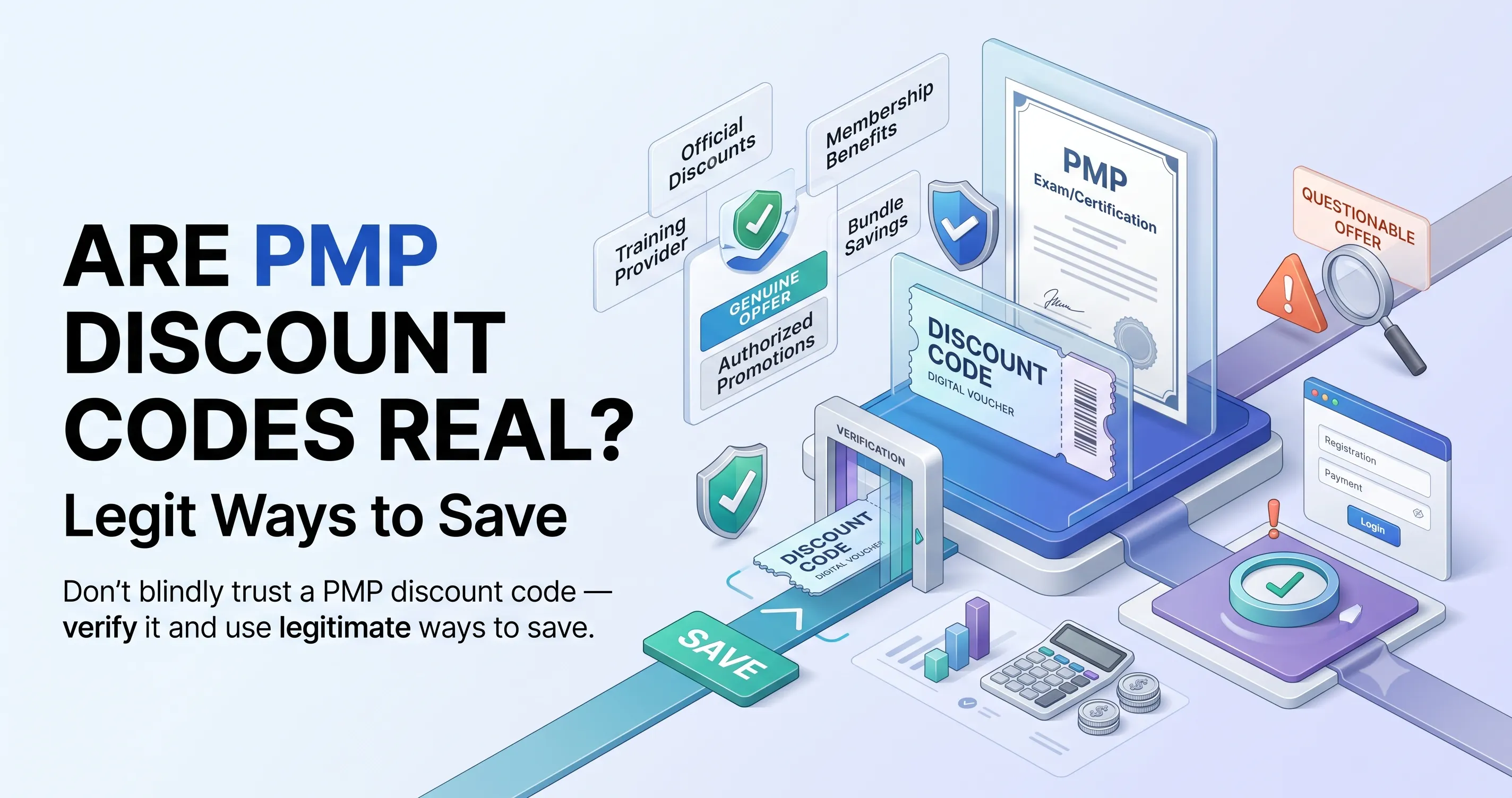
PMP discount codes advertised on coupon aggregator sites are almost never real, and PMI does not publish public promo codes for the PMP exam. The genuine ways to reduce PMP certification costs are PMI membership pricing, PMI Authorized Training Partner bundles, occasional local chapter offers, and employer reimbursement, not a code typed into a checkout box. Anyone who buys a "PMP voucher" from a resale site is very likely to lose the money, because vouchers are tied to a specific PMI account and region and are validated server-side at redemption. This guide explains exactly which savings routes work, how much each one is worth, and why the rest fail.
Key Highlights of PMP Discount Codes
- PMI does not issue public PMP promo codes. No code listed on coupon aggregator sites has been verified active on pmi.org.
- PMI raised the PMP exam fee on 6 August 2026: members now pay $445 and non-members pay $675, a gap of $230.
- PMI membership costs $139 to $159 a year and immediately lowers the exam fee by more than the membership itself costs.
- Resold "PMP exam vouchers" fail because redemption is tied to the original candidate's PMI account, email and region, and is checked by PMI's system at the point of use.
- PMI Authorized Training Partner (ATP) bundles that combine training, an exam voucher and 35 contact hours typically cost $800 to $2,500, and genuinely undercut buying each piece separately.
- Employers can reimburse up to $5,250 per employee per year in the US tax-free under IRC Section 127, making employer sponsorship the largest single saving available to most candidates.
- Local PMI chapters occasionally distribute member-only codes through newsletters and events, but these are never posted publicly, which is exactly why "leaked" versions on forums are usually fake or expired.
Does PMI Actually Offer PMP Discount Codes?
No, PMI does not maintain a public promo code programme for the PMP exam. Searching pmi.org directly turns up membership pricing, retake pricing and Authorized Training Partner pages, but no page inviting candidates to enter a discount code at checkout. What does exist, and gets confused with a "PMP promo code," is member pricing itself: PMI's own materials describe member pricing as offering up to 30 percent off certification, learning and events compared with the non-member rate. That is a pricing tier you unlock by joining, not a code you find on a coupon site.
Coupon aggregator pages such as those on Coupert, SimplyCodes and similar sites list codes with names like SEOUL30 or BLACKFRIDAY26 that are presented as live discounts on PMI purchases. In practice these listings are compiled automatically from historic promotions, some tied to specific PMI conferences or regional campaigns years ago, and most fail the moment they are tested at pmi.org checkout.
A small number of these sites do carry occasional, time-boxed PMI marketing offers, such as a seasonal discount on PMI membership itself, but none of them offer a working code specifically for the PMP exam fee on an ongoing basis. Treat every "PMP promo code" you find through a search engine as unverified until you test it yourself directly on pmi.org, and expect it to fail.
It is worth being precise about what these sites are actually indexing. Many carry genuine, historic PMI marketing codes that applied to conference tickets, PMI Study Hall subscriptions, or membership sign-up during a limited window, then never update the listing once the code lapses. A candidate searching specifically for a PMP exam fee reduction, rather than a membership or event discount, is very unlikely to find a currently working code on any of these pages, no matter how recently the page claims to have been updated.
What Does the PMP Exam Actually Cost Right Now?
PMI increased PMP exam fees on 6 August 2026, moving the member price from $405 to $445 and the non-member price from $555 to $675. That widened the gap between member and non-member pricing to $230, which is now larger than the annual cost of PMI membership itself. Anyone who registers for the exam after that date is on the new fee schedule, and retake fees moved in step, commonly reported at $275 for members and $375 for non-members.
For a full breakdown of what changed and why, see Simpliaxis's dedicated PMP exam fee increase analysis, and for the complete list of every cost a candidate should budget for, from application through renewal, the PMP certification cost guide lays out the full picture in one place.
Cost item | PMI member | Non-member |
|---|---|---|
| PMP exam fee (from 6 August 2026) | $445 | $675 |
| PMP retake fee | $275 | $375 |
| PMI membership (annual) | $139 to $159 | Not applicable |
| Certification renewal (every 3 years) | $60 | $150 |
The one-time cost of joining PMI is recovered on the exam fee alone before the candidate has spent a cent on study material. Someone paying non-member pricing spends $675 on the exam. Someone who joins first spends roughly $150 on membership and $445 on the exam, a combined $595, and still holds an active PMI membership worth continued discounts on renewal, retake and future certifications such as CAPM or PMI-ACP.
The Four Legitimate Ways to Reduce PMP Certification Costs
Every credible saving on a PMP certification traces back to one of four channels: PMI membership, an Authorized Training Partner bundle, a local chapter offer, or employer reimbursement. Each works differently, and combining more than one is usually possible.
1. PMI Membership Pricing
Joining PMI before applying for the exam is the single most reliable saving available to an individual candidate. Membership costs $139 to $159 a year and immediately drops the exam fee by $230 under the current 2026 schedule, before counting the free digital PMBOK Guide and reduced pricing on future renewals, retakes and other PMI certifications.
2. PMI Authorized Training Partner (ATP) Bundles
PMI-authorised providers such as Simpliaxis are permitted to bundle the mandatory 35 contact hours of project management education with exam preparation material, and in many cases an exam fee, into a single package. ATP bundles that combine training, practice material and a voucher typically run $800 to $2,500 depending on delivery format and inclusions, and represent genuine savings compared with paying for 35 contact hours, a prep course and the exam fee as three separate purchases.
Simpliaxis's own PMP certification training course is built this way, bundling the required 35 PDUs with study support so the candidate is not assembling components from different vendors. Because pricing, format and inclusions vary meaningfully between training providers, it is worth comparing options before committing, and Simpliaxis's comparison of leading PMP training providers is a reasonable starting point for that evaluation.
3. Local PMI Chapter Discounts
PMI operates more than 300 local chapters worldwide, and many distribute member-only discount codes for events, membership renewal and, occasionally, exam fees through chapter newsletters and meetings. These codes are deliberately not published on the open web, which is precisely why a code claiming to be a "leaked chapter discount" on a forum or coupon site should be treated as unverifiable. The only reliable way to access a chapter discount is to join a local chapter directly through PMI's chapter directory and watch its own newsletter.
4. Employer Reimbursement and Group Training
For many candidates, an employer footing part or all of the bill is worth more than any code could ever be. In the US, employers can provide up to $5,250 per employee per year in tax-free educational assistance under IRC Section 127, which comfortably covers the exam fee, training and study materials combined. Roughly half of US employers already offer some form of tuition or certification reimbursement, so it is worth asking L&D or a manager before assuming the cost falls entirely on the candidate.
This channel scales further for organisations training more than one employee at a time. An L&D or PMO manager planning PMP certification across a project team rarely gets the best value paying full retail per seat, and group or corporate bookings through an Authorized Training Partner typically bring the per-person cost down substantially. Simpliaxis's corporate group training programme is built for exactly this scenario, bundling multiple seats, flexible scheduling and account-level pricing for teams rather than individuals.
Comparing the Legitimate Discount Channels
Laid side by side, the four legitimate channels differ in who they suit, how much they save, and how quickly the saving arrives.
Channel | Typical saving | Best suited to | How to access it |
|---|---|---|---|
| PMI membership pricing | $230 off the exam fee, minus $139 to $159 membership cost | Any individual candidate, especially first-time applicants | Join at pmi.org before submitting the PMP application |
| ATP bundle (training and voucher) | Varies by provider, commonly several hundred dollars versus buying components separately | Candidates who also need the mandatory 35 contact hours | Book directly through an Authorized Training Partner such as Simpliaxis |
| Local chapter discount | Small and irregular, occasionally free events or minor exam credits | Members active in a local PMI chapter | Join a chapter and read its member newsletter |
| Employer reimbursement or group training | Up to full cost, and up to $5,250 tax-free per employee per year in the US | Employed candidates, and teams of three or more | Company tuition assistance policy, or a corporate group booking through an Authorized Training Partner |
Why Do Resold PMP Vouchers Fail?
Resold vouchers fail because a PMP exam voucher is not a generic gift card, it is a database entry linked to one candidate's PMI account, one region, and one redemption window, and PMI's system checks all three when the code is entered. Understanding the mechanics explains why almost every "cheap PMP voucher" sold outside official channels stops working exactly when the buyer tries to use it.
- Account-level binding. A voucher issued to one candidate's PMI account is generally recorded against that candidate's profile and cannot simply be applied to a different person's application, because PMI validates the code against the account it was issued to, not against the code alone.
- Region-locking. PMI and its exam delivery partner price and issue vouchers by country to reflect regional cost differences, and a voucher purchased or issued in a lower-cost region is typically blocked from redemption in a higher-cost region. Buying a "discounted" voucher from a reseller claiming it works anywhere ignores this control entirely.
- One-time, server-side validation. Every voucher is checked centrally at the moment of redemption, not just at the point of sale. A code that has already been used once, even by the original owner, shows as redeemed and cannot be reused, no matter how it is described in a resale listing.
- No recourse when it fails. Because the transaction happened outside PMI's own channels, a buyer whose resold voucher is rejected at checkout has no support path with PMI and is generally unable to recover the payment from the reseller either.
The practical warning signs are consistent across the scam reports circulating on forums such as r/pmp and r/projectmanagement and on threads on projectmanagement.com: unsolicited "last chance" urgency messaging, a code sold outside pmi.org or an Authorized Training Partner's own checkout, and a seller who cannot explain why a legitimate voucher would ever need to be resold in the first place. A genuine PMI discount always arrives through membership pricing, a training provider's own bundle, or an employer, never through a third party selling a code with no connection to the candidate's PMI account.
How Can You Tell a Legitimate Offer from a Scam Before You Pay?
A legitimate PMP saving can always be traced back to one of the four channels described above, and it never asks the candidate to pay a third party for something PMI itself would otherwise provide. Before paying for anything described as a PMP discount, voucher or promo code, running through a short checklist avoids most of the losses reported in forum threads.
- Check the seller. Confirm whether the payment goes directly to pmi.org, an Authorized Training Partner's own checkout, or an unrelated third party. Only the first two are ever legitimate for a PMP exam fee.
- Test the code yourself first. A genuine code should apply cleanly at pmi.org before any payment changes hands. If a seller insists on payment before you can verify the code works, treat that as a decisive warning sign.
- Ask why it is being resold. A real PMI voucher is issued to a specific candidate's account for that candidate's own use. There is rarely a legitimate reason for someone to be selling one on rather than using it themselves.
- Check the region match. Confirm the voucher was issued in the same country where you intend to sit the exam, since region-locking will otherwise block redemption regardless of how valid the code looks.
- Look for urgency language. Phrases like "last chance," "code expires tonight" or "limited codes remaining" are common pressure tactics used to stop a buyer from checking the code first.
What Simpliaxis and Other Authorized Training Partners Actually Offer
Because PMI does not run a public coupon programme, the credible alternative for most candidates is the pricing structure built directly into an Authorized Training Partner's own course. This typically includes several mechanisms candidates can act on immediately, rather than searching for a code that may not exist.
- Bundled exam-and-training pricing, where the mandatory 35 contact hours and exam preparation are sold together at a lower combined cost than buying each separately.
- Group and corporate discounts for teams booking multiple seats at once, most relevant to PMOs and L&D functions training several project managers in the same cycle.
- Early-bird pricing for candidates who commit to a course date ahead of time rather than booking close to the session.
- Referral discounts for candidates who come through an existing student or colleague.
These are worth comparing against each other rather than assumed to be identical across providers, since inclusions and pricing structures differ meaningfully by training partner, and a bundle that looks cheaper on the surface can exclude the exam voucher or charge separately for retake support.
Reviewing several providers side by side before booking is a more productive use of research time than testing expired codes on coupon sites, since the saving from choosing the right bundle is usually larger than anything a promo code would have delivered anyway.
What Happens After You Pass: Renewal Costs to Plan For
Saving on the exam fee is only half the cost picture, since the PMP certification requires renewal every three years through PMI's Continuing Certification Requirements programme. Renewal costs $60 for members and $150 for non-members, on top of the 60 PDUs required in each three-year cycle. Candidates evaluating membership purely against the exam fee should factor in that the same membership keeps reducing renewal costs every cycle going forward, which Simpliaxis's PMP certification renewal fee guide breaks down in detail.
Conclusion
The honest answer to "are PMP discount codes real" is that the codes themselves mostly are not, but the underlying savings absolutely are. PMI's public promo code programme does not exist in any verifiable form, and every resold voucher fails for the same structural reason: it is checked against an account, a region and a one-time redemption record that a reseller cannot transfer.
What does work is joining PMI before applying, choosing an Authorized Training Partner bundle instead of assembling training and exam fees separately, checking in with a local chapter, and asking an employer to fund some or all of the cost. Individually these channels save anywhere from roughly $80 to the full certification cost, and a candidate who stacks membership with an employer-funded ATP bundle is very likely to end up paying close to nothing out of pocket, without ever touching a "promo code" that was never going to work at checkout.


_1726227423.jpg)



 Lowest-Price Challenge











 Personalized Path


.webp)


 USA
USA  Canada
 India
India UK
UK Australia
 Singapore


