


 Call Us



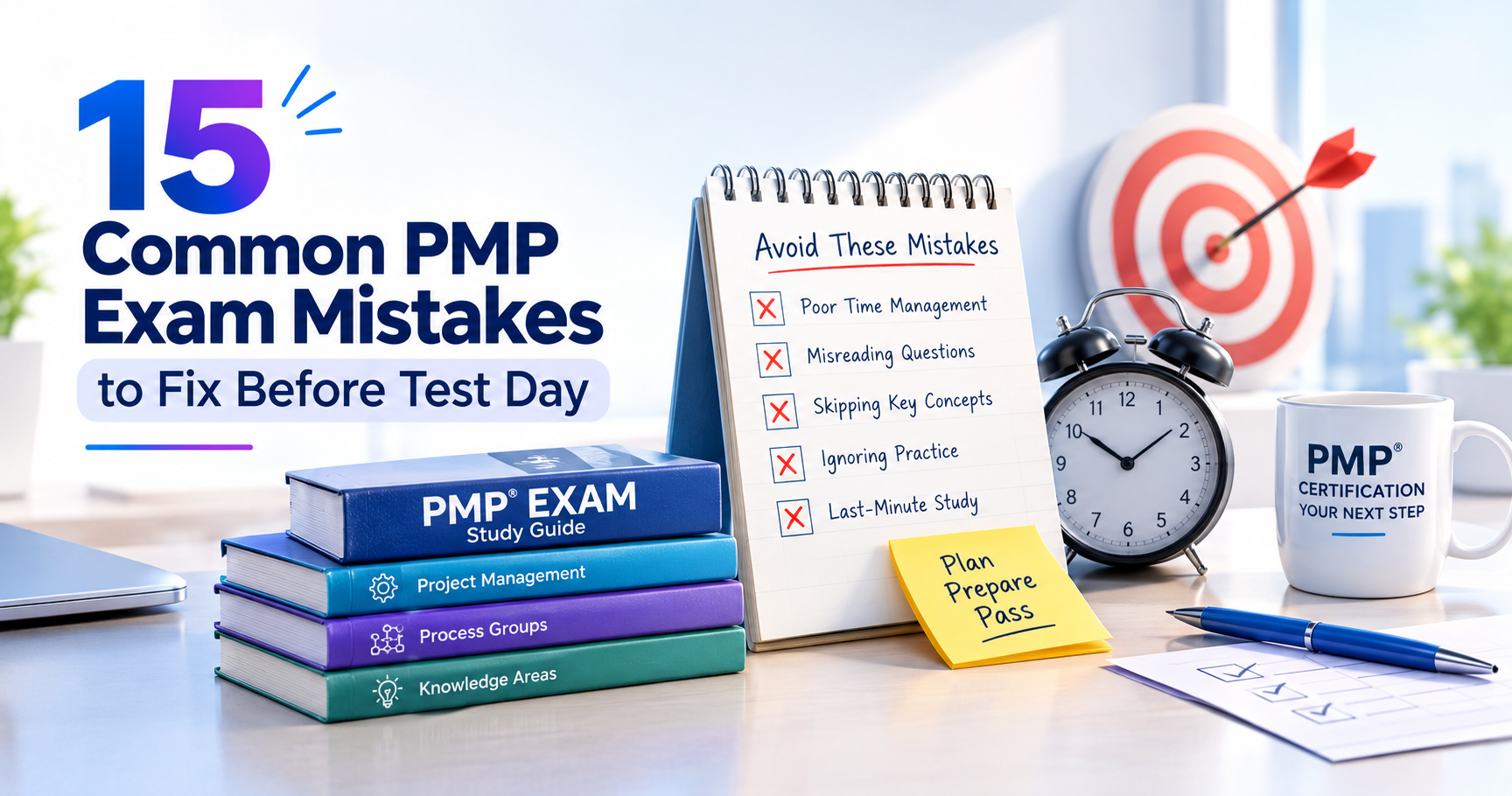
The most common PMP exam mistakes in 2026 include studying from outdated pre-July-2026 materials, memorizing ITTOs instead of practicing scenario-based application, underestimating the Business Environment domain (now 26% of the exam), skipping full-length timed mock exams, and mismanaging time across the exam's new case-study and independent-question sections. Most failed attempts trace back to two or three of these fifteen patterns, not a lack of underlying project management knowledge.
Key Highlights of PMP Exam Mistakes:
- Business Environment jumped from 8% to 26% of the exam in July 2026, a domain many older study materials still underweight
- The exam now includes a dedicated case-study section plus new question types (Enhanced Matching, Graphic-Based, Point and Click)
- Roughly 60% of exam content spans agile, adaptive, and hybrid approaches, a frequent blind spot for predictive-only candidates
- Candidates who skip full-length, timed mock exams are significantly more likely to mismanage the 240-minute time limit on test day
- PMI's four-band score report (Above Target, Target, Below Target, Needs Improvement) can help candidates retroactively identify which mistakes actually cost them points
- A well-documented pattern: over-relying on personal work experience instead of PMI's standardized, principle-based approach.
Most PMP exam failures aren't caused by a lack of project management knowledge. They're caused by a handful of specific, well-documented, and entirely avoidable mistakes, made during preparation, in how candidates study the content, or in how they manage the exam itself. This article walks through all 15, organized into three categories, so you can quickly identify which ones apply to your own preparation before they cost you a passing score.
Why Most PMP Exam Mistakes Are Avoidable ?
Every mistake on this list has shown up repeatedly across training-provider data, candidate forums, and PMI's own guidance on how the exam is structured. None of them requires exceptional intelligence or years of extra experience to avoid; they require awareness that the mistake exists, and a specific adjustment to your preparation. That's the entire premise of this article: naming the pattern clearly enough that you can check your own study plan against it.
Preparation Mistakes
1. Studying from outdated, pre-July-2026 materials. PMI updated the PMP exam on July 9, 2026, rebalancing the three domains (People dropped from 42% to 33%, Process from 50% to 41%, and Business Environment jumped from 8% to 26%) and introducing new question types. Courses, books or simulators can be out of date, and candidates can waste study time on an exam version that is no longer offered. Always ensure your materials align to the current PMP Certification Exam Content Outline. The fix: before your first study session, cross-check your course's table of contents against the current domain percentages; if Business Environment gets less than a fifth of the total content, the material is likely outdated.
2. Cramming vs. a Multi-Week Schedule, structured. The PMP exam rewards judgment applied over time, not short-term memorization. Candidates who compress preparation into a week or two, even if they put in long hours, tend to retain less scenario-level nuance than those who spread the same hours across 6 to 10 weeks. The fix: block out a fixed number of weeks on your calendar now, even if it feels generous, and treat study sessions as recurring appointments rather than something you'll get to when time allows.
3. Over-reliance on scattered resources rather than one structured plan. Many people tend to collect books, YouTube channels, forums and multiple practice-question banks at the same time. This often creates the illusion of being well prepared, but in reality it distracts from studying and results in patchy coverage of the ECO’s tasks and enablers. The fix: pick one primary structured course, ideally from a PMI Authorized Training Partner, and use additional resources only to fill specific gaps that course identifies, not as parallel, competing study tracks.
4. Skipping or delaying full-length, timed mock exams. Passive review, reading, watching videos, highlighting notes, feels productive but doesn't build the stamina or pacing instincts a 240-minute, 180-question exam demands. Candidates who take their first full-length mock exam only in the final week are frequently caught off guard by fatigue and pacing on test day. The fix: schedule your first full mock exam by the midpoint of your study plan, not the final week, so you have time to act on what it reveals.PMP Practice Exam Questions with Explanations is a useful starting point if you need scenario-based questions aligned to the current exam.
5. Not reviewing or analyzing mistakes from practice exams. Taking mock exams without a structured review of every wrong answer, and why it was wrong, wastes most of the diagnostic value those exams offer. An error log that categorizes each miss as a content gap, a misread scenario, or a timing issue turns practice exams into a genuine improvement tool rather than a stress test. The fix: spend at least as much time reviewing a mock exam's wrong answers as you spent taking the exam itself; a mock exam you don't review is closer to a guessing exercise than a study tool.
Content and Knowledge Gaps
6. Memorizing ITTOs and definitions instead of practicing application. The PMP exam is scenario-based; it tests whether you can apply a concept correctly in a messy, multi-stakeholder situation, not whether you can recite that "expert judgment" is a tool in a given process. Candidates who lean heavily on flashcard-style memorization often struggle when every answer choice sounds partially correct. The fix: for every concept you study, immediately follow it with two or three scenario-based practice questions that test its application, rather than moving to the next definition.
7. Underestimating the Business Environment domain. This domain tripled in weight under the July 2026 update, now covering financial management (NPV, IRR, benefit-cost ratios), governance, compliance, sustainability, and organizational change in real depth. This is still done by many candidates, especially those following study plans designed prior to 2026, as a small domain that doesn’t warrant much of their study time. This is a major miscalibration. Fix: Allocate study time according to the current weighting, i.e. Business Environment should get a significantly large share of study time, not an afterthought that is crammed in the last few days.
8. Ignoring agile and hybrid methods. Roughly 60% of the current exam spans adaptive, agile, and hybrid methodologies, woven through all three domains rather than isolated to one section. Candidates from strictly predictive or Waterfall-heavy backgrounds sometimes assume this content is optional or minor, which it no longer is at any meaningful level. The fix: if you've never worked on an agile project, treat this as a genuine new subject to learn from scratch, not a light supplement to your existing predictive-methodology knowledge.
9. Over-relying on personal work experience over PMI's standardized approach. Real-world project management experience is valuable, but the exam tests PMI's principle-based, standardized methodology, which doesn't always match how your specific organization or industry actually operates. When your workplace habits conflict with PMI's tested approach, the exam expects the PMI answer, not the way you'd handle it at your job. The fix: whenever a practice question's correct answer surprises you, ask whether you were answering as a PMI-trained project manager or as an employee of your specific company; the exam only rewards the former.
10. Not understanding the new question types. July 2026 update: Case or Scenario questions (a detailed situation followed by several related questions); Enhanced Matching Graphic-Based questions (requiring candidates to interpret charts or diagrams); Point and Click items. Candidates who've only practiced traditional multiple-choice formats can lose time simply adjusting to an unfamiliar interface and question style mid-exam. The fix: make sure at least one of your practice-question sources includes these newer formats, not just traditional single-answer multiple choice, so the interface itself isn't a surprise on test day.
Exam-Day and Test-Taking Mistakes
11. Poor time management across the exam's sections. With 240 minutes for 180 questions, roughly 80 seconds per question on average, candidates who spend too long on early, difficult questions often find themselves rushing through the back half of a section. The exam's new structure, a dedicated case-study section followed by an independent-question portion, adds another layer: misjudging how long the case-study section takes can throw off your entire pacing plan. The fix: practice with checkpoint pacing during mock exams; if you're behind schedule at a natural checkpoint, move faster rather than trying to make up the entire deficit on one difficult question. PMP Exam Time Management covers a full, section-by-section pacing strategy if this is your specific concern.
12. Mismanaging the exam's mandatory breaks. There are two 10-minute breaks: the first after the case-study section and the second roughly midway through the independent questions, but once you review your responses and start a break, you cannot return to the previous section's questions. Candidates who rush through review before a break, or who don't use the breaks at all to reset focus, sometimes carry avoidable errors into a section they can no longer revisit. The fix: build a specific pre-break routine into your mock exams, flag anything uncertain, do one final pass over flagged items, then take the break deliberately rather than skipping it to save time.
13. Change answers for no good reason. Second-guessing a well-reasoned initial answer, especially under time pressure, tends to introduce more errors than it corrects. This doesn't mean never revising an answer; it means only revising when you can articulate a specific reason the original answer was wrong, not a vague feeling of doubt. The fix: if you flag a question to revisit, write a one-line note on why you're uncertain; if you can't articulate a concrete reason when you return to it, leave your original answer as is.
14. Treating unscored pretest questions differently. Of the 180 total questions, 10 are unscored pretest items used to validate future exam content, but they're randomly placed and indistinguishable from the 170 scored questions. Candidates who try to guess which questions "don't count" and rush through them risk treating a scored question carelessly. The fix: commit before the exam to giving every single question equal focus and time, since you have no reliable way to identify the unscored ten.PMP Pass Rate has more background on how PMI's scoring model evolved to this pretest-question approach, if you want the fuller context.
15. Not simulating full exam-day conditions before test day. Taking practice questions in short, comfortable sessions is useful for content review, but it doesn't prepare you for four hours of sustained focus, unfamiliar testing-center or online-proctoring conditions, and the mental fatigue that sets in by the final section. At least one or two full-length, properly timed mock exams under realistic conditions should happen before your actual exam date. The fix: run at least one mock exam at the same time of day as your scheduled exam, in a similarly quiet, distraction-free environment, so the conditions themselves aren't a new variable on the actual day.
How Do These Mistakes Map to Your Score Report?
If you've already taken the exam and didn't pass, your score report's domain-level ratings can help you retroactively identify which of these 15 mistakes were most costly.
If Your Score Report Shows... | Most Likely Contributing Mistakes |
| Below Target or Needs Improvement in Business Environment | Mistake 1 (outdated materials), Mistake 7 (underestimating this domain) |
| Below Target or Needs Improvement in People | Mistake 6 (memorization over application), Mistake 9 (over-relying on personal experience) |
| Below Target or Needs Improvement in Process | Mistake 8 (neglecting agile/hybrid), Mistake 6 (memorization over application) |
| Inconsistent ratings across all three domains | Mistake 11 (time management), Mistake 15 (no full-condition simulation) |
| A close overall result despite reasonable domain ratings | Mistake 13 (answer-changing), Mistake 14 (pretest question handling) |
It's worth being honest about the limits of this table. PMI's score report doesn't tell you which specific question types or mistakes cost you points; it only tells you your rating per domain, so this mapping is a reasonable, evidence-informed starting hypothesis rather than a diagnosis PMI itself confirms. Use it to prioritize where you look first, then validate against your own mock-exam history and error log rather than treating it as the final word. For a deeper walkthrough of the score report itself, what each of the four bands actually means, and how PMI's underlying scoring model works,PMP Exam Retake covers this in detail, including the specific fee and timeline implications of a second attempt.
Why These Mistakes Rarely Happen in Isolation?
One pattern worth naming explicitly: these 15 mistakes tend to cluster rather than occur one at a time. A candidate who skips full-length mock exams (Mistake 4) is also more likely to under-review their wrong answers (Mistake 5), simply because they haven't generated enough practice data to review in the first place. Someone using outdated materials (Mistake 1) almost by definition also underestimates Business Environment (Mistake 7), since the two are directly connected. Recognizing these clusters matters because fixing one root cause, switching to a current, structured study plan, for instance, often resolves two or three related mistakes simultaneously, rather than requiring 15 separate fixes.
This is also why a generic "study harder" response to a failed attempt rarely works as well as a targeted one. If you can trace your result back to a specific cluster (outdated materials feeding into a Business Environment gap, for example, versus a pacing-and-simulation cluster feeding into inconsistent domain performance), your retake preparation becomes dramatically more efficient than restudying everything evenly.9 Key Steps to Pass the PMP Certification Exam offers a positively framed companion checklist if you'd rather work from a "what to do" list once you've identified your specific cluster here.
The One Mistake That Costs the Most Candidates: Studying the Wrong Exam Version
If this article had to name a single highest-impact mistake, it would be Mistake 1: preparing with materials that don't reflect the current, July 2026 Examination Content Outline. This mistake is unusually dangerous because it's invisible to the candidate while it's happening. You can follow a study plan diligently, complete every practice question in a course, and feel fully prepared, while still misallocating a significant share of your study time toward a domain weighting that no longer applies. Before finalizing any study plan, confirm the specific date of your scheduled exam and verify that your training provider's materials, especially anything covering Business Environment, agile/hybrid content, and the new question types, are built around the current ECO rather than a pre-update version.
A 4-Week Mistake-Proofing Checklist
- Week 1: Confirm your materials are current, cross-check your course or book against the domain weights (People 33%, Process 41%, Business Environment 26%) and correct any gap immediately.
- Week 1-2: Build a single, structured study plan instead of juggling scattered resources, mapped to the ECO's actual tasks and enablers rather than a generic table of contents.
- Week 2: Take your first full-length, timed mock exam under real conditions to establish a baseline, then start an error log categorizing every wrong answer by cause.
- Week 3: Focus remaining study time on whichever domain your error log and mock-exam results show as weakest, with deliberate attention to agile/hybrid scenarios woven through all three domains.
- Week 3-4: Do at least one more full-length mock exam with the format of the real test (review and take a break after a chunk of case-study-style questions, and then again halfway through the rest of the questions) to get a feel for real-world pacing.
- Week prior: No new material, just review and light practice. No last-minute cramming of new material. Make sure to double-check your testing center or online proctoring arrangements well in advance.
If you want structured support running through this checklist rather than building it entirely solo,Simpliaxis's PMP Certification Training is built around the current 2026 exam content, with mock exams and practice questions included. If you'd rather start with a lower-commitment overview first, theSimpliaxis PMP Orientation session is a useful preview. And if pacing specifically, rather than content, is your biggest open question,PMP Exam Time Managementgoes deeper into exactly that.
Conclusion
Fifteen mistakes sound like a long list, but almost every candidate who fails traces the result back to two or three of them, not all fifteen at once. The highest-leverage move available to you right now is an honest audit: which of these patterns show up in your current study habits? Fixing the one or two that actually apply to you will do more for your score than trying to perfect all fifteen simultaneously.
If you've already sat the exam and are mapping your result back to this list,PMP Exam Retake walks through exactly how to turn that diagnosis into a focused retake plan. And if you haven't sat the exam yet,How Hard Is the PMP Exam and How to Crack Itis a useful companion read for the broader difficulty picture beyond just these specific mistakes.





 Lowest-Price Challenge











 Personalized Path


.webp)


 USA
USA  Canada
 India
India UK
UK Australia
 Singapore


