


 Call Us


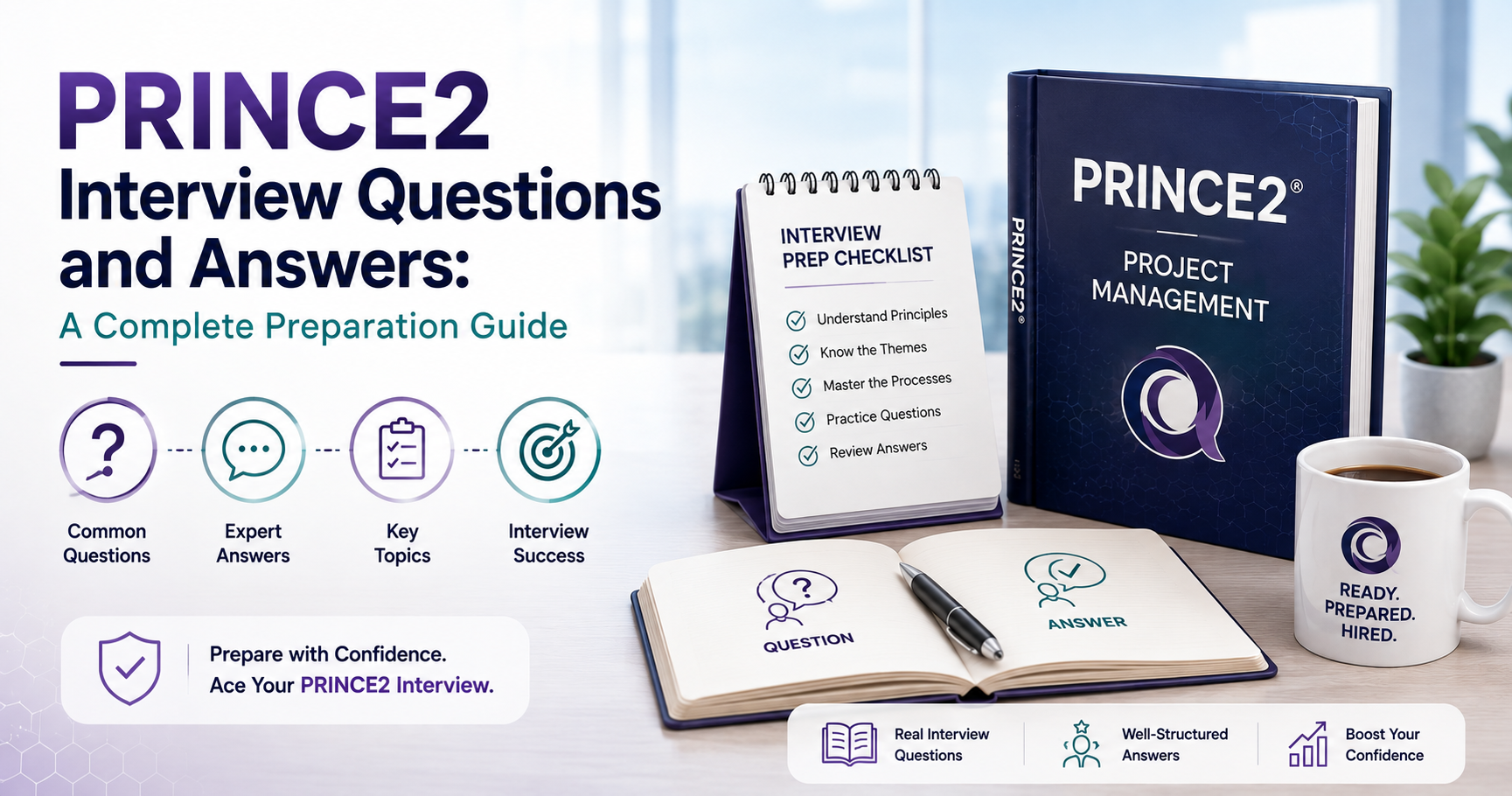
PRINCE2 interviews typically mix three question types: conceptual questions about principles, themes (practices) and processes, situational questions asking how you would apply PRINCE2 to a real project problem, and role-specific questions that differ for project managers, coordinators and PMO staff. Strong candidates pair accurate terminology with a short, structured example from their own project experience.
Key Highlights of PRINCE2 Interview Questions
- PRINCE2 interview questions generally fall into three buckets: conceptual/knowledge, situational/behavioural, and role-specific.
- Interviewers rarely want a textbook recitation. They want to see that you understand why a principle, theme or process exists and can apply it to a real scenario.
- The STAR method (Situation, Task, Action, Result) works well for structuring answers to situational PRINCE2 questions.
- Questions differ by role: project managers are tested on decision-making and stage control, coordinators on documentation and coordination, PMO staff on governance and reporting.
- A short, focused week-before-interview routine covering principles, themes, processes, roles and a couple of practical scenarios covers most of what actually gets asked.
- Certification (Foundation, Practitioner, or PRINCE2 Agile) gives you the shared vocabulary interviewers expect, but the way you explain your reasoning in the interview room is what actually separates candidates.
If you are preparing for a project management, project coordination or PMO interview where PRINCE2 is part of the job description, you have probably already noticed that the questions rarely stop at "what does PRINCE2 stand for." Employers use PRINCE2 interview questions to check two things at once: whether you know the framework's vocabulary (principles, themes, processes, roles), and whether you can actually apply that vocabulary to decide what to do when a project starts drifting off course.
This guide walks through the PRINCE2 interview questions that come up most often for project managers, project coordinators and PMO professionals, organised by category rather than as a random list. For each category, you will find real example questions along with a model answer approach, not a script to memorise, but a way of thinking through the question so your own answer sounds like it is coming from experience rather than a revision guide. We have also included a practical week-before-interview plan, a look at how to structure situational answers using the STAR method, and guidance on where PRINCE2 certification fits into the picture.
One clarification before we start: PRINCE2's 7th edition (the current version accredited by PeopleCert) renamed the seven "themes" to seven "practices." Many interviewers, job descriptions and older study guides still use the word "themes," and both terms describe the same seven areas of project management (business case, organisation, quality, plans, risk, change, and progress), so this guide uses "themes (practices)" to stay accurate across both versions.
Conceptual and Knowledge-Based PRINCE2 Interview Questions
This is the category most candidates expect, and it is usually the first filter an interviewer applies. These questions check whether you actually understand the PRINCE2 structure (seven principles, seven themes/practices, seven processes, and the roles that sit around the project board) rather than having memorised a glossary.
“Can you explain the seven principles of PRINCE2 and why they matter?”
Model answer approach: Do not just list the seven principles (continued business justification, learn from experience, defined roles and responsibilities, manage by stages, manage by exception, focus on products, tailor to suit the project). Pick two or three and explain, in one sentence each, what would go wrong on a real project if that principle were ignored. For example, “without continued business justification, a project can keep consuming budget long after the original reason for doing it has disappeared, which is why the business case is reviewed at every stage boundary.”
“What are the PRINCE2 themes (practices), and which one do you think is hardest to get right in practice?”
Model answer approach: Name the seven themes (business case, organisation, quality, plans, risk, change, progress) briefly, then spend most of your answer on the one you pick, with a reason grounded in experience. Risk and change are common honest answers because both require judgement calls under uncertainty rather than a checklist.
“Walk me through the seven PRINCE2 processes from starting up a project to closing a project.”
Model answer approach: Give the sequence at a high level (Starting up a Project, Initiating a Project, Directing a Project, Controlling a Stage, Managing Product Delivery, Managing a Stage Boundary, Closing a Project) and then anchor it with one concrete deliverable per process, such as the Project Brief coming out of Starting up a Project, or the End Stage Report coming out of Managing a Stage Boundary.
“Who sits on the PRINCE2 project board, and what does each role actually do day to day?”
Model answer approach: Cover the Executive (accountable for the business case and overall success), Senior User (represents the interests of those who will use the product), and Senior Supplier (represents those providing the resources and expertise). Then add the Project Manager's relationship to the board: running the project day to day within the tolerances the board sets, and escalating when those tolerances are at risk of being breached.
“What is the difference between a Project Board and Project Assurance in PRINCE2?”
Model answer approach: The Project Board makes decisions and owns accountability; Project Assurance checks, independently of the Project Manager, that the project is being run correctly on behalf of the board. Candidates who confuse these two are a common red flag for interviewers, so this is worth getting precise.
“How does PRINCE2 define 'management by exception,' and how would you use it?”
Model answer approach: Explain that tolerances (time, cost, quality, scope, risk, benefit) are set at each level, and the person managing at that level only escalates upward if a tolerance is forecast to be exceeded. Then give a short example: as a Project Manager, if a work package is tracking three days over its agreed time tolerance, you escalate to the board rather than trying to quietly absorb the delay.
“What goes into a PRINCE2 business case, and who owns it?”
Model answer approach: Cover the standard contents (reasons, business options, expected benefits and dis-benefits, timescale, costs, investment appraisal, major risks) and note that the Executive owns the business case throughout the project, even though the Project Manager typically drafts and maintains it.
For a broader refresher on how these pieces fit together before an interview, Simpliaxis's beginner's guide to PRINCE2 is a useful plain-language starting point, and the PRINCE2 Foundation Certification Training course covers this exact structure in the depth an interviewer expects a Foundation-level candidate to demonstrate.
Situational and Behavioural PRINCE2 Interview Questions
Once an interviewer is satisfied you know the framework, they usually move to "how would you use this" questions. These are designed to see whether you can apply PRINCE2 thinking under realistic pressure, not just recite definitions.
“A work package is falling behind schedule but is still within its agreed tolerance. What do you do?”
Model answer approach: Explain that staying within tolerance means you do not need to escalate to the board yet, but you should still investigate the cause, update the stage plan and checkpoint reports, and flag it as a risk if the trend suggests tolerance will be breached soon. This shows you understand tolerance is a threshold for escalation, not a licence to ignore a developing problem.
“A senior stakeholder asks you to add scope mid-stage without going through change control. How would you handle it?”
Model answer approach: Reference the Change theme (practice) and explain that any change request, regardless of who raises it, needs to go through the agreed change control procedure so its impact on cost, time, quality and the business case can be assessed before it is approved. Acknowledge the interpersonal reality too: you would explain this respectfully to the stakeholder rather than simply refusing, and route it through the Change Authority or Project Board as appropriate.
“Midway through a project, you find that the original business case assumptions no longer hold. What is your next step?”
Model answer approach: Tie this back to the principle of continued business justification. You would raise this at the next stage boundary (or immediately if material enough to justify an exception report), update the business case, and let the Project Board decide whether the project should continue, be adjusted, or be stopped.
“How would you manage a risk that has a low probability but a very high impact on the project?”
Model answer approach: Walk through the risk management procedure (identify, assess, plan, implement, communicate) and explain that low-probability, high-impact risks often call for a contingency response rather than prevention, plus regular monitoring so early warning signs are caught.
“Describe a time you had to escalate an issue to a project board. What happened?”
Model answer approach: This is the clearest STAR-method question in the list. Set up the situation and task briefly, describe the specific action you took (what you escalated, how, and why it met the criteria for escalation rather than something you should have absorbed), and close with the result, including what you would do differently.
“How do you decide what level of detail to put in a Highlight Report versus an End Stage Report?”
Model answer approach: A Highlight Report is a short, regular update to the board during a stage; an End Stage Report is a fuller review at the stage boundary, including performance against the stage plan and a recommendation on whether to proceed. Interviewers ask this to check you understand PRINCE2's rhythm of regular, proportionate reporting rather than one big report at the end.
Role-Specific PRINCE2 Interview Questions
The same PRINCE2 knowledge gets tested differently depending on the role you are interviewing for. It helps to know which angle to expect.
For Project Manager roles, expect questions about decision-making authority, tolerance management, and how you run controlling a stage day to day. A typical question: "As a PRINCE2 Project Manager, how do you decide when to raise an exception report instead of simply managing the issue yourself?" The model answer approach centres on tolerance: if the forecast breach of any tolerance (time, cost, scope, quality, risk, benefit) at your level cannot be resolved within your own authority, an exception report goes to the board with options and a recommendation. Certification at the PRINCE2 Practitioner Certification Training level is usually the expected baseline for this kind of role, since Practitioner content focuses specifically on applying the framework rather than just recognising its terms.
For Project Coordinator or Project Support roles, questions lean toward configuration management, documentation control, and how information flows between the Project Manager and the team. A typical question: "How would you keep the project's configuration item records up to date across multiple work packages?" The model answer approach describes a simple, consistent tracking method (a configuration management log or equivalent) updated at defined checkpoints, with version control and status accounting so anyone can see what is in progress, complete or in review at any point.
For PMO or Project Assurance roles, questions focus on governance, consistency across projects, and independent oversight. A typical question: "If you noticed a Project Manager consistently skipping stage boundary reviews, what would you do?" The model answer approach explains the assurance function: you would raise it independently of the Project Manager, most likely to the Project Board or the person responsible for assurance, because part of PMO's job is confirming the method is actually being followed, not just that the paperwork exists.
For candidates moving between PRINCE2 and agile delivery environments, especially where a job blends traditional governance with iterative delivery, interviewers may also ask how PRINCE2's stage-based control fits alongside sprints or iterations. A reasonable answer notes that PRINCE2 Agile blends PRINCE2's governance layer (business case, tolerances, stage boundaries) with agile delivery techniques at the working level, so the project board still gets the assurance it needs while delivery teams retain their iterative cadence. If this combination shows up regularly in your target roles, the PRINCE2 Agile Foundation Certification Training is worth mentioning as something you are familiar with or working toward.
Question Categories at a Glance
| Category | What It Tests | Example Question |
| Conceptual / Knowledge | Understanding of principles, themes (practices), processes and roles | "Explain the seven PRINCE2 themes and why they matter." |
| Situational / Behavioural | Judgement under realistic project pressure | "A stakeholder wants to add scope without change control. What do you do?" |
| Project Manager (role-specific) | Decision authority, tolerance management, stage control | "When do you raise an exception report instead of handling an issue yourself?" |
| Coordinator / Support (role-specific) | Documentation, configuration management, coordination | "How do you keep configuration records current across work packages?" |
| PMO / Assurance (role-specific) | Governance, independent oversight, consistency | "What would you do if a PM kept skipping stage boundary reviews?" |
| Agile-blended | Combining PRINCE2 governance with iterative delivery | "How does PRINCE2 Agile keep board oversight while teams work in sprints?" |
Practical Guidance: How to Prepare in the Week Before Your Interview
You do not need to re-read the entire manual the night before. A focused week gets you further than a panicked read-through, and it mirrors how the questions above are actually structured.
| Day | Focus | What to Actually Do |
| Day 7-6 | Principles and themes (practices) | Re-read the seven principles and seven themes, and for each one write one sentence connecting it to a project you have actually worked on. |
| Day 5-4 | Processes and roles | Trace the seven processes end to end using one real or hypothetical project as your example. Confirm you can name every project board role and what it owns. |
| Day 3 | Situational scenarios | Pick five likely situational questions for your target role and draft a STAR-style answer for each, out loud, not just in your head. |
| Day 2 | Role-specific angle | Re-read the job description and match it against the role-specific questions above (PM, Coordinator, or PMO). Prepare one story per likely theme. |
| Day 1 | Light review and logistics | Skim your notes once, prepare two or three questions to ask the interviewer about how PRINCE2 is actually used on their projects, and stop studying early enough to get a proper night's sleep. |
Structuring Situational Answers with the STAR Method
Most situational PRINCE2 questions reward the same structure, adapted slightly for PRINCE2's vocabulary:
- Situation: Set the project context briefly. What stage was it in, and what was the tolerance or theme involved (risk, change, business case, and so on)?
- Task: State what you specifically were responsible for deciding or resolving, using PRINCE2 terms where they genuinely apply (for example, "I needed to decide whether this qualified for an exception report").
- Action: Describe the concrete steps you took, referencing the relevant PRINCE2 mechanism (change control procedure, risk register, exception report, stage boundary review) rather than vague language like "I dealt with it."
- Result: Close with the outcome and, ideally, one honest line about what you would refine next time. Interviewers tend to trust answers more when they include a small caveat rather than a flawless outcome.
Practising this structure out loud, even alone, closes the gap between knowing the framework and sounding confident applying it under interview pressure. It is the same discipline used in 21 tips and tricks for acing your PRINCE2 Practitioner exam, where scenario-based exam questions reward the same clear, structured thinking that interviewers are listening for.
Simpliaxis Training Relevance
Certification does not answer interview questions for you, but it does two things that matter in the room: it gives you the shared vocabulary an interviewer is listening for (tolerance, theme, exception, stage boundary), and it signals that you have studied the framework in a structured way rather than picking up terms secondhand. For candidates early in their PRINCE2 journey, PRINCE2 Foundation Certification Training builds the conceptual base covered in the first section of this guide, principles, themes, processes and roles, which is exactly where most conceptual interview questions live.
For candidates who need to demonstrate they can apply PRINCE2 in practice, not just recognise its terms, PRINCE2 Practitioner Certification Training is the level most project manager job descriptions actually ask for, since it focuses on tailoring the method to a real project and making the judgement calls behind situational questions like the ones in this guide. Candidates who want to complete both levels in a single structured pathway often choose the combined PRINCE2 Foundation & Practitioner Certification Training, which covers the full arc from terminology to application before an interview cycle begins.
If your target roles blend PRINCE2 governance with agile delivery, which is increasingly common in hybrid delivery teams, the PRINCE2 Agile Foundation Certification Training and PRINCE2 Agile Practitioner Certification Training build directly on the concepts above and prepare you for the agile-blended questions covered earlier in this guide. Candidates covering both levels together can look at the combined PRINCE2 Agile Foundation & Practitioner Certification Training as a single pathway.
Organisations preparing a whole project team for PRINCE2-based interviews or role changes, rather than a single candidate, typically look at corporate and group training, which lets teams build a consistent shared vocabulary and application standard together instead of individuals studying in isolation. For a look at how PRINCE2 roles connect to the project board structure referenced throughout this guide, Simpliaxis's PRINCE2 Project Board guide is a useful companion read, and if you are still confirming which certification level fits your current experience, the PRINCE2 certification eligibility guide lays out what each level typically expects.
Conclusion
PRINCE2 interview questions are rarely designed to catch you out. They are designed to check whether you understand why the framework's principles, themes and processes exist, and whether you can apply that understanding when a real project starts to wobble. Conceptual questions test your grasp of the structure, situational questions test your judgement, and role-specific questions test whether you understand what your particular seat at the table is actually accountable for.
Preparing for all three, with real examples drawn from your own project experience rather than memorised definitions, is what separates a candidate who "knows PRINCE2" from one who can clearly demonstrate using it.
Ready to Build Interview-Ready PRINCE2 Knowledge?
If you are mapping out which certification level matches the roles you are interviewing for, compare the PRINCE2 Foundation Certification Training and PRINCE2 Practitioner Certification Training programs to see which one lines up with your current experience and the seniority of the roles you are targeting, or start with the beginner's guide to PRINCE2 if you are still confirming that PRINCE2 is the right framework for your career path.





 Lowest-Price Challenge










 Personalized Path


.webp)


 USA
USA  Canada
 India
India UK
UK Australia
 Singapore


