


 Call Us


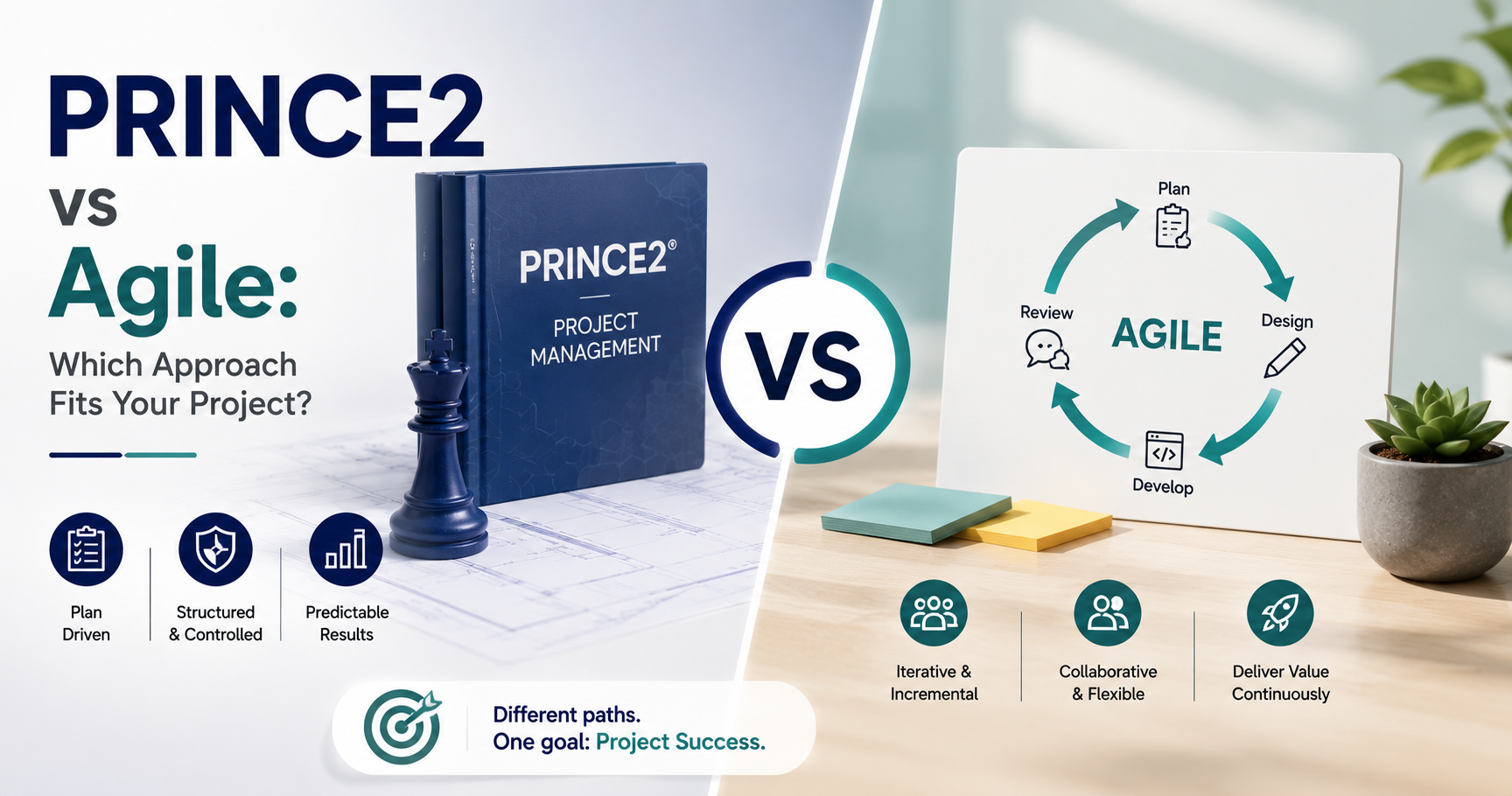
PRINCE2 and Agile solve different problems, so neither one is universally better. PRINCE2 gives you governance, defined stages, and clear accountability. Agile gives you speed, flexibility, and constant customer feedback. Many organisations use both together, which is exactly what PRINCE2 Agile was created to support: PRINCE2's controls layered over Agile's iterative delivery.
Key Highlights of PRINCE2 vs Agile
- PRINCE2 is a structured, principles-based project management method built around stage gates, defined roles, and a business case that must justify the project at every step.
- Agile is a way of working built on iterative delivery and the values in the Agile Manifesto, with Scrum, Kanban, and similar frameworks as its most common implementations.
- PRINCE2 works well when governance, audit trails, and predictable reporting matter; Agile works well when requirements are expected to change and customer feedback needs to shape the product continuously.
- The two approaches conflict mainly around planning style: PRINCE2 plans a project in stages upfront, while Agile plans in short, rolling increments.
- PRINCE2 Agile, PeopleCert's official hybrid certification, was built specifically to combine PRINCE2 governance with Agile delivery, so teams do not have to choose one over the other.
- Simpliaxis offers the full PRINCE2 certification path, including PRINCE2 Agile Foundation and Practitioner training, for professionals who want either method or both.
Project managers get asked this question constantly: should the project run on PRINCE2 or on Agile? It is a fair question, but it is also slightly the wrong one. PRINCE2 is a project management method, complete with principles, practices, and a defined process model. Agile is not a method at all. It is a set of values and principles from the Agile Manifesto that gets implemented through frameworks like Scrum, Kanban, or Extreme Programming. Comparing them is a bit like comparing a building code to a construction style. One tells you what controls need to exist. The other tells you how the work actually gets done day to day.
That distinction matters because a lot of organisations end up choosing based on trend rather than fit. A team adopts Agile because it sounds modern, then struggles because their stakeholders still expect fixed-price contracts and formal sign-off at each milestone. Another team runs a rigid, stage-gated PRINCE2 process on a product where requirements genuinely cannot be locked down six months in advance, and the plan is obsolete before the first stage boundary. Neither failure is really about PRINCE2 or Agile being "bad." It is about applying the wrong control mechanism to the wrong kind of uncertainty.
This article breaks down what PRINCE2 is actually built for, what Agile is actually built for, where the two genuinely conflict, where they complement each other, and why PeopleCert built PRINCE2 Agile as a formal bridge between them. It also includes a practical decision framework so you can match the approach, or the blend, to your project rather than to a preference.
What PRINCE2 Is Built For
PRINCE2 (PRojects IN Controlled Environments) is a process-based project management method, now in its 7th edition. It is built to answer one core question at every point in a project's life: is this project still worth doing? That question is formalised through the continued business justification principle, which requires the business case to be checked and re-validated at each stage boundary, not just signed off once at the start.
Governance and Controlled Stage-Gated Delivery
PRINCE2 organises a project into a defined process model with distinct stages, each ending in a formal decision point where the project board reviews progress, risk, and the business case before authorising the next stage. This stage-gated structure is what gives PRINCE2 its reputation for governance and control. Nothing proceeds by default. Every stage has to earn its continuation.
The 7th edition of PRINCE2 organises the method around five integrated elements: People, Project Context, Principles, Practices, and Processes. The seven principles (things like continued business justification, learn from experience, defined roles and responsibilities, manage by stages, manage by exception, focus on products, and tailor to suit the project) are non-negotiable; if you drop one, PeopleCert says you are no longer really following PRINCE2. The seven practices, renamed from "themes" in the 6th edition, cover business case, organization, quality, plans, risk, issues, and progress. The seven processes describe the actual activities from starting up a project through to closing it. If you are building this foundation from scratch, the PRINCE2 Foundation Certification Training covers all five elements in depth before you move into applying them on real projects.
Roles, Documentation, and Predictability
PRINCE2 defines clear roles: the project board (typically an executive, senior user, and senior supplier), the project manager, and the team manager, among others, each with specific accountabilities. This is deliberate. PRINCE2 assumes that ambiguity about who can approve what is a bigger risk than the extra documentation it takes to remove that ambiguity.
That documentation, the business case, the stage plans, the highlight reports, the risk register, is what makes PRINCE2 well suited to environments with audits, regulatory oversight, fixed budgets, or multiple external stakeholders who need a paper trail. It is also why PRINCE2 pairs naturally with the traditional, plan-driven end of project delivery, even though the 7th edition explicitly supports agile and hybrid delivery approaches within the same governance wrapper.
What Agile Is Built For
Agile is not a certification body's method the way PRINCE2 is. It originates from the Agile Manifesto, published in 2001 by seventeen software practitioners, which set out four values: individuals and interactions over processes and tools, working software over comprehensive documentation, customer collaboration over contract negotiation, and responding to change over following a plan. Twelve supporting principles expand on those values, emphasising early and continuous delivery, welcoming changing requirements even late in a project, and frequent face-to-face collaboration between business people and developers, as published by the Agile Alliance.
Iterative Delivery and Adaptive Planning
Where PRINCE2 plans a project in stages that can span months, Agile plans in short, fixed-length iterations, commonly one to four weeks, and re-plans at the start of every one. Requirements are captured as a backlog rather than a fixed specification, and that backlog is expected to change as the team learns more and as customer feedback comes in. The core bet Agile makes is that for a lot of product and software work, you cannot know the right requirements upfront, so the fastest way to get them right is to build something small, show it to real users, and adjust.
Common Agile Frameworks: Scrum and Kanban
Agile itself is a mindset, not a checklist, so in practice teams implement it through named frameworks. Scrum is the most widely used: it organises work into time-boxed sprints, with defined roles (Product Owner, Scrum Master, Developers) and events (sprint planning, daily stand-up, sprint review, retrospective). Kanban is a flow-based alternative that visualises work on a board, limits how much work is in progress at once, and pulls new work as capacity frees up, without fixed-length sprints. Both aim at the same underlying goal as the Agile Manifesto: shorten the feedback loop between doing the work and finding out whether it was the right work to do.
Where PRINCE2 and Agile Conflict
The friction between PRINCE2 and Agile is real, and pretending otherwise does readers a disservice. The main points of tension are:
- Planning horizon. PRINCE2 wants a defined stage plan with committed scope, cost, and time before the stage starts. Agile deliberately avoids committing to detailed scope more than one or two iterations ahead, because the whole point is to keep responding to change.
- Change control. PRINCE2 treats a change request as an exception that needs to be logged, assessed, and approved, often by the project board. Agile treats changing requirements as normal input to the next sprint planning session, not an exception at all.
- Documentation expectations. PRINCE2's management products (business case, stage plans, highlight reports) exist to support governance and audit. Agile's "working software over comprehensive documentation" value can look, on the surface, like a rejection of that kind of paperwork, even though most mature Agile teams still track backlogs, burndown charts, and definition-of-done criteria.
- Success measurement. PRINCE2 measures success against a pre-agreed business case and tolerances. Agile measures success more against working increments and stakeholder feedback, which makes it harder to report progress in the fixed-cost, fixed-scope language that a PRINCE2 project board expects.
None of this means the two are incompatible in every case. It means that running them side by side without reconciling these four points usually produces a project where the reporting says one thing and the delivery team is actually doing another.
Where PRINCE2 and Agile Complement Each Other
The complementary fit is easy to miss if you only look at the conflicts above. PRINCE2 does not actually specify how a stage's work has to be delivered internally, only that the stage needs a plan, a business justification, and a governance checkpoint. That leaves room for a team to run Agile sprints inside a PRINCE2 stage: the project board still gets its stage-gate control and business case review, while the delivery team still gets short iterations, a backlog, and continuous feedback.
This is genuinely common in practice. A programme with external stakeholders, fixed regulatory milestones, or a contractual need for formal governance can still want the delivery team building software or products in an adaptive way underneath. PRINCE2 supplies the "are we still doing the right project" layer. Agile supplies the "are we building the right thing, this sprint" layer. Used together intentionally, they answer different questions instead of fighting over the same one.
The 7th edition of PRINCE2 acknowledges this directly by naming three delivery approaches a project can use: the traditional linear-sequential (waterfall) approach, the agile (iterative-incremental) approach, and a hybrid that combines both, chosen based on the nature of the work in each stage.
Why PRINCE2 Agile Exists as a Bridge
PRINCE2 Agile is PeopleCert's own answer to the "do we have to choose" question. It is not a separate method competing with PRINCE2. It is an extension that keeps every PRINCE2 principle, practice, and process intact at the governance layer, and adds specific guidance on how to flex the delivery layer using Agile concepts like Scrum roles, Kanban flow, and iterative planning.
In practice, PRINCE2 Agile guidance covers things like how to write a business case that tolerates changing scope, how a project board should interpret progress reporting from a team running sprints, and how to blend PRINCE2's "manage by exception" principle with Agile's preference for self-organising teams. It gives project managers and Scrum Masters a shared vocabulary instead of two separate, competing ones.
For readers who came to this article trying to decide "PRINCE2 or Agile," the PRINCE2 Agile Practitioner Certification Training is usually the honest answer to look into next, especially if your organisation genuinely needs both governance and iterative delivery rather than a purely either/or choice. A separate comparison, PRINCE2 vs. PRINCE2 Agile: Which Certification Fits Your Needs, is useful reading if you want to understand that specific relationship in more depth (this article focuses on PRINCE2 versus Agile approaches generally, not PRINCE2 versus its own agile extension). If PMP is also on your shortlist, PRINCE2 vs. PMP: Choosing the Best Certification for IT Pros and Agile vs PMP: Difference Between Agile and PMP cover those two adjacent comparisons.
PRINCE2 vs Agile: Side-by-Side Comparison
| Dimension | PRINCE2 | Agile |
|---|---|---|
| Governance style | Formal, stage-gated; project board approves continuation at each stage | Lightweight, continuous; product owner and team prioritise the backlog each iteration |
| Planning approach | Detailed stage plans set before each stage begins | Rolling, iteration-by-iteration planning against a living backlog |
| Roles | Project board (executive, senior user, senior supplier), project manager, team manager | Product Owner, Scrum Master (or team lead), self-organising delivery team |
| Change handling | Formal change control and exception reporting to the project board | Built into normal backlog refinement and sprint planning |
| Documentation | Business case, stage plans, highlight and end-stage reports | Backlog, sprint goals, burndown/flow metrics, definition of done |
| Best-fit project types | Regulated, audited, fixed-budget, or multi-stakeholder programmes | Software and product work with evolving requirements and frequent user feedback |
| Certification path | PRINCE2 Foundation, PRINCE2 Practitioner | No single certifying body; commonly paired with Scrum or Kanban certifications |
| Hybrid option | PRINCE2 Agile Foundation and Practitioner combines both | Same |
Practical Guidance: A Decision Framework
Rather than asking "PRINCE2 or Agile," it helps to ask a short series of questions about the actual project:
- Does the project need formal, auditable governance (regulatory approval, public-sector funding, multi-vendor contracts)? If yes, PRINCE2's stage-gate structure is hard to replace.
- Are the requirements genuinely stable, or are they expected to evolve as users see working increments? Stable requirements lean PRINCE2; evolving requirements lean Agile.
- Does delivery involve software, digital products, or anything where user feedback materially changes the next piece of work? That points toward Agile frameworks like Scrum or Kanban at the delivery layer.
- Do you have external stakeholders who expect fixed-price, fixed-scope reporting, but an internal team that works best in short iterations? That combination is the classic case for PRINCE2 Agile rather than either method alone.
- Is the organisation new to structured project management altogether? Starting with PRINCE2 Foundation gives a common vocabulary and control framework that many industries already expect, even before layering Agile delivery on top.
- Does your team already know PRINCE2 fundamentals and need to apply them to live, complex projects rather than just learn the theory? That is the gap the PRINCE2 Practitioner Certification Training is built to close, including how to tailor stage boundaries when a delivery team underneath is working in sprints.
A simple way to summarise it: choose PRINCE2 when the question you need answered is "should we still be doing this project, and who is accountable for it." Choose Agile frameworks when the question is "what is the most valuable thing to build next, given what we just learned." Choose PRINCE2 Agile when you need both answers from the same project, which is the case for most digital delivery inside larger, governed organisations.
Simpliaxis Training Relevance
Simpliaxis offers the full range of PRINCE2 certification training, so you can build whichever skill set actually matches your project environment rather than picking a method because it is trendy.
If your organisation runs formal, stage-gated projects and you need the foundational vocabulary and control framework, the PRINCE2 Foundation Certification Training covers the principles, practices, and process model from the ground up. Professionals who already understand the fundamentals and need to apply PRINCE2 to real project scenarios, tailoring it to their organisation's context, should look at the PRINCE2 Practitioner Certification Training. For those who want both levels in one structured programme, the PRINCE2 Foundation & Practitioner Certification Training covers the complete path from first principles through applied practice.
Given everything covered above about how PRINCE2 and Agile actually complement each other more often than they conflict, the certification most directly relevant to readers weighing "PRINCE2 vs Agile" is PRINCE2 Agile. The PRINCE2 Agile Foundation Certification Training introduces how Agile concepts like Scrum and Kanban fit inside PRINCE2 governance, while the PRINCE2 Agile Practitioner Certification Training goes further into applying that blend on real projects, including how a project board should interpret sprint-based progress reporting. If you want both levels together, the PRINCE2 Agile Foundation & Practitioner Certification Training is the most efficient route to the hybrid skill set this article has been building toward.
For teams rather than individuals, Simpliaxis also runs Corporate and Group Training, which lets an organisation train project managers, product owners, and delivery teams together, so everyone shares the same PRINCE2 or PRINCE2 Agile vocabulary instead of half the team speaking PRINCE2 and half speaking Scrum.
Conclusion
PRINCE2 and Agile are not rivals fighting for the same job. PRINCE2 governs whether a project should continue and who is accountable for it. Agile, through frameworks like Scrum and Kanban, governs how a delivery team adapts what it builds based on real feedback. Most conflict between them comes from trying to force one to do the other's job, expecting PRINCE2 to move at sprint speed, or expecting a Scrum board to satisfy a regulator's audit requirements.
The more useful question is not which one wins, but which combination fits your project's actual risk profile and delivery style. For a lot of organisations working inside larger, governed structures while still needing iterative delivery, that combination already has a name: PRINCE2 Agile. Building fluency in PRINCE2, Agile frameworks, or the certified hybrid between them is less about picking a side and more about being able to run whichever control model the project actually needs.
Compare the PRINCE2 certification levels and decide which path fits your project environment. If your organisation needs both structured governance and iterative delivery, the PRINCE2 Agile Foundation & Practitioner Certification Training gives you the combined skill set in one program, and Simpliaxis's Corporate and Group Training options can bring that same vocabulary to your whole delivery team.





 Lowest-Price Challenge











 Personalized Path


.webp)


 USA
USA  Canada
 India
India UK
UK Australia
 Singapore


