


 Call Us



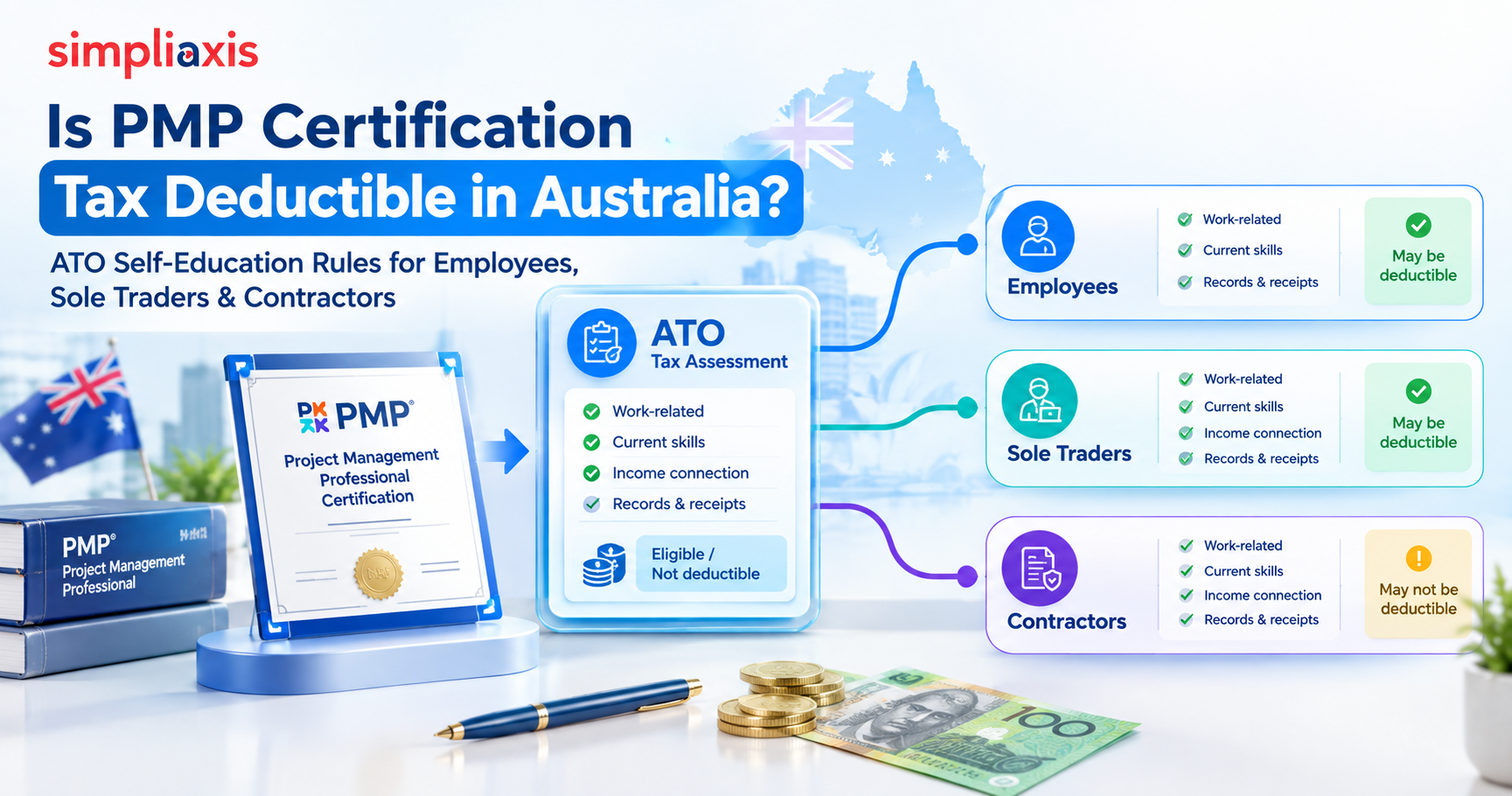
PMP certification costs are generally tax-deductible in Australia for employees and sole traders, provided the study maintains or improves skills used in your current employment or is likely to increase your income from that employment. This falls under the Australian Taxation Office's self-education expense rules, and since 1 July 2022 there is no minimum threshold to clear before you can claim, unlike the old $250 non-deductible floor. Employer-paid PMP training raises a separate question around fringe benefits tax, since a benefit provided because of employment can attract FBT for the employer unless a specific exemption applies.
Key Highlights: Is PMP Certification Tax Deductible in Australia?
- PMP certification costs are deductible as self-education expenses under ATO rules if the course maintains or improves skills required in your current job, or is likely to increase your income from that job.
- The $250 non-deductible threshold for self-education expenses was removed for expenses incurred from 1 July 2022 onward, so smaller costs are now claimable from the first dollar.
- A course that qualifies you for entirely new employment, rather than improving your current role, generally fails the ATO's self-education test, which is the key trap for career changers pursuing PMP.
- Sole traders and contractors claim PMP costs as a general business deduction rather than through the self-education category, provided the expense relates to earning their business income.
- Employer-funded PMP training can trigger fringe benefits tax for the employer at the current 47% FBT rate, unless the training falls within an available exemption, which is a cost employers should model before agreeing to fund certification.
- The PMI exam fee is billed in US dollars, so the AUD cost moves with the exchange rate, and PMI's exam fee increase from 6 August 2026 raises both member and non-member pricing globally.
- Organisations certifying several employees at once should assess the FBT and deductibility position at the programme level, since group training changes both the invoicing structure and the tax exposure compared with reimbursing individuals separately.
The Core ATO Test: Does PMP Relate to Your Current Job?
Australia's self-education expense rules turn on a single question: does the course maintain or improve the specific skills or knowledge you need for your current employment activities, or is it likely to increase your income from those activities? If the answer is yes, PMP-related costs, including the exam fee, PMI membership, training course fees, textbooks and exam simulators, are generally deductible. If instead the course is designed to help you get a new job or open up a new income-earning activity unrelated to your current role, the ATO does not allow the deduction, regardless of how directly relevantproject management skillsmight seem in the abstract.
This distinction matters enormously for PMP candidates specifically, because the certification sits in a genuinely ambiguous zone for some claimants. A software developer moving into a formal project management role for the first time is arguably acquiring skills for a new position, which weakens the claim. A person already working as a project coordinator, delivery lead or programme analyst who pursues PMP to formalise and improve skills they already use daily has a much stronger claim, since the course sits squarely within their existing employment activities rather than opening a new one.
What You Can Actually Claim?
Once you clear the relevance test, the ATO allows a reasonably broad set of costs connected to the self-education activity itself.
Expense Type | Deductible? |
| PMP exam fee | Yes, if the course/exam relates to your current employment |
| PMI annual membership fee | Generally yes, as a course or membership-related cost tied to maintaining relevant skills |
| Training course or bootcamp fees | Yes, this is the core self-education expense |
| Study guides, mock exam simulators and textbooks | Yes, as related course materials |
| Equipment under AUD 300 | Yes, claimed in full in the year of purchase |
| Travel to attend in-person training | Yes, where directly connected to attending the course |
| A course that qualifies you for new, unrelated employment | No |
Keep in mind that from 1 July 2022 the historical $250 non-deductible threshold no longer applies, so even modest costs, such as a standalone exam simulator subscription, are claimable in full provided the broader relevance test is satisfied. If you are unsure whether your specific role and study plan clear that test, the ATO's own self-education expenses guidance and calculator are the primary reference, and a registered tax agent can confirm the borderline cases before you lodge.
If You Are a Sole Trader or Contractor
Sole traders and contractors operating through an ABN do not use the employee self-education category at all. Instead, PMP-related costs are claimed as a general business expense against business income, provided the expense is incurred in the course of earning that income. In practice this usually makes the deductibility question simpler for independent project management consultants than for employees, since the connection between the certification and the income-earning activity is typically direct and easy to demonstrate. As with any business deduction, you still need to retain invoices and be able to show the expense relates to your consulting or contracting work rather than personal development unconnected to current billable activity.
Employer-Funded PMP Training and Fringe Benefits Tax
When an employer pays for an employee's PMP training directly, rather than the employee paying and claiming a personal deduction, the analysis shifts to fringe benefits tax. FBT applies to benefits provided in respect of employment, and training paid for by an employer can, in principle, fall within that definition. FBT is a separate tax from income tax, is paid by the employer rather than the employee, and is calculated on the grossed-up taxable value of the benefit at the current FBT rate of 47%.
In practice, many employers structure work-related training so that it either falls within an available exemption or is treated as an otherwise-deductible benefit, since training that an employee would have been able to claim as a personal tax deduction if they had paid for it themselves is generally not subject to FBT under the otherwise deductible rule. This is a genuinely technical area, and the exact treatment depends on how the course is structured, invoiced and documented, so employers funding PMP training for their teams should confirm the specific exemption or otherwise-deductible position with their tax adviser rather than assuming either outcome by default.
This is precisely the kind of detail an L&D manager or PMO lead should resolve before signing off on certification for a whole delivery team rather than one person at a time, since the FBT exposure and paperwork scale differently depending on whether training is arranged as a single negotiated group enrolment or as multiple individual reimbursements. Reviewing options through Simpliaxis's corporate and group training programmeis a practical way to consolidate invoicing and documentation across an entire cohort, which also makes the FBT and otherwise-deductible analysis considerably easier for finance to apply consistently.
Reimbursement, Direct Payment or Salary Sacrifice: Which Structure Is Best?
Employers have three common ways to fund an employee's PMP certification, and each carries a different tax outcome. Direct payment, where the employer pays the training provider and PMI invoice directly, is the most common structure and is the one most likely to qualify for the otherwise-deductible rule, since the benefit is clearly identifiable and directly tied to the employee's current duties. Reimbursement, where the employee pays first and the employer refunds the cost, generally produces the same tax outcome as direct payment, provided the employee retains and hands over proper receipts, though it adds an administrative step that direct payment avoids.
Salary sacrifice arrangements, where the employee agrees to forgo a portion of future salary in exchange for the employer funding the training, are used less often for a single certification but can be worth considering for larger, multi-course professional development plans, since the arrangement needs to be documented before the income is earned to be effective and is generally more suited to structured annual training budgets than a one-off exam fee.
For a PMO or L&D manager deciding how to fund PMP certification across a delivery team, direct payment through a single negotiated group booking is usually the simplest structure to administer and the easiest to defend consistently if the ATO ever queries the arrangement.
What PMP Certification Actually Costs in Australia in 2026?
Cost Component | PMI Member (approx.) | Non-Member (approx.) |
| PMI annual membership | USD 139 (~AUD 215) | Not applicable |
| PMP exam fee (current, before increase) | USD 405 (~AUD 625-650) | USD 555 (~AUD 860-900) |
| PMP exam fee (from 6 August 2026) | Higher than current member rate | Higher than current non-member rate |
| Formal training (35 contact hours) | Varies by provider and delivery format | |
Because PMI bills in US dollars, your final AUD figure moves with the exchange rate at the time of payment, so it is worth checking PMI's published pricing close to your exam date rather than relying on older AUD conversions. Simpliaxis maintains a detailed PMP certification cost breakdowncovering exam fees, membership and training formats, which is a useful reference point before you calculate your likely deduction.
Claiming the Deduction: A Practical Walkthrough
- Confirm the relevance test first. Write down, honestly, whether PMP maintains and improves skills in your current role or is aimed at a different job entirely. This single judgement decides whether the rest of the claim is available at all.
- Keep every receipt and invoice. PMI's exam and membership payment confirmations, and your training provider's course invoice, should be retained for at least five years.
- Separate reimbursed amounts. If your employer has already paid or reimbursed any portion, you cannot claim that same amount again as a personal deduction.
- Use the ATO's self-education calculator. It walks through the categories of allowable expenses and helps you avoid claiming an ineligible cost by mistake.
- Sole traders record the expense against business income. Categorise it consistently with how you record other professional development costs in your accounts.
- Ask a registered tax agent about genuinely borderline cases. Career changers moving into project management for the first time should get this confirmed before lodging, since this is the scenario the ATO scrutinises most closely.
Common Mistakes That Cause Problems With the ATO
The most frequent error is claiming PMP costs as self-education when the course genuinely qualifies the claimant for a new line of work rather than improving their current one, since this is the exact distinction the ATO's self-education rules are built around. A second common mistake is double-claiming: an employee claims the exam fee personally after their employer has already reimbursed it, which is easy to do by accident if payroll and personal tax records are not cross-checked at year-end.
A third is assuming the old $250 threshold still applies and therefore not bothering to claim smaller costs like a mock-exam simulator subscription, which is no longer necessary since that threshold was removed for expenses incurred from 1 July 2022. Employers, for their part, sometimes overlook the FBT question entirely when agreeing informally to "cover the PMP exam" for a staff member, without checking whether the arrangement is structured in a way that avoids an unexpected FBT liability.
Record-Keeping and Substantiation Rules
The ATO's substantiation rules for self-education expenses require you to keep written evidence for claims, generally in the form of receipts, invoices or bank statements, showing the supplier, the amount, the date and a description of what was purchased. For a PMP claim this typically means retaining the PMI payment confirmation for the exam fee and membership separately, the training provider's course invoice, and, where you are claiming travel to attend in-person sessions, a record of the dates and distance travelled.
If your total claimed work-related expenses exceed certain thresholds in a given year, the ATO's data-matching systems are more likely to flag the return for review, so having this paperwork organised before you lodge, rather than reconstructing it afterward, is the difference between a smooth assessment and a drawn-out one. A diary note showing how the course content connects to specific tasks in your current role is a small extra step that meaningfully strengthens a claim if it is ever questioned, particularly for candidates whose job title does not obviously say "project manager."
How PMP Compares With Other Deductible Certifications?
PMP is not unique in this respect. Courses such as PRINCE2, PMI-ACP and various Scrum and Agile certifications are assessed under the identical self-education framework, since the deciding factor is always the relationship between the course and your current employment activities rather than which specific credential is involved. This matters if you are weighing up more than one certification path, since a project manager who already holds a PMP and is considering an additional Agile credential to round out delivery skills used in the same role is on comparably solid ground for both claims.
It also matters for employers building a broader capability uplift programme rather than a single certification, since a mixed cohort training programme covering PMP alongside complementary certifications raises the same fringe benefits tax and otherwise-deductible questions discussed above, just across a wider set of course types.
Does This Change Once You're Certified?
The self-education question does not stop at the exam. PMP holders must earn 60 PDUs across a rolling three-year cycle to keep the credential active, and ongoing PDU-earning courses, along with the renewal fee itself, are assessed against the same relevance test described above, since they maintain a skill and credential you continue to use in your current role. Simpliaxis publishes a current PMP certification renewal fee schedule, which is a useful reference each cycle when working out what portion of your ongoing PDU spending is deductible.
If you are weighing up your original training route or comparing formats before committing to a renewal-cycle refresher course, Simpliaxis's PMP certification training courses in Australia outline current delivery formats and course inclusions, which is worth checking against your own deduction position rather than assuming every training format is treated identically for tax purposes.
Conclusion
PMP certification costs are deductible in Australia for most working project managers, but the deduction is conditional, not automatic. The ATO's self-education test hinges on whether the course maintains or improves skills you already use in your current job, or whether it is instead a stepping stone into a new one, and that distinction determines the entire outcome of the claim.
Sole traders and contractors have a comparatively simpler path through general business deductions, while employees need to apply the self-education relevance test carefully, particularly if they are changing career direction rather than upskilling within an existing role.
Employers funding certification for their teams carry a separate and genuinely technical fringe benefits tax question that is worth resolving with a tax adviser before rolling out training across multiple staff, since the right structure can materially change the employer's tax exposure. Whichever category applies to you, keep your receipts, apply the relevance test honestly, and get professional advice on anything genuinely borderline before you lodge.






 Lowest-Price Challenge











 Personalized Path


.webp)


 USA
USA  Canada
 India
India UK
UK Australia
 Singapore


