


 Call Us



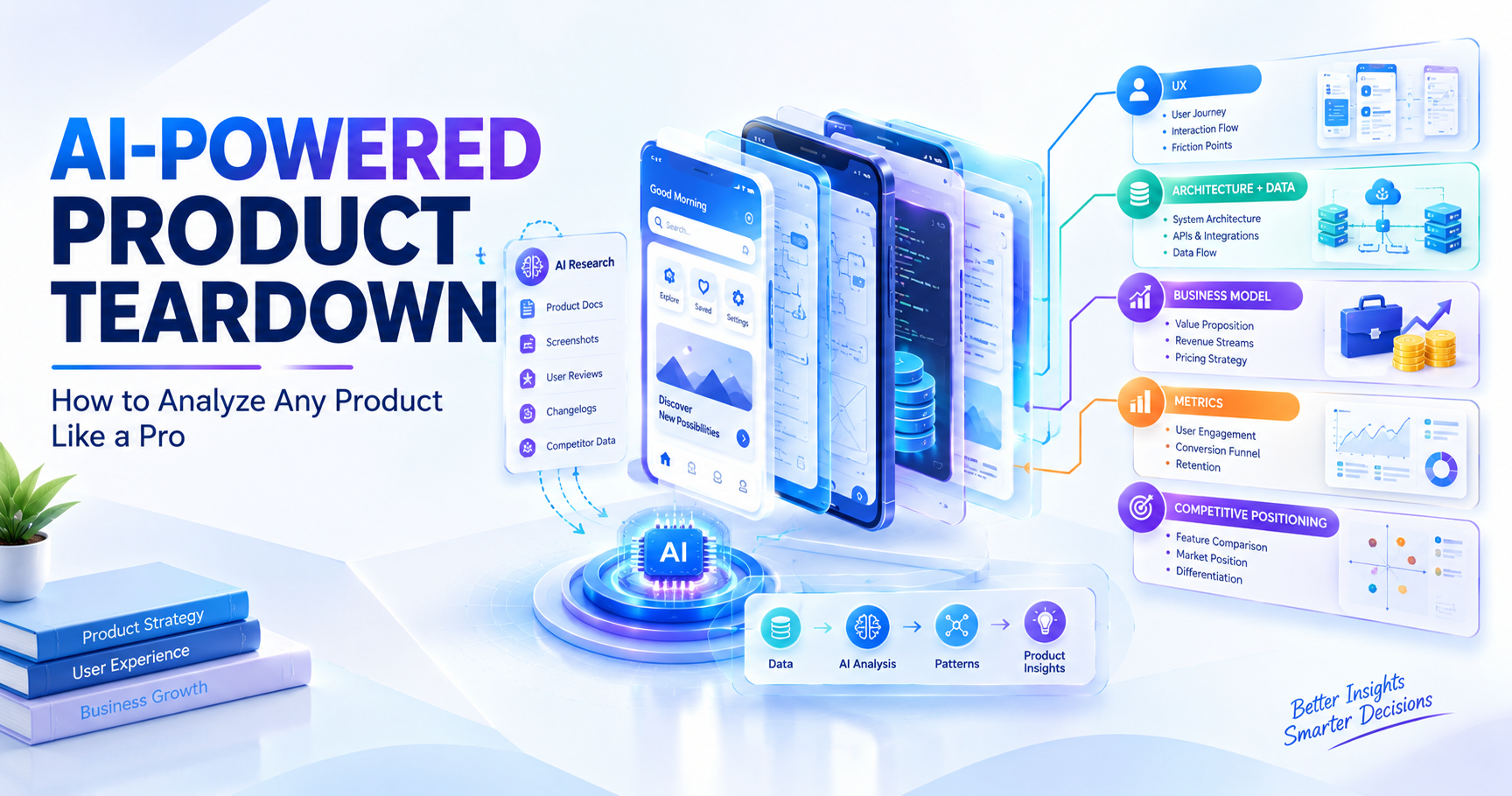
An AI-powered product teardown uses artificial intelligence to speed up the research side of competitive analysis, feeding tools thousands of reviews, changelogs, or screenshots to surface patterns a human would take days to find manually. It does not replace the judgment part of the job. AI can tell you what customers complain about; only you can decide what that means for your roadmap. A 2023 Product School survey found 67% of product managers in North America and Europe regularly run structured competitive analysis, and 54% linked that practice directly to a 10% to 15% improvement in product launch success rates. The strongest teardowns go beyond a feature list and examine five layers: user experience, data and architecture choices, business model, metrics strategy, and competitive positioning. Done well, a teardown becomes a repeatable skill you can apply to any product, one that also strengthens the case for anyone weighing a move into a dedicated AI Product Manager role.
Key Highlights of AI-Powered Product Teardown
- 67% of product managers in North America and Europe regularly use structured competitive analysis frameworks, according to a Product School survey.
- 54% of those PMs report a direct 10% to 15% improvement in product launch success rates tied to competitive insight work.
- A genuine AI-powered teardown covers five layers: UX flow, architecture and data strategy, business model, metrics trade-offs, and competitive positioning, not just a surface feature list.
- AI tools are best as a research multiplier, pulling together unstructured data such as app reviews or support tickets, but the strategic “so what” still requires human judgment.
- Purpose-built AI product agents like Productboard's Spark now generate competitive summaries and product briefs directly from data teams already maintain.
- Weak teardowns treat AI complexity as automatically better; strong teardowns evaluate whether a product's technical approach is proportional to the actual user problem.
AI-Powered Product Teardown: What It Actually Means
An AI-powered product teardown is the practice of using artificial intelligence to accelerate how you deconstruct a product, whether it is a competitor's app, your own product, or one you admire from an unrelated market. As LogRocket's product teardown framework puts it, the goal is understanding how and why a product works the way it does, not just what it does. Instead of manually screenshotting every screen and guessing at intent, you point AI tools at real data, app store reviews, changelogs, support tickets, pricing pages, and let them surface patterns first.
The result is not the analysis itself. AI can tell you that a competitor's one-star reviews cluster around onboarding confusion. It cannot tell you whether fixing that gap is worth delaying your own roadmap by six weeks. That judgment call is still the product manager's job, and it is exactly the kind of reasoning skill worth building if you are still weighing whether product management is a good career move for you.
Why Most Product Teardowns Fail to Teach Anything
The typical teardown reads like a feature tour: a few screenshots, generic praise for "clean UX," and a list of what the product does. That is documentation, not analysis. It builds familiarity with a product, but it does not build the reasoning skill that hiring managers and senior stakeholders actually test for.
A real teardown forces you to reason about tradeoffs. Why did this product choose a simple rules engine instead of a large language model for this specific feature? Why does the pricing page hide the enterprise tier behind a "contact sales" button instead of listing it? These are the questions that reveal strategy, and most structured product manager certification programs now test exactly this kind of reasoning, not just feature recall.
The 5-Layer Framework for a Real Teardown
Use these five layers every time, whether you are tearing down a competitor's product or your own.
- User experience and flow. Map the actual user journey, not the marketing journey. Where does friction appear? Where does the product get out of the user's way?
- Architecture and data strategy. What technical approach powers the core feature, and is it proportional to the problem? A simple classifier that solves the problem as well as a large language model at a fraction of the cost is often the better product decision, not the weaker one, a distinction technical product owners are specifically trained to make.
- Business model. How does the product actually make money, and does the free tier exist to convert users or to starve competitors of market share?
- Metrics strategy. What does the product optimize for, visibly? Session length, task completion, or something else? The metric a team optimizes for shapes every design decision downstream, which is exactly the muscle Simpliaxis's AI for Product Metrics micro-credential is built to train.
- Competitive positioning. Where does this product sit relative to direct competitors, adjacent products, and substitutes that solve the same underlying job differently?
Skipping any one of these layers turns a teardown back into a feature tour. All five together are what make the exercise transferable to the next product you analyze, and the next one after that.
How AI Tools Actually Help at Each Layer
AI earns its place in a teardown as a research accelerator, not a strategist. Feed a tool thousands of app store reviews and ask it to identify the top three recurring complaints, and you get in minutes what would take a human analyst days of manual tagging. Learning to direct these tools effectively, covered in Simpliaxis's Mastering Generative AI Tools program, changes how much real signal you extract from this step. The same applies to scanning changelogs for feature release cadence, or summarizing a pricing page's tier structure across multiple competitors at once.
Purpose-built AI product agents have started to formalize this. Productboard's AI agent Spark synthesizes customer feedback, generates product briefs, and runs competitive analysis using product data teams already maintain inside their existing tools. The advantage compounds over time: the more real product work lives inside a connected system, the more context that AI agent has to work with on the next teardown, a discovery discipline covered in more depth in AI for Product Discovery micro-credential.
Where teams go wrong is treating the AI output as the conclusion instead of the input. An AI summary of "users want more integrations" is a data point. Deciding which three integrations matter enough to build this quarter is still a product management decision, informed by the teardown, not delegated to it.
Running Your First AI-Powered Teardown: A Practical Workflow
- Pick a target with intent. Choose a direct competitor solving the same problem for the same audience, or an adjacent product worth learning from, not a random app.
- Gather real data before opinions. Pull app store reviews, public changelogs, pricing pages, and any available usage benchmarks before you form a point of view.
- Run AI synthesis on the raw data. Ask an AI tool to cluster complaints, summarize release patterns, and flag pricing tier structures across your target and its closest rivals. Well-structured prompts matter more here than people expect, a skill covered directly in Prompt Engineering Course.
- Work the five layers manually. Use the AI output as a starting point, then reason through UX, architecture, business model, metrics, and positioning yourself.
- Write the "so what," not just the "what." End with a specific recommendation for your own roadmap or strategy, tied to a real tradeoff you are willing to defend in a stakeholder meeting. Translating research into a defensible strategy call is exactly what Simpliaxis's AI for Product Strategy micro-credential is built to teach.
If you are building this skill as part of a broader move into AI-focused product work, Simpliaxis's Generative AI for Product Owners & Managers Training covers the wider role shift this kind of analysis supports.
Common Mistakes to Avoid
The most common mistake is assuming more AI complexity always signals a better product. Some teardown authors praise a competitor for using multi-agent systems or chain-of-thought reasoning without asking whether that complexity is actually justified by the user problem it solves. As Institute PM's AI teardown framework puts it, the best AI products use the minimum viable AI to solve the problem, and noticing that mismatch is itself a valuable analytical skill.
A second mistake is stopping at the free version of a competitor's product because it is the only one accessible without a sales call. This misses enterprise-tier decisions, which often reveal more about a company's actual strategy than the consumer-facing surface does.
A third mistake is treating a teardown as a one-time exercise instead of a repeatable habit. Product managers who run this analysis regularly build pattern recognition across products and markets that a single deep-dive cannot replicate, a habit reinforced throughout structured programs like AI for Business Analysts and IT Consultants.
A Worked Example: Tearing Down a Note-Taking App
Frameworks are easier to apply once you have seen them run against something concrete. Imagine you are evaluating a competitor's note-taking app because your own product is considering adding AI-powered summarization. Here is how the five layers actually play out.
Layer 1, UX and flow. You open the app and time how long it takes to create a note, add a tag, and search for it again. You notice the search bar is buried two taps deep, a friction point that shows up repeatedly in one-star reviews when you feed those reviews into an AI summarizer. That is not a guess anymore; it is a pattern with evidence behind it.
Layer 2, architecture and data strategy. The AI summarization feature only appears after a note passes roughly 200 words, which suggests the team is routing short notes through a cheaper, simpler process and reserving the more expensive language model call for content where it adds real value. That is a deliberate cost decision, not a limitation, and it tells you something about how the team thinks about margin.
Layer 3, business model. The free tier caps AI summaries at ten per month, not storage or note count. That is a strategic choice: they want you dependent on the AI feature specifically before asking you to pay, not dependent on the product broadly.
Layer 4, metrics strategy. Release notes over the past six months mention "time to first summary" three separate times but never mention raw daily active users. That is a strong signal the team is optimizing for activation depth over top-line growth right now, which changes what you would learn from copying their approach.
Layer 5, competitive positioning. Compared against two adjacent products, this app is the only one gating AI features behind a usage cap rather than a feature tier. That is either a differentiated bet or a sign they have not yet found sustainable unit economics on the AI feature. Only your own research into their funding stage and public statements can tell you which.
Notice what happened across all five layers: you never once described what the product looks like. You reasoned about why it is built the way it is. That is the difference a real teardown produces, and it is exactly the reasoning skill that is transferable to the next product you analyze, regardless of category. The specific product in this example does not matter nearly as much as the habit of asking "why" at each layer instead of settling for "what," a habit that gets sharper with repetition rather than with any single teardown alone.
How to Present Your Teardown Findings to Stakeholders
A sharp teardown loses most of its value if it gets delivered as a wall of screenshots and bullet points nobody reads past the first slide. Structure your findings the same way you built them: lead with the "so what," not the "what."
Open with your single strongest recommendation and the layer it came from, not a chronological walkthrough of everything you found. A stakeholder meeting has limited attention, and burying your best insight on slide twelve means most of the room never reaches it. Follow the recommendation with the two or three data points that support it directly, whether that is a cluster of review complaints, a pricing tier structure, or a release note pattern.
Resist the urge to include everything you found. A teardown that surfaces fifteen observations with no prioritization reads as unfinished thinking, even when every observation is accurate. Cut ruthlessly down to what actually changes a decision your team is about to make, and archive the rest for your own reference rather than presenting it.
Finally, always end with a specific ask, not a general summary. "Here is what I found" invites polite nodding. "I recommend we prioritize X because of Y, and here is what I need from this group to move forward" invites an actual decision. That distinction is often what separates a teardown that changes a roadmap from one that gets filed away and forgotten.
Conclusion
An AI-powered product teardown is only as good as the five layers behind it. AI can compress the research phase from days to minutes, but the strategic judgment, what a pattern means, what tradeoff to defend, what to build next, still belongs to you. Treat teardowns as a repeatable habit rather than a one-time report, and you build a transferable analytical skill that gets sharper with every product you take apart.
Start with one competitor this week. Run the five layers manually before leaning on AI, then compare how much faster the same process feels the second time.







 Lowest-Price Challenge











 Personalized Path


.webp)


 USA
USA  Canada
 India
India UK
UK Australia
 Singapore


