


 Call Us


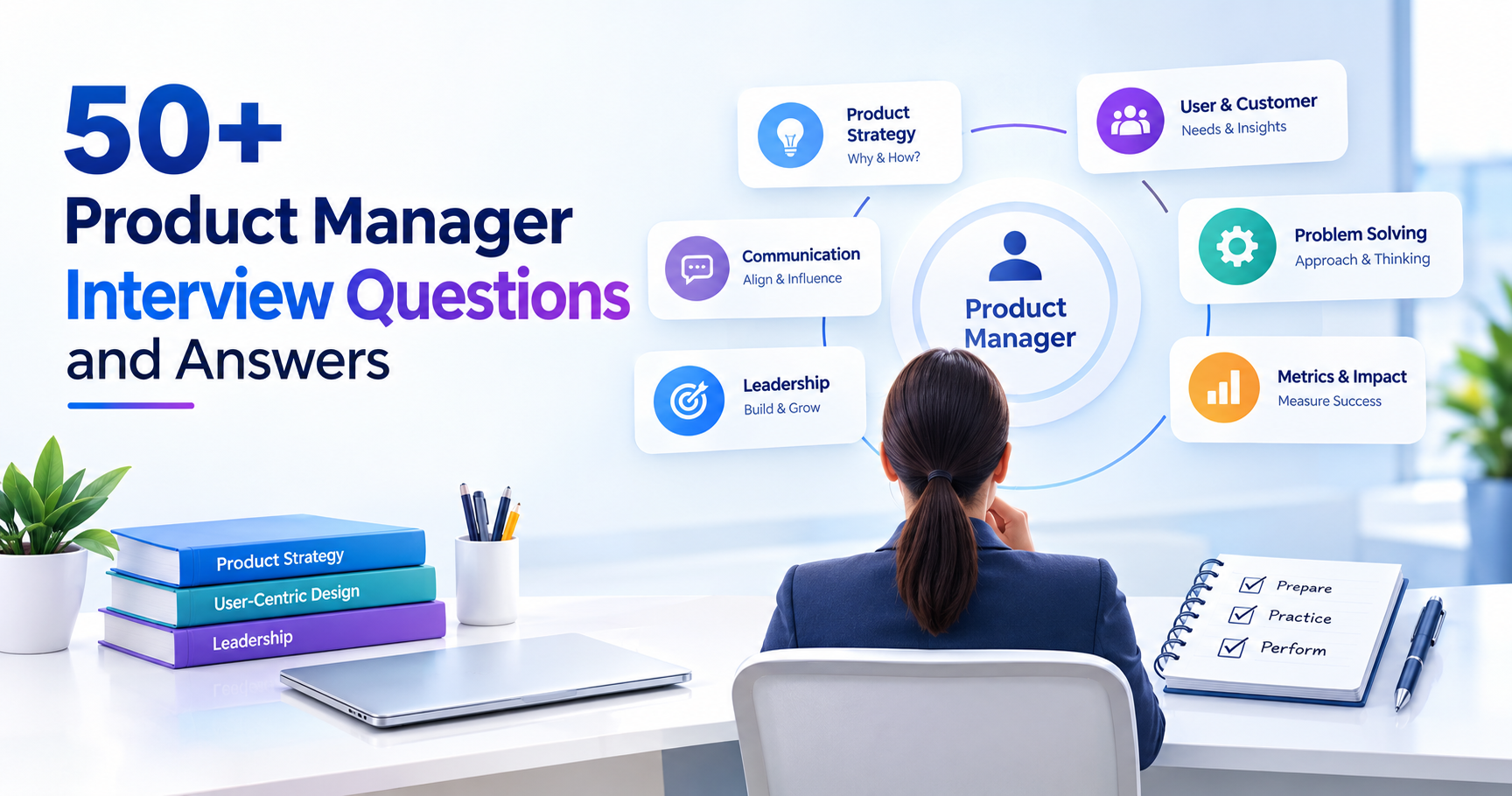
Product manager interviews assess more than whether you know common frameworks. Interviewers want to understand how you identify customer problems, make product decisions, work across teams, use data, manage trade-offs, and communicate clearly.
The best preparation is to practice structured thinking rather than memorise polished answers. Use the questions below to build adaptable responses based on your own experiences, the company’s product, and the role requirements.
Key Highlights:
- Covers 50+ common product manager interview questions across product strategy, design, technical knowledge, leadership, data analysis, product launches, and company research.
- Explains how to prepare effectively by researching the company and product, practising structured thinking, and building strong behavioural examples.
- Provides practical answer frameworks for product sense questions, including how to improve products, prioritise features, identify opportunities, and measure success.
- Shows how to approach product design and case-study questions by defining users, uncovering pain points, prioritising an MVP, and tracking outcomes.
- Helps candidates demonstrate leadership through examples of stakeholder management, conflict resolution, influence without authority, product failures, and difficult decisions.
- Shares guidance on using STAR, RICE, MoSCoW, funnel analysis, A/B testing, metrics, and trade-off explanations to deliver structured, credible interview answers.
Introduction
A product manager must balance the interests of the customer, the business, and the constraints of a given technology. Therefore, interviews for product management positions incorporate behavioral questions, product vision and design, analytics, and business and industry strategy.
There are few, if any, definitive answers during an interview, but product management candidates are evaluated on their ability to make reasonable judgments. These judgments are often assessed by incorporating the interests of the user and the business.
This guide covers 50+ product management interview questions. Additional information is provided to assist the applicant in developing well-rounded responses.
How to Prepare for a Product Manager Interview?
Research the company and its products. If you are able, evaluate the product yourself, check out the competition, and review the company’s help center. Read user reviews.
Think about your experiences and evaluate how you’ve influenced the outcome of a product to meet the needs of the user. Product management experience is not a necessity; it can be derived from other business functions such as marketing and sales.
Other things to review and focus on include the company’s customers and business, frameworks and formulas, product metrics, and company strategies. Review how users interact with the product.
Have constructive conversations about your interests, including the company’s team, product offerings, and business model.
Using frameworks is helpful in organizing your thoughts for an answer, but make sure to speak in complete sentences and don’t repeat yourself.
General Product Manager Interview Questions
Some of the important general product manager interview questions include the following
1. Tell me about yourself
This is an icebreaker in nearly all PM interviews. You should see this as an opportunity to make a strong first impression and briefly give them a snapshot of why you're qualified for the position and why you are passionate about product management.
A good framework to use is the ‘Present, Past, Future’ framework.
- Present: Briefly tell them what product you work on and the major responsibilities of your role.
- Past: Talk about your relevant experiences that demonstrate your interest in, and passion for, product management. This can be your school projects, extracurriculars, or an example from your work or personal life.
- Future: Briefly explain why this company and role are your next step.
Interviewers want to understand your thought process and interest in the product management function, and the rationale behind your career transition.
Your goal is to touch on your interest in this role, your understanding of the function (i.e. requirements, challenges and uncertainties of the job), and the rationale for your career transition.
Your response should include your interest in the user group the product serves and the user insights the product may gain from your product management skills.
Touch on experience and skills most related to product management.
Product management is a broad role, and interviewers may assess whether you understand the challenges and requirements of the role as well as your motivation for transitioning into the role.
Sample Answer:
“I have a strong interest in this role because it allows for interaction with clients and uses strategic and creative skills to solve company and client needs. I have the ability to define and analyze client requirements. It is very important for the product management team to build strong relationships with the client and understand their business. I believe I have the ability to successfully perform this responsibility.
I see the greatest potential with this position because it allows for broad responsibilities. I gain the most job satisfaction when I feel I can directly impact and am held accountable for the success of the product. In this role, I will have an opportunity to manage the product and the areas most impacting the product.”
Avoid sharing a full career history. Focus on the experiences most relevant to product management.
Why Do You Want to Be a Product Manager?
This is your opportunity to speak directly to the product challenges and differentiate yourself from other applicants. Think evidence-based examples over adjectives when describing your personality and skills.
Sample answer:
“I want to be a product manager because the role combines customer understanding, strategic thinking, and execution. I enjoy taking an unclear problem, learning what users actually need, and working with different teams to build a practical solution”
Why Should We Hire You as a Product Manager?
Identifying the right problems to solve is the first step to succeeding as a product manager. In addition, having the ability to bring together business and consumer needs with the constraints of a product’s infrastructure, and mobilize a team toward achieving this end is essential.
Product managers instill clarity among the members of the product team and bring the right stakeholders to the table when critical decisions concerning a product need to be made.
What Does a Product Manager Do?
Product managers handle the following functions:
- Understanding customers and end-users and the marketplace, as well as, competitors.
- Setting and articulating the vision of the product to the marketplace and stakeholders, and devising strategies on how to best accomplish this.
- Creating product plans and outlining the features to be incorporated.
- Collaborating with various stakeholders, including marketing, sales, support, operations, management and engineering, to product realization.
- Analyzing the outcome of a product launch and determining areas for enhancement.
What Makes a Good Product Manager?
The most effective product managers are able to integrate and demonstrate customer service, business acumen, and management all in one.
Some of these attributes include:
- Customer service: Understanding the needs of customers and occasionally anticipating what customers may need.
- Business acumen: Understanding the mission of the business, and how features of a product help realize the mission.
- Management: Overseing and incorporating learnings from product realization to better achieve business goals.
Product Strategy and Product Sense Interview Questions
How Would You Improve Our Product?
When proposing improvements, it is important to show that you completely understand your product and the area to which it belongs. Try not to jump into a list of specific features right away.
Use this structure:
- Define the product area and its goal in terms of business goals
- More particularly, define the user groups or segments of potential customers.
- Pick one of the groups you identified above and describe its user journey.
- Outline the difficulties users face and ways to improve the products.
- Select one idea and prioritize it according to two parameters – how numerous its impacts are and how easy implementation of the idea is.
- Develop key metrics for your success.
Sample answer:
“If I had to improve your product, I would first need to clarify whether the primary aim of the product is to start transactions, increase user retention or increase profits”. After that, I would pick a group of users to focus on, for instance, the ones who use the service for the first time and the ones who fail to complete their first action on a site.
How Would You Prioritize Features?
Generally speaking, people prefer talking about the features they would like to see over the things they don’t, but talking only about features, in this case, is ultimately not as helpful as determining the specific areas of the product that you wish to address.
One popular method is the RICE framework:
- Reach: How many users will the initiative affect?
- Impact: How much value could it create?
- Confidence: How certain are you about the estimates?
- Effort: How much time and work will it require?
You can also use MoSCoW.
Sample answer:
“We would first need to determine what aspect of the app we want to improve, be it the rate at which we convert users (activation), how long users continue to use the app (engagement), how long users keep coming back (retention), or how successful we are at making money (monetization). Let’s say we are looking to improve the retention of users who sign up but do not complete our main action.
I would review data regarding the funnel for the action, check to see if support has received a lot of questions regarding that action, and review customer support tickets to figure out where users are dropping off. Based on what the main support/customer tickets are regarding the action, and if a lot of customers are having a hard time completing the action, I would add a feature to the app that guides the user regarding the action and/or prompts the user once they have completed the action to determine if they are successful.
I would define success based on whether the action was completed, how long it took for the user to take that action, and user retention, among other things.”
How Would You Decide Which Product to Build?
A product should be created to satisfy a customer's needs and help the business achieve its goals. When creating a new product, one should identify an important customer need and explain the business opportunity, the competition, the market, the product, the business model, the strategy, the risks, and how the product would help achieve the company's goals.
It should also include the minimum product features and explain how it would be evaluated to determine success.
You want to create a customer segment and describe your understanding of the problem this segment faces. Describe how frequently and severely this occurs. You should include data to validate your understanding.
Next, you need to determine if there are workarounds or if customers are using competitive offerings. You need to develop a hypothesis of the potential solution and the job to be done. You should come up with a minimum viable product of the solution and test it on a target audience to gauge if the solution improved the outcome for the customer and the business.
Sample Answer:
"I'd start by looking for chronic, high-friction problems that a significant number of users have. To identify these problems, I would review user data and find support and sales calls.
I would evaluate each of the issues I found and determine the potential market size, the level of strategic fit, the average willingness to pay, and our ability to create and deliver the product.
Once I determined that the product could meet the market need, I would validate this assumption by creating and testing a product in the form of a prototype, a landing page, or a limited beta release. ”
How Would You Identify a New Product Opportunity?
New product opportunities can emerge from many sources:
- Customer interviews and surveys.
- Sales calls and lost-deal analysis.
- Support tickets and feature requests.
- Search behaviour and market research.
- Product usage data.
- Competitor gaps.
- Regulatory or technology changes.
- Internal operational problems.
The important step is validation. A request from a few loud customers may not represent a broad market opportunity.
Sample answer:
“I would look for recurring, high-friction problems that affect a meaningful customer segment. I would combine qualitative evidence, such as interviews and support conversations, with quantitative signals, such as drop-off rates, feature usage, churn reasons, and sales objections.
Once I identified a potential opportunity, I would estimate market size, strategic fit, willingness to pay, and delivery feasibility. I would then test the core assumption with a prototype, landing page, concierge test, or limited beta before committing to a full build.”
How Would You Define a Product Vision?
A product vision is a long-term statement of the change a product aims to create for users and the business. It is broader than a roadmap and more enduring than a quarterly goal.
A useful product vision answers:
- Who are we helping?
- What future problem are we solving?
- What meaningful outcome will users achieve?
- Why is this valuable for the company?
Sample answer:
“I would define a product vision by combining customer insight with company strategy. First, I would understand the company’s mission, market position, and long-term priorities. Then I would identify the user group and the future outcome the product should enable.
A good vision should be ambitious enough to guide long-term decisions but specific enough to help teams decide what fits and what does not. ”
For example, a productivity platform might have a vision of helping distributed teams complete important work with less coordination overhead. The roadmap may change, but the intended customer outcome remains clear.
How Would You Measure Product Success?
There are different ways to measure success depending on the product and its stage. For example, a newly launched product feature may not have the same level of concern for retention and revenue as an established product. However, that feature may need to concern itself with feature adoption.
Success may also be viewed in terms of:
- The number of customers who have signed up for your service?
- The number of customers who have accomplished a specific goal of the service?
- How often a customer uses the service?
- Whether a customer uses the service over a specified time period?
- How much revenue does a customer generate?
- How satisfied is a customer with the service?
- Is the service meeting operational goals?
Sample answer:
“I would start by determining the main goal of the product. For example, if the goal of the product is to have a user achieve a specified outcome in the shortest time possible, then I’d be concerned with the activation and early retention of that user. I’d also consider support tickets and/or uninstalls to be guardrails and ensure that focus on activation and retention is not at the expense of support tickets and/or uninstalls”.
Product Design and Case Study Interview Questions
How Would You Design a Product for a Specific User?
Product design questions test whether you can structure an ambiguous problem. Interviewers usually care more about your reasoning than the exact feature idea.
Use this approach:
- Clarify the prompt and constraints.
- Identify possible user segments.
- Choose a segment based on need and potential impact.
- Define the user’s job to be done.
- Map pain points in the current journey.
- Brainstorm solutions.
- Prioritise an MVP.
- Define metrics and risks.
Example prompt: Design a product for first-time gym users.
A strong response might focus on people who want to exercise but feel intimidated by unfamiliar equipment and routines. Their core need is not necessarily more workout content. It may be confidence, guidance, and a simple way to track progress.
An MVP could include a short onboarding assessment, beginner-friendly routines, visual equipment instructions, and a progress tracker. Success metrics could include onboarding completion, first workout completion, weekly active users, and four-week retention.
How Would You Solve a Customer Problem?
More often than not, a customer’s request for a new feature is really a request to address a different problem. Understanding a customer’s issue often helps product teams better address a customer’s true need.
A customer may request “more filters,” when the real issue is a lack of relevant information. Improving the request and suggestion features, along with better categorisation and recommendations, could help resolve the customer’s issue.
Sample answer:
“I'd learn more about the problem by analyzing data (e.g. support tickets, usage data) or by speaking with customers. Ideally, I would like to understand the context in which the problem occurs, the frequency, severity, and what the customer is hoping to achieve.
I’d determine the underlying causes and explore potential solutions. I would craft a minimum viable solution to a potential solution and make it available to a small, representative group of customers. Based on the feedback and data, I would determine if the solution should be made broadly available. I would repeat this process for the next most likely solution.”
How Would You Redesign an Existing Product?
There are many reasons to redesign a product. Reasons may include the product no longer supports the tasks customers want or need to do, the product doesn’t support the company’s brand or product strategy, the product’s usability and accessibility take a back seat during development and design, and the product no longer supports new features.
Sample answer:
“I would first define the reasons for redesign. I would analyze data and user feedback, usage and task completion rates, and usability. I would define the most problematic issues, and for the most critical issues, create and test alternatives with users. I would prioritize issues based on the expected impact and ease of implementation.
I would roll out changes, if possible. I would monitor and measure the impact of the changes to determine if support and service requests increased, and if task completion improved and customer engagement and satisfaction rates increased.”
How Would You Launch a New Feature?
Prior to the feature launch, the feature must gain broad support and integration across numerous departments of the company, including engineering, design, QA, support, sales, marketing, product, and management.
Launch process steps include:
- Identifying target users and defining desired usage.
- Validating that the feature resolved a customer problem.
- Defining requirements and edge cases.
- Determining success.
- Partnering with Design and Engineering to define and refine the feature.
- Conducting design, load, and penetration tests.
- Setting up communications and training the support and sales teams.
- Determining and implementing a rollout strategy.
- Analyzing support and service requests, and identifying usage and performance trends.
- Improving and prioritizing the feature based on customer feedback and evidence.
How Would You Handle an Ambiguous Product Problem?
Ambiguity is part of the product management job. There are many instances where you work with incomplete data. There are times when you do not have a clear and documented problem. Also, there are situations where your stakeholders are not in agreement.
You are responsible for moving the product management process forward using the information and resources available.
Sample Answer
“There are many variables that I would consider when defining ambiguity. Some of these variables include the constraint of time and the limitations of the available technology. I would consider what data (if any) is available and the requirements of the stakeholders.
In situations like these, I find it helpful to write out what I believe to be true (my assumptions) to help form a hypothesis. Once the hypothesis is defined, the next step is to determine the best way to test the hypothesis. Once the plan is developed, I would communicate with the stakeholders to help them understand the rationale behind management’s decision to proceed with the recommended plan of action.”
Technical Product Manager Interview Questions
What Technical Skills Should a Product Manager Have?
Most product managers do not need to be full-time software developers. However, they need enough technical understanding to work effectively with engineering teams and make informed trade-offs.
Useful technical skills include:
- Understanding how web and mobile products work.
- Knowing basic system architecture concepts.
- Understanding APIs and integrations.
- Familiarity with databases, data flows, and analytics.
- Awareness of security, privacy, scalability, and reliability concerns.
- Reading product requirements, technical documentation, and basic diagrams.
- Understanding agile delivery processes and software release cycles.
Technical PM roles may require deeper expertise in cloud platforms, data products, machine learning, cybersecurity, developer tools, enterprise systems, or APIs.
How Do You Work With Engineering Teams?
A strong PM-engineering relationship is built on early collaboration, mutual trust, clarity, and respect.
Sample answer:
“I involve engineers early, especially when we are still defining the problem and exploring possible solutions. Rather than arriving with a fixed feature request, I share the user need, business objective, evidence, and constraints.
Engineers often identify technical risks, dependencies, or simpler ways to achieve the same customer outcome. During delivery, I keep priorities clear, respond quickly to open questions, and make trade-offs transparent. My goal is shared ownership of the outcome, not simply handing over requirements.”
Avoid suggesting that engineering teams only execute PM instructions. Good product decisions are collaborative.
How Do You Handle Technical Constraints?
Technical constraints may involve legacy systems, performance limitations, security requirements, data quality, platform dependencies, engineering capacity, or architectural debt.
Sample answer:
“I would first understand the constraint well enough to explain its impact on scope, timeline, customer experience, cost, and risk. Then I would work with engineering to evaluate options. We may reduce scope, build a temporary workaround, change sequencing, invest in platform improvements, or delay the feature if the risk is too high. I would make the trade-offs visible to stakeholders and connect the final decision back to the product objective.”
How Would You Explain a Technical Concept to a Non-Technical Stakeholder?
Start with why the topic matters to the person listening. Then use plain language and connect the concept to outcomes.
Sample answer:
“If I were explaining an API integration to a non-technical stakeholder, I would say that an API is a structured way for two software systems to exchange information. For example, it could allow our product to automatically share customer order data with a partner system, reducing manual work and errors. I would focus on the customer and business benefit, explain any risks in clear terms, and only add technical detail if it helps the stakeholder make a decision.”
What Is Your Experience With APIs, Data, or Technical Systems?
Use a story structure that includes the business context, technical environment, your role, key decisions, collaborators, and outcome.
If you lack direct technical experience, be honest. Then highlight relevant exposure and the steps you have taken to build technical fluency.
Sample answer:
“In my previous role, I worked with product and analytics teams to improve reporting for campaign performance. I did not build the data pipeline myself, but I helped define the business questions, required metrics, data fields, and reporting requirements. I worked with analysts to validate data quality and used the dashboard to identify customer behaviour patterns. That experience taught me the importance of clear metric definitions and close collaboration between business and technical teams.”
Behavioural and Leadership Product Manager Interview Questions
Tell Me About a Product Failure You Experienced
Interviewers are not looking for a perfect record. They want accountability, learning, and resilience.
Choose an example where you can explain:
- The context and objective.
- What went wrong.
- Your role in the outcome.
- How you diagnosed the issue.
- What you changed.
- What you learned.
Sample answer:
“In a previous project, we launched a new customer communication flow expecting it to improve activation. Early results were below expectations because we focused too heavily on sending more information rather than helping customers complete the most important first action. I reviewed the funnel, customer responses, and feedback from support.
We simplified the communication, introduced more contextual guidance, and adjusted the sequence based on where users were dropping off. The experience taught me to validate the core user problem before scaling an execution idea.”
Do not blame a team member, leadership, or external conditions. Show what you owned and what you would do differently.
Tell Me About a Difficult Stakeholder You Worked With
This question assesses emotional intelligence and stakeholder management. Avoid describing the other person as unreasonable.
Sample answer:
“I worked with a stakeholder who strongly preferred a faster launch, while the team had concerns about readiness and customer impact. Rather than framing it as a disagreement between teams, I asked questions to understand the urgency and the outcome they were trying to achieve. We agreed on shared decision criteria, including the customer segment, launch risk, timeline, and success measures.
We ultimately chose a smaller controlled release that addressed the business need while allowing us to manage risk. The experience reinforced the value of listening before trying to persuade.”
How Do You Handle Conflict Between Teams?
Conflict often comes from different incentives, priorities, incomplete information, or unclear decision rights.
Sample answer:
“I start by understanding the underlying issue, because stated disagreements are sometimes symptoms of a deeper concern. I bring the teams back to the shared customer and business outcome, clarify the facts, and identify where assumptions differ. I use data, user evidence, and agreed decision criteria to evaluate options. If there is still no agreement, I make sure the decision owner is clear and that the rationale is documented. The goal is not to eliminate disagreement but to resolve it constructively.”
How Do You Influence Without Authority?
Product managers often need people to support a direction without direct reporting relationships.
You can influence through:
- Clear customer evidence.
- Reliable communication.
- Credibility and follow-through.
- Strong relationships.
- Shared goals.
- Data and business context.
- Early involvement of key stakeholders.
- Respect for other teams’ expertise.
Sample answer:
“I influence without authority by building trust before I need alignment. I make sure stakeholders understand the problem, the evidence, the customer impact, and the trade-offs. I involve teams early enough that they can shape the solution rather than react to a finished proposal. When there is disagreement, I focus on shared goals and decision criteria rather than personal preferences. Over time, consistent follow-through and transparent communication make it easier to earn support.”
Tell Me About a Difficult Product Decision You Made
This question tests judgment. A difficult product decision usually involves competing customer needs, limited resources, risk, timing, or strategic trade-offs.
Sample answer:
“I had to decide whether to invest in a requested capability for a small group of high-value customers. I reviewed revenue impact, customer risk, strategic alignment, engineering effort, and evidence of broader demand.
We decided to address the larger problem first, while creating a clear communication plan and interim process for the smaller group. The decision was difficult because both needs were valid, but it was aligned with our goals and available capacity.”
How Do You Handle Saying No to Stakeholders?
Saying no is part of prioritisation. The key is to be respectful, transparent, and constructive.
Sample answer:
“I do not treat saying no as rejecting a stakeholder’s idea. I first make sure I understand the problem behind the request. Then I explain the prioritisation criteria, current commitments, expected impact, and trade-offs.
If the request is not a priority now, I look for alternatives, such as a smaller experiment, a workaround, a future review date, or another team that may be able to help. Stakeholders usually respond better when they understand the rationale and see that their concern was considered seriously.”
Data, Metrics, and Analytical Interview Questions
Which Metrics Would You Track for a Product?
The right metrics depend on the product, customer journey, and business objective.
For a consumer app, metrics may include daily active users, session frequency, activation, retention, conversion, and referrals. For a B2B SaaS product, useful metrics may include active accounts, feature adoption, renewal rate, expansion revenue, customer health, and support volume.
Sample answer:
“I would start by defining the product’s primary customer value. Then I would choose a north-star metric that reflects that value and support it with a set of input metrics.
For example, if the product helps teams complete work more efficiently, the north-star metric may relate to completed workflows or successful tasks. I would then track activation, feature adoption, retention, conversion, reliability, and customer satisfaction to understand what is driving the overall outcome.”
How Would You Investigate a Drop in User Engagement?
Do not jump to a conclusion. Start by validating the signal.
A structured approach is:
- Confirm the metric definition and data quality.
- Identify when the decline began.
- Segment the decline by user type, channel, device, geography, product version, and cohort.
- Review recent releases, bugs, outages, experiments, pricing changes, and onboarding changes.
- Compare behaviour before and after the decline.
- Review customer feedback and support tickets.
- Form hypotheses and test them.
- Prioritise corrective actions based on likely impact and urgency.
Sample answer:
“I would first confirm that the decline is real and not caused by a tracking change or reporting issue. Then I would locate the time period and segment affected users. If engagement dropped only for new Android users after a release, I would investigate onboarding performance, crashes, app speed, and changes in the first-session experience. I would combine data with customer feedback, identify the most likely causes, and define immediate mitigation steps alongside longer-term fixes.”
How Would You Measure the Success of a Feature?
Measure success based on the feature’s intended outcome, not only usage volume.
For example, a feature may have high clicks but still fail if users abandon the process or do not receive the expected value.
Useful feature metrics include:
- Adoption rate.
- Activation or completion rate.
- Frequency of use.
- Time saved or tasks completed.
- Customer satisfaction.
- Retention impact.
- Conversion or revenue impact.
- Reduction in support tickets.
- Guardrail metrics such as errors, complaints, or negative impact on another key flow.
Sample answer:
“If the feature is designed to reduce time spent on a recurring task, I would measure adoption, successful task completion, average time saved, repeat usage, and customer feedback. I would also monitor guardrail metrics, such as errors or support volume, because a feature that drives usage but creates confusion is not truly successful.”
How Would You Use Data to Make a Product Decision?
Data is essential, but it should not be viewed in isolation. Quantitative data tells you what is happening, while qualitative research often helps explain why.
Sample answer:
“I use data to define and validate product decisions. I begin with the decision we need to make and identify the evidence required. I review behavioural data, customer feedback, market context, and technical feasibility. If the data reveals a pattern, I investigate the underlying reason through interviews or usability research. I also consider data quality, sample bias, and strategic context before deciding. The goal is not to let a single metric make the decision, but to use evidence to reduce uncertainty.”
How Would You Design an A/B Test?
An A/B test compares two versions of an experience to determine whether a change improves a defined outcome.
A strong test includes:
- A clear hypothesis.
- A defined target audience.
- A control version and treatment version.
- A primary success metric.
- Guardrail metrics.
- A sufficient sample size and test duration.
- A plan for interpreting results.
- Clear rollout criteria.
Sample answer:
“My hypothesis might be that simplifying the account setup flow will increase activation for new users. I would randomly assign eligible users to the existing flow or the simplified version. The primary metric would be completion of the first key action, while guardrails could include error rate, customer support contacts, and seven-day retention. I would run the test long enough to reach a reliable sample size and account for differences by device or acquisition channel. If the treatment improves activation without harming guardrails, I would consider a broader rollout.”
Product Launch and Go-to-Market Interview Questions
How Would You Plan a Product Launch?
A launch is not only a marketing event. It is a coordinated effort to bring a valuable product or feature to the right audience with the right support.
A product launch plan should cover:
- Target audience and customer problem.
- Product positioning and key message.
- Launch objectives and metrics.
- Product readiness and quality checks.
- Pricing and packaging, where relevant.
- Marketing channels and campaign assets.
- Sales, success, and support enablement.
- Rollout plan.
- Feedback collection and monitoring process.
Sample answer:
“I would first define who the launch is for, what problem it solves, and what action we want users to take. I would ensure the product is ready from a quality, reliability, support, and documentation perspective. Then I would align messaging, channels, internal training, and rollout timing. After launch, I would monitor sign-ups, activation, adoption, support feedback, customer sentiment, and business results. A launch should continue into a learning phase, not end on release day.”
How Would You Define a Go-to-Market Strategy?
A go-to-market strategy describes how a company will bring a product to the right customers and help them understand, adopt, and buy it.
It includes:
- Target market and ideal customer profile.
- Customer problem and positioning.
- Differentiation from alternatives.
- Pricing and packaging.
- Acquisition and distribution channels.
- Sales approach and enablement.
- Onboarding and adoption strategy.
- Measurement plan.
For a B2B product, the strategy may involve account-based marketing, product demos, sales support, and customer success. For a consumer product, it may focus more on brand, digital acquisition, community, creators, referrals, and self-serve onboarding.
How Would You Measure a Product Launch?
Measure the full customer journey, not just awareness.
Possible launch metrics include:
- Reach and awareness.
- Website visits or product page visits.
- Leads, sign-ups, or trials.
- Activation.
- Feature adoption.
- Conversion to paid plans.
- Revenue.
- Retention.
- Customer feedback and sentiment.
- Support tickets.
- Product performance and reliability.
Sample answer:
“I would define launch success before the release. If the aim is to grow adoption among existing customers, I would focus on awareness, activation, repeat usage, and retention. If it is a new paid product, I would also track pipeline, conversion, revenue, and sales-cycle feedback. I would compare results with pre-launch benchmarks and investigate whether weak performance comes from awareness, messaging, onboarding, product value, or technical friction.”
What Would You Do If a Product Launch Failed?
A disappointing launch requires diagnosis, not blame.
Sample answer:
“I would first define what failed against the original goals. Was awareness low, were customers not interested, did users fail to activate, or did technical issues damage the experience? I would review funnel data, customer interviews, sales feedback, support issues, and competitor context. Then I would identify the most likely cause, such as poor positioning, weak product-market fit, pricing, onboarding friction, or distribution gaps. Based on the evidence, I would recommend an iteration, repositioning, targeted relaunch, pause, or sunset decision.”
Company and Product-Specific Interview Questions
What Do You Know About Our Product?
A strong answer demonstrates research and thoughtful product judgment. Do not simply repeat the company website.
Use this structure:
- Describe the product and its target audience.
- Explain the core value proposition.
- Mention a notable strength or differentiator.
- Identify one thoughtful opportunity or question.
Sample answer:
“My understanding is that your product helps small and mid-sized teams manage customer relationships and sales activity in one place. Its value appears to come from making workflows easier for teams that do not have large operations resources. I also noticed that your onboarding content is designed to support self-serve adoption. One area I would be interested in learning more about is how the product balances simplicity for new users with the advanced customisation needs of larger customers.”
Who Are Our Main Competitors?
Competitors are not limited to businesses with similar products. They can include direct alternatives, indirect alternatives, manual workflows, spreadsheets, in-house tools, or the decision to do nothing.
Sample answer:
“I would identify direct competitors that serve the same customer segment with a similar product, indirect competitors that solve the same underlying problem in another way, and non-consumption alternatives such as spreadsheets or manual processes. I would compare them on target audience, positioning, pricing, key capabilities, user experience, distribution, and customer proof. The goal would be to understand where your product can create a distinct reason for customers to choose it.”
What Would You Improve About Our Product?
Be constructive. Show that you understand the product before criticising it.
Sample answer:
“Based on my initial review, I would want to validate this through customer research, but I would explore improving the first-time user experience.
The product offers many capabilities, which is valuable, but new users may need clearer guidance to reach their first meaningful outcome quickly. I would investigate where onboarding drop-off occurs, interview recent sign-ups, and test contextual guidance around the highest-value workflow. Success would be measured through activation, time to first value, early retention, and support requests.”
How Would You Position Our Product Against a Competitor?
Positioning should be based on meaningful customer value, not a feature checklist.
Sample answer:
“I would begin by understanding the customer segment we want to win and what they value most. Then I would identify the competitor’s strengths, weaknesses, and market perception.
Our positioning should highlight the distinct outcome we deliver, supported by proof points such as customer results, ease of implementation, product capabilities, service, reliability, or pricing model. I would avoid trying to be better at everything. Clear positioning requires choosing the customer and benefit where we can be most credible.”
What Product Would You Build for Our Customers?
Do not begin with an idea. Begin with a customer and a problem.
Sample answer:
“I would first identify a customer segment with a high-value unmet need. I would study the journey, current workarounds, frequency of the problem, and willingness to change behaviour or pay for a solution.
Then I would define the smallest version of a product that creates meaningful value. I would test it with a limited group, measure adoption and customer outcomes, and iterate before expanding scope.”
How Should You Answer Product Manager Interview Questions?
Use the STAR Method for Behavioral Questions
STAR helps you give clear behavioural answers:
- Situation: Set the context.
- Task: Explain your responsibility or objective.
- Action: Describe what you specifically did.
- Result: Share the measurable outcome and lesson.
For product roles, add a short reflection after the result. Explain what you learned and how it changed your approach.
A weak answer says, “The project was successful because the team worked hard.” A strong answer explains the problem, your role, decisions you made, stakeholders involved, measurable results, and key learning.
Structure Product Questions With a Clear Framework
For product design and strategy questions, use a consistent flow:
- Clarify the objective and constraints.
- Define users and prioritise a segment.
- Identify user needs and pain points.
- Generate possible solutions.
- Prioritise an MVP.
- Explain trade-offs and risks.
- Define success metrics.
This approach shows that you can move from ambiguity to action. Keep the framework flexible and conversational rather than reciting it mechanically.
Support Answers With Metrics and Outcomes
Metrics make your experience credible. Use real numbers when you can share them.
Examples include:
- Improved conversion rate.
- Increased feature adoption.
- Reduced customer churn.
- Improved activation.
- Reduced time to complete a workflow.
- Increased revenue or pipeline.
- Reduced support tickets.
- Delivered a project faster or within a defined budget.
If figures are confidential, use ranges or relative impact. You can say, “The change improved activation by a double-digit percentage,” or “The project reduced turnaround time substantially.”
Explain Your Trade-Offs and Decision-Making?
PM interviewers want to understand how you think when every option has costs.
State:
- The objective.
- The assumptions.
- The alternatives considered.
- The evidence used.
- The constraints.
- The risks.
- Why you chose one option over another.
- How you would measure the decision after implementation.
A thoughtful explanation of a reasonable decision is more valuable than claiming certainty.
Questions to Ask the Interviewer
The questions you ask reveal what you value as a product manager. Avoid questions that can be answered easily through the company website.
Consider asking:
- What are the most important outcomes expected from this PM role in the first six months?
- What customer problem is the team most focused on solving right now?
- How are product priorities and roadmap decisions made?
- Which metrics matter most for this product team?
- How does the product team work with engineering, design, sales, marketing, and customer success?
- What distinguishes high-performing product managers at the company?
- How does the company conduct customer research and product discovery?
- What are the biggest product, market, or technical challenges facing the team?
Conclusion:
But when preparing for product manager interviews, you must learn the practice of product strategy, prioritization, management of stakeholders, Agile development, and delivery of customer value.
Use the 50+ questions below to practice responding to these requests and provide concrete and relevant answers. But in addition, if you want to hone your skills, get certified as a CSPO certificationScrum Product Owner or take aSAFe POPM Courseto learn how to manage products using large-scale Agile correctly.
So what are you waiting for? Start preparing for your interviews by determining which certification programs will help you advance your career path as a product manager.





 Lowest-Price Challenge











 Personalized Path


.webp)


 USA
USA  Canada
 India
India UK
UK Australia
 Singapore


