


 Call Us



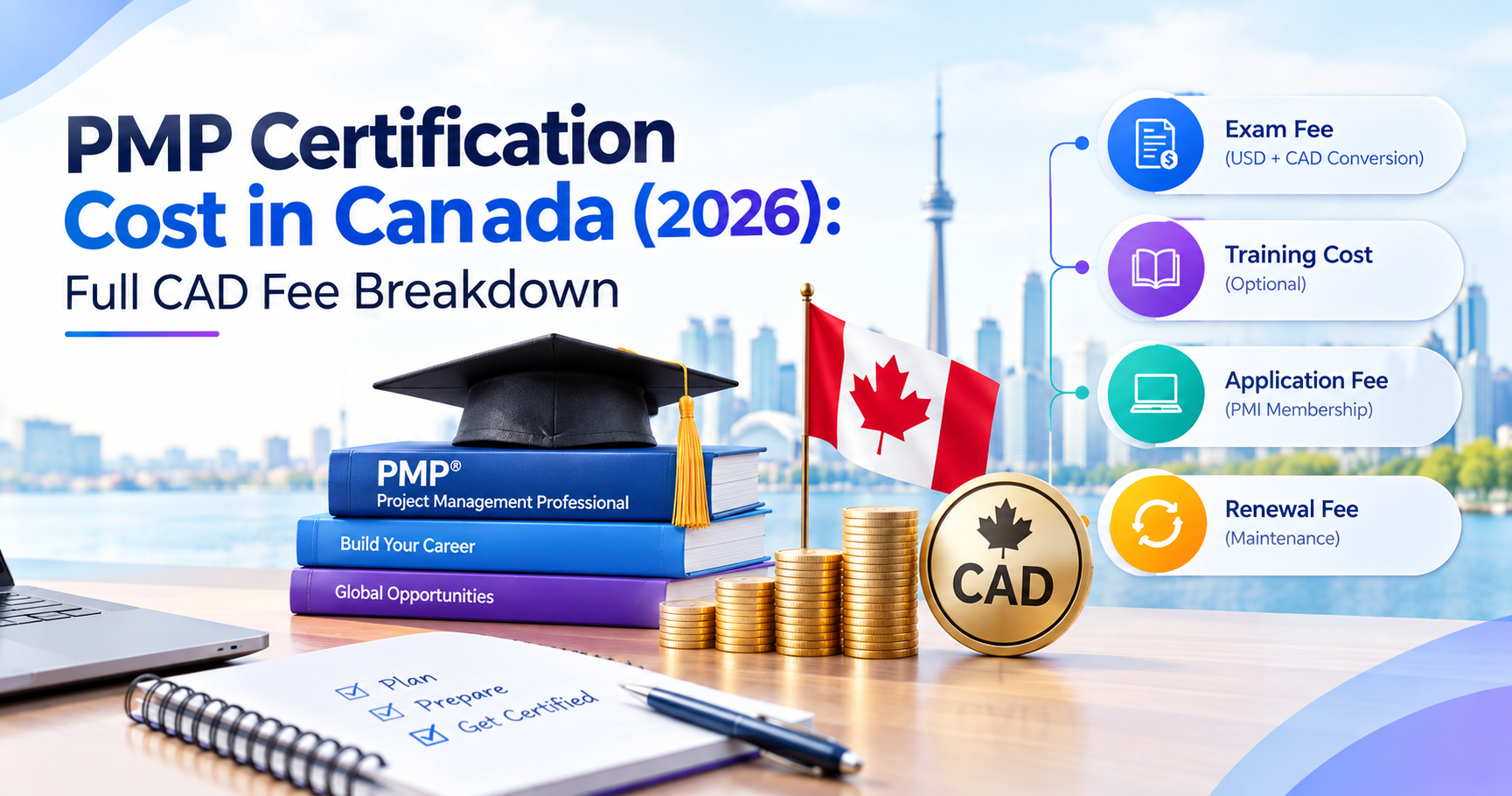
PMP certification in Canada typically costs between CAD 1,300 and CAD 4,500 in total once the PMI exam fee, optional PMI membership and training are combined. PMI bills the exam itself in US dollars, currently USD 425 for members and USD 675 for non-members, which converts to roughly CAD 590 and CAD 945 at prevailing exchange rates. Most Canadian candidates who pair PMI membership with a mid-range live online course land somewhere between CAD 1,800 and CAD 2,600 all-in. Renewing the credential every three years then adds a further CAD 85 to CAD 380 depending on membership status and how the required PDUs are earned.
Key Highlights
- The PMI PMP exam fee, set in USD, is USD 425 for members and USD 675 for non-members as of the August 2026 fee change, roughly CAD 590 and CAD 945 at a ~1.40 USD/CAD rate.
- PMI membership costs approximately USD 139 to 159 a year (about CAD 195 to 225) and cuts the exam fee by USD 250, so it pays for itself before you even sit the exam.
- Canadian PMP training ranges widely: roughly CAD 300 to 600 for self-paced e-learning, CAD 900 to 1,800 for live online instructor-led courses, and CAD 1,800 to 3,000+ for in-person bootcamps or premium programs.
- Because PMI charges in USD, the CAD amount candidates actually pay moves with the exchange rate, so a course booked and paid weeks apart can settle at a different CAD total.
- GST, HST or PST may apply to commercial PMP training fees depending on the province and how the provider structures the course, so it is worth confirming whether quoted prices are tax-inclusive.
- Renewal every three years costs USD 60 (members) or USD 150 (non-members) plus whatever is spent on the 60 required PDUs, typically another USD 0 to 150.
- Employer-funded PMP training is common in Canadian banking, consulting, government and technology employers, and group bookings through a training provider's corporate programme usually cost less per head than individual enrolments.
How Much Is the PMI PMP Exam Fee for Canadian Candidates?
The PMP exam fee for Canadian candidates is the same USD figure PMI charges everywhere else, because PMI has no separate CAD price list and bills every candidate centrally in US dollars regardless of test location. As of the fee change that took effect on 6 August 2026, PMI charges USD 425 for PMI members and USD 675 for non-members, up from USD 405 and USD 555 respectively. Anyone who registered and paid before that date locked in the older, lower fee, but any Canadian candidate booking now is on the current schedule. A fuller timeline of that August 2026 change, including how the new PMBOK 8-aligned exam content lines up with the fee increase, is covered on Simpliaxis's PMP exam fee increase explainer.
Because there is no official PMI CAD price, the Canadian-dollar figures below are estimates based on an approximate USD/CAD exchange rate of 1.40, which was roughly where the pair traded through mid-September 2026. Treat the CAD column as a planning estimate, not a fixed price, and check the live rate your card or bank applies at the time you pay
| Fee type | PMI members (USD) | Estimated CAD | Non-members (USD) | Estimated CAD |
| PMP exam fee (first attempt) | USD 425 | ~CAD 590 | USD 675 | ~CAD 945 |
| Re-examination fee (2nd/3rd attempt) | ~USD 275 | ~CAD 385 | ~USD 375 | ~CAD 525 |
| Renewal (CCR) fee, every 3 years | USD 60 | ~CAD 85 | USD 150 | ~CAD 210 |
Two things matter for Canadian budgeting here. First, the gap between the member and non-member exam fee is now USD 250, which is wider than a year of PMI membership, so joining PMI before you register is close to a free decision financially. Second, a failed first attempt is expensive to redo at the full USD 425 or USD 675 rate, but PMI's reduced re-examination fee softens that if you need a second or third sitting within your one-year eligibility window, so it is worth budgeting a contingency line rather than assuming a single pass on the first try.
Is PMI Membership Worth It If You Are Certifying From Canada?
For almost every Canadian candidate who is actually sitting the PMP exam, PMI membership is worth it on cost alone, before counting any of the non-financial benefits. Annual PMI membership runs approximately USD 139 to 159 (roughly CAD 195 to 225 at current rates), depending on the exact fee schedule PMI is running and whether a one-time new-member application fee applies. Paying that unlocks the member exam price of USD 425 instead of USD 675, a saving of USD 250, meaning the membership effectively costs nothing and can leave USD 90 to 110 in hand even before other perks are considered. Current membership pricing and enrolment can be checked directly on PMI's own membership page, since PMI has adjusted fees more than once in 2026 and the live figure there overrides any estimate in this guide
| Item | Approximate cost | Notes for Canadian candidates |
| PMI membership, first year | ~USD 149 to 164 (~CAD 210 to 230) | May include a one-time application fee on top of the annual rate |
| PMI membership, renewal years | ~USD 139 to 149 (~CAD 195 to 210) | No new-member application fee on renewal |
| Exam fee savings from membership | USD 250 (~CAD 320) | Difference between the member and non-member exam price |
| Net first-year cost of membership | Roughly break-even or a small saving | Before counting free PMBOK access, PDU webinars and templates |
Beyond the exam discount, membership includes digital access to the PMBOK Guide and PMI's standards library, PMI Study Hall content, discounted PDU webinars and access to local PMI chapters, several of which operate actively in Canadian cities. For a candidate who plans to keep the credential active for years and will need PDUs anyway, the ongoing member renewal fee of USD 60 versus USD 150 every three years is a second, recurring reason membership tends to win out over a one-off non-member payment.
What Does PMP Training Cost in Canada?
PMP training cost in Canada varies more than the exam fee, mainly because format drives price far more than location does. Every PMP applicant without a waiver needs 35 contact hours of project management education from an authorized source, and Canadian candidates can meet that requirement through several formats that sit at very different price points.
| Training format | Typical CAD price range | Best suited to |
| Self-paced e-learning / on-demand video | CAD 300 to 600 | Disciplined self-starters on a tight budget |
| Live online instructor-led (virtual classroom) | CAD 900 to 1,800 | Most working professionals in Canada, including remote or hybrid teams |
| In-person classroom / weekend bootcamp | CAD 1,800 to 3,000+ | Candidates who want in-room coaching and a fixed local schedule |
| Corporate or group training for multiple staff | Custom, usually discounted per seat | PMOs and L&D teams certifying several employees at once |
Live online instructor-led training is the format most Canadian candidates end up choosing, since it satisfies the 35-contact-hour requirement in a fixed number of days, includes an instructor to answer questions in real time, and avoids travel costs in a country where candidates are spread across cities such asToronto, Vancouver, Montreal, Calgary, Winnipeg, Mississauga, Brampton and Quebec City. Candidates comparing options can review a national overview of formats and schedules onSimpliaxis's PMP certification training page for Canada before deciding which format fits their timeline and budget.
Where an organisation needs to certify more than one employee, per-seat pricing on an individual course is rarely the most efficient route, which is why corporate and group training exists as a separate purchasing path for PMOs and learning and development teams rather than something staff arrange for themselves one by one.
Total Cost of Ownership: Three Realistic PMP Budgets for Canadian Candidates
Total PMP cost of ownership in Canada spans roughly CAD 1,000 at the leanest to CAD 4,500 at the most premium, depending on how many of the optional extras a candidate chooses to pay for. The table below sets out three realistic paths so a candidate can see where their own plan is likely to land.
| Budget tier | PMI membership | Exam fee | Training | Estimated total (CAD) |
| Lean / self-study | Yes (~CAD 210) | Member rate (~CAD 590) | Self-paced course + free resources (~CAD 300 to 400) | ~CAD 1,100 to 1,300 |
| Mid-range / most common | Yes (~CAD 210) | Member rate (~CAD 590) | Live online instructor-led (~CAD 1,000 to 1,600) | ~CAD 1,800 to 2,600 |
| Premium / in-person | Yes (~CAD 210) | Member rate (~CAD 590) | In-person bootcamp or premium programme (~CAD 2,000 to 3,500) | ~CAD 2,800 to 4,500 |
Every tier above assumes membership is taken up, since skipping it only saves roughly CAD 210 while costing an extra CAD 320 at the exam counter, a net loss for almost every candidate. The variable that actually moves the total is training format, so the single highest-leverage budgeting decision most Canadian candidates make is choosing between self-paced, live online and in-person delivery rather than shopping for a marginally cheaper exam fee, which PMI does not negotiate. A broader, country-agnostic version of this breakdown, useful for comparing against other markets, sits on Simpliaxis'sglobal PMP certification cost page.
How Do Currency and Canadian Taxes Affect Your PMP Budget?
Currency conversion and provincial sales tax rules are the two Canada-specific variables that a generic PMP cost guide will not capture. PMI invoices every candidate in USD through its own payment system, so the CAD amount that actually leaves a Canadian bank account or credit card depends on the exchange rate applied on the day of payment, not a fixed published Canadian price. Through 2026, USD/CAD has traded broadly in the 1.37 to 1.41 range, so a candidate paying the USD 425 member exam fee could see anywhere from roughly CAD 585 to CAD 600 depending on timing and on whether their card issuer adds a foreign transaction fee, which many Canadian cards do at around 2.5%.
On the training side, whether GST, HST or PST applies depends on the province and on how the training provider is registered. The Canada Revenue Agency treats general commercial training and vocational instruction as taxable in most cases, while a narrower exemption exists for courses that lead to a certificate, diploma or licence recognised under a federal or provincial statute when delivered by a qualifying vocational school, public college or university. Since PMP is a globally issued professional credential rather than a provincially licensed trade qualification, most commercial PMP training bought from a private training company should be expected to carry GST at 5% or HST at 13% to 15% depending on the province, unless the invoice states otherwise, and candidates budgeting precisely should confirm the tax treatment directly with their chosen provider rather than assuming either way. The narrower exemption for vocational schools and statute-recognised certificate programmes is set out on the Canada Revenue Agency's own vocational schools and courses guidance, which is a useful reference if a provider claims a course is tax-exempt.
Candidates who pay tuition personally, rather than through an employer, may also want to check the Canada Training Credit and related tuition provisions, since certain professional examination and training fees can qualify for federal tax relief depending on individual circumstances, though employer-reimbursed amounts cannot also be claimed personally.
How Can You Reduce Your PMP Certification Cost in Canada?
There are several legitimate ways Canadian candidates cut the total PMP bill without cutting corners on preparation, and most of them stack on top of each other. The list below moves roughly from the easiest, no-downside decisions to the ones that take a bit more planning or organisational buy-in.
- Join PMI before you register for the exam: paying for membership first drops the exam fee by USD 250, which is more than the membership itself costs, so this single step is close to free money for almost any Canadian candidate.
- Choose the training format deliberately, not by default: self-paced e-learning meets the 35-contact-hour requirement at a fraction of the cost of an in-person bootcamp, and is a reasonable choice for candidates who are confident studying independently.
- Ask your employer to fund or reimburse the certification: PMP is widely funded as professional development by Canadian employers in banking, consulting, government, construction and technology, and employer-paid training for a job-related credential is generally treated as a non-taxable benefit rather than added to a T4, though the employee typically cannot also claim a personal tuition credit for the same amount.
- Book as a group rather than individually if you manage a team: PMOs and learning and development managers certifying several employees at once should request a quote through a corporate and group training programme rather than enrolling each person separately, since group bookings are typically priced below the sum of individual seats and let a whole team train on one schedule.
- Avoid a failed first attempt where possible: a reduced re-examination fee exists, but it is still a real added cost, so investing slightly more time or a slightly better-supported course upfront is usually cheaper than retaking the exam.
- Time the payment to a favourable exchange rate where practical: since PMI bills in USD, watching the USD/CAD rate for a week or two before paying can shift the CAD cost by a noticeable margin on a fee already in the hundreds of dollars.
What Does It Cost to Renew Your PMP Certification in Canada?
PMP renewal costs Canadian credential holders a flat CCR fee plus whatever is spent earning the required PDUs, repeated once every three years. PMI charges USD 60 for members and USD 150 for non-members to process the renewal, alongside 60 Professional Development Units, at least 35 of which must come from Education activity rather than volunteering or working in the profession.
| Renewal component | PMI members | Non-members |
| CCR renewal fee (per 3-year cycle) | USD 60 (~CAD 85) | USD 150 (~CAD 210) |
| Typical PDU cost (free to paid options) | USD 0 to 150 (~CAD 0 to 210) | USD 0 to 150 (~CAD 0 to 210) |
| Estimated total per cycle | ~USD 60 to 210 (~CAD 85 to 295) | ~USD 150 to 300 (~CAD 210 to 420) |
Many of the 60 required PDUs can be earned at no cost through PMI-provided webinars, volunteering, reading or PMI Study Hall content, so the renewal cycle does not have to be expensive if a credential holder plans rather than buying a last-minute PDU bundle. A full walkthrough of what counts toward renewal and how the fee is structured is available on Simpliaxis'sPMP certification renewal fee page, which is worth bookmarking alongside the exam date rather than reading for the first time when the three-year deadline is already close.
Conclusion
The PMP exam fee itself is fixed by PMI in USD and is identical no matter where in Canada a candidate sits the test, so the real budgeting decision for a Canadian professional is not the exam line item but everything wrapped around it: whether to join PMI first, which training format to buy, how to treat currency and provincial tax, and whether an employer can be brought in to cover some or all of the bill. Candidates who join PMI before booking, pick a training format that matches how they actually study rather than what looks impressive, and check whether their employer already funds professional certification tend to land near the lower end of the CAD 1,300 to 2,600 range that covers most real Canadian PMP journeys, while those who default to premium in-person training without weighing the alternatives can end up paying close to CAD 4,000 or more for the same credential. Because the August 2026 fee increase widened the gap between member and non-member pricing, and because the exam itself was refreshed for PMBOK 8-aligned content in the same cycle, this is a reasonable moment for Canadian candidates to lock in a study plan and a training format rather than delaying and absorbing a further cost increase later.







 Lowest-Price Challenge











 Personalized Path


.webp)


 USA
USA  Canada
 India
India UK
UK Australia
 Singapore


