


 Call Us



Introduction
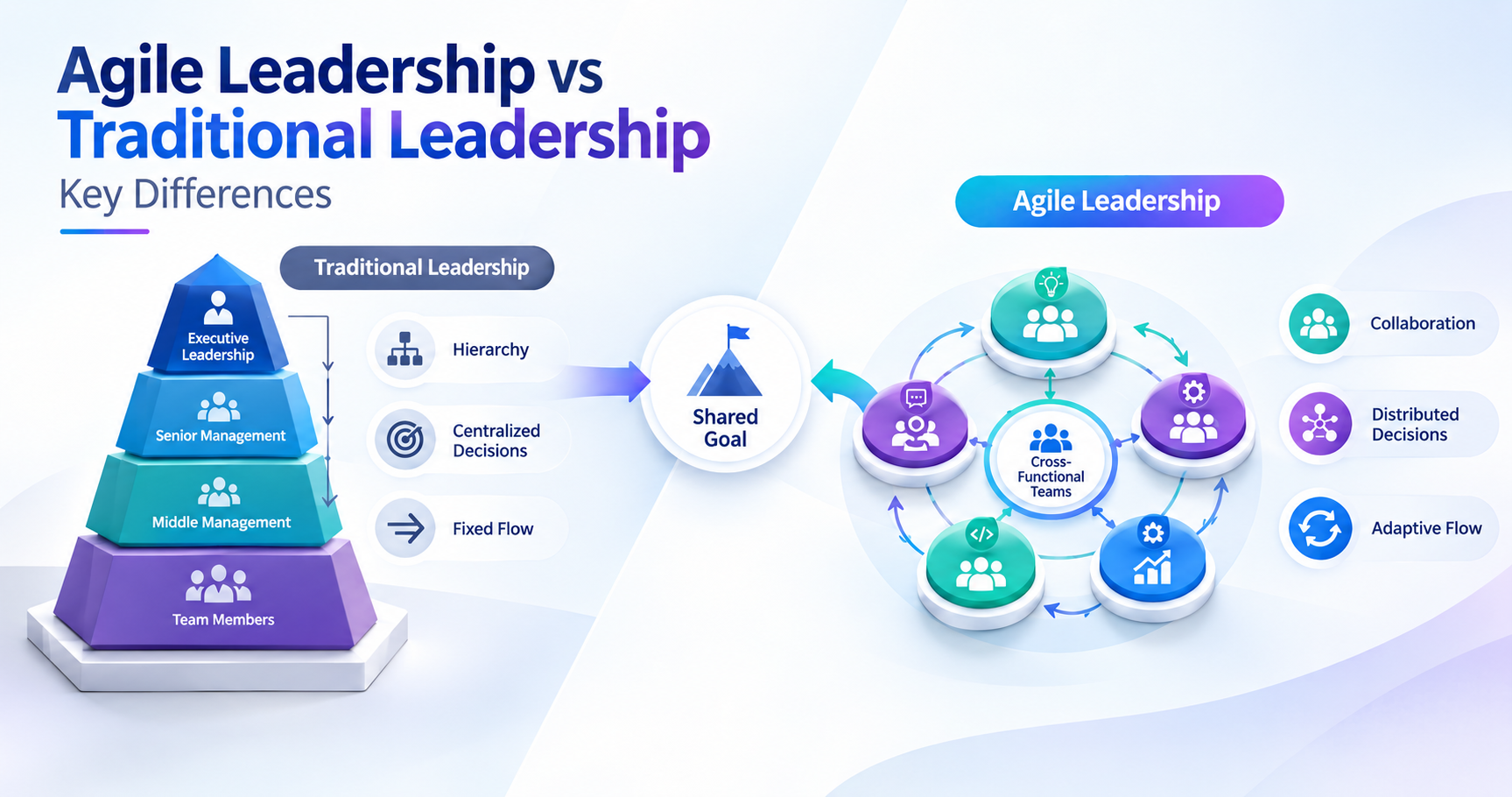
To understand what works best for an organization in terms of leading teams, managing work, adapting to change and delivering value to the customer, it is important to understand the difference between Agile and traditional leadership. Traditional leadership is about stability and consistency. Agile leadership is about empowerment and adaptability.
Understanding the differences between them can help the organization’s leadership to choose the most appropriate approach to managing its employees and to respond effectively to dynamic customer needs, an unpredictable external environment, and complex business demands.
Key Highlights
- Learn the primary differences between Traditional and Agile leadership in aspects like communication, team dynamics, and planning.
- Explore how the Agile leadership form of management encourages flexibility, communication, and continuous improvement amongst team members and teams across the organization.
- Understand the pros and cons of both Agile Leadership and Traditional Leadership
- Based on the needs of an organization, learn when to use the Traditional, Agile, or Hybrid approach to leadership
- Gain practical tips to move from Traditional to Agile Leadership.
- Learn how teams are strengthened in Agile leadership environments through collective ownership, delivery of value that inclines to customer needs, and feedback.
What Is Traditional Leadership?
Traditional leadership means that only one person or some specific people, usually the leader or leadership, have the most decision-making authority. It is organized hierarchically, and tasks are distributed among teams to carry out.. Communication moves top-down; that is, information flows from leadership to team members, with minimal room for feedback. This leadership style focuses on ensuring that teams perform their tasks in a structured and consistent manner, enabling stability and control over the project.
However, while this leadership style ensures process stability, it lacks autonomy for its employees, rendering them as ‘followers’ who are to do the work assigned to them rather than people who actively contribute to the process with feedback and discussions and the space to exercise autonomy. This can lead to increased employee disengagement and lower productivity.
What Is Agile Leadership?
Agile leadership involves an active and versatile form of leadership and is best displayed through flexibility and the ability to deliver valuable outputs to customers and stakeholders even in the midst of uncertainty, constant flux, and market and priority shifts.
This leadership methodology not only drives effective change and output but also ensures that change affects the way in which orgnizations work. Instead of elaborate structure and extensive plans, Agile leadership embraces uncertainty and optimizes its workflow based on the work that is most pressing and that can deliver the most valuable output. This optimization is accompanied by frequent feedback loops, which not only allow space for improvement of existing processes but also give agency to employees to experiment, discuss, and iterate with new ideas, boosting productivity.
Agile leadership does not focus on structure; instead, it helps teams use the best practices, detects potential obstacles, and improves collaboration between team members for better work efficiency. Professionals can build the right leadership skills to help their team effectively work in Agile environments through courses like the Certified Agile Leader Certification training with Simpliaxis.
Agile Leadership vs. Traditional Leadership: Comparison Table
The table below elaborates on the difference between Agile leadership and the traditional leadership model.
Criterion | Traditional Leadership | Agile Leadership |
Flexibility |
|
|
Communication |
|
|
Team Functionality |
|
|
Feedback |
|
|
Focus |
|
|
Key Differences Explained
Decision-Making: Centralised vs Decentralised
In traditional leadership methods, decisions are centralised, which means that any authority pertaining to organizational decisions rests with the leadership or top management executives. Such practices prompt uniformity and control across the organization that drives stability and consistency within already established processes.
On the contrary, Agile leadership is decentralized, enabling different teams and seniority present in the organization to take responsibility for different tasks. Here, organizational decisions are spread across different teams and employees to better accommodate contextual requirements, deliver faster outputs, and have the liberty to make the most impactful decision for the team and overall business goal. While the top management focuses more on the long-term goal, employees get to execute their day-to-day tasks with autonomy, leading to more transparency and employee engagement.
Communication: Top-Down vs. Two-Way/Transparent
Traditional leadership primarily communicates through the top-down method, where information moves in a hierarchy from the highest levels of management to lower levels of management and teams. The information delivered is treated as absolute, meaning that employees receive and process the information and proceed to execute the task assigned to them. Although this type of communication maintains order and consistency, it is not susceptible to feedback or engagement.
The two-way or transparent mode of communication is largely found in Agile environments. Here, teams are encouraged to provide their feedback, exchange insights, and contribute to the decision-making process. This type of communication style allows the iteration of processes that can make outputs better, quicker, and more relevant.
Planning: Fixed Roadmaps vs. Adaptive/Iterative
Traditional frameworks are heavily dependent on fixed roadmaps and planning. This means a need for extensive research, forecasts, and established objectives. While fixed roadmaps happen to provide a structure, a coherent long-term plan, and direction, they become rigid, outdated, and immune to change. This becomes more obvious in the face of changing priorities and sudden market shifts. Such rigidity makes organizations less equipped to handle and adapt to unforeseen changes and challenges.
The adaptive/iterative nature of planning lets organizations plan their roadmap in a way that still lets new information or ideas to make their way into processes easily. This is done by creating a living and working framework that is constantly gets updated and frequent feedback loops that allow changes to be made more quickly. Adaptive planning also gives importance to decisions that lead to valuable outcomes; this helps increase customer satisfaction.
Risk Tolerance: Risk-Averse vs. Experiment-Friendly
Traditional leadership methods give a lot of importance to control and stability. This ensures that there is minimal disruption in workflow. Such organizations avoid taking risks and usually make decisions through careful planning, research, and discussions.
On the other hand, Agile leadership promotes experimentation, believing it to be necessary for the growth of an organization.
Accountability: Individual vs. Collective Ownership
Traditional leadership depends on individual ownership; each team member has a designated task that they are responsible for executing. This type of work is evaluated through defined metrics and criteria that are mostly quantitative. While this method is useful for work efficiency, it can create miscommunication, misdirection, and misalignments with other teams and the overarching business objective.
The Agile method of ownership holds entire teams accountable for a certain decision. This means acknowledging that although each team member has a definite role, they all contribute towards a common goal. This ensures that team members hold each other accountable for overall success and that there are fewer confusions regarding what the goal is.
Team Structure: Rigid Roles vs. Cross-Functional/Self-Organizing Teams
Traditional team roles are fixed and defined. Each team is usually organized on the basis of a common skill set or department, meaning that individuals with similar roles work together. For instance, engineering and marketing teams. While having rigid roles within teams is important for maintaining consistency and is excellent when specialized bodies of knowledge are required, it can lead to the creation of silos, where one team’s objectives are starkly different from another team’s. This can hinder the progress of overarching business goals and lead to complicated handoffs and alignments.
Agile teams often consist of cross-functional teams where individuals with different skill sets come together to work towards a shared objective. Such teams are common in areas like operations and product delivery, where collaboration plays a crucial role in the quick execution of tasks. This model helps reduce delays that may be prevalent between teams with different functions, hence making processes faster and aligning teams in a better way.
Focus: Process/Output Control vs. Value & Customer Feedback
Traditional leadership tends to value things like control and consistency. This ensures that processes are consistent and followed in a systematic way. This can lead to the creation of rigid processes that can’t be changed or iterated on until a process cycle comes to an end, as decisions made are often long-term. The focus on process regulation and control can result in the delivery of output that is out of date and delayed.
However, Agile leadership prioritizes customer feedback and value output, which changes the way in which organizations function. Multiple feedback loops, along with two-way communication, allow the flow of inputs during early or formative stages of the workflow. This ensures that feedback is incorporated into the workflow immediately instead of at the end, which can otherwise lead to elaborate and time-consuming reworks. The implementation of feedback also highlights the importance of delivering outputs that are relevant and valuable to the customers.
Pros and Cons of Traditional Leadership
Pros
1. Stability
Processes in traditional leadership methods are stable since they are extensively planned, better predicted, and fixed in nature and designate functions and roles. This allows them to be better managed in the long run.
2. Existence of Order
There is a controlled environment which is easy to manage, with defined roles and processes, and structural hierarchy.
3. Hierarchy is Present
In traditional leadership settings, there's a hierarchy of command with each designation having a specific purpose. In larger organizations with many employees, such a hierarchy can be useful to help build the structure.
Cons
1. Affects Creativity and Innovation
Excessive processes and top-down methods of communication give employees little to no room to participate in decision-making or provide constructive feedback. This limits their skill set to only what is necessary and hinders the creation of creative approaches to re-examine established processes. The traditional leadership’s aversion to calculated risks and new approaches also slows down room for innovation and experimentation, which can often lead to outdated outcomes and decreased employee productivity.
2. Creation of Silos
The emphasis on individual ownership and rigid team roles leads to the creation of silos where the goals of one team fail to align with the goals of the other. This leads to situations where different team alignments and handoffs become tedious and tricky. Furthermore, the presence of different goals leads to misalignment of priorities, which can affect overall business processes.
3. Inflexible and Time-Consuming
The top-down communication structure can slow down decision-making. This can be harmful when organizations have to make quick decisions or need to restructure their processes quickly.
4. Unrealistic Expectations
When decision-making remains with a certain group of people and with no possibility for input or feedback from employees, it can create unrealistic targets for employees to achieve. Not only does this disrupt efficient workflow, but leads to burnout and unproductivity.
Pros and Cons of Agile Leadership
Pros
1. Better Teamwork
Shared ownership makes team members come together and work towards a certain goal; this not only ensures the organization's success but also helps team members understand the importance of each of their roles and leads to better accountability between them.
2. Extra Flexibility
Agile methodology values adaptability highly and responds to changes in organizational, market and customer needs faster than traditional leadership environments. This is important as it helps organizations to continuously update themselves with changing needs and to deliver outputs that are relevant to customers. It improves the overall business development.
3. Better Discussion & Communication
Unlike the traditional top-down style of communication, Agile leadership lets members and leaders discuss with one another. This builds transparency while also allowing room for feedback and input to flow through for better quality of processes and productivity.
4. Room for Innovation and Experimentation
The Agile leadership model encourages teams to take risks and try out new ideas. It fosters an environment where innovation can thrive, and new ideas can arise that improve processes and propel business growth.
5. Employee Welfare
The adaptive and flexible nature of the Agile leadership model focuses on realistic team capacities and potential. Unlike the traditional model where employees may be forced to meet difficult deadlines, the Agile methodology ensures that employees make the best use of their capabilities for better productivity and prevents burnout.
Cons
1. Ever-Changing
While Agile leadership principles stress flexibility regarding change, constant change can generate chaos and confusion, impacting team productivity and preventing them from working in an organized manner.
2. Unpredictable
The Agile leadership model doesn’t work for the industries that are built on sustainability and consistency. The model relies on a constant flow of information, making it unpredictable and vulnerable to changes in the process.
3. Too Much Flexibility
While the Agile leadership model is known for flexibility, too much of it can lead to disorder and chaos. In the model, there is a certain degree of control that has to be kept to be able to keep it organized.
4. Slows down decision-making
Two-way communication means gathering feedback from employees as well. This can be time-consuming and tedious.
When to Use Traditional Leadership?
Traditional leadership is organizationally useful in environments that need stability and consistency or strict compliance standards such as the manufacturing and healthcare industries. It is also useful in enterprises with a large number of employees, as a distinct hierarchy and centralized decision-making enable control that helps in making workflows more efficient.
It is also important in high-stakes or crises where decisions need to be made immediately; a clear chain of command is required, or when risk management becomes critical.
When to Use Agile Leadership?
Agile leadership is the best fit for organizational environments that are highly volatile, that is, where decisions need to be made quickly, and teams need to figure out how to adapt to changing situations immediately. Since Agile prioritizes value, incorporates quicker feedback loops, and allows space for testing and experimentation, teams can find ways to improve processes and make them relevant to changing needs.
Unlike traditional environments where processes remain fixed for consistency, environments under Agile leadership observe constant change, with processes being continuously refined for better process output. These changing dynamics lead to better outputs, improving customer experience and contributing to the growth of business revenue.
Can You Combine Both? (Hybrid Leadership Approach)
While the Agile methodology subverts and challenges the rigidity of traditional frameworks through embracing uncertainty, constant feedback, and openness to discussions and testing, it still needs to be regulated, structured, and possess risk readiness. These are traits that are usually found in the traditional leadership approach.
Leaders can therefore adopt the hybrid leadership model that combines techniques from both the Agile and Traditional forms of leadership. This enables leaders to effectively help their teams navigate high-stakes and uncertain situations while ensuring that their structural integrity and processes remain functional, ensuring the delivery of value.
For instance, during the initial phase of Agile planning, having defined roles, visions, and expectations can help provide teams with a clear head start so that the team can gain ownership and autonomy over time.
How to Transition From Traditional to Agile Leadership?
To transition from Traditional to Agile leadership models, professionals need to change the way they approach work and adopt new perspectives on process execution.
Agile Methodologies
The best way to transition to Agile leadership is to adopt Agile frameworks like Scrum, Kanban, and the Scaled Agile Framework (SAFe) to change how work is done and increase efficiency.
Encourage Team Growth
Move away from a top-down command-and-control leadership model to a more collaborative servant leadership model where teams are empowered by being advised on priorities and possible blockers instead of a centralized, hierarchical command.
Scrum Masters are servant leaders who coach teams on improving their workflow with better practices, prioritization, and identifying work processes that might be hampering growth. The CSM® Certification Training is an excellent way to pave the way to more Agile work environments, and becoming a Certified Scrum Master through courses such as this is an excellent way to go about it.
Measure Value
Instead of relying on traditional measures of effectiveness, leaders should focus on more meaningful value indicators such as customer satisfaction, quality of innovation, and quality of team collaboration.
Embrace an Agile Mindset
A true Agile leader needs to have Agile thinking, which includes learning new processes, adapting to changes and being open to feedback. These characteristics train professionals to become effective Agile leaders, inspiring their teams to adopt the same mindset by example.
Encourage Cooperation
Effective collaboration enables agile leadership. That means breaking down rigid roles and functions and creating space for cross-functional collaboration and collective ownership. Not only does this align team members with different domains towards a common goal, but it also holds each other accountable for their tasks and gives them a better understanding of the importance of each role performed.
Common Challenges When Making the Shift
The most common challenge that emerges when making the transition from a traditional leadership style to an Agile one is when teams adopt Agile practices without truly understanding their purpose in making processes more efficient. This renders Agile methods as extra sets of steps in workflow processes rather than a meaningful improvement methodology.
Listed below are a few common challenges and misconceptions that arise during the transition to Agile leadership.
Ineffective Incorporation of Agile Practice
Several organizations may adopt Agile practices but may fail to truly execute them. While Agile methods prioritize quick decision-making and better efficiency, teams may still follow project processes that resemble traditional frameworks. Planning becomes extensive and long, feedback is continually delayed, and workflow remains slow due to the presence of unnecessary tasks and impediments that should not be present.
Fragmentation of Teams
The Agile leadership model places a heavy emphasis on collaboration and teamwork. Yet organizations may struggle to dissolve siloed and rigid team structures, which can lead to the misalignment of goals, individual work that is ignorant of greater organizational objectives, and the lack of shared ownership between teams.
Over-Implementation
Another common challenge during the transition into the Agile way of leadership is the overimplementation of Agile methods. In the process of adopting Agile practices, organizations may try to adopt every framework and process to mimic an ideal Agile environment, even when it might not adhere to their unique needs or add any type of meaningful value to the workflow.
Agile Leadership vs. Traditional Leadership: Which Is Right for Your Organization?
Both Agile and Traditional Leadership have their pros and cons. So choosing the right leadership model is less about the techniques and more about what your organization needs.
If your organization is about stability and you need consistency and clear structure, then the traditional model of leadership may be right for you. The structure, the centralized communication, and the clear roles ensure that the employees and the teams know what they have to do and what their tasks are. It’s an environment where you can get predictable, measurable results.
But for more dynamic organizations that need to be able to change quickly to meet changing needs, the Agile leadership model is perfect. This model is useful in environments such as technology companies and startups because it has Agile practices such as experimentation, continuous improvement, and regular feedback to make the workflow and quality of output better.
Conclusion
When organizations understand the difference between the Agile Leadership model and the Traditional Leadership model, they are better able to guide their teams, respond to business needs, and find the best way to deliver value. Traditional leadership provides order, stability, role and process clarity, and concentrated power. Best for environments where the priorities are consistency, predictability, and prioritization. However, agile leadership is more appropriate in dynamic environments that emphasize traits such as adaptability, shared ownership, and continuous feedback
But organizations don’t have to commit to a single model. A combination of these approaches, that is, the hybrid leadership model, combines the aspects of risk management and structure from the traditional leadership perspective with the adaptability, collaboration, and responsiveness of Agile leadership. However, choosing which type of leadership to use has less to do with what each model offers and more with the organization's needs, team capacity, environment, and the need to adapt.








 Lowest-Price Challenge











 Personalized Path


.webp)


 USA
USA  Canada
 India
India UK
UK Australia
 Singapore


