


 Call Us



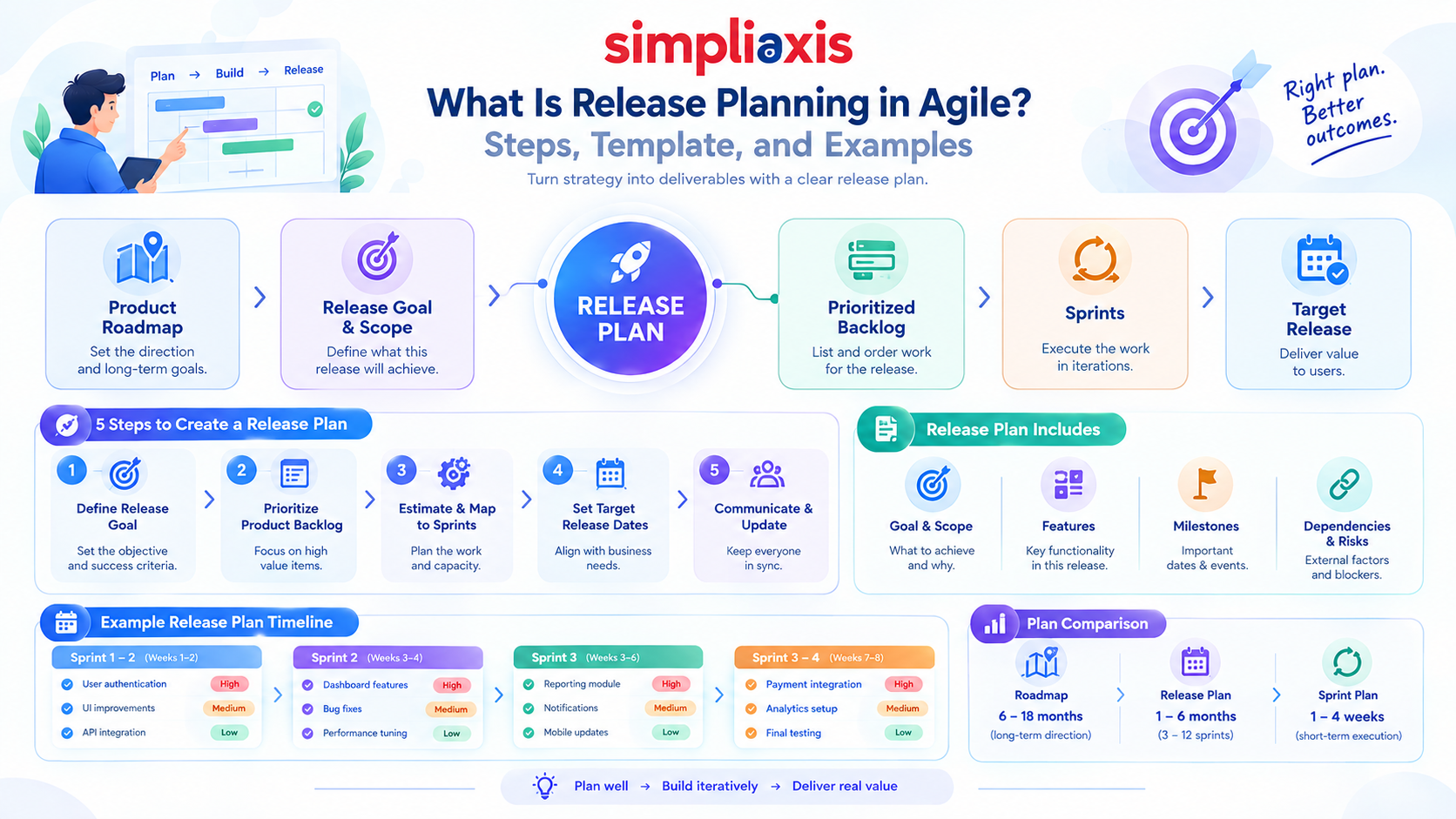
Release planning, in Agile, is the process of grouping the prioritized backlog items into a forecasted timeline that spans multiple sprints (usually 3 to 6 months). So, a team knows what it will ship and roughly when to ship. More concisely, release planning sits between the long-term product roadmap and day-to-day sprint planning, turning strategic goals into a realistic, trackable delivery plan built on team velocity, dependencies, and risk.
Key Highlights of Release Planning in Agile
- Release planning translates a product roadmap into a concrete forecast covering several sprints, typically three to twelve iterations or three to six months of work.
- It is not a Scrum event by definition, but most Scrum, Kanban, and SAFe teams treat it as an essential practice for setting realistic expectations with stakeholders.
- A release plan is a forecast, not a contract. It gets more accurate as sprints are completed and velocity data accumulates.
- The core inputs are a prioritized product backlog, an estimated or historical team velocity, and clear conditions of satisfaction for scope, schedule, and quality.
- In scaled environments, SAFe replaces standalone release planning with Program Increment (PI) Planning, a structured event where an Agile Release Train aligns on an 8- to 12-week increment.
Introduction
A development team can run flawless two-week sprints and still leave stakeholders guessing about when a feature will actually reach customers. That gap between "we finished the sprint" and "we shipped the release" is exactly what release planning closes. It answers the question every executive, customer, and sales team eventually asks: when will we have it?
Release planning matters because sprints alone don't tell a coherent story. A single iteration produces an increment of work, not a market-ready release. Without a plan that ties several sprints together around a shared goal, teams end up with technically sound code that doesn't add up to something a customer can use. This article walks through what release planning actually is, what a release plan contains, how to build one step by step, and where it fits alongside Scrum and SAFe practices such as PI Planning.
What Is Release Planning?
Release Planning Definition
Release planning is the practice of mapping product backlog items onto a sequence of sprints to forecast when a meaningful set of features will be ready for customers. It typically covers three to six months, or roughly three to twelve sprints, depending on the size of the release and the team's velocity.
Unlike a fixed project schedule, a release plan is treated as a living forecast. The product owner and delivery team revisit the plan regularly. They adjust scope or timing as they learn more about the work, the team's actual throughput, and shifting business priorities. The output is usually a release goal, a set of target dates or milestones, and a prioritized list of features mapped against sprints.
Release Planning vs Sprint Planning vs Roadmapping
Teams often blur the lines between these three planning layers, and that confusion is one of the most common reasons releases slip. Each layer answers a different question, at a different altitude, for a different audience.
Planning Layer | Time Horizon | Core Question | Typical Owner | Output |
| Product Roadmap | 6–18 months | Where is the product heading? | Product Management / Leadership | Strategic themes, goals, direction |
| Release Plan | 1–6 months (3–12 sprints) | When will this batch of features ship? | Product Owner | Release goal, target dates, feature scope |
| Sprint Plan | 1–4 weeks | What will we build this sprint? | Scrum Team | Sprint backlog, sprint goal |
A product roadmap stays intentionally high-level, communicating themes such as improving performance or expanding into a new market segment. A release plan takes those themes and turns them into a specific, time-bound scope: which epics and features will actually be built and roughly when they will reach users. Sprint planning then takes a thin slice of that release scope and commits the team to concrete stories for the next one to four weeks.
Confusing these layers creates predictable problems. Teams that plan only at the sprint level often ship excellent individual increments that never add up to a coherent release, because dependencies get missed and features arrive in the wrong sequence. Teams that skip release planning and rely purely on a roadmap tend to make promises that ignore actual team capacity. Release planning exists precisely to connect the two.
Why Release Planning Matters
Release planning gives every stakeholder a shared, realistic view of delivery, and that shared view pays off in a few concrete ways.
First, it reduces risk. By grouping backlog items into a release and reviewing dependencies before work starts, teams surface technical and cross-team blockers early rather than discovering them mid-sprint. Second, it protects predictability. A release plan built on historical velocity gives the product owner room to make scope-versus-date trade-offs before they turn into last-minute crises, rather than after. Third, it keeps stakeholders aligned. Marketing, sales, support, and customer success all need a dependable signal for when a capability will be ready, and a release plan is that signal.
Industry data backs up the value of structured planning. PMI's research on project performance has repeatedly found that organizations with mature planning practices complete a far higher share of projects successfully than those with weak planning discipline, and lack of a clearly defined goal remains one of the most cited reasons software initiatives fail. Release planning directly addresses that gap by forcing a team to define, and periodically reconfirm, exactly what a release goal is before committing engineering time to it.
What Does a Release Plan Include?
A useful release plan is not a giant Gantt chart. It is a compact set of decisions that answer what will be delivered, in what order, and under what conditions.
Release Goal and Scope
Every release plan starts with a goal: the specific outcome or value the release is meant to deliver, not just a list of features. A goal such as "let customers self-serve refunds without contacting support" gives the team a test for every scope decision that follows. Scope is the boundary around that goal, the epics, features, and fixes that belong in this release, and just as importantly, what has been explicitly left out. Naming what is out of scope is as valuable as naming what is in, because it prevents scope creep once the release is underway.
Prioritized Backlog and Features
The release plan draws from a single, ranked product backlog rather than a scattered list of requests. Features are prioritized by customer value, technical dependency, and effort, so the highest-value, lowest-risk work is sequenced first. This is also where the product roadmap earns its keep: a well-maintained product roadmap gives the release plan its strategic anchor, ensuring the features chosen for this release actually ladder up to the broader direction rather than being selected in isolation.
Target Dates and Milestones
Once the scope is roughly set, the team lays that work across upcoming sprints and identifies checkpoints: a code freeze, a beta release to a subset of customers, a security review, or a go-live date. These dates are forecasts anchored in the team's velocity, not commitments carved in stone. Treating them as fixed, immovable deadlines is one of the fastest ways to force quality shortcuts later in the release.
Dependencies and Risks
No release plan is complete without a clear-eyed look at what could delay it. Dependencies include work owed by other teams, third-party integrations, infrastructure changes, or compliance sign-offs. Risks include unknowns such as unproven technology, key-person availability, or unclear requirements. Surfacing these early and assigning an owner to track each one keeps small issues from turning into release-day surprises.
How to Do Release Planning Step by Step
Building a release plan is a repeatable five-step process. Teams that run through these steps at the start of every release cycle tend to hit dates far more consistently than teams that plan release by instinct.
Step 1: Define the Release Goal
Start by articulating why this release exists and what value it delivers to customers or the business. This step is deliberately done before any feature discussion, because a clear goal gives the team a test for every later scope decision. If a proposed feature doesn't clearly serve the goal, it becomes an easy candidate to defer to a later release.
Step 2: Prioritize the Product Backlog
With the goal set, rank the backlog items that could plausibly serve it. Most teams weigh value, effort, risk, and dependencies together rather than picking whatever feels most urgent that week. A structured technique such as MoSCoW prioritization, sorting items into Must-have, Should-have, Could-have, and Won't-have buckets, gives the product owner and stakeholders a shared vocabulary for these trade-offs, and it makes it far easier to defend what has been left out of the release.
Step 3: Estimate and Map Work to Sprints
Next, the delivery team sizes the prioritized items, typically in story points, and maps them onto the number of sprints the release will cover. This is where historical velocity becomes essential: if the team has consistently completed 30 story points per sprint over the last several iterations, that number, not optimism, should drive how much gets pulled into the release. Items too large for a single sprint get broken down further at this stage.
Step 4: Set Target Release Dates
Once scope is mapped against realistic capacity, the team can propose a target date or a date range. Most experienced teams frame this as a fixed-date-or-fixed-scope trade-off: either the date holds and scope flexes, or the scope holds and the date flexes, but rarely can both stay fixed without sacrificing quality. Being explicit about which side of that trade-off applies to a given release prevents a lot of downstream conflict.
Step 5: Communicate and Update
A release plan is only useful if people outside the delivery team can see it. Share the goal, scope, and target dates with stakeholders in a format they can revisit, and commit to updating it at a regular cadence, typically at the end of each sprint. As actual throughput comes in, refine the forecast rather than treating the original plan as untouchable. This continuous update loop is what separates a living release plan from a document nobody trusts by week three.
The Release Planning Meeting
Release planning usually culminates in a dedicated meeting, sometimes called a release planning session, the format practiced hands-on in anAgile Release Planning workshop, and that brings the product owner, delivery team, Scrum master, and key stakeholders together to align on the plan before sprints begin. A typical agenda covers a short recap of the product vision and current status, a review of team velocity, agreement on the release goal and theme, coarse-grained sizing of candidate backlog items, mapping of stories into sprints, and an explicit check-in on dependencies and open risks.
The session usually closes with a commitment step: the team signals, often through a quick confidence poll, whether this is the best plan they can make with what they currently know. That commitment isn't a guarantee the plan won't change; it simply confirms the team believes the plan is realistic enough to start executing against. Any unresolved concerns raised during the meeting should turn into tracked action items rather than being left unaddressed once the session ends.
Release Plan Example and Template
A release plan does not need to be elaborate to be useful. Most effective templates capture five things: the release goal, the prioritized feature list mapped to sprints, key milestones, dependencies and risks, and the definition of done for the release. The table below shows a simplified example for a fictional release.
Feature/Epic | Sprint | Priority | Status | Dependency |
| Self-service refund flow | Sprint 1–2 | Must-have | In Progress | Payments API update |
| Refund status notifications | Sprint 2 | Should-have | Not Started | Notification service |
| Refund analytics dashboard | Sprint 3 | Could-have | Not Started | None |
| Multi-currency refund support | Sprint 3–4 | Won't-have (this release) | Deferred | Currency conversion service |
Alongside a table like this, most teams also track a short release summary: the release goal in one sentence, the target date or date range, the team's current velocity, and a running list of risks with owners. Keeping the template lightweight makes it far more likely the team will actually maintain it sprint after sprint, rather than abandoning it the moment the plan starts to shift.
Release Planning in Scrum and SAFe
In Scrum, release planning is not an official event defined by the Scrum Guide, but it remains common practice for teams that need mid-term visibility beyond a single sprint. The product owner uses the prioritized, estimated backlog along with the team's known or estimated velocity to build a forecast spanning several sprints and reviews it as part of ongoing backlog refinement and sprint reviews.
At scale, the Scaled Agile Framework (SAFe) formalizes this same idea through Program Increment (PI) Planning. Instead of a single team forecasting its own sprints, an entire Agile Release Train, a group of Agile teams working on a shared solution, comes together to plan an 8- to 12-week Planning Interval. Professionals pursuing a SAFe POPM Certification Training spend considerable time on exactly this event, because product management and product ownership responsibilities converge heavily during PI Planning.
How PI Planning Extends Release Planning on an ART
PI Planning takes the core mechanics of release planning- a goal, a prioritized scope, capacity, and dependencies- and runs them at the level of an entire Agile Release Train rather than a single team. Over a typical two-day event, business owners present context and strategic themes, product management presents the vision and top features, and each team breaks out to plan its own capacity, draft PI objectives, and identify both local and cross-team dependencies.
The event closes with a committed set of PI objectives, a visible program board showing features and dependencies across teams, and a set of identified risks reviewed using the ROAM method: Resolved, Owned, Accepted, or Mitigated. Understanding these responsibilities in depth is a core part of what the SAFe POPM roles and responsibilities cover, since Product Owners and Product Managers jointly drive the backlog and vision inputs that make PI Planning possible. For teams evaluating whether to invest in this certification path, reviewing what is SAFe POPM certification is a useful starting point before committing to the training.
Common Release Planning Mistakes
Even experienced teams fall into a handful of predictable traps when building release plans.
Treating the plan as a fixed contract: A release plan is a forecast built on current evidence. Refusing to adjust it as the team learns more defeats its purpose and usually leads to quality shortcuts near the deadline.
Overstuffing the release: To meet the deadline, sometimes the team tries to force many features into a single project. It ultimately results in collapsing the project. Velocity is a planning tool, rather than a commitment device. Ignoring it can invite missed goals.
Ignoring dependencies until they surface late: Cross-team and third-party dependencies that aren't identified during planning tend to appear at the worst possible moment, close to the release date, when options for mitigation are limited.
Skipping the release goal: If there is not a clear goal, scope decisions become arbitrary, and every stakeholder request looks equally urgent. It will, in turn, make prioritization almost impossible.
Leaving the definition of done vague: If the team hasn't agreed on what theDefinition of Done means for the release, including testing, documentation, and rollout criteria, the release date becomes meaningless even if the code is technically complete.
Planning in isolation from the roadmap: A release plan disconnected from the broader product roadmap risks shipping technically sound features that don't move the product toward its strategic goals.
Conclusion
Release planning is the connective layer that keeps a product roadmap honest and keeps sprint work purposeful. It forces a team to agree on a goal before debating scope, size work against real velocity instead of optimism, and surface dependencies and risks while there's still time to address them. Treated as a living forecast rather than a fixed contract, a release plan gives product owners the data to negotiate scope-versus-date trade-offs early, gives stakeholders a dependable signal for when value will actually reach customers, and gives delivery teams a shared target that makes each sprint add up to something coherent. Whether a team runs simple Scrum-based release planning or coordinates an entire Agile Release Train through SAFe's PI Planning, the underlying discipline is the same: plan at the right altitude, revisit often, and let evidence, not hope, drive the dates.







 Lowest-Price Challenge











 Personalized Path


.webp)


 USA
USA  Canada
 India
India UK
UK Australia
 Singapore


