


 Call Us



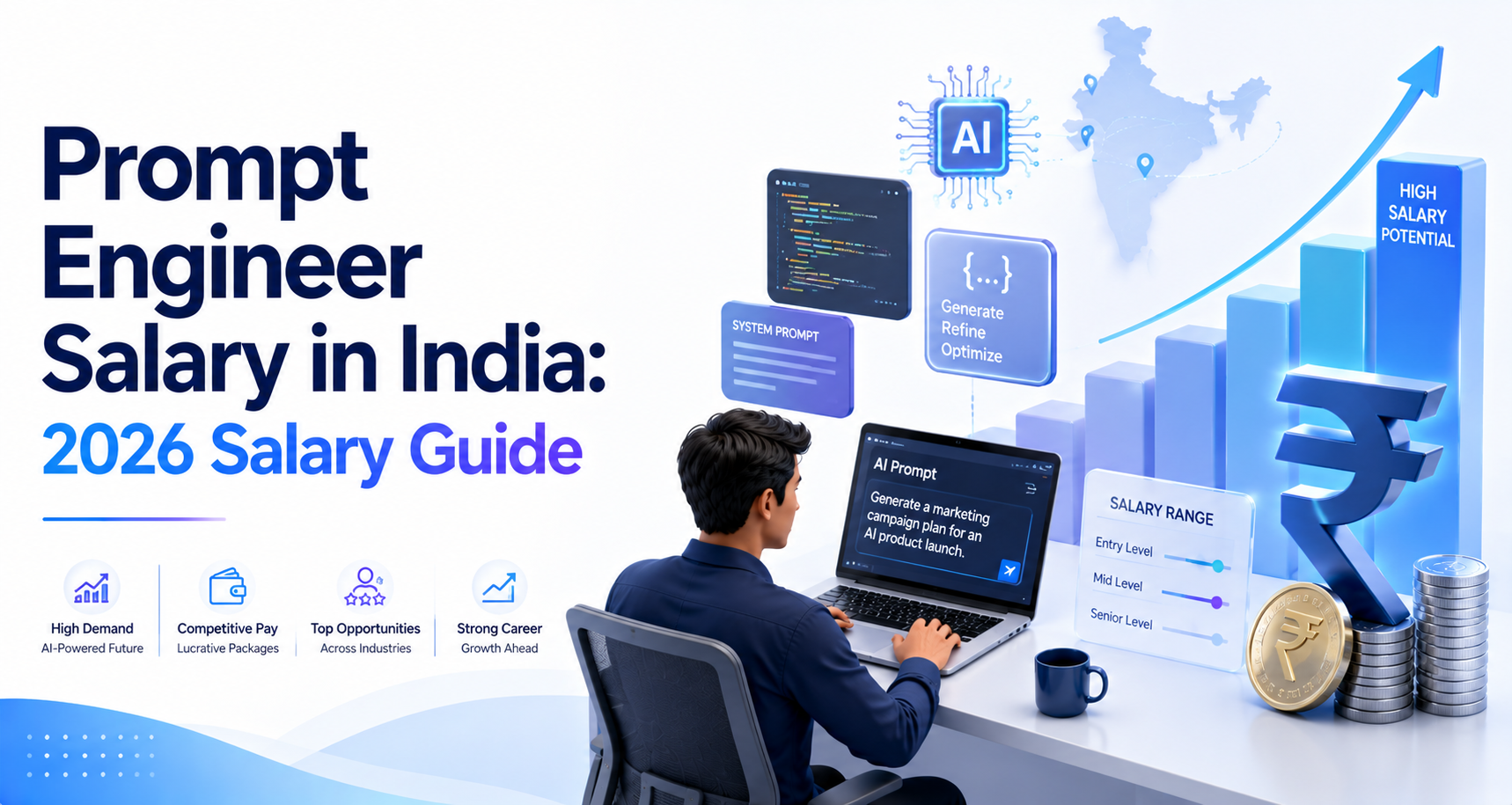
Prompt engineering is becoming part of the broader landscape of the highest-paying jobs in India. The salary of a prompt engineer varies from ₹4 lakh to ₹60 lakh per annum, depending on factors like experience, technical expertise, industry, location, and the role’s scope. Entry-level employees today could be earning around ₹5-8 lakh a year. But the ones who have expertise in prompt engineering and working knowledge of Python, RAG, LLM evaluation, and AI engineering can earn anywhere between ₹25 and 60 lakh and above.
But there is a big distinction. Prompt engineering is increasingly being absorbed into wider AI roles, rather than being a standalone role. Most of the current job postings for prompt engineers today ask for experience with Python, LLMs, RAG, cloud platforms, evaluation, and production AI. This means your earning potential is less about knowing how to write a clever prompt and more about how well you can use prompting to solve real business and technical problems.
Key Highlights of Prompt Engineer Salary in India
- Prompt engineer salary in India: ₹4-60 LPA (approx.) depending on experience and skill levels.
- Starting Salary Range: ₹4-8 LPA (approx.), based on current market estimates.
- Mid-level: ₹15-25 LPA (approx.) with coding & AI skills.
- Senior Range: ₹30-50 LPA for AI Engineering Professionals with wider skills
- Bengaluru: It is one of the higher-paying markets in India for prompt engineering today, according to salary estimates.
- Technical skills are important: Knowing languages like Python, RAG, LLM evaluation, APIs, and AI frameworks can broaden your job search.
- Standalone roles are shifting: Many companies are combining prompt engineering with applied AI, GenAI, product, or LLM roles.
- Freshers are welcome to enter the field: There are entry-level prompt engineer roles available, but the requirements vary a lot by employer.
Introduction
A prompt can look simple on the surface. You give an AI model an instruction, receive an answer, refine the instruction, and try again. But professional prompt engineering goes much further. Businesses are using Large Language Models (LLMs) for customer support, document processing, content generation, software development, research, data extraction, and workflow automation. So someone has to generate the instructions, test output, work around edge cases, and make sure the system continues to function.
That is where prompt engineering comes in. AWS describes prompt engineering as the process of providing the necessary instructions, wording, formats, and context to steer generative artificial intelligence systems toward the desired outputs. Likewise, IBM describes prompt engineers as professionals who understand artificial intelligence systems and their limitations and can design, test, and refine prompts.
The job has also quickly evolved. In the early days of adoption of generative AI, companies often viewed prompt engineering as a specialized, standalone skill. Many employers in 2026 want people who can do prompting in combination with programming, development, evaluation of AI applications, and domain knowledge. So, what does a prompt engineer earn in India (2026)? What separates a ₹6 LPA opportunity from a ₹30 LPA-plus opportunity?
As this guide unfolds, it will cover prompt engineering salaries in India, salary by experience and city, factors affecting pay, related AI roles, career paths, job opportunities, and the skills you need to build a sustainable career.
What Does a Prompt Engineer Do?
A prompt engineer designs and improves instructions that guide LLMs toward useful, accurate, and consistent outputs.
The work is not simply about writing longer prompts. A professional prompt engineer needs to understand the task, model behavior, business requirements, expected output, limitations, and possible failure cases. For example, a basic instruction might ask an AI model, "Summarize this customer complaint."
A production application needs something much more specific:
- Find out what the customer’s main issue is.
- Identify the product in question.
- Determine the complaint type.
- Determine the resolution requested.
- Return the information in a specified JSON format.
- Do not add information not contained in the complaint.
The prompt engineer might then try the instruction against hundreds or thousands of examples, see if there are inconsistent outputs, change the prompt, and see if the new version works better.
AWS defines prompt engineering as a “process of iteratively refining prompts to achieve the desired outputs," and it can be used for classification, question answering, code generation, and creative writing.
Typical duties may include:
- Prompt engineering for certain AI use cases
- Testing the model responses against the requirements listed.
- Prompt templates for teams & apps (reusable).
- Better quality and consistency of output.
- Minimise hallucinations and unwanted responses.
- Work with development and product teams to embed prompts in applications.
- Trying different models and prompts.
- Examples of cases, prompts for recording, and results.
- Domain-specific AI workflows.
- More technical roles with APIs, RAG systems, evaluation frameworks, or AI agents.
That’s what the current job ads show. For example, a recent Accenture Prompt Engineer role in Bengaluru is looking for prompt engineering and programming skills, and another job opening also lists knowledge of Python and LLMs as useful skills.
Prompt Engineer Salary in India: 2026 Salary Breakdown
There is no one official salary figure for prompt engineers in India. The position is a fairly new one; job titles vary from employer to employer, and pay can vary significantly depending on technical duties.
Average Prompt Engineer Salary in India
| Experience/Profile | Indicative Annual Salary | Typical Skill Profile |
| Entry Level | ₹5–8 LPA | Prompting, communication, basic GenAI knowledge |
| Early to mid-career | ₹10–15 LPA | Prompt design, LLM workflows, evaluation |
| Mid-level technical | ₹15–25 LPA | Python, APIs, LLMs, RAG, evaluation |
| Senior AI-focused | ₹30–50 LPA | Production AI systems, RAG, agents, evaluation |
| Highly specialized roles | Up to ₹60 LPA+ | Advanced AI engineering and domain expertise |
Note: These are indicative ranges based on publicly posted job listings and salary estimates reviewed in 2026. Actual pay varies by employer, role, and location.
The spread is large because employers do not always mean the same thing when they use the title Prompt Engineer.
For example, one current Bengaluru listing offers ₹4–8 lakh per year for a prompt engineer position focused on LLM prompting, conversational writing, and dialogue design. By contrast, another Bengaluru listing for a prompt engineer offers ₹12–16 LPA for professionals with 1–2 years of experience and describes the work as production-oriented prompt design for enterprise AI agents.
These examples show why comparing salary numbers without comparing job responsibilities can be misleading.
Prompt Engineering Salary by Experience
Experience can influence compensation, but it is not the only variable. In prompt engineering, the type of experience can matter as much as the number of years.
| Experience | Indicative salary range | What employers may expect |
| 0–2 years | ₹5–10 LPA | Prompt design, LLM basics, testing, communication |
| 2–5 years | ₹15–25 LPA | Python, APIs, evaluation, RAG, production workflows |
| 5–8 years | ₹30–50 LPA | AI architecture, advanced evaluation, domain expertise |
| 8+ years | ₹45–60 LPA+ | Technical leadership, AI strategy, system ownership |
Note: These are indicative ranges based on publicly posted job listings and salary estimates reviewed in 2026. Actual pay varies by employer, role, and location.
A professional who spends five years only writing and editing prompts may not have the same earning profile as someone who spends those five years building RAG systems, evaluating LLM outputs, integrating APIs, and deploying AI workflows.
Prompt Engineer Salary by City
Location may also play a role in salary, with larger technology hubs having a higher concentration of AI companies, product companies, GCCs, and niche technology teams.
| City | Indicative salary range in 2026 |
| Bengaluru | ₹10–60 LPA |
| Mumbai | ₹10–50 LPA |
| Hyderabad | ₹9–48 LPA |
| Delhi/NCR | ₹9–42 LPA |
| Pune | ₹8–35 LPA |
| Chennai | ₹7–32 LPA |
| Remote | ₹10–55 LPA |
Note: These are indicative ranges based on publicly posted job listings and salary estimates reviewed in 2026. Actual pay varies by employer, role, and location.
Bengaluru is currently at the higher end of the Indian market. The job market says there are jobs for prompt engineers in Bengaluru. Recent listings include openings from Accenture, Ringg AI, Uplers, LTM, and other employers.
But location should not be a rule for a fixed salary. Experience of a professional, their employer, responsibilities, technical depth, and negotiation position can make a bigger difference.
Prompt Engineer Salary by Employer Type
Employer type can create substantial differences in compensation.
| Employer type | Indicative salary pattern | Typical work |
| IT services | Lower to mid-range | Client projects, automation, AI implementation |
| Consulting | Mid- to upper range | AI transformation and client solutions |
| Startups | Wide range | Product experimentation, agents, AI workflows |
| SaaS/product companies | Mid- to high-range | Production AI features |
| GCCs | Mid- to high-range | Enterprise AI platforms and specialized systems |
| AI-first companies | High range possible | Core AI products and advanced workflows |
| Global remote employers | Highly variable | AI development for international products |
Note: These are indicative patterns based on publicly posted job listings and salary estimates reviewed in 2026. Actual pay varies by employer, role, and location.
Current salary estimates suggest that AI-first product companies and GCCs can pay substantially more than traditional services environments for comparable prompt engineering work. However, compensation is only one part of the equation. A lower-paying role that gives you production experience with LLM applications may provide different long-term career value than a higher-paying role limited to basic prompt writing.
What Factors Affect Prompt Engineer Salary in India?
The salary of a prompt engineer in India depends on a combination of technical skill, experience, business acumen, location, and the type of artificial intelligence (AI) systems you work on.
Technical and Coding Skills
Coding is one of the clearest differentiators in the current market. You do not necessarily need advanced software engineering skills to start learning prompt engineering. But as you get into production AI work, Python can become more and more important. The useful technical skills are Python, APIs, large language models, RAG, vector databases, LLM evaluation, AI application development, prompt testing, AI agents, cloud platforms, and basic software development.
The current job listings show that. LTM is looking for a prompt engineer who has experience with Python, LLMs, Azure services, RAG frameworks, vector databases, and agentic AI.
Industry & Domain Knowledge
Prompt engineering is even more valuable when paired with expertise in a specific business domain. Consider the case of an AI system in health care. Someone doing prompt engineering on it might need to know medical terminology, privacy requirements, structured information extraction, and the consequences of wrong output. The same applies to banking, insurance, legal services, and e-commerce. The same applies to cybersecurity, customer service, and financial analysis.
Recent salary estimates suggest that specialized domain knowledge may be associated with higher pay, particularly in regulated industries.
Portfolio and Real-World AI Projects
A portfolio provides evidence to employers of what you can actually create. Do not just do a bunch of generic prompts; build out projects that demonstrate a full workflow. Here is what you need to do:
Project 1: Customer support assistant: How did you come up with the prompts? What did you experiment with in various inputs? What was your approach to edge cases? What was your final output structure?
Project 2: RAG Knowledge Assistant: Demonstrate how a model can access information from a knowledge base and produce an answer.
Project 3: Document Extraction System: Build a process for extracting structured data from invoices, contracts, and business documents.
Project 4: Build an AI evaluation framework: Show how you evaluate the results against the accepted criteria of accuracy, relevance, consistency, and safety.
This approach demonstrates more than the ability to write prompts. It shows you know how prompt engineering is used in a real-world AI application.
Communication and Problem-Solving Skills
Prompt engineering sits at the intersection of language and technology. You have to understand what the user or business team is asking for and convert that ask into an unambiguous AI command, test the result, understand the failures, and communicate the result to others. It makes communication and analytical thinking valuable, even in highly technical positions.
Prompt Engineer Salary vs Other AI Roles
Prompt engineering overlaps with several AI careers, but the responsibilities are different.
| Role | Indicative salary information | Core skills | Typical career focus |
| Prompt Engineer | ₹4–60 LPA | Prompting, LLMs, evaluation | Designing and optimizing AI interactions |
| AI Engineer | ₹4–60 LPA+ | Python, ML, LLMs, deployment | Building AI systems |
| ML Engineer | Varies by experience and employer | ML, Python, model development | Developing and deploying ML systems |
| Data Scientist | Around ₹8.85–23 LPA is the typical reported range. | Statistics, Python, ML, analytics | Data-driven modelling and decisions |
| Generative AI Engineer | Highly variable | LLMs, RAG, agents, software engineering | Building production GenAI applications |
Salary figures come from different datasets and periods, so they should not be treated as directly comparable.
For example, our AI engineer salary guide gives an indicative 2026 range of ₹6–8 LPA at entry level (up to ₹12–15 LPA with strong GenAI project experience), ₹10–20 LPA at mid level, and ₹25–60 LPA+ at senior or lead level. Meanwhile, data show a reported mean annual salary of ₹13.66 lakh for data scientists in India, with a typical reported range of ₹8.85–23 lakh.
The key difference is scope. Prompt engineering is about how humans and applications communicate with AI models. An AI/ML engineer develops the core systems, pipelines, integrations, and deployment infrastructure behind machine learning applications. A data scientist is more attuned to statistical analysis, modeling, experimentation, and business insights.
Hence, it is your preference for the work that you want to do that should decide your career path, not the salary figures.
How to Become a Prompt Engineer in India
You do not need to master every AI technology before applying for your first prompt engineering opportunity. A practical learning path is to build foundational skills first and then add technical depth. Skills to learn first are,
Generative AI basics: LLMs, tokens, context, hallucinations, model limitations, and output variety. An introduction to Generative AI course covers these foundations.
Prompt Engineering: What Instructions, Context, Examples, Constraints, and Output Formats Can Do to Model Outputs
Output evaluation: Be able to contrast outputs, rather than evaluating a response based on whether it sounds convincing.
APIs and AI tools: How do applications talk to language models?
RAG basics: How to use retrieval to provide relevant external information to an LLM
Domain knowledge: Pick a domain where you can use AI to solve meaningful problems.
Learn some basic Python to manipulate data, call APIs, automate experiments, and build basic AI workflows.
Prompt quality depends on a variety of factors, including the task, the context, the demonstrations, and the input information, according to AWS. It also touches on how to improve results and mitigate issues such as hallucinations.
Do You Need Python to Become a Prompt Engineer?
No, you do not always need to know Python to get a job as an entry-level prompt engineer.
Some roles require a lot of prompt designing, conversational writing, content, or workflow building. One of the current roles in Bengaluru is for ₹4–8 LPA and covers LLM prompting, prompt engineering, conversational writing, and dialogue writing. But the more you have to manage, the more useful Python becomes. Knowing how to code can make a huge difference if you want to work with APIs, automate prompt testing, process datasets, build RAG pipelines, evaluate models, or integrate AI into applications.
Do You Need a Computer Science Degree?
Not much. One of the great things about prompt engineering is that you can come in from many different educational backgrounds, especially if the role leans more toward language, content, business workflows, or designing AI interactions. But for technical prompt engineer jobs, those hiring may want formal education or relevant engineering experience. A recent Accenture posting is looking for 15 years of full-time education and at least three years of experience. The pragmatic advice is straightforward: a degree will help meet job requirements, but a portfolio and demonstrated skills can boost your application.
How to Build a Prompt Engineering Portfolio
Your portfolio should answer one question: Can you use AI to solve a real problem reliably? Include:
- The business problem
- The initial prompt
- The testing approach
- Examples of failed outputs
- Your revisions
- The final prompt or workflow
- Evaluation criteria
- Results and limitations
- Tools and models used
Avoid filling the portfolio with hundreds of isolated prompts. A few well-documented projects can demonstrate more capability than a long prompt collection.
Where Can Freshers Start Their AI Career?
Below are some roles that freshers can start with: AI Content Specialist, Conversational AI Trainer, AI Associate, Generative AI Associate, Automation Associate, AI Engineer - Junior, AI Product Associate, Prompt Engineer (Junior), and Entry-Level Prompt Engineer Jobs. You’ll find them in current listings. For example, SCLEN.AI has posted a 0–1 year AI Prompt Engineer position that requires prompt design, testing, optimization, and LLM use cases. In the meantime, many employers are seeking more general skills. So, with knowledge of prompt engineering, Python, AI basics, and building hands-on projects, you can expand the scope of jobs you are qualified for.
Prompt Engineer Job Openings in India
We are starting to see prompt engineering roles emerge in India, in technology companies, consulting firms, startups, AI product companies, and companies building AI applications for domain-specific use cases. As of October 2026, publicly posted job listings show some recent openings for opportunities in Bengaluru and elsewhere in India. Accenture is hiring for multiple Prompt Engineer roles in Bengaluru with 3 to 5 years of experience.
Other recent listings show the diversity of the role:
- Uplers: Prompt engineering combined with conversational writing and dialogue design.
- Ringg AI: Production prompt engineering for enterprise voice and chat agents.
- LTM: Prompt engineering, Python, Azure, RAG, vector databases, agentic AI.
- MEA: Prompt engineering for document intelligence and insurance workflows.
This shows an important shift. Prompt engineering is increasingly connected to the product or business problem rather than existing as an isolated writing task.
Where Prompt Engineering Skills Are Used
Prompt engineering skills can support:
- Customer-service automation
- Document analysis
- Content generation
- Software development
- Data extraction
- AI search
- Knowledge assistants
- Marketing automation
- Healthcare workflows
- Financial services
- Insurance
- Education
- AI agents
- Enterprise workflow automation
The underlying skill is transferable because LLMs can perform many different tasks when provided with suitable instructions and context. AWS identifies use cases including classification, question answering, code generation, and creative writing.
Prompt Engineer vs AI-Augmented Roles
An AI-augmented professional uses AI to improve an existing role.
For example:
- A software developer uses AI coding tools, a skill covered in Generative AI for software developers.
- A marketer uses AI for campaign research.
- A lawyer uses AI for document review.
- A project manager uses AI for reporting.
- A content professional uses AI for research and drafting.
A prompt engineer, by contrast, may be responsible for designing the AI interaction itself.
The distinction can become blurred in practice. Many companies now expect professionals in existing roles to have strong AI skills rather than creating a separate Prompt Engineer position for every workflow.
Is Prompt Engineering Still a Career in 2026?
Yes, but the career is evolving.
The question is no longer simply whether companies need people who can write prompts. They need people who can make AI systems produce useful results consistently.
Current hiring evidence shows that standalone prompt engineer roles still exist. At the same time, many job descriptions combine prompt engineering with Python, RAG, cloud platforms, LLM evaluation, AI agents, or domain expertise.
Job postings for prompt engineers as a stand-alone position have fallen off since 2023, and prompt-related responsibilities are shifting into broader roles, such as applied AI engineer GenAI developer, and LLM product specialist, based on broader hiring trends observed in 2026. That doesn’t mean prompt engineering itself is going away. Instead, the skill is being integrated into a broader AI skill set.
LinkedIn’s 2026 Skills on the Rise report also underscores how AI-related skills and complementary skills are becoming more important as employers adjust to shifting work demands. It matters for someone who is planning a career. Just learning the prompt syntax will restrict your options. Understanding how prompts work in AI apps can open up a much wider career.
Common Mistakes That Can Limit Your Prompt Engineering Salary
Learning prompt engineering can be relatively accessible. Building a strong career requires more than knowing prompting techniques.
1. Treating Prompt Engineering as Just Writing: Good instructions are a good start, but production artificial intelligence systems require testing, evaluation, integration, and monitoring.
2. Skipping Programming Entirely: No coding skills are required to begin. However, a lack of basic knowledge of Python can be an issue for technical jobs.
3. Stockpiling Prompts vs. Making Projects: A generic prompt list doesn’t give you an idea of how you can solve real problems.
4. Ignoring the model’s limitations: AI models can make mistakes or provide inconsistent responses. The professional should be aware of these limitations and plan his/her workflow accordingly.
5. One AI Tool Only: The models and platforms are evolving at a great pace. Knowing the interface of one tool is less valuable than knowing transferable principles.
6. No Evaluation: A response can sound convincing but be wrong. Add concrete metrics to your AI pipelines.
7. Lack of domain knowledge: The prompt engineer’s technical skills may not be sufficient to address specific business requirements. Domain knowledge makes your work more valuable and less replaceable.
8. Expecting a Job Because You're Certified: A certification may be a plus in your educational experience; however, it’s no substitute for real-world proof. Employers still want to see what you can build, test, and improve.
Prompt Engineer Career Growth and Future Opportunities
The career path for prompt engineering is becoming broader. A professional may start with prompt design and progressively work toward:
Prompt Engineer → AI/GenAI Specialist → Applied AI Engineer → Senior AI Engineer → AI Product or Technical Lead
The exact route depends on where you came from. If you are a strong writer and communicator, you may be interested in jobs in conversational AI, AI content systems, or AI products. If you have a programming background, you could go into applied AI engineering, RAG systems, AI agents, or LLM application development. A person with good business knowledge can move into AI consulting, AI product management, or domain-specific AI solutions.
The broader AI market also continues to create opportunities. Current Indian job postings include roles for generative AI engineers with compensation ranging from ₹10 to ₹50 LPA in one remote India listing, while another Bengaluru GenAI engineering position advertises ₹15–20 LPA for an early-career candidate.
That does not mean prompt engineers automatically move into these salary levels. Instead, it shows the wider opportunity available when prompt engineering skills are combined with engineering and AI development capabilities.
If you are looking at “top-paying jobs in India” and AI career options side by side, look at the skill sets required, not the salary figures. Likewise, learning how to become an AI engineer will help you understand the technical skills that become valuable as your AI career evolves.
Conclusion
In India, a prompt engineer salary in 2026 can range from an average of around ₹5–8 LPA for entry-level positions to ₹30–50 LPA or more for experienced professionals with strong technical and AI engineering skills. Current estimates also indicate a market range of about ₹4 lakh to ₹60 lakh a year in all. But salary should not be looked at in isolation.
The prompt engineering market is changing. Employers increasingly want professionals who can connect prompts with real AI applications, evaluate outputs, work with RAG and APIs, write Python, understand business requirements, and solve domain-specific problems.
That makes the most useful career strategy broader than simply learning how to write better prompts. Start with prompt engineering. Then build technical depth, create practical projects, understand AI evaluation, and develop expertise in a business domain.
The most promising opportunities for prompt engineering in 2026 will not be about getting a better answer from a chatbot but rather about getting standard artificial intelligence systems to work reliably in the real world.








 Lowest-Price Challenge











 Personalized Path


.webp)


 USA
USA  Canada
 India
India UK
UK Australia
 Singapore


