


 Call Us



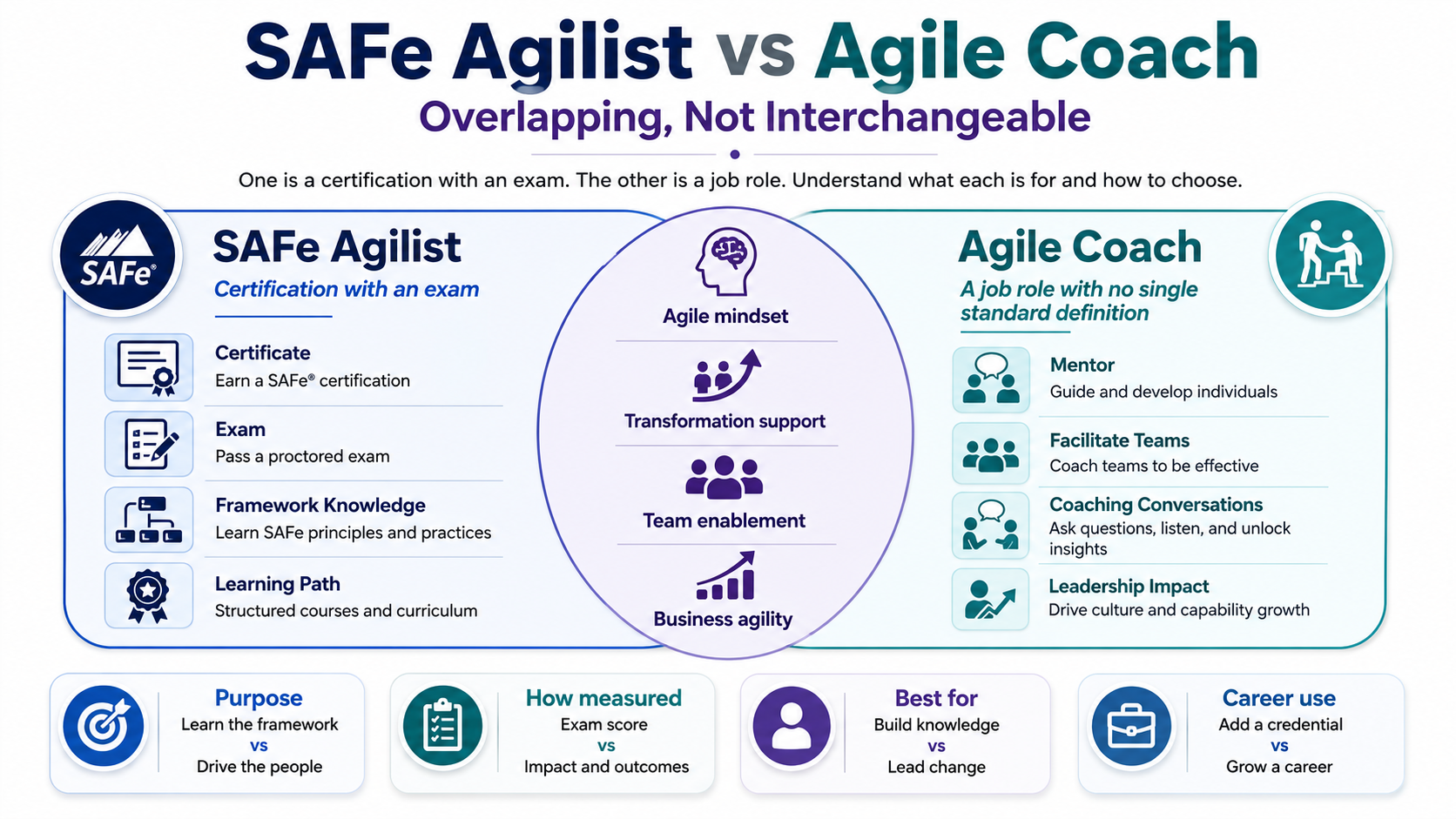
SAFe Agilist is a certification. Agile Coach is a job. That sounds like a pedantic distinction and it is the whole answer, because it explains why one has a defined syllabus and an exam while the other has neither a standard definition nor an owner. Agile Coach does not appear in the SAFe glossary at all, which tells you something useful about how the framework treats the role.
Key Highlights
- SAFe Agilist is a foundational certification with a published exam of 45 questions at an 80 percent pass mark. Agile Coach is a job title with no single certifying body and no standard definition.
- Agile Coach does not appear as a defined role in the SAFe glossary, unlike Release Train Engineer, Product Management and Business Owners.
- The certification evidences framework literacy. The job requires demonstrated ability to change how people work, which no certification evidences.
- Most employers hiring Agile Coaches weight demonstrated coaching experience well above any credential, including this one.
- Many working Agile Coaches hold SAFe Agilist because clients operate in SAFe environments, which makes it a working requirement rather than a qualification for the role.
- Choosing between them is a category error. The real question is whether coaching is the job you want, and if so the credential is one input among several.
Why this comparison is asked at all
The question comes up because both sit in the same part of a career and the marketing around certification blurs them.
Someone in a delivery role looking to move into something more advisory sees two options: take a certification, or pursue a coaching role. The two look like alternatives. They are not, because one is a qualification and the other is a destination, and you can hold the first without reaching the second.
The confusion is worth clearing up early because it wastes money. A candidate who takes SAFe Agilist expecting it to produce a coaching role will be disappointed, and will usually conclude the certification was worthless when the actual error was in what they expected it to do.
What each one actually is
SAFe Agilist is a credential awarded by Scaled Agile on passing an exam. It has a published syllabus, a defined weighting across six domains, no prerequisites, and an annual renewal requiring a minimum of 12 Continuing Education Units. It certifies that you understand the framework at the level a leader needs.
Agile Coach is a job. There is no single certifying body, no agreed scope, and no standard definition. Two people with the same title at two organisations may do substantially different work: one embedded with teams improving practice, another working with executives on operating model. Both are legitimately Agile Coaches.
That asymmetry runs through everything else in this comparison. One is precisely defined and narrow. The other is broad and locally defined. It also explains why the two get mentioned together in career advice constantly and compared usefully almost never: there is no common measure between them, so the comparison collapses into whichever the writer happens to favour.
The absence in the glossary is informative
Worth pulling out, because it is a genuinely useful signal rather than an oversight.
SAFe defines its roles carefully. Release Train Engineer, Product Management, System Architect, Business Owners, Product Owner, Scrum Master all have glossary entries with specific accountabilities. Agile Coach does not.
The reason is structural. SAFe is a framework describing how an organisation delivers, so it names the roles required to make that work. Coaching is a discipline applied to organisations rather than a position within one, which means the framework has nothing to say about it.
The practical consequence for a certified SAFe Agilist is that the credential tells you how a SAFe organisation is meant to operate and tells you nothing about how to coach one. Those are different bodies of knowledge, and the second is not covered by any SAFe certification at this level.
What each is used for in hiring
The clearest way to separate them.
| SAFe Agilist certification | Agile Coach role | |
| What it signals | Framework literacy | Demonstrated ability to change practice |
| How it is assessed | 45-question exam | Interview, references, track record |
| Standardised | Yes, by Scaled Agile | No |
| Prerequisite experience | None | Substantial, in practice |
| Appears in job adverts as | A requirement or a nice-to-have | The job title itself |
The row that matters is the last one. SAFe Agilist appears in the requirements section of a job advert. Agile Coach appears in the title. Asking which is better is like asking whether a driving licence is better than being a driver.
Where they overlap
Genuine overlap exists, which is why the confusion persists.
Shared vocabulary. Both need the framework language if the organisation runs SAFe. A coach who cannot follow a conversation about PI Objectives and dependencies will not be taken seriously in that environment.
Shared subject matter. The leadership material in Leading SAFe, covering how leaders have to change their own behaviour, is close to what a coach spends much of their time on. That module is the strongest overlap between the certification and the discipline.
Shared audience. Both work with leaders as much as with teams, which distinguishes them from team-level roles.
Frequently the same person. A large share of working Agile Coaches hold SAFe Agilist, not because it qualified them to coach but because their clients operate in SAFe environments and expect the vocabulary.
Where they diverge sharply
Depth against breadth. The certification covers one framework thoroughly. Coaching requires working knowledge of several, since an organisation running SAFe at portfolio level is usually running something else at team level, and a coach who only knows SAFe is limited.
Knowledge against behaviour change. This is the fundamental divergence. The exam tests whether you know what an event produces. Coaching is about getting a room of people to do something differently when they do not want to, which is a skill no written exam can assess.
Authority. A SAFe Agilist in a leadership role often has positional authority. A coach almost never does, and the entire craft is built around influence without it. That difference shapes how each approaches the same problem.
Renewal. The certification renews annually with 12 CEUs. Coaching competence has no expiry and no maintenance requirement, which cuts both ways.
If you want to become an Agile Coach
The honest sequence, which does not start with a certification.
Coach before you are called a coach. Almost everyone who holds a coaching role was coaching informally beforehand. Helping another team improve its practice, running a retrospective for a group that is not yours, mentoring a new Scrum Master. That work is available inside most organisations and it is what the role is hired on.
Get breadth. Knowing one framework deeply is a consultant's profile rather than a coach's. Exposure to team-level Scrum, to Kanban, and to at least one scaling approach makes you useful across the range of situations a coach meets.
Learn the discipline itself. Coaching has its own body of knowledge, largely independent of any Agile framework, covering questioning, contracting, and knowing when not to intervene. This is the part most certified practitioners skip and the part that separates a coach from a subject-matter expert with opinions.
Take SAFe Agilist if your market runs SAFe. In an enterprise market it is close to a working requirement, since clients expect the vocabulary and often the credential. In a start-up or product market it matters far less.
The order matters. Certification first and experience later is the sequence that produces frustration, because the credential opens no coaching doors on its own.
What a coach does that a certified leader does not
Worth being concrete, because the difference is easy to state abstractly and hard to picture.
Works without a mandate. A leader with the credential can require a team to hold a retrospective. A coach cannot, and would not want to, because a required retrospective produces compliance rather than reflection. The entire craft is built on getting a change adopted by people who could refuse.
Diagnoses before prescribing. The single most common failure of newly certified practitioners is arriving with the framework and looking for where to apply it. A coach spends considerably longer establishing what is actually wrong, and frequently concludes that the answer is not a SAFe practice at all.
Leaves. A coach's success condition is being unnecessary. That is a genuinely different incentive from a leadership role, where becoming necessary is usually career progress, and it changes what they do day to day.
Holds silence. The most cited skill among experienced coaches and the least intuitive. Answering a team's question is faster and teaches nothing. Sitting with it while they work it out is slower and is the job.
None of the four is assessed by a written exam, which is not a criticism of the certification. It is a statement about what certifications can do.
The market for each
A practical note, since the decision usually has an economic component.
Demand for SAFe Agilist tracks SAFe adoption, which is concentrated in large organisations with integration-heavy delivery. In those markets it is close to a working requirement and it appears in job adverts as a filter.
Demand for Agile Coaches is broader and considerably more volatile. Coaching budgets are discretionary in a way delivery budgets are not, which means they expand in good conditions and are cut early in poor ones. Experienced coaches generally treat this as a known feature of the work rather than a surprise.
The practical implication is that the credential is a lower-variance investment than the career move. It costs less, it is quicker, and its value is more predictable. That is not an argument against coaching. It is an argument for going into it with clear expectations rather than treating it as the natural progression from a certification.
Our comparison of SAFe Agilist and SAFe Scrum Master covers the other fork people face at this point, and current Leading SAFe certification costs are listed separately if you are pricing the credential side.
If you are already certified and wondering what to do next
Three routes from SAFe Agilist, and only one of them is coaching.
The Release Train Engineer route is the most direct operational step, with a defined role and a clear remit. It suits people who like facilitation and want scope beyond one team.
The transformation route is organisational rather than advisory, and generally requires seniority you either already have or do not.
The coaching route is the slowest and least predictable of the three, and it rewards patience and a tolerance for invisible outcomes. Our piece on SAFe Agilist career paths compares all of them properly.
Worth being clear that coaching is not the natural or default next step. It is one option, it is the most competitive, and it weights the certification least.
What the certification does contribute to coaching
Having drawn the distinction sharply, it is worth being fair about the overlap, because the credential is not irrelevant to the discipline.
It gives you the map. Coaching an organisation running SAFe without knowing what a Program Increment produces or where portfolio funding sits means coaching blind. You can ask good questions and you cannot tell whether the answers describe a functioning implementation or a broken one.
It gives you credibility with leaders. Executives in a SAFe environment take the credential as evidence you understand their operating model. That is a low bar and it is a real one, and without it early conversations start further back.
It gives you the leadership material. The part of Leading SAFe covering how leaders have to change their own behaviour is genuinely close to coaching content, and it is the module experienced attendees rate most highly. Our piece on Lean-Agile leadership covers the substance.
It gives you the diagnostic vocabulary. Being able to say that the Innovation and Planning Iteration is being used as a catch-up sprint, and explain why that removes the buffer the commitment depended on, is more useful in a coaching conversation than a general observation that the team seems overloaded.
What it does not give you is the ability to get anyone to change. That remains the whole difficulty of the job, and it is learned by doing it badly for a while.
Deciding what to do this quarter
Practical, since the comparison is usually asked by someone deciding where to spend time and money.
If you are in a SAFe organisation and want to move toward leading change, take the credential. It is a two-day class, it is the entry point to the family, and the framework literacy is what your next conversations will assume. Leading SAFe certification training includes the exam attempt and current costs are listed separately.
If you want to coach and have no coaching experience, do not take a certification this quarter. Find a team that is not yours and help them with something. That single move does more for a coaching CV than any credential, and it also tells you whether you actually enjoy the work, which is information worth having before investing years in it.
If you are already coaching in a SAFe environment without the credential, take it, because your clients expect the vocabulary and the gap is doing you quiet damage in rooms you are not in.
The free Leading SAFe practice test is a reasonable first step in all three cases, since it takes minutes and tells you how much of the framework you already hold.
A note on the other coaching credentials
SAFe Agilist is not the only certification in this space, and people weighing it against a coaching route usually encounter two others.
There are coaching credentials issued by bodies outside the Agile world entirely, focused on the coaching discipline itself rather than on any framework. These teach the craft that Leading SAFe does not: contracting, questioning, and the judgement about when to intervene. For someone genuinely committed to coaching as a career, these are more relevant than any framework certification, and almost nobody in the Agile space holds them.
There are also Agile-specific coaching credentials from various bodies, which sit between the two. They cover coaching applied to Agile teams and carry varying degrees of market recognition depending on region and sector.
The practical position is that framework credentials like SAFe Agilist are widely recognised and narrow, coaching credentials are less widely recognised in Agile hiring and broader in what they teach, and employers weight demonstrated experience above both. Someone choosing where to spend a training budget should be honest about which of those three they are short of, because the answer is usually experience and no certificate fixes that. Leading SAFe certification training is the right choice when the framework literacy is genuinely the gap.
The short answer
Compare them properly and the question dissolves. SAFe Agilist is a qualification with a syllabus, an exam and a renewal cycle. Agile Coach is a job with none of those things, defined differently by every organisation that hires one.
If you want the credential, Leading SAFe certification training covers the syllabus across two days with the exam attempt included, and current Leading SAFe certification costs are listed separately. Testing your framework grounding with the free Leading SAFe practice test takes a few minutes and tells you whether the class will be revision or new ground.
If you want the job, the credential is a small part of a longer route, and the most useful thing you can do this month costs nothing: find a team that is not yours and help them get better at something.






 Lowest-Price Challenge











 Personalized Path


.webp)


 USA
USA  Canada
  India
India  UK
UK  Australia
  Singapore


