


 Call Us



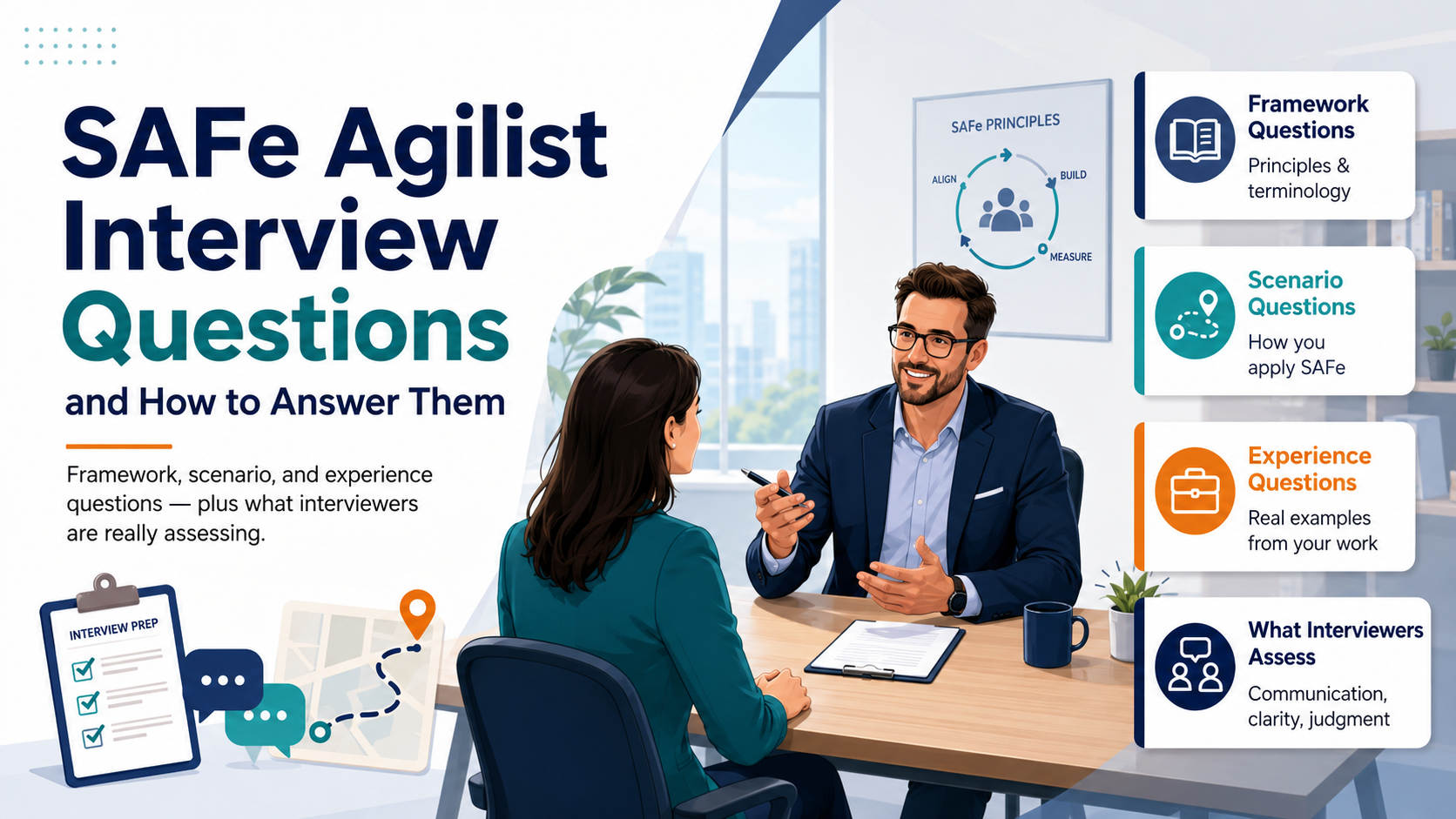
Interviews for SAFe roles test two things the certification does not: whether you can apply the framework to a situation you have not seen before, and whether you have watched an adoption fail. Expect roughly a third of the conversation on framework mechanics, a third on judgement, and a third on what you personally changed. The candidates who struggle are almost always the ones who prepared definitions and nothing else.
Key Highlights
- Framework questions are the easiest third of the interview and the least discriminating, because every certified candidate can answer them.
- Scenario questions are where offers are decided, and they usually describe a dysfunction rather than a healthy implementation.
- Interviewers probe the gap between the credential and the experience, since SAFe Agilist is a foundational certification with no prerequisites and does not evidence hands-on delivery.
- The single most common failure is describing what a role should do in theory instead of what you did.
- Questions about a failed or stalled adoption are usually the most important in the interview, and answering that nothing went wrong is treated as a lack of experience.
- Precision on the sizing hierarchy and role accountabilities is checked early and quickly, and vagueness there ends interviews.
The four kinds of question you will get
Interviews for SAFe roles have a fairly consistent shape once you have sat a few.
Framework mechanics. What a Feature is, what happens in PI Planning, who assigns business value. These are screening questions. They are not designed to select the best candidate, they are designed to remove people who put a credential on a CV without absorbing it. Answer crisply and move on.
Scenario judgement. A situation is described and you are asked what you would do. This is where the interview is actually decided, and the situations described are almost always broken rather than working.
Your own experience. What you have done, at what scale, and what changed as a result. The hardest questions for recently certified candidates, and the ones they prepare for least.
Organisational awareness. How you would handle resistance, a sceptical executive, or a team that does not want to adopt. These test whether you understand that the framework is a political undertaking as much as a delivery one.
Framework questions, and how to answer them well
The bar here is precision rather than depth. A vague answer signals that the credential is decorative.
What is the difference between a Feature and a Capability?
A Feature is sized to be delivered by one Agile Release Train within a single Program Increment. A Capability is larger solution functionality spanning multiple ARTs, still sized to fit within one PI. The distinction is the number of trains, not the size of the thing. Say it in that order and you have signalled competence in two sentences.
Who assigns business value to PI Objectives?
Business Owners, during PI Planning, with the teams present. The follow-up is often why it happens in the room rather than afterwards, and the answer is that the conversation is the point: teams learn what leadership actually values, and leadership learns what the teams think is achievable.
What is an Agile Release Train?
A long-lived team of Agile teams that develops and delivers one or more solutions in a development value stream. Our guide to what an Agile Release Train is covers formation and sizing if you want the fuller version.
What is the difference between cadence and synchronization?
Cadence is the rhythm. Synchronization is multiple teams operating on that rhythm together so their work can integrate. Candidates routinely treat these as one concept, and separating them cleanly is a small signal that lands well.
What are the SAFe Core Values?
Alignment, transparency, respect for people, and relentless improvement. Four of them. If you have time, add which one you have seen break most often and why, because that turns a recall answer into an experience answer.
Scenario questions, which decide the outcome
These are the ones worth preparing properly. A pattern runs through them: the interviewer describes something dysfunctional and wants to know whether you diagnose or prescribe.
A team consistently fails to meet its PI Objectives. What would you do?
Weak answer: talk about improving estimation. Strong answer: establish why first. The causes are different and the remedies are opposite. If they are over-committing, that is a planning problem. If dependencies keep arriving late, that is a train problem and not theirs. If the objectives were assigned rather than agreed, that is a leadership problem. Naming that you would diagnose before acting is most of the mark.
PI Planning produced a plan that nobody is following. Why might that be?
The strongest answers reach for commitment rather than process. A plan produced in a room where teams could not genuinely say no is not a plan they own. Mention that you would check whether the objectives were negotiated or presented.
Two teams have a dependency neither has scheduled. When should this have surfaced?
At PI Planning, on the programme board. The interesting part of the answer is what you do now, in the middle of a PI, which is where a real RTE spends their time.
An executive says SAFe is too much process. How do you respond?
Do not defend the framework. The best answers agree that it is a lot of process and ask what problem it was adopted to solve, then work back from there. Candidates who evangelise here mark themselves as inexperienced, because anyone who has run an adoption has heard this and knows it is often a fair point.
Your organisation adopted SAFe eighteen months ago and nothing has improved. What is happening?
The most revealing question on this list. The expected answer touches governance: ceremonies were adopted, funding and decision rights were not. Our piece on the SAFe Core Values covers the failure modes underneath this, and it is a genuinely useful frame to bring to the answer.
Experience questions, where recently certified candidates struggle
The gap between holding the credential and having run anything is what these are designed to find.
Tell me about a PI Planning event you were part of.
If you have been in one, describe your specific role and one thing that went wrong. If you have not, say so plainly and describe the closest equivalent at a smaller scale. Inventing an event is transparent to anyone who has run them, because the follow-up questions get specific quickly.
What is the largest number of teams you have coordinated across?
Answer honestly. This is a calibration question, not a test, and inflating it fails at the next question rather than this one.
What did you change?
The question that decides most interviews. Attended, participated and supported are not answers. One concrete instance is worth more than a list: a dependency you removed by moving work between teams, a planning event you restructured, a report you stopped producing because nobody read it.
Why did you take SAFe Agilist?
A softer question with a real signal in it. The strong answer connects to a problem you were facing. The weak answer is that it was the next certification available.
Questions about failure, which matter more than they look
Almost every interview contains one and candidates routinely mishandle it. This is also the section where interviewers learn most about you, because how someone describes a failure reveals whether they were close enough to it to understand what happened. Candidates who describe a failed adoption entirely in terms of what other people got wrong are telling you they were an observer. Candidates who can name their own contribution to it, without being self-flagellating about it, are telling you they were involved and paying attention. That distinction decides more interviews than any framework question, and it cannot be prepared as a script because the follow-up questions go wherever your answer opens.
Tell me about an adoption that did not work.
Answering that everything went well is heard as inexperience rather than as competence. Every adoption struggles somewhere. Interviewers are testing whether you noticed and whether you can describe it without blaming.
What would you do differently?
Have a real answer. Something specific about sequencing, or about who you should have brought along earlier.
The underlying test in both is whether you treat the framework as a solution or as a tool with tradeoffs. Candidates who cannot name a limitation of SAFe read as people who have only read about it.
Questions you should ask them
Interviews run both ways, and for SAFe roles the questions you ask are unusually diagnostic. A weak implementation is easy to detect from the outside if you know what to ask, and taking a role inside one is how good practitioners end up with a bad year on their CV.
How many Agile Release Trains are there and how were they drawn? Trains organised around value streams behave very differently from trains drawn around the existing org chart. The second produces endless cross-train dependencies, and the answer tells you which you are joining.
What changed for leadership when you adopted? The single best question on this list. If the answer is about ceremonies and attendance, funding and governance did not move, and you would be joining a ceremonial implementation. If the answer involves how money is allocated or who approves what, something real happened.
What comes out of Inspect and Adapt, and what happened to the last set of items? Tests whether improvement is funded or merely identified.
Who are the Business Owners and do they attend PI Planning? If nobody can name them, or they attend for one session, the value assignment is administrative.
How is the Innovation and Planning Iteration used? If the honest answer is finishing carryover work, the train has no buffer and predictability will be poor regardless of what you do.
Asking two or three of these does two things at once. It gives you genuine information about what you would be walking into, and it demonstrates operational understanding more convincingly than any answer you give to their questions.
What they are actually assessing
Behind the questions, interviewers are usually resolving four things.
Can you be precise? Checked early with the definitional questions, and it takes about ninety seconds.
Do you diagnose or prescribe? Checked with scenarios. Candidates who jump to a solution before establishing a cause are marked down consistently, because that is exactly the failure mode a facilitation role cannot afford.
Have you actually done this? Checked relentlessly through follow-up questions, which get more specific the vaguer your answer.
Would people follow you without being told to? The hardest to assess and the most important, since roles like the Release Train Engineer have no line authority. It is inferred from how you describe getting people to do things.
How the interview differs by role
The shape shifts noticeably depending on what you are interviewing for, and preparing for the wrong shape is a common waste.
Release Train Engineer interviews are the most operational. Expect detailed questions about facilitation: how you run a room of a hundred people, how you handle a team that will not commit, what you do when the programme board reveals a dependency nobody can resolve. Experience weighs heavily and framework theory weighs least. These are also the most concrete interviews, which makes them the fairest if you have done the work.
Agile Coach interviews weight behaviour over structure. Expect questions about resistance, influence without authority, and how you handle a team that does not want coaching. The framework questions are lighter and the situational ones are harder to prepare, because they are testing judgement rather than knowledge.
Transformation and programme roles weight the organisational. Expect executive stakeholder scenarios, questions about sequencing an adoption, and a great deal about governance and funding. Framework mechanics barely feature. This is the interview where knowing Lean Portfolio Management properly pays off.
Internal moves are different again. When you already work there, the framework questions largely disappear and everything becomes about what you have changed and whether people will follow you. That makes internal interviews easier to prepare for and harder to pass, because your track record is already known.
Read the job description for which of these you are in, and prepare the matching third. Candidates who prepare framework depth for a coaching interview, or behavioural stories for an RTE interview, are answering questions nobody asked.
Preparing without overpreparing
Four things worth doing, and one worth avoiding.
Prepare three specific stories. One where you changed something concrete, one where something failed, and one where you handled resistance. Most questions can be answered from three well-chosen examples.
Get the definitions to reflex. Feature against Capability, the four Core Values, who assigns business value, cadence against synchronization. These should not require thought, and the free Leading SAFe practice test is a faster way to get there than rereading notes.
Know your own numbers. How many teams, how long, what changed. Vagueness here reads as inflation.
Read the job advert for scope. A Release Train Engineer post and a transformation post ask very different questions, as our comparison of the SAFe Agilist career paths covers.
What to avoid: rehearsing framework answers so thoroughly that you recite them. Interviewers notice, and it invites harder follow-ups. If your framework knowledge is genuinely shaky, the free Leading SAFe practice test will surface it faster than rereading notes.
The salary conversation
It comes up in most processes and candidates handle it worse than they handle the technical questions.
Two things are worth knowing going in. SAFe role compensation tracks scope rather than credential, so the number follows how many teams and how much accountability rather than what is on your CV. And the range for the same job title varies enormously between sectors and regions, which means a figure you saw online is weak evidence for your specific situation. Our data on SAFe Agilist salary covers the reported ranges by region, and it should be read as the range for the roles rather than as a premium the certificate produces.
The practical advice is to anchor on scope. Asking what the largest number of teams this role coordinates across is, and how many trains the organisation runs, tells you more about the appropriate band than any published figure. It also signals that you understand the role is sized by remit.
Avoid framing the credential as the justification. A candidate arguing for more because they are certified is telling the interviewer they think a two-day course is worth a raise, which is not the impression to leave. Arguing for more because you have coordinated across nine teams and this role is twelve is an argument that lands.
Where the credential fits in all of this
The honest position, and one worth holding in the interview itself.
SAFe Agilist is foundational. It has no prerequisites, the training is not required to sit the exam, and it certifies framework literacy rather than delivery experience. Interviewers know this. Candidates who present it as more than it is create a credibility problem in the first ten minutes that the rest of the conversation has to recover from.
What it does do is get the CV read and establish that you and the interviewer share a vocabulary, which is not nothing. The rest is on the three stories you prepared.
If your framework grounding is the weak part rather than your experience, that is the more fixable problem. Leading SAFe certification training covers the material across two days, and the free Leading SAFe practice test will tell you in a few minutes whether that is actually where your gap is.
The short version
The certification gets you the interview. What gets you the role is being able to describe a real situation, a decision you made, and what changed because of it. Everything else in this article is scaffolding around that one sentence, and candidates who prepare three genuine examples outperform candidates who prepare thirty framework answers. If the framework side is genuinely your weak point rather than the experience side, Leading SAFe certification training fixes that in two days; the experience side takes considerably longer and cannot be bought.
If you are certified but light on experience, the fastest fix is not another credential. It is getting inside a real PI Planning event in any capacity, so that when the question comes you are describing a room you sat in rather than a diagram you studied.
If you are still working toward the credential, Leading SAFe certification training covers the framework across two days and includes the exam attempt, and the certification cost is listed separately.



inLargePortfolios_1724999009.jpg)



 Lowest-Price Challenge











 Personalized Path


.webp)


 USA
USA  Canada
  India
India  UK
UK  Australia
  Singapore


