


 Call Us




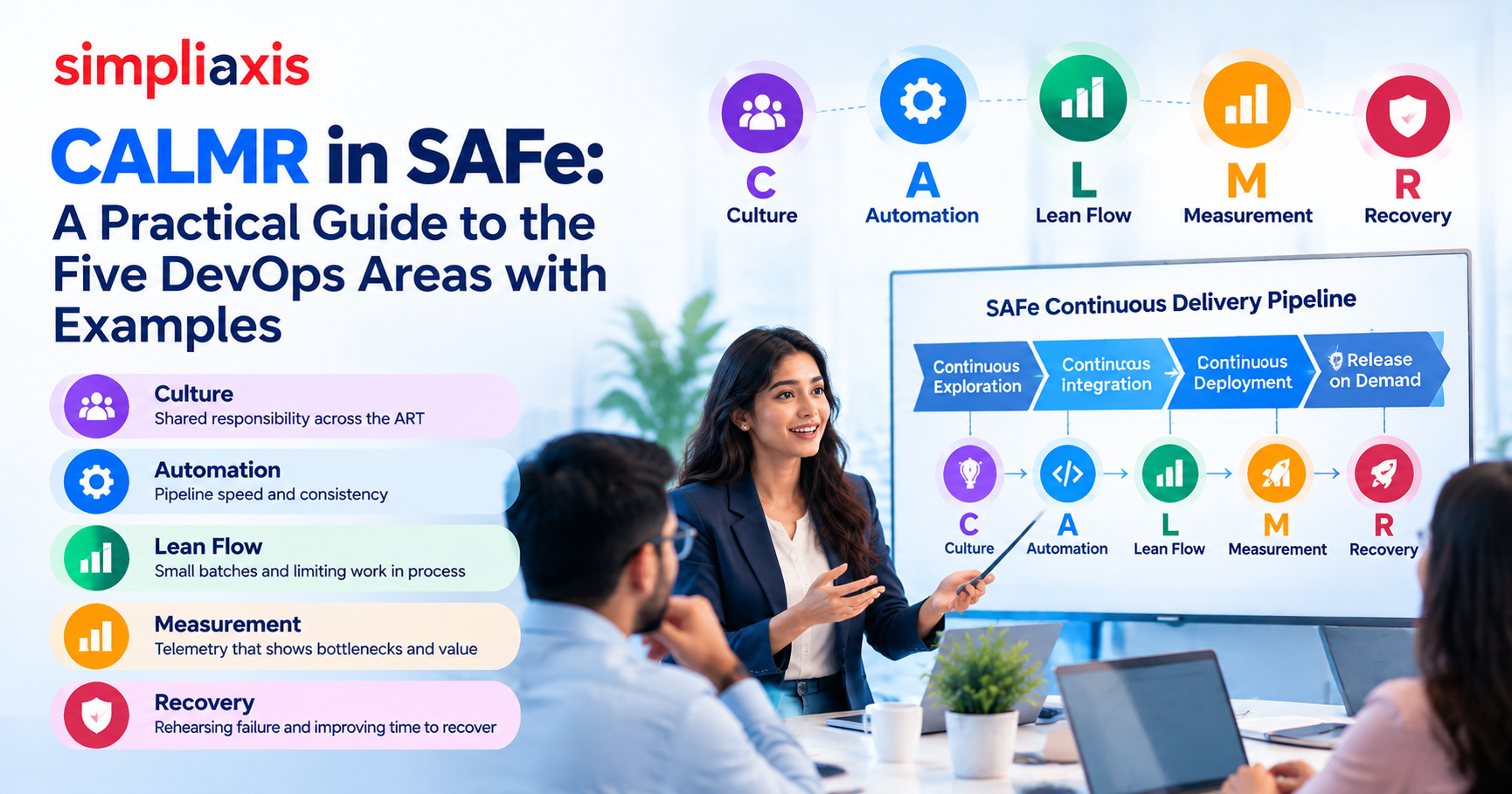
Many teams adopt DevOps tools and still ship slowly, break production and blame each other when something fails. SAFe's answer is not a longer tool list. It is a mindset with five parts, summarised by the acronym CALMR: culture, automation, lean flow, measurement and recovery. The idea is that an Agile Release Train needs all five to deliver value continuously, and that neglecting any one limits the rest.
This guide explains each element with concrete examples, shows how CALMR differs from the older CALMS model, maps the five areas to the Continuous Delivery Pipeline and offers a short self-assessment you can use with your own release train. It is written for SAFe learners, DevOps practitioners and anyone preparing for SAFe DevOps training.
Key Highlights of CALMR in SAFe
- CALMR is a DevOps mindset in SAFe that helps an Agile Release Train deliver value continuously by strengthening culture, automation, lean flow, measurement and recovery.
- It adapts the DevOps community's CALMS model by treating sharing as part of culture and adding recovery as its own element.
- The five elements reinforce each other. Culture is the foundation, and automation without culture, or measurement without recovery, gives only part of the benefit.
- SAFe lists outcomes such as faster time to market, fewer and less severe failures and a shorter mean time to recover from production incidents.
- CALMR works best when teams assess it regularly, pick one weak area at a time and treat the improvement as normal backlog work.
What Is CALMR in SAFe?
CALMR is a SAFe DevOps mindset that guides an Agile Release Train toward continuous value delivery by strengthening culture, automation, lean flow, measurement and recovery. The SAFe Knowledge Base describes it on its page for CALMR, and notes that it applies to everyone involved in continuous delivery, from developers to operations and business leaders.
The five elements are not steps to take in order. They are five areas to develop together, and the Knowledge Base notes that energy should go into each area in balance, not necessarily equally. If you want the wider argument for including DevOps in SAFe at all, read our guide to why DevOps matters in SAFe.
Where CALMR comes from: CALMS to CALMR
The DevOps community often uses CALMS, which stands for culture, automation, lean, measurement and sharing. SAFe keeps the first four and folds sharing into culture, which frees the last letter for a new element, recovery. The result is a model that is explicit about something many pipelines neglect: what happens when a release goes wrong.
CALMR vs CALMS: What Changed
The two models are close cousins. The comparison shows where they differ.
| Letter | CALMS | CALMR | What the difference means |
| C | Culture | Culture | In SAFe, culture includes sharing responsibility across the train |
| A | Automation | Automation | Same idea: repeatable, fast and consistent pipelines |
| L | Lean | Lean flow | SAFe stresses small batches, work in process limits and queue lengths |
| M | Measurement | Measurement | Same idea: telemetry that shows bottlenecks and value |
| S or R | Sharing | Recovery | Sharing moves into culture, and recovery becomes explicit |
A practical consequence is that a team following CALMR cannot call a pipeline finished until it has rehearsed failure. That is a stronger standard than simply having a pipeline.
Culture: Shared Responsibility Across the ART
In SAFe, the Agile Release Train is a team of Agile teams that builds, delivers and operates the solution together. Culture in CALMR means that this shared responsibility is real, not a diagram. The SAFe DevOps article in SD Times describes a mindset of risk tolerance and knowledge sharing as the thing that enables the other four areas.
What it looks like in practice. Developers contribute to runbooks. Operations staff review deployment code. People from both groups take turns on call. Incidents lead to learning, not to blame. Decisions about release and recovery are made by the people who will live with them.
Warning signs. Work is thrown over a wall between roles. Only one person knows how to deploy. Incident reviews end with a name, not a system change. Our overview of common SAFe anti-patterns shows how these patterns appear at the leadership level, and the guide to the three ways of DevOps provides the principles behind them.
Automation: Pipeline Speed and Consistency
SAFe says plainly that continuous delivery pipelines cannot be efficient and effective without automation. Automation brings speed, consistency, repeatable processes and repeatable environments. It is what makes small, frequent releases economical.
What it looks like in practice. Builds, tests, security scans and deployments run without manual steps. Environments are created from code and not by hand. Promotion from one stage to the next follows rules that anyone can read.
Warning signs. Releases depend on a checklist that a person runs by hand. Environments differ in ways nobody can explain. Tests are run only before a release. To see what a pipeline contains in practice, our article on CI/CD and how it works walks through the stages, and our overview of DevOps tools lists common options.
Lean Flow: Small Batches and Limiting Work in Process
Lean flow means that work moves through the pipeline in small batches with short waiting times. SAFe's guidance is that large batches and bottlenecks slow delivery, so finding and removing them is a key activity for a Lean enterprise.
What it looks like in practice. Changes are merged to the main line often. Teams limit how much work is in progress. Queues between stages are visible and short. A feature is split so that part of it can be deployed early.
Warning signs. Work waits for a big integration event. Branches live for weeks. Approvals pile up in a queue. A SAFe DevOps article in SD Times describes a mature team that cut some early steps from 30 minutes to 5 but still faced a very long wait for release approval, which is a useful reminder to look at the whole flow and not just the part your team controls. The piece is labelled as sponsored content, so treat it as an illustration, not evidence. Our article on continuous delivery pipeline management shows how to think about flow through the pipeline.
Measurement: Telemetry That Shows Bottlenecks and Value
Measurement in CALMR means evaluating the pipeline and building telemetry that reveals both bottlenecks in flow and whether the value delivered is what customers need. It is not only about speed. It also asks whether you are delivering the right thing.
The DORA research programme defines four delivery metrics that fit this element well: deployment frequency, lead time for changes, time to restore service and change failure rate. Track them together, because improving one at the expense of the others can hide a problem. For leaders, our article on the SAFe flow metrics covers the measures SAFe asks teams to report upward.
Warning signs. Nobody tracks how long a change takes to reach production. Metrics are used to compare teams and not to find constraints. Business outcomes are never connected to the pipeline.
Recovery: Rehearsing Failure and Improving Time to Recover
Recovery is the element that SAFe added to the original model. The idea is that fast delivery is risky if recovery procedures have never been practised. Teams should rehearse failure and be able to react quickly, either by rolling back or by fixing forward.
What it looks like in practice. Rollback is automated and tested. Teams run failure drills. Production has monitoring that shows problems quickly. Incident reviews are blameless and lead to a change in the system. SAFe lists a shorter mean time to recover from production incidents among the outcomes of the approach.
Warning signs. The rollback plan exists only in a document. A deployment failure triggers a long search for the person who knows what to do. The same type of incident keeps coming back.
How CALMR Maps to the Continuous Delivery Pipeline
The Continuous Delivery Pipeline has four parts in SAFe: continuous exploration, continuous integration, continuous deployment and release on demand. CALMR is not a separate process. It describes the mindset that makes each part work, and the table shows an example of where each element matters most.
| Pipeline part | Where CALMR matters most | Example focus |
| Continuous exploration | Culture and measurement | Teams and the business test hypotheses together and measure results |
| Continuous integration | Automation and lean flow | Frequent merges, automated tests, small batches |
| Continuous deployment | Automation, measurement and recovery | Automated deployment, production verification, tested rollback |
| Release on demand | Culture, measurement and recovery | Business decides release timing, outcomes feed back to exploration |
SAFe describes continuous deployment as deploy, verify, monitor and respond, and each of those activities draws on automation and recovery. Our guide to features in SAFe explains how work is shaped so that it can move through the pipeline in small pieces.
CALMR Self-Assessment for Your Release Train
Use this assessment as a conversation starter, not as an official SAFe tool. SAFe has its own DevOps Health Radar, which is taught in its DevOps course, and teams often use both. Score each question from 1 (not true) to 5 (fully true) with the whole train in the room.
| Element | Question to ask | Example evidence |
| Culture | Do developers and operations share responsibility for running the solution? | Shared on-call rotation, joint runbooks |
| Automation | Can we build, test and deploy without manual steps? | One-command pipeline, environments from code |
| Lean flow | Are our batches small and our queues short? | Short-lived branches, visible work in process limits |
| Measurement | Can we see where changes wait and whether we deliver value? | Pipeline dashboards, lead time and failure rate tracked |
| Recovery | Have we rehearsed failure and shortened time to recover? | Tested rollback, failure drills, blameless reviews |
Add up the scores, pick the lowest one and agree one improvement for the next iteration. Our article on SAFe core values is a helpful companion when the weakest area turns out to be culture. Repeat the assessment every Program Increment so you can see whether the changes are working.
Worked Example: Applying CALMR to a Train That Ships Quarterly
This example is fictional and is meant to show how the five areas guide improvement work. A train that supports an insurance claims portal releases once a quarter. Releases take a weekend, often need a rollback, and nobody is sure why customer-facing fixes take weeks.
The first step is a baseline, scored by the whole train.
| Element | Starting position | Score |
| Culture | Operations joins only at release time | 2 |
| Automation | Build is automated, deployment is manual | 3 |
| Lean flow | Large quarterly batches, long approval queue | 1 |
| Measurement | Release dates tracked, lead time unknown | 2 |
| Recovery | Rollback documented, never rehearsed | 1 |
Lean flow and recovery score lowest, so the train picks those for the next Program Increment. It does not try to fix everything at once.
| Improvement | CALMR element | Backlog item |
| Split features so parts can be deployed early | Lean flow | Enabler stories for toggles and smaller slices |
| Remove one approval step by automating the checks | Lean flow and automation | Automated policy checks in the pipeline |
| Rehearse a rollback every iteration | Recovery | A scheduled failure drill with a short review |
| Track lead time from commit to production | Measurement | A dashboard owned by the Release Train Engineer |
| Put an operations engineer in the planning events | Culture | Joint planning and a shared on-call rotation |
After one Program Increment, the train reruns the assessment. Suppose lean flow rises to 3 and recovery to 3, while the others stay put. The numbers are not a result to report to executives, but they show the direction, and the train picks the next weakest area. The key points are that improvement work goes into the same backlog as other work, and that the train reviews the effect, not only the activity. Our guide to DevOps best practices lists practical habits you can borrow for each area.
CALMR and DevOps Skills: What to Learn and Where It Shows Up
CALMR connects to skills that employers ask for. The culture and measurement areas align with collaboration, facilitation and data literacy. Automation and recovery align with scripting, pipeline design, observability and incident response. Our article on top in-demand DevOps skills shows the technical side.
For people who plan to take SAFe DevOps training, the practical value of CALMR is as a vocabulary. It helps you explain why a pipeline failed, which area is weak and what to try next. It is also a good conversation tool with leaders, because the five areas map to questions they already care about: speed, quality, risk and learning.
When you decide on a certification route, our article on whether DevOps certification is worth it can help you weigh the options, and the SAFe DevOps course is the one that covers CALMR directly.
Common Mistakes When Adopting CALMR
- Treating DevOps as a tool purchase. Tools support the five elements. They do not replace the cultural change.
- Improving one element only. Heavy automation with no recovery practice only makes failures faster.
- Measuring without acting. Dashboards that nobody uses do not change flow.
- Keeping DevOps in one team. The mindset has to spread across the train and the business.
- Skipping blameless reviews. Without them, recovery improves slowly or not at all.
- Running the assessment once. Value comes from repeating it and seeing the trend.
- Ignoring the business side. Release timing and value measurement need business involvement, which is why Business Owners belong in the conversation.
For a broader view of typical obstacles, see our article on DevOps challenges.
Conclusion
CALMR gives a SAFe release train a balanced way to think about DevOps: build a shared culture, automate the pipeline, keep work flowing in small batches, measure delivery and value, and rehearse recovery. Use the elements together, assess them regularly and improve the weakest one first.
Build the full DevOps skill set for SAFe: Learn how to apply CALMR across the pipeline with the SAFe DevOps Practitioner training.
Start with the foundations of DevOps: Explore the principles and practices behind it with the DevOps Foundation certification.






 Lowest-Price Challenge












 Personalized Path



.webp)


 USA
 Canada
 India
 UK
 Australia
 Singapore


