


 Call Us



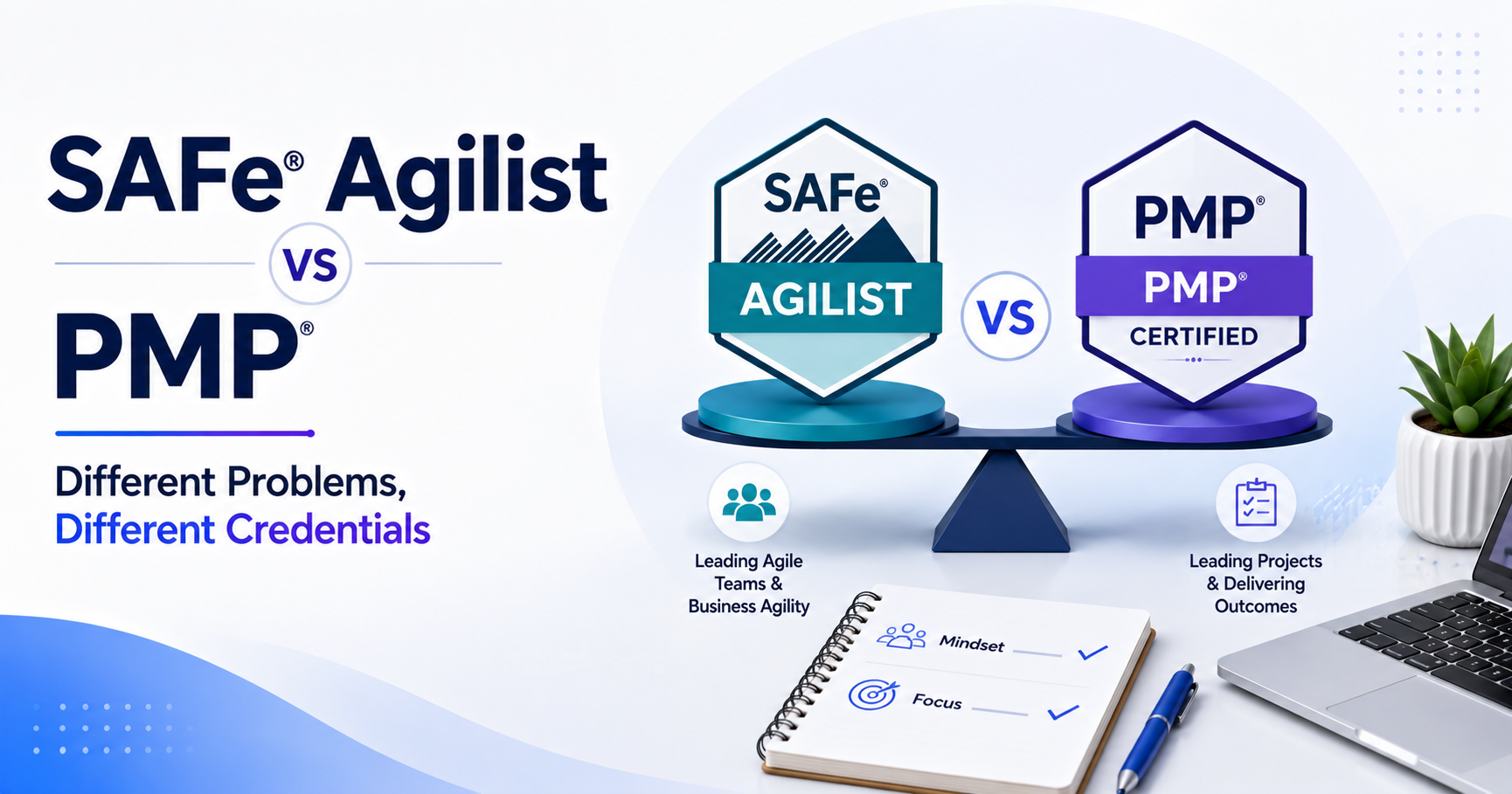
PMP certifies that you can manage a project. SAFe Agilist certifies that you understand a framework for running many teams continuously without projects. That is not a difference of degree, it is a difference of premise, and it explains why the two have almost opposite entry requirements: PMP demands documented experience before you sit it, while Scaled Agile lists no prerequisites for SAFe Agilist at all.
Key Highlights
- SAFe Agilist has no prerequisites and does not require the training course to sit the exam. PMP requires documented project experience and formal training hours before you can apply.
- The SAFe Agilist exam is 45 questions in 90 minutes at an 80 percent pass mark. PMP is a considerably longer paper with a different assessment model.
- PMP is organised around projects with a defined start, scope and end. SAFe is organised around long-lived value streams and trains that have no end date.
- SAFe Agilist renews annually with a minimum of 12 Continuing Education Units. PMP operates on a longer renewal cycle with a professional development unit requirement.
- Neither replaces the other, and a large number of practitioners hold both because their organisation runs projects and products side by side.
- The choice follows from what your organisation actually does, not from which credential is more prestigious.
The premise each one rests on
Worth establishing before comparing anything else, because everything downstream follows from it.
PMP assumes projects. A project has a beginning, a defined scope, a budget, an end, and a manager accountable for delivering it within those constraints. The discipline is about planning that work, controlling variance against the plan, and closing it out.
SAFe assumes continuous flow. There is no end date. An Agile Release Train is long-lived, funded as a capability rather than as a piece of work, and plans in Program Increments that repeat indefinitely. Nothing gets closed out because nothing was opened.
These are not competing methods for the same job. They are answers to different questions about how an organisation should be arranged, and an organisation that genuinely runs projects will find SAFe heavy in exactly the way an organisation running continuous product development finds project management constraining.
What each one asks of you before you sit it
The clearest practical difference, and the one that surprises people.
Scaled Agile lists no prerequisites for SAFe Agilist, and does not require the training course in order to attempt the exam. It is classified as foundational. Anyone can book it tomorrow.
PMP works the other way. It requires documented project management experience and formal project management education before an application is accepted, and the application itself is reviewed. The barrier is deliberate: the credential is designed to certify experienced practitioners rather than to introduce a subject.
That asymmetry tells you what each is for. PMP is a professional credential validating a career. SAFe Agilist is an entry point into a framework's credential family, establishing that you understand a model.
Treating them as equivalent in market signal is a mistake in both directions. PMP carries weight because it is hard to obtain. SAFe Agilist carries weight in SAFe organisations because it is the shared vocabulary, and very little outside them.
The exams themselves
| SAFe Agilist | PMP | |
| Prerequisites | None | Documented experience plus formal training hours |
| Course required to sit | No | Formal training hours required |
| Exam length | 45 questions, 90 minutes | Substantially longer |
| Pass mark | 80 percent | Not published as a simple percentage |
| Level | Foundational | Professional |
| Renewal | Annually, minimum 12 CEUs | Longer cycle, PDU-based |
The pass mark difference is worth noting. An 80 percent threshold on a short paper is unforgiving, and it catches candidates who treat a foundational label as a low-effort one. Our piece on how hard the SAFe Agilist exam is covers where the difficulty actually sits.
PMP's difficulty is differently shaped: a much larger body of knowledge, a longer sitting, and an application process before you get there.
What each one qualifies you to do
PMP signals that you can take responsibility for delivering a defined piece of work within constraints. It travels across industries and across countries, and it is recognised by people who have never heard of Agile. In sectors with formal procurement, it is frequently a contractual requirement.
SAFe Agilist signals that you understand how a SAFe organisation operates. It is valuable inside organisations that have adopted or are adopting the framework, and considerably less so elsewhere. It is not a role credential, as our comparison of SAFe Agilist and Product Owner covers in more detail.
The practical read: PMP's value is portable and slow to acquire. SAFe Agilist's value is contextual and quick to acquire. Which matters more depends entirely on where you intend to work.
Where the two genuinely conflict
Most comparison writing pretends these are complementary. They mostly are, and there are three real points of friction worth knowing.
Scope control against emergent scope. Project management treats scope change as variance to be controlled. SAFe treats it as expected and builds planning cadence around absorbing it. A PMP-trained manager in a SAFe environment will initially experience the framework as undisciplined, and an Agile practitioner in a project environment will experience change control as obstruction. Both reactions are rational given their training.
The role of the plan. In project management the plan is a commitment to be tracked against. In SAFe the plan is a hypothesis refreshed every Program Increment. Reporting percentage complete against a fixed scope inside a SAFe organisation is a category error that produces genuinely misleading information.
Who decides. Project management concentrates decision authority in the manager. SAFe pushes it toward the teams and the train. This is the deepest conflict and it is behavioural rather than procedural, which is why it survives training.
Understanding these is more useful than knowing both syllabuses, because they are what actually causes friction when an organisation runs both.
Holding both
Common and frequently sensible, since most large organisations run projects and products simultaneously.
A construction programme is a project. A regulatory compliance deadline is a project. A customer-facing digital platform is not, and treating it as one produces the fixed-scope planning that SAFe exists to replace.
Practitioners who hold both tend to describe the value as knowing which mode a piece of work is in. That judgement is genuinely useful and it is not taught by either credential, since each teaches its own premise as the default.
If your organisation is mid-transition, holding both is close to a requirement, because you will be translating between two groups who each think the other is being unreasonable.
How the two describe the same problem differently
A useful exercise for anyone holding both, or deciding between them: take one situation and see how each frames it.
A piece of work is running late. Project management asks what the variance is against baseline, what caused it, and what the recovery plan is. The frame is deviation from a plan, and the remedy is correction.
SAFe asks a different question. Is the work in progress too high, are dependencies surfacing late, is the team committing to more than its capacity. The frame is systemic, and the remedy is usually to start less rather than to work harder.
Neither framing is wrong. They lead to different actions and both actions are sometimes correct. A genuinely fixed-scope deliverable with a contractual date needs the first. A continuously delivering product team needs the second, and applying the first to it produces a recovery plan that will not survive contact with the next fortnight.
The skill worth having is knowing which situation you are in, and that judgement sits outside both syllabuses. It is why practitioners who hold both credentials tend to describe the value as diagnostic rather than procedural.
What each community gets wrong about the other
Worth naming, since the comparison is usually written by someone inside one camp.
Project management practitioners frequently characterise Agile approaches as undisciplined, on the evidence of poorly run implementations. That evidence is real and the conclusion does not follow. A badly run SAFe adoption is undisciplined; the framework itself is prescriptive to a degree that surprises people expecting looseness.
Agile practitioners frequently characterise project management as rigid and waterfall-adjacent, on the evidence of organisations that used it badly. Also real, also not a property of the discipline. Competent project management has always handled uncertainty; the rigidity is usually organisational rather than methodological.
The honest position is that both are frequently implemented poorly, in ways that produce exactly the caricature the other side describes, and that neither caricature tells you much about the discipline itself.
If you are weighing the project route, our PMP certification training covers what it involves. For the framework route, Leading SAFe certification training runs two days with the exam attempt included, and the free Leading SAFe practice test is a quick way to gauge your current framework grounding.
Which to take first
Depends on where you are, and the answer is usually clear once stated.
Take PMP first if you already have documented project experience, work in an environment where projects are the unit of work, or operate in a sector where the credential is a procurement requirement. The experience prerequisite means it is not available as a starting point regardless.
Take SAFe Agilist first if your organisation has adopted or is adopting SAFe, if you need the vocabulary for conversations happening now, or if you are early in your career and cannot yet meet PMP's experience requirement. The absence of prerequisites makes it accessible in a way PMP is not.
Take neither yet if you are collecting credentials speculatively. Both carry renewal obligations, SAFe Agilist annually and PMP on a longer cycle, so an unused certification is an ongoing cost rather than a one-off.
If you are weighing the project management route, our PMP certification training covers what that involves. For the framework route, Leading SAFe certification training runs two days with the exam attempt included, and current Leading SAFe certification costs are listed separately.
What each teaches that the other does not
Beyond the credentials, there is genuine content in each that the other omits, and practitioners who hold both usually name the same gaps.
PMP teaches estimation, risk and procurement rigour. Structured estimation techniques, formal risk registers, contract and vendor management. SAFe assumes some of this and teaches almost none of it. An Agile practitioner who has never had to build a defensible estimate for a fixed-price contract will find that gap real the first time they meet one.
PMP teaches stakeholder management as a discipline. Formal identification, analysis and engagement planning. SAFe handles stakeholders through the events, which works inside a train and offers less for the political work around it.
SAFe teaches flow and systems thinking. Why work in progress limits matter, why local optimisation produces global slowdown, why long queues make everything unpredictable. Project management largely does not cover this and it is the more useful lens for continuous delivery.
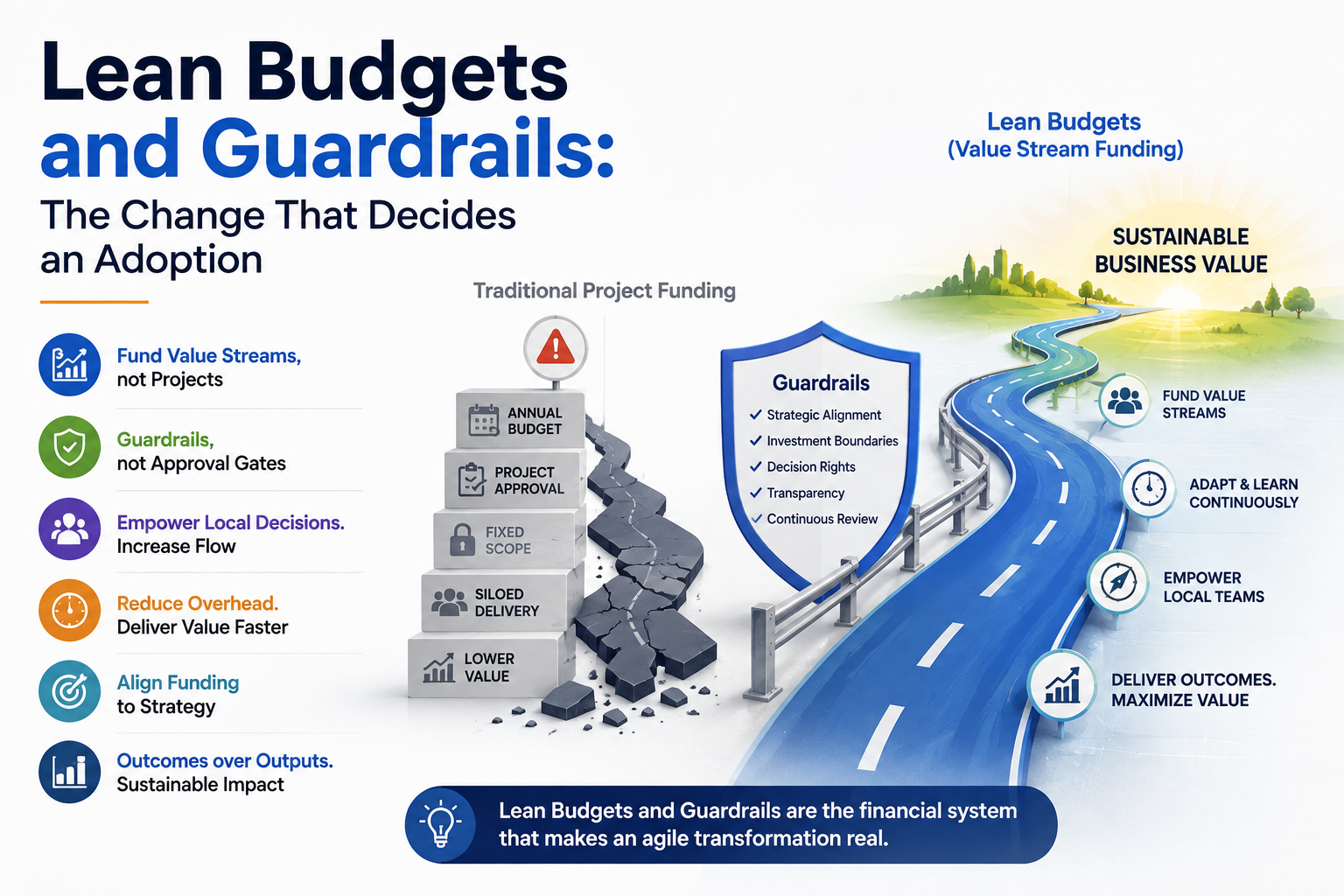
SAFe teaches funding as a design choice. That how money moves determines how work behaves, and that annual project funding forces fixed scope. This is the single most valuable idea in the framework and it has no equivalent in project management, where the funding model is treated as a given.
Someone deciding between them on content rather than on credential should notice which of those four gaps is currently costing them more.
Where each fails
Fair treatment requires naming the weaknesses, since both are frequently oversold.
PMP's weakness is the assumption that scope can be known. In genuinely uncertain work, planning to a fixed scope produces a plan that is wrong from the first week and a change control process that spends its time processing the wrongness. The discipline is sound and the premise sometimes is not.
SAFe's weakness is weight. The framework is heavy, and applied below the scale it was designed for it produces coordination machinery costing more than the coordination problem. Our guide to what an Agile Release Train is covers the scale at which it starts to pay.
Both are also vulnerable to the same failure: adoption of the artefacts without the reasoning. A project plan maintained because the process requires it, and a PI Planning event run because the calendar says so, are the same failure in different vocabulary.
What employers actually read into each
A note on signalling, since this drives a lot of the decision.
PMP on a CV says the holder has managed real projects and passed a demanding exam. It is treated as evidence of experience, which is unusual for a certification and is a consequence of the prerequisite.
SAFe Agilist says the holder understands the framework. Employers in SAFe organisations read it as a baseline rather than a differentiator, because most candidates for those roles have it. It gets a CV read and rarely wins a role on its own.
The implication is that they do different work in a hiring process. PMP can be the reason someone is shortlisted. SAFe Agilist is usually the reason someone is not filtered out, and the interview then decides on experience, as our piece on SAFe Agilist interview questions covers.
If your organisation is moving from one to the other
A common situation and the most difficult version of this comparison, since you are living in both at once.
The transition period is genuinely uncomfortable and it is worth knowing why. For a while the organisation will have project funding and Agile delivery simultaneously, which means teams plan in Program Increments and are still measured against annual fixed-scope commitments. That is not a failure of either approach; it is the predictable consequence of changing one layer before the other.
Three things help during it.
Be explicit about which mode a piece of work is in. Some work genuinely remains a project. Saying so removes an argument rather than starting one.
Do not report both. Producing percentage complete against fixed scope alongside Program Increment objectives doubles the reporting burden and confuses everyone. Pick the one that matches how the work is actually funded.
Expect the finance conversation to be the long pole. It is the layer that changes last and the one that determines whether the transition completes or stalls halfway, which is where a great many organisations sit indefinitely.
Holding both credentials is genuinely useful here, because you will spend the period translating between two groups who each believe the other is being unreasonable, and both are operating rationally within their own frame.
A note on cost and time
Both credentials carry a cost beyond the exam fee, and the shapes differ enough to matter when budgeting.
SAFe Agilist is quick to obtain: a two-day class and a 45-question exam, with no application process and no experience requirement. The ongoing cost is the annual renewal and its minimum 12 Continuing Education Units, which is modest but recurs every year without exception.
PMP is slow to obtain. The experience prerequisite means it cannot be acquired on demand, the application is reviewed, and the formal training requirement adds time before you sit anything. Its renewal cycle is longer, which means the maintenance burden is spread rather than annual.
The practical implication is that SAFe Agilist is the lower-commitment decision and the higher-frequency obligation, while PMP is the reverse. Someone uncertain about their direction should weight that: an annual renewal on a credential you have stopped using is a small recurring irritation, whereas PMP's cost is largely paid once at the front.
Current Leading SAFe certification costs are listed separately for the framework side.
The short answer
Ask what your organisation actually does. If work arrives with a defined scope and an end date, project management is describing your reality and PMP is the credential that matches it. If work is continuous, funded as a capability, and delivered by long-lived teams, SAFe is describing your reality instead.
Most large organisations do both, which is why the comparison keeps being asked and why the answer is so often both eventually, in the order your current work makes sensible.
For the framework side, Leading SAFe certification training covers the syllabus across two days with the exam attempt included, and the free Leading SAFe practice test will show you how much framework grounding you already hold before you commit.







 Lowest-Price Challenge











 Personalized Path


.webp)


 USA
USA  Canada
  India
India  UK
UK  Australia
  Singapore


