


 Call Us



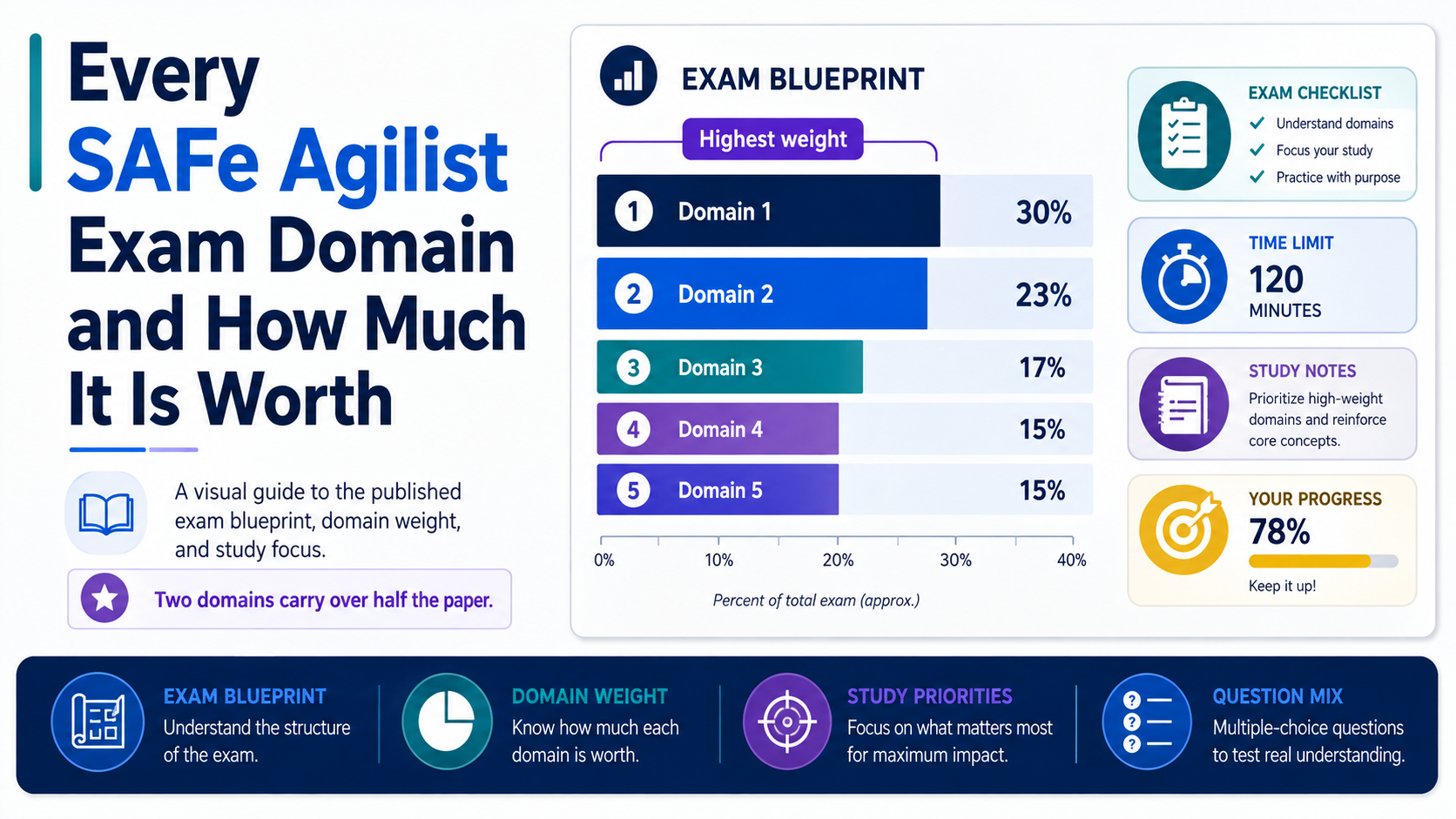
Scaled Agile publishes the exam blueprint for the SAFe Agilist certification, and it is weighted far more unevenly than most candidates expect. Two domains, Product Development Flow and Lean Portfolio Management, account for somewhere between 50 and 56 percent of the paper on their own. The leadership and change material that the class spends most of its energy on is worth roughly 7 to 9 percent each. Revising in proportion to how the course felt is the fastest route to a narrow fail.
Key Highlights
- Scaled Agile publishes six exam domains for the SAFe Agilist certification, each with a percentage range rather than a fixed weighting.
- Product Development Flow carries 25 to 28 percent and Lean Portfolio Management carries 25 to 28 percent, so between them they are over half the exam.
- Building a Foundation with Mindset, Values and Principles carries 18 to 21 percent, making it the third-largest domain.
- Adapting and Thriving with SAFe, Establishing Team and Technical Agility, and Leading the Change each carry only 7 to 9 percent.
- The exam is 45 questions at an 80 percent pass mark, so a single domain worth 25 percent is roughly 11 to 13 questions.
- Product Development Flow is the domain renamed in SAFe 6.0 from Agile Product Delivery, so older study material may not label it correctly.
The blueprint, with the weightings
| Domain | Weighting | Questions out of 45 |
| Product Development Flow | 25 to 28 percent | roughly 11 to 13 |
| Exploring Lean Portfolio Management | 25 to 28 percent | roughly 11 to 13 |
| Building a Foundation with Mindset, Values and Principles | 18 to 21 percent | roughly 8 to 9 |
| Adapting and Thriving with SAFe | 7 to 9 percent | roughly 3 to 4 |
| Establishing Team and Technical Agility | 7 to 9 percent | roughly 3 to 4 |
| Leading the Change | 7 to 9 percent | roughly 3 to 4 |
Two things follow immediately from that table.
The top two domains are worth more than the bottom four combined. If you scored perfectly on Adapting and Thriving, Team and Technical Agility, and Leading the Change, and then lost half of Product Development Flow and Lean Portfolio Management, you would fail comfortably.
And the pass mark makes the arithmetic unforgiving. At 80 percent you need 36 of 45. Nine wrong answers ends it. A domain worth 25 percent is around a dozen questions, so being weak in one of the top two consumes your entire margin before you have answered anything else badly.
Product Development Flow, 25 to 28 percent
The largest domain, jointly, and the one most likely to be mislabelled in study material.
This is the domain SAFe 6.0 renamed. It was previously called Agile Product Delivery, and older guides, forum posts and third-party question banks still use that name. If you are revising from anything more than a couple of years old, you may be studying this domain without realising it is this domain.
Substantively it covers how a customer-centric flow of value gets defined, built and released: the continuous delivery pipeline, release on demand, how Features move through an Agile Release Train, and the planning that supports it. Expect questions on the sizing hierarchy here as well as in the foundations domain, since Features and Capabilities are flow constructs.
Because it is both large and practical, this is the domain where scenario questions concentrate. Knowing the definitions is necessary and not sufficient. A candidate who can recite what a continuous delivery pipeline contains but cannot say what should happen when a Feature is ready and the release is not will lose marks here repeatedly.
Exploring Lean Portfolio Management, 25 to 28 percent
Jointly the largest, and the one delivery-side candidates consistently underestimate.
Lean Portfolio Management covers how strategy connects to execution: funding value streams rather than projects, lean budgets and guardrails, portfolio Kanban, and how governance operates when money stops moving through annual project approval.
The reason this catches people is straightforward. Most attendees come from delivery, where portfolio funding is something that happens to you rather than something you do. The material is unfamiliar in a way that team-level content is not, and it is a quarter of the exam.
If you are triaging revision time and you work below portfolio level, this is where the hours should go. It is also, not coincidentally, the domain that matters most for the transformation-leadership path after certification.
Building a Foundation with Mindset, Values and Principles, 18 to 21 percent
The third-largest domain and the most learnable.
This covers the Lean-Agile mindset, Lean-Agile leadership, the four Core Values, and the ten SAFe Lean-Agile principles. Roughly eight or nine questions.
It is learnable because much of it is finite and enumerable. There are four values. There are ten principles. Those are pure recall and there is no excuse for losing them.
The catch is that the principles do not appear as recall. They appear as scenarios, where a situation is described and you identify which principle applies or what a leader should do given it. Memorising the list of ten gets you very little. Being able to apply each to a described situation gets you most of the domain.
Given the size of this domain and how tractable it is, it is the best return on revision time available on the paper.
The three small domains, 7 to 9 percent each
Adapting and Thriving with SAFe. The framing content: business agility, why organisations struggle to respond to change, and what the framework claims to fix. Roughly three or four questions. Light on recall and heavy on framing, which makes it feel more substantial in the room than it is on the paper.
Establishing Team and Technical Agility. How teams operate inside the framework and the technical practices the model assumes. Also three or four questions, and the domain most familiar to anyone with a Scrum background.
Leading the Change. The implementation roadmap and what leaders do to move an organisation. Three or four questions.
Here is the uncomfortable observation. Leading the Change is the closing module of the class, the part instructors are most passionate about, and the reason many people attend. It is worth around four questions. Adapting and Thriving opens the class and is worth around four questions. Together the bookends of the course, which occupy a disproportionate share of the room's attention and discussion, are worth about eight questions out of 45.
That is not an argument for ignoring them. It is an argument for not letting how memorable a section was determine how long you revise it.
Where the class emphasis and the exam weighting diverge
This is the single most useful thing to take from the blueprint.
The two days are built to change how leaders think. That means they open on why, spend real time on mindset and behaviour, and close on organisational change. Attendees leave energised by the leadership content, because that is what the class is designed to do and it does it well.
The exam is built to test framework knowledge. Half of it sits on flow and portfolio management, which are the two most structural, least inspirational parts of the syllabus.
Neither is wrong. They are doing different jobs. But candidates revise from memory of the class, and memory of the class over-weights the parts that were most engaging. That mismatch is a large share of why an exam with a foundational label produces narrow failures.
The corrective is simple and slightly joyless: allocate revision by the blueprint, not by how the two days felt. The free Leading SAFe practice test is the quickest way to find out whether your recall is distributed the way the paper is.
What each domain assumes you already know
The blueprint tells you the weighting. It does not tell you the starting point each domain assumes, which is what actually determines how long it takes you.
Product Development Flow assumes you understand a delivery pipeline. If you have worked anywhere that ships software regularly, most of this is familiar language applied to a larger unit. If your background is programme management in a stage-gated environment, the assumptions underneath it are unfamiliar and the domain takes considerably longer.
Lean Portfolio Management assumes almost nothing and teaches a lot. This is why it is a quarter of the paper and why it catches people. There is no prior knowledge to lean on unless you have worked in or near portfolio funding, so it is close to pure learning rather than reframing.
The foundations domain assumes an Agile background. The values and principles make immediate sense to anyone who has practised Agile at team level, and read as slogans to anyone who has not. That is the difference between an hour of revision and an afternoon.
Team and Technical Agility assumes engineering context. Straightforward for delivery-side candidates and the least intuitive domain for executives, which inverts the usual pattern.
The practical use of this is to weight your revision by the product of the domain's exam weighting and your own distance from it. A candidate from portfolio finance and a candidate from a Scrum team should revise almost inverted priorities against the same blueprint.
Turning the blueprint into a revision split
Concretely, for someone with a delivery background sitting in a fortnight.
Give roughly half your time to Product Development Flow and Lean Portfolio Management together, weighted toward whichever is further from your day job. For most delivery-side candidates that is portfolio management, and it is worth being deliberate about it because it is the least enjoyable material in the syllabus and therefore the most avoided.
Give roughly a fifth to the foundations domain, concentrated on applying the principles to situations rather than reciting them. This is the best-value block on the paper because the content is finite and the weighting is high.
Spread the remainder across the three small domains, and do not skip any. Twelve questions across those three exceeds the nine-question margin an 80 percent pass mark allows.
Then stop revising and sit questions, because the blueprint tells you where the marks are and only practice tells you where your gaps are. Those are different pieces of information and candidates routinely substitute the first for the second.
If your framework grounding is uneven and you have not yet taken the class, Leading SAFe certification training covers all six domains in the order the framework builds them, which is a more efficient route than assembling the material yourself.
How to read a percentage range
A small point that causes unnecessary anxiety.
The weightings are published as ranges rather than fixed figures, which means the exact question count varies between papers. Product Development Flow at 25 to 28 percent means somewhere between roughly 11 and 13 questions on any given sitting.
Do not try to game this. The ranges are narrow enough that the practical planning figure is the midpoint, and the variance is not large enough to change how you revise. What the ranges do tell you is that no domain is ever absent, so there is no viable strategy of skipping one entirely and absorbing the loss.
The three small domains are worth around a dozen questions combined. That is more than your entire nine-question margin for error, which is the argument against writing any of them off.
What the blueprint does not tell you
Worth being clear about the limits, since a blueprint invites over-planning.
It does not tell you the balance of recall against scenario questions within a domain. In practice the foundations domain skews toward scenario for the principles and recall for the values, and the two large domains skew toward scenario, but that is observation rather than published fact.
It does not tell you which specific concepts within a domain are tested. Lean Portfolio Management is a large body of material and a quarter of the exam does not mean uniform coverage of all of it.
And it does not change with your background. A candidate who runs a portfolio and a candidate who has never seen one sit the same paper with the same weightings, which is why the same blueprint implies very different revision plans for different people.
Why the blueprint is worth checking before you book
A small piece of practical advice that applies beyond this exam.
Scaled Agile revises the framework periodically, and the domain names move with it. Product Development Flow is the clearest current example, having been renamed from Agile Product Delivery, and there is a reasonable chance something else is renamed within the life of your certification.
That has two consequences. Third-party study material ages badly and often silently, since a question bank written against the previous naming will look plausible and teach you outdated labels. And if you are returning to the certification after a gap, or renewing, the structure you remember may not be the structure you sit.
Checking the published blueprint on the day you book takes two minutes and removes an entire category of avoidable surprise. It is also the only fully authoritative source for the weightings, which is worth saying because a good deal of the material circulating online reproduces older splits without noting the date.
The free Leading SAFe practice test is calibrated to the current structure, which makes it a reasonable cross-check on whether the material you have been revising from is current.
One thing the weighting does not excuse
A closing caution, because a blueprint invites optimisation and optimisation has a limit here.
Knowing that Leading the Change is worth four questions is useful for allocating revision hours. It is not a reason to leave the class early or skip the module, and the distinction matters because the two domains carrying half the exam are the ones the change material makes sense of.
Lean Portfolio Management is a quarter of the paper and is close to unintelligible without understanding why an organisation would move funding away from projects in the first place. That reasoning lives in the framing and change modules that are worth four questions each. Revising them lightly is correct. Skipping them makes the expensive domains harder.
The blueprint is a guide to where marks sit, not a map of how the material connects. Treat it as the former and it is genuinely useful. Treat it as the latter and you will revise the two large domains as disconnected vocabulary, which is precisely the failure the scenario questions are built to catch.
For the full picture of how the domains build on each other, the Leading SAFe course curriculum sets out the module order, and Leading SAFe certification training covers all six across the two days with the exam attempt included.
One final observation about the ranges. Because every domain is expressed as a band rather than a fixed number, the total across all six does not resolve to exactly one hundred percent at either end. That is normal for a published blueprint and it is not worth trying to reconcile. Treat the midpoints as the planning figures.
Planning your revision against this
The practical version of everything above is one sentence: spend half your time on flow and portfolio management, a fifth on mindset, values and principles, and the remainder across the other three.
That distribution will feel wrong, because it inverts how the two days felt. Lean Portfolio Management is the least discussed part of most classes and a quarter of the paper. Leading the Change is what people talk about on the way out and is worth four questions.
If you have not taken the class yet, Leading SAFe certification training covers all six domains across two days with the exam attempt included, and reviewing the certification requirements beforehand is worth ten minutes. Current Leading SAFe certification costs are listed separately. If you have already taken it and are deciding when to sit, the Leading SAFe practice test will show you whether your weak domains are the expensive ones.

_1738229179.jpg)
_1738229338.jpg)





 Lowest-Price Challenge











 Personalized Path


.webp)


 USA
USA  Canada
  India
India  UK
UK  Australia
  Singapore


