


 Call Us



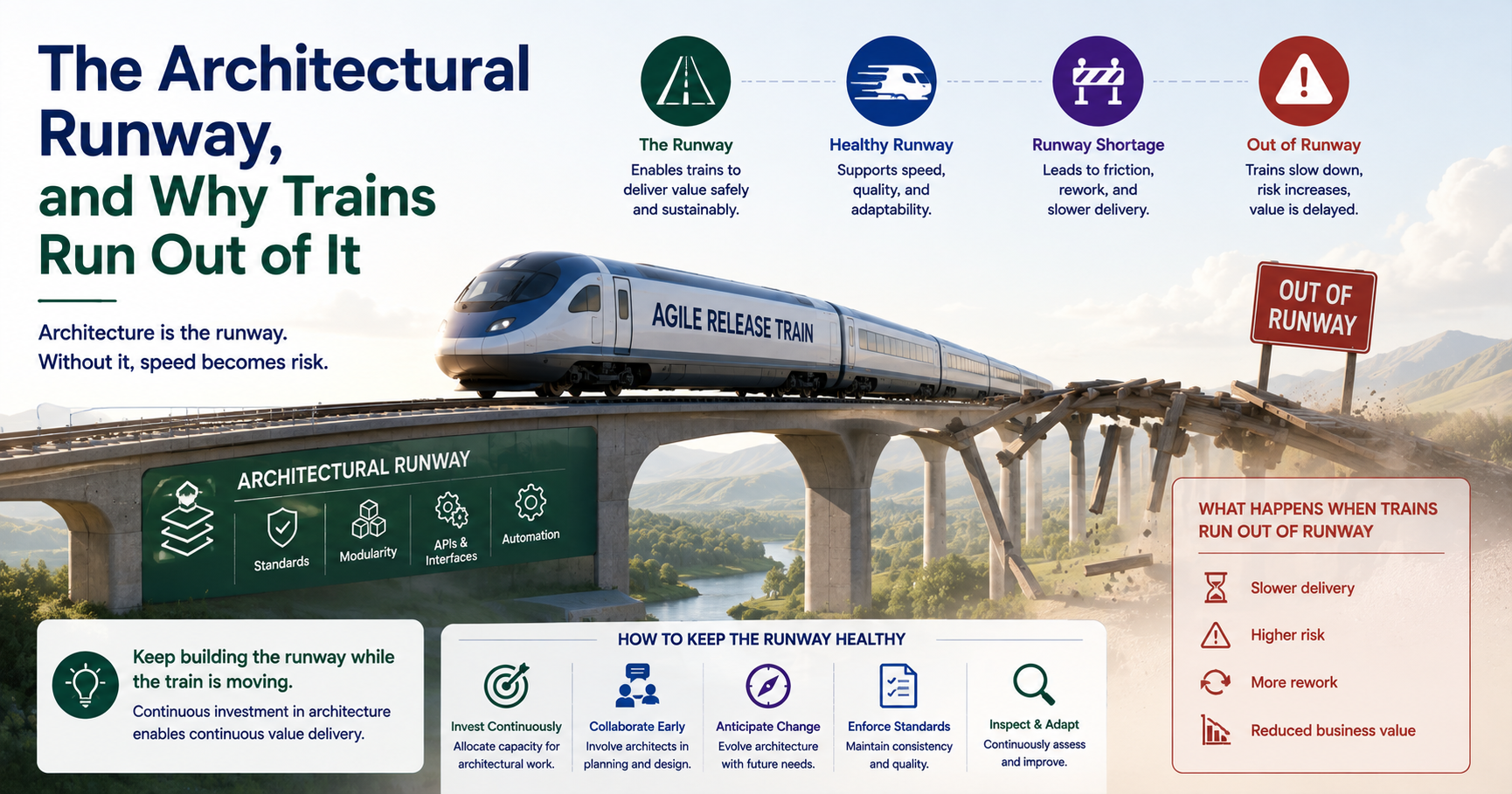
The architectural runway is the code, components and technical infrastructure already in place that lets a train build near-term Features without redesign or delay. It gets consumed every time a Feature is delivered on top of it, and it gets extended by Enablers. Trains that stop funding Enablers do not notice immediately. They notice about three Program Increments later, when everything suddenly takes longer and nobody can say why.
Key Highlights
- Scaled Agile defines architectural runway as the existing code, components and technical infrastructure needed to implement near-term Features with minimal redesign and delay.
- Enablers are backlog items that extend the runway or improve the performance of the development value stream.
- Runway is consumed by Feature delivery and replenished by Enabler work, which makes it a balance rather than a milestone.
- The failure is invisible for two or three Program Increments, because a train can deliver at pace on existing runway while building none.
- Enabler work competes with Feature work for capacity and loses every time unless someone protects it deliberately.
- The System Architect defines the architecture and the Enablers required to support it, but the funding decision sits with whoever allocates capacity.
What the runway actually is
The term is a metaphor and it is a good one, so it is worth taking literally for a moment.
An aircraft needs runway ahead of it to take off. It cannot manufacture more while accelerating. Whatever was built before the aircraft arrived is what it has.
Architectural runway works the same way. When a team picks up a Feature, the technical foundation that Feature needs either exists or it does not. If it exists, the Feature gets built at pace. If it does not, the team stops and builds the foundation first, which is when a two-week Feature becomes a two-month one.
Scaled Agile's definition is precise about this: existing code, components and technical infrastructure sufficient to implement near-term Features with minimal redesign and delay. Two words carry the weight. Existing, meaning already there rather than planned. And near-term, meaning the runway is scoped to what is coming rather than to everything imaginable.
That second word is what separates runway from over-engineering, which is the objection people reach for immediately.
How it gets consumed
Every Feature delivered uses some of the runway it was built on.
This is not obvious and it is the reason the failure is invisible. Building a Feature on existing infrastructure does not visibly deplete anything. Nothing turns red. The train delivers, the demo goes well, the Program Increment closes with objectives met.
What has actually happened is that the set of Features which can now be built without new foundation work has shrunk. Do that for three Program Increments while building no new runway, and the next set of Features all require foundation work that was never scheduled.
The symptom is a train that was delivering reliably and suddenly is not, with no change in team, scope or process. Leadership looks for a delivery problem and finds a healthy-looking team working hard on something that is taking four times longer than the estimate.
That is runway exhaustion, and by the time it presents, the correction takes a Program Increment or two of concentrated Enabler work that nobody has budgeted for.
Enablers, and the type-not-level distinction
Enablers are how runway gets extended. Scaled Agile defines them as backlog items that extend the architectural runway of the solution under development, or that improve the performance of the development value stream.
The critical structural point, and one that appears on the SAFe Agilist exam, is that Enabler is a type rather than a level. It can exist as an Epic, a Capability, a Feature or a Story. A portfolio-level Enabler Epic might be a platform migration. A team-level Enabler Story might be adding the instrumentation a future Feature will depend on.
Candidates routinely place Enabler as a fifth tier in the hierarchy below Story. It is not. The hierarchy runs Epic, Capability, Feature, Story, and Enabler is a classification applied across all four. Our the Leading SAFe course curriculum covers the full set of terms this sits inside.
Enablers come in several kinds: exploration work to reduce uncertainty, architectural work to extend the runway, infrastructure work to improve the development environment, and compliance work required to release. All four extend capability rather than deliver customer-visible functionality, which is precisely why they are hard to fund.
Why Enabler work loses every argument
The economics are straightforward and they are why this fails so consistently.
A Feature has a business sponsor, a business value score assigned during PI Planning, and a visible customer outcome. An Enabler has none of those. It has a technical justification, which is legible to the System Architect and to nobody else in the room.
Put those two in competition for the same capacity every Program Increment, and the Feature wins every time. Not because anyone is being short-sighted, but because the comparison is being made between something with a quantified business value and something with an argument.
The consequence compounds. Each Program Increment where Enablers lose, the runway shortens slightly and the pressure to deliver Features increases, which makes the next argument harder. Organisations arrive at runway exhaustion through a series of individually reasonable decisions.
This is the same shape as the improvement-item problem covered in our piece on SAFe certification requirements: work that is important and not urgent loses to work that is urgent, indefinitely, unless someone changes the mechanism rather than the argument.
What actually protects it
Four approaches, in ascending order of how well they hold.
Argue better. The System Architect explains why the Enabler matters. This works occasionally and fails under pressure, because the argument has to be won again every Program Increment against a business case that gets stronger each time delivery slips.
Attach Enablers to Features. Where a Feature genuinely requires foundation work, bundle them so the Enabler inherits the Feature's sponsor. Effective for near-term runway and useless for anything more than one Program Increment ahead, which is the runway that actually matters.
Reserve a percentage of capacity. Allocate a fixed share of each Program Increment to Enabler work, agreed in advance and protected. Considerably more robust because it removes the recurring argument, and it survives only if leadership holds the line the first time a deadline is at risk.
Fund it at portfolio level. Treat significant runway work as Enabler Epics with their own business case, funded through the portfolio rather than competing inside the train's capacity. This is the only approach that reliably handles large architectural work, and it requires the portfolio funding model to exist in the first place.
The pattern across all four is that the reliable options are structural rather than rhetorical. An organisation relying on the architect being persuasive has not solved the problem; it has personalised it.
The four kinds of Enabler
Worth separating, because they are funded differently and confusing them muddles the conversation.
Exploration Enablers reduce uncertainty. A spike to establish whether an approach is viable, a prototype to test a technical assumption. These are the easiest to justify because the alternative is estimating work nobody understands, and the cheapest to run because they are timeboxed by design.
Architectural Enablers extend the runway itself. New components, refactored foundations, capability that future Features will be built on. The largest and hardest to fund, because the benefit accrues to work that has not been scheduled yet.
Infrastructure Enablers improve the development value stream rather than the solution. Build pipelines, test environments, deployment automation. These pay back in flow efficiency across every subsequent Feature, which makes them the highest-return category and the least visible.
Compliance Enablers are the work required to release legally or contractually. Regulatory evidence, security assurance, audit trails. Unique in that they cannot be deferred indefinitely, which is why regulated organisations often fund Enablers better than unregulated ones. The deadline does the arguing.
Recognising which kind you are proposing changes how you make the case. An infrastructure Enabler is a flow argument. A compliance Enabler is a risk argument. Presenting the second as the first, or vice versa, is a common way to lose a funding conversation you should have won.
Runway and the Program Increment horizon
A question that comes up constantly: how far ahead should runway extend.
The framework's answer is embedded in the definition. Runway supports near-term Features, which in practice means roughly the next Program Increment plus visibility into the one after. Not further.
That boundary matters in both directions. Build runway for Features two years out and you are speculating about requirements that will change, which is the over-engineering objection and it is fair. Build only for the Features in the current increment and you have no runway at all, because by definition the foundation arrives at the same time as the work that needs it.
The practical target is that when a train enters PI Planning, the Features it is about to commit to should mostly sit on foundation that already exists. Where a significant share require new foundation, the plan is optimistic and the confidence vote should reflect it.
That connection between runway and planning quality is worth making explicit to a Product Management group, because it reframes Enablers from a technical indulgence into a precondition for credible commitment. Our PI Planning guide covers what a realistic plan requires.
Who owns it
The System Architect defines the architecture and the Enablers required to support it. That is the design accountability and it is clear.
What is less clear, and where organisations get stuck, is who decides that Enabler work gets capacity. In practice that is a negotiation between the System Architect, Product Management who owns the ART Backlog, and whoever holds the funding.
Product Management is the pivotal role here, because the ART Backlog contains both Features and Enablers and the ordering is theirs. A Product Management function that treats Enablers as an engineering concern rather than as part of the product will systematically underfund them. One that understands runway as the thing determining future delivery speed will not.
That is worth stating to a Product Management group explicitly, because it is rarely how the role is framed when people arrive in it from a purely commercial product background.
How to tell whether yours is running out
Five signals, none of which requires reading any code.
Estimates are drifting upward for similar work. The clearest early indicator. Features comparable to ones delivered two Program Increments ago now take noticeably longer.
Teams are asking for spikes more often. Exploration Enablers rising in frequency means teams are hitting unknowns where they previously had foundation.
The same technical concern appears in multiple retrospectives. Usually phrased as needing to sort something out before it becomes a problem, and usually ignored.
Enabler items have been in the backlog for more than three Program Increments. If they are ordered but never pulled, the backlog is recording an intention rather than a plan.
Nobody can say what percentage of last Program Increment went to Enabler work. If the number is not tracked, it is almost certainly close to zero. Checking that you hold the Enabler classification correctly takes a few minutes with the free Leading SAFe practice test. If the number is not tracked, it is almost certainly close to zero, because unmeasured work that competes with measured work does not survive.
Any two of those together justify a conversation. All five means the correction is already overdue and will cost a Program Increment.
Making the argument to a business audience
The technical framing does not travel. Three that do.
Frame it as delivery speed, not architecture. Runway determines how fast Features can be built. That is a business metric, and it is the one deteriorating.
Use the estimate drift. If comparable work now takes 40 percent longer than it did two Program Increments ago, that is evidence rather than opinion, and it is the kind of number our piece on Lean Portfolio Management training is built around surfacing.
Name the compounding. The cost of restoring runway rises the longer it is deferred. That is a familiar shape to anyone who has managed maintenance backlogs, deferred capital expenditure or technical debt in any other form.
What does not work is describing the architecture. A business audience cannot evaluate whether the proposed foundation work is the right foundation work, so the conversation has to be about consequence rather than design. This translation is exactly the skill Leading SAFe certification training is trying to build in leaders.
Where this sits in the framework
Runway is not a standalone concept and it connects to three things a SAFe Agilist is expected to hold together.
It sits in the Product Development Flow domain, which carries 25 to 28 percent of the SAFe Agilist exam and is jointly the largest. Our breakdown of the the SAFe Agilist certification process covers where the marks concentrate, and Enabler and runway questions appear here as well as in the foundations domain.
It is funded through Lean Portfolio Management when the work is large enough to be an Enabler Epic. That connection is why runway problems in organisations without a working portfolio layer are close to unsolvable: there is no mechanism for funding capability that does not belong to a single Feature.
It shows up in flow metrics before it shows up anywhere else. Flow time lengthening on comparable work is the earliest quantitative signal, well ahead of missed objectives.
Holding those three together is the difference between recognising a runway problem and being able to do something about it, and it is why the topic sits in a leadership course rather than an engineering one. Leading SAFe certification training covers all three across the two days.
What over-engineering actually looks like
Fair treatment requires naming the opposite failure, because it is real and it is the reason Enabler proposals get resisted.
Over-engineered runway is foundation built for requirements that never arrive. A configurable framework for variation nobody asked for. Abstraction layers anticipating an integration that was never commissioned. Capacity provisioned for scale the product never reached.
The cost is not only the wasted effort. It is that the speculative foundation becomes something the team maintains, works around and explains to new joiners, indefinitely. Unused runway is not neutral. It is drag.
Three questions separate genuine runway from speculation. Is there a named Feature in the next Program Increment or two that needs this. Would delivering that Feature without this foundation require redesign rather than just more work. And is the thing being built the smallest version that unblocks it.
Where all three answers are yes, it is runway. Where the justification reaches for flexibility, future-proofing or general robustness, it is usually speculation wearing runway's vocabulary, and the people resisting it are correct.
A SAFe Agilist who can make that distinction publicly earns considerably more credibility on the Enabler conversations that genuinely matter, because they have demonstrated they are not simply advocating for engineering.
The short version
Architectural runway is the clearest example in SAFe of something that degrades silently and corrects expensively.
Nothing goes wrong while it is being consumed. The train delivers, the objectives are met, and every individual decision to prioritise a Feature over an Enabler is defensible on its own terms. Then delivery slows for reasons that look like a team problem and are not.
The organisations that avoid this do one structural thing: they make the Enabler allocation explicit and protect it, rather than relying on the architect winning an argument every twelve weeks. Everything else is a variation on losing slowly.
If you are leading or advising on an adoption, Leading SAFe certification training covers the runway alongside the portfolio funding mechanisms that make protecting it possible, across two days including the exam attempt. Current certification costs are listed separately, and the free Leading SAFe practice test will show you how solid your grounding is on Enablers and the work item hierarchy, which are among the most tested areas on the paper.



_1738223178.jpg)



 Lowest-Price Challenge











 Personalized Path


.webp)


 USA
USA  Canada
  India
India  UK
UK  Australia
  Singapore


