


 Call Us



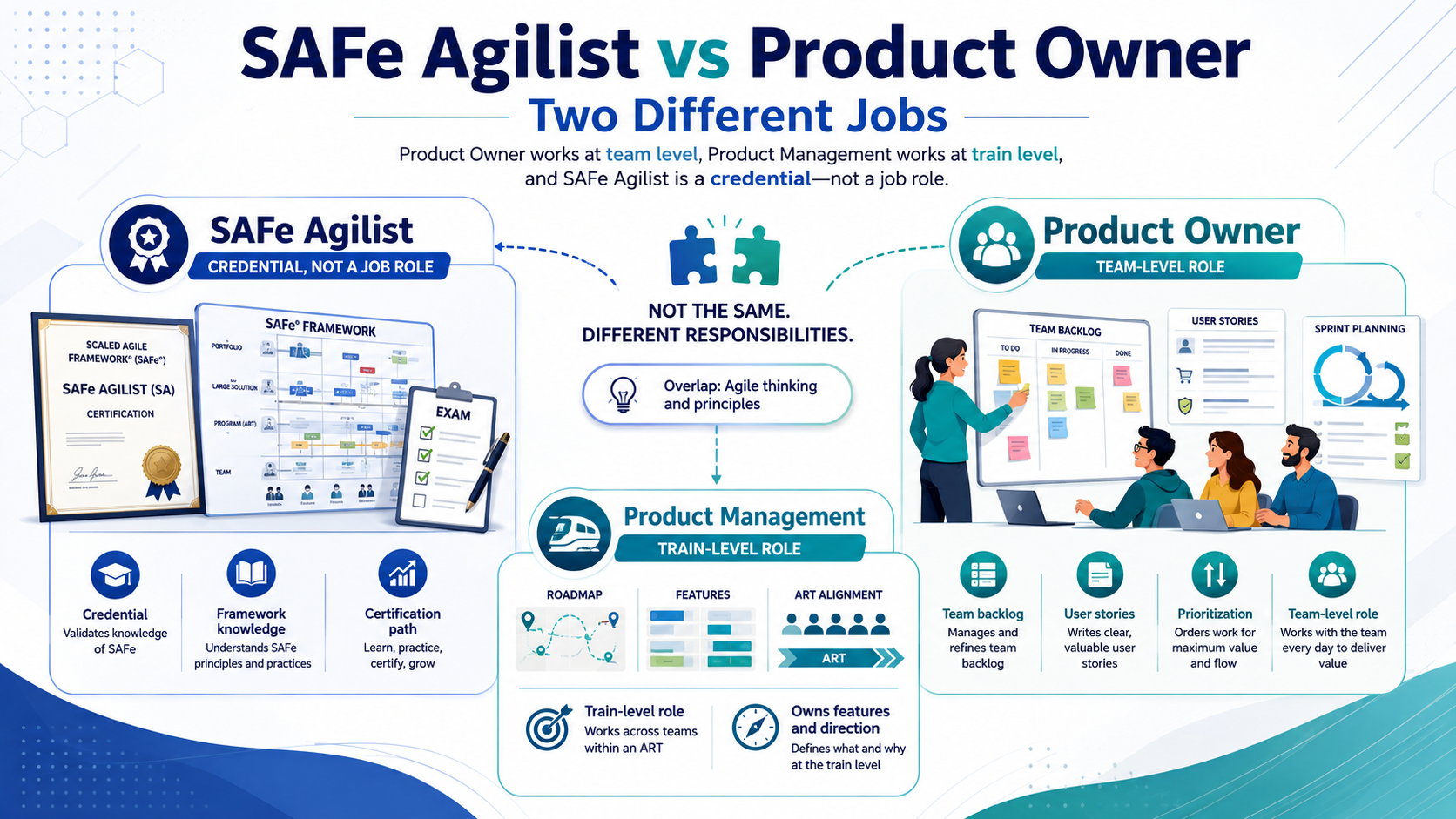
A SAFe Agilist understands how the framework works and usually leads or influences an adoption. A Product Owner owns a team's backlog and decides what that team builds next. They sit at different levels, answer different questions, and only one of them is a full-time role. The comparison is asked constantly and the confusion usually traces to a third thing entirely, which is that SAFe also has Product Management, and that is the role people actually mean.
Key Highlights
- SAFe Agilist is a certification covering the framework at leadership level. Product Owner is a full-time role owning a single team's backlog.
- The role most often confused with Product Owner at train level is Product Management, which owns the ART Backlog and decides what the Agile Release Train builds.
- Product Owner operates at team level within one iteration. Product Management operates at train level across a Program Increment.
- A SAFe Agilist certification does not qualify anyone to be a Product Owner, and Scaled Agile publishes a separate credential for the product role.
- The two are frequently held by the same person in smaller organisations, which is where most of the confusion originates.
- Neither is a step toward the other. They diverge on whether you want to own what gets built or how the organisation delivers.
The three roles people are actually comparing
Worth discarding one framing before going further: neither is higher than the other. One is a certification and one is a role, so they do not sit on a common scale, and asking which ranks above the other produces no useful answer.
Most of the confusion clears once you separate three things rather than two.
SAFe Agilist is a credential, held by people in many different roles, evidencing that they understand the framework at the level needed to lead or participate in an adoption. It is not a job.
Product Owner is a team-level role. One team, one backlog, working within iterations. The Product Owner decides what that team builds next and accepts the work when it is done.
Product Management is the train-level role. It owns the ART Backlog and is accountable for what the whole Agile Release Train builds across a Program Increment.
When someone asks whether to be a SAFe Agilist or a Product Owner, they usually mean one of two different questions. Either should I lead adoptions or own products, which is a real fork. Or what is the product role at train level, which has the answer Product Management rather than Product Owner.
Where each one operates
| Product Owner | Product Management | SAFe Agilist | |
| Scope | One Agile team | One Agile Release Train | Not a role; a credential |
| Owns | Team backlog | ART Backlog | Nothing by virtue of the credential |
| Horizon | Iteration | Program Increment | Depends on the job held |
| Decides | What this team builds next | What the train builds | Depends on the job held |
| Full-time role | Yes | Yes | Not applicable |
The distinction between the first two columns is the one worth committing to memory, because it is examined and because organisations get it wrong structurally. A Product Owner spread across four teams is not doing the role. A Product Management function that has never seen the team backlogs is not doing theirs.
What a Product Owner actually does
Team level, and closer to the work than most people expect.
The Product Owner owns and orders the team backlog, defines what the team will build in the next iteration, and accepts work as complete against the definition of done. They attend the team's events and are available through the iteration for the questions that arise, which is the part that makes it genuinely full-time.
They also participate in PI Planning, where the team drafts its objectives, and in the Product Owner Sync during the Program Increment. That sync gives visibility into the train's progress toward its PI Objectives and is where scope adjustments get made.
The availability point is worth dwelling on, because it is where organisations quietly break the role. A Product Owner who is only present at ceremonies leaves the team guessing for the other four days a week, and teams that guess build the wrong thing efficiently.
What a Product Owner does not do is decide the direction of the train. That sits with Product Management, and the boundary between them is one of the more common sources of organisational friction in a SAFe implementation.
What a SAFe Agilist does, given it is not a role
Whatever their actual job is, with the framework knowledge applied to it.
In practice the credential is held by transformation leads, delivery managers, programme managers, Release Train Engineers, architects and executives. What it establishes is that they understand how the framework operates: the structure of a train, what each event produces, how portfolio funding works, and why the principles produce the behaviours they do.
The reason it is not a role is worth being clear about. Scaled Agile classifies SAFe Agilist as foundational, with no prerequisites and no requirement to take the training in order to sit the exam. It is the entry point into the credential family rather than a qualification for a specific position, which our piece on SAFe Agilist career paths covers in more depth.
The comparison people should actually be making
If you are deciding what to do rather than what to study, the fork is between owning a product and improving how the organisation delivers.
Owning a product means being accountable for what gets built and whether it was worth building. The satisfaction is direct: you decided, it shipped, it worked or it did not. The frustration is that you are constrained by delivery capacity you do not control.
Improving how the organisation delivers means being accountable for the system rather than the output. The satisfaction is indirect and compounds: teams get faster, dependencies reduce, planning becomes credible. The frustration is that success is invisible and slow, and the people who benefit rarely notice.
Those are genuinely different temperaments and the credential question follows from the answer rather than preceding it. Someone who wants to own products should be looking at the product credential family. Someone who wants to improve delivery is in SAFe Agilist territory.
Do you need SAFe Agilist as a Product Owner
Usually not, and there is a better option.
If you are a Product Owner in a SAFe organisation, you need enough framework literacy to operate: what a Program Increment is, what happens at PI Planning, how your team's objectives connect to the train's. SAFe Agilist gives you considerably more than that, weighted toward portfolio funding and organisational change, which is not your job.
Scaled Agile publishes a dedicated product credential covering the Product Owner and Product Manager roles specifically, and for someone staying in the product track that is the better use of the budget. Our SAFe Product Owner and Product Manager certification page covers what it involves.
Where SAFe Agilist does make sense for a product person is when they are moving toward Product Management at train level, or when they expect to be involved in the adoption itself rather than only operating inside it.
Do you need Product Owner experience as a SAFe Agilist
Not required, and it helps more than people expect.
The framework makes a great deal more sense once you have had to order a backlog with real constraints and defend the ordering to someone who wanted something else. Concepts that read as abstract in the class, particularly around business value and prioritisation, land differently when you have done the work.
The specific area where it shows is Weighted Shortest Job First. A leader who has never prioritised under pressure treats it as a formula. Someone who has treats it as a way of making an argument explicit, which is closer to what it is for. The same applies to business value assignment: it reads as an administrative step until you have been the person whose work was scored low in front of the room, at which point the purpose of doing it publicly becomes obvious.
Where the two overlap in practice
The theory separates them cleanly. Real organisations do not, and the overlap is worth understanding because it is where the friction lives.
In smaller organisations one person does both. A product lead who owns the backlog and is also driving the adoption is common below a certain scale, and it works until the organisation grows enough that the two jobs conflict. The conflict shows up as the adoption work getting deprioritised, because backlog decisions are urgent and organisational change is not.
Product Owners frequently end up doing Product Management's job. Where Product Management is absent or overloaded, the Product Owners collectively decide what the train builds by default, through their individual backlog choices. Nobody intends this and it produces a train with no coherent direction, since each team is optimising locally.
Product Management sometimes ends up doing the Product Owner's job. The reverse failure, usually in a train with too few Product Owners. Product Management gets pulled into iteration-level decisions and loses the horizon that made the role valuable.
Both get pulled into the adoption. In an organisation mid-transformation, product people are frequently asked to explain and defend the new way of working, which is SAFe Agilist territory rather than product territory. This is the most legitimate reason for a product person to hold the credential.
The diagnostic for whether the boundary is working is straightforward. Ask who decides what the train builds next Program Increment. If the answer is a name, the boundary is intact. If the answer is that it emerges from the teams, Product Management is not functioning regardless of who holds the title.
What each one needs to learn
Different reading lists, which is another way of seeing that these are different jobs.
A Product Owner needs to get good at ordering work under constraint, writing things that a team can act on, saying no defensibly, and being available. The skills are close to the work and improve through repetition. Framework knowledge helps at the margin and is not the constraint on doing the job well.
A SAFe Agilist needs to get good at reading an organisation, understanding where funding and governance actually sit, and making an argument to people who do not report to them. The skills are further from the work and improve slowly, mostly through watching adoptions succeed and fail.
Someone genuinely unsure which they want should notice which of those two descriptions they found more appealing, because that instinct is a better guide than any comparison of certifications. If it is the first, the SAFe Product Owner and Product Manager certification is the right track. If it is the second, Leading SAFe certification training is where to start, and the free Leading SAFe practice test will show you how much framework grounding you already have.
How the two appear on the exam
Both appear, and the questions target the boundary rather than the roles themselves.
Expect to be asked who owns the ART Backlog, which is Product Management, and who owns the team backlog, which is the Product Owner. Expect at least one question that offers a plausible confusion between them.
The other boundary tested is between Product Management and Business Owners. Product Management decides what the train builds. Business Owners hold business and technical responsibility for the value delivered and assign business value to PI Objectives during PI Planning. Both are senior and business-facing, which is exactly why the distinction is examined. Our piece on what Business Owners do in PI Planning covers that accountability properly.
Role boundary questions are among the more reliable marks available on the paper, since they are pure recall once you have the model straight.
What this means for an organisation designing its roles
Beyond the individual career question, the comparison matters structurally, and organisations get it wrong in a consistent direction.
The dominant error is under-resourcing Product Management while over-resourcing Product Owners. A train with eight Product Owners and no dedicated Product Management has eight people making local decisions and nobody accountable for the train's direction. Each individual decision is defensible and the aggregate is incoherent, which shows up as a train that delivers steadily and never seems to move the business.
The second error is treating Product Owner as a part-time role. It is not. The role requires availability through the iteration for the questions that arise, and a Product Owner attending only ceremonies produces a team that guesses. Where organisations cannot staff it fully, the honest response is fewer teams rather than thinner Product Owners.
The third is assuming a certified SAFe Agilist can cover the product roles. The credential establishes framework literacy across the whole model, which includes knowing that these roles exist and what they own. It does not develop product judgement, and treating it as a substitute produces a train run by someone who knows the process and cannot decide what to build.
Getting this right is part of what value stream and ART design actually involves, and it is covered alongside the rest of the structural material in Leading SAFe certification training. The certification requirements are published separately if you are checking eligibility first.
If you already hold one and are considering the other
The practical situations, since most people asking this are not starting from zero.
A Product Owner considering SAFe Agilist. Worth it if you are moving toward Product Management at train level, if you expect to be involved in the adoption itself, or if you want to understand why the organisation around you is changing. Not worth it if you intend to stay in the team-level product role, where the dedicated product credential covers your work far more directly.
A certified SAFe Agilist considering a product role. The credential contributes context and not capability. Product judgement is developed by making prioritisation calls and living with the consequences, which no class provides. The realistic route is to take on backlog ownership somewhere small before pursuing it as a career move.
Someone holding neither, deciding where to start. Start with the job you want rather than the certification that seems most prestigious. If you want to decide what gets built, the product track. If you want to change how the organisation builds, the framework track.
Someone whose employer is paying. Take whichever matches the work you will actually do next year. Certifications acquired speculatively, on the basis that they might be useful, are the least likely to produce a return, and the annual renewal requirement means they carry an ongoing cost rather than a one-off one.
Choosing between them
The question to settle first is not which certification. It is whether you want to be accountable for what gets built or for how the organisation builds it.
If the answer is what gets built, the product track is where your budget should go, and SAFe Agilist is optional context rather than a requirement. If the answer is how the organisation builds, then the framework credential is the right entry point and the product credential is the optional one.
If you genuinely do not know yet, the cheaper experiment is to spend a Program Increment paying close attention to which set of problems you find yourself thinking about outside work hours. That answer is more reliable than any comparison article.
For the framework side, Leading SAFe certification training covers the syllabus across two days with the exam attempt included, current certification costs are listed separately, and the free Leading SAFe practice test will tell you how much of the framework you already hold.


HowtoEstablishOne_1788350087.png)
_1788349430.jpeg)




 Lowest-Price Challenge











 Personalized Path


.webp)


 USA
USA  Canada
  India
India  UK
UK  Australia
  Singapore


