


 Call Us



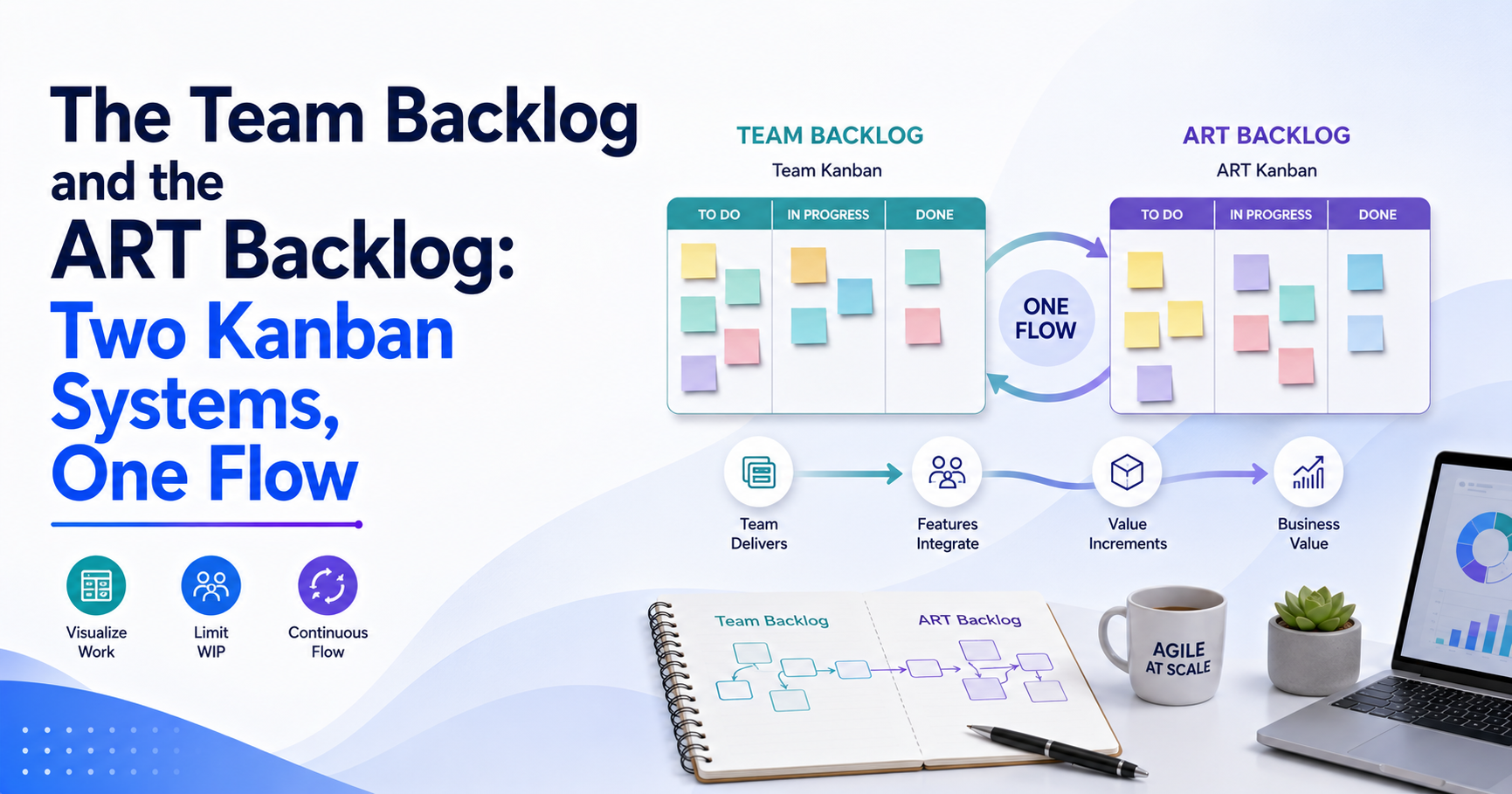
Scaled Agile defines both backlogs as Kanban systems rather than as lists, and that distinction carries more weight than it first appears. The Team Backlog captures user stories and Enablers intended to enhance the solution. The ART Backlog captures Features and Enablers, and explicitly includes extending the architectural runway. Treating either as a queue of requests rather than a flow system is where most backlog problems in a SAFe organisation begin.
Key Highlights
- Scaled Agile defines the Team Backlog as a Kanban system for capturing and managing user stories and Enablers intended to enhance the solution.
- The ART Backlog is a Kanban system for Features and Enablers, and its definition explicitly includes extending the architectural runway.
- Both are Kanban systems rather than lists, which implies flow, work-in-progress limits and pull rather than assignment.
- The Product Owner owns the Team Backlog. Product Management owns the ART Backlog. Conflating the two is a common exam error and a common organisational one.
- Enablers appear in both, which is how architectural work reaches teams rather than being handled separately.
- A backlog nobody removes items from is a wish list, not a Kanban system, and it stops functioning as a planning input.
Why the framework calls them Kanban systems
The wording is deliberate and it is the most useful thing in either definition.
A list is a record of things somebody wants. It has no capacity constraint, no flow, and no natural mechanism for removal. It grows monotonically, because adding to it costs nothing and nobody is accountable for its size.
A Kanban system is different in three ways. Work moves through defined states rather than sitting in one. There is a limit on how much can be in progress. And work is pulled when there is capacity rather than pushed when someone decides it is important.
Most organisations adopting SAFe bring a list and rename it a backlog. The vocabulary changes and the behaviour does not, which is why backlogs in the first year of an adoption reach several hundred items and stop being useful for planning.
The test is simple: has anything been removed in the last Program Increment. If nothing has, it is a list.
What the Team Backlog holds
User stories and Enablers, intended to enhance the solution.
Two things are worth pulling out of that. It holds Enablers, meaning the technical work that extends the SAFe DevOps certification or improves the development value stream, not only customer-facing stories. Teams that keep technical work somewhere else have created a shadow backlog, and the capacity it consumes becomes invisible to planning.
And it is scoped to enhancing the solution, which excludes a great deal of what typically accumulates in team backlogs: support requests, minor administrative tasks, and work belonging to another team. Those things exist and they need somewhere to live; putting them in the Team Backlog makes velocity meaningless and planning unreliable.
The Product Owner owns and orders it. That ownership is singular by design, which is what allows a team to have one direction rather than several.
What the ART Backlog holds
Features and Enablers, intended to enhance the solution and extend its architectural runway.
The explicit mention of the architectural runway in the definition is significant and easy to skim past. It means runway extension is not a side activity happening somewhere in engineering. It is one of the two stated purposes of the train's backlog, alongside enhancing the solution.
That framing matters because it settles an argument organisations have repeatedly. Enabler work is not competing with the backlog's purpose; it is part of it. Product Management underfunding Enablers is not prioritising the backlog correctly, it is prioritising half of it.
Product Management owns the ART Backlog. That is the accountability tested on the SAFe Agilist exam and the one organisations most often leave unfilled, as our comparison of SAFe POPM certification covers.
How the two connect
Features live in the ART Backlog. Stories live in the Team Backlog. The connection between them is decomposition, and it happens in refinement rather than in planning.
A Feature is sized for one Agile Release Train within one Program Increment. During refinement, teams break the Features they are likely to take into stories sized for a single iteration. Those stories enter the Team Backlog.
The failure mode is decomposing during PI Planning itself. The event is two days for the whole train and there is no time to do genuine breakdown work in it. Trains that arrive with unrefined Features produce plans built on guesses, and the confidence vote reflects it if anyone is honest.
The other failure is decomposing too far ahead. Stories refined three Program Increments out will be rewritten before anyone builds them, which is effort spent producing something that decays.
Ordering, and who actually does it
Ordering a backlog sounds administrative and is the most consequential recurring decision either owner makes.
For the ART Backlog, Product Management orders Features, informed by business value, dependencies and the Weighted Shortest Job First model. WSJF is the only prioritisation method the framework prescribes by name, calculated as relative cost of delay divided by relative job duration.
For the Team Backlog, the Product Owner orders stories within the direction the Features set. This is narrower and more frequent, and it is where availability matters: a Product Owner who cannot answer an ordering question within a day leaves the team choosing for themselves.
The recurring organisational error is ordering by whoever asked most recently or most loudly. That produces a backlog that reflects the political weather rather than value, and it is invisible until someone asks why a low-value item shipped before a high-value one.
Where Enablers sit in both
Enablers appear in both backlogs, and that is the mechanism by which architectural work actually reaches a team.
At ART level, an Enabler Feature might be new infrastructure that several upcoming Features will build on. At team level, an Enabler Story might be the specific piece of that infrastructure one team is implementing this iteration.
The important structural point is that Enabler is a type rather than a level. It classifies work across Epic, Capability, Feature and Story rather than sitting beneath them. Candidates get this wrong on the exam constantly, and organisations get it wrong by creating a separate technical backlog, which removes the work from the prioritisation conversation entirely.
If technical work is not in the backlog competing openly, it is being done invisibly or not at all. Neither outcome is good, and the second is more common.
The backlog as a planning input
Both backlogs exist primarily to make PI Planning possible, which is worth remembering when deciding how much effort to put into maintaining them.
For the event to work, the ART Backlog needs enough refined Features at the top that teams can plan a Program Increment against them. Not the whole backlog. The top of it.
A useful rule of thumb is that roughly a Program Increment's worth of Features should be refined enough to be planned, with the next increment's worth roughly understood. Beyond that, refinement is speculation.
Trains that refine too little arrive at planning and spend day one doing analysis. Trains that refine too much have spent capacity on Features that will change before anyone builds them. The first failure is more common and considerably more visible.
Why backlogs grow without limit
The mechanics of the failure, since it is nearly universal in the first year of an adoption.
Adding an item costs nothing. There is no approval, no budget line, and no person whose job gets harder when the backlog grows by one. Removing an item costs a conversation with whoever asked for it, which is uncomfortable and produces no visible benefit.
Given those incentives, backlogs grow. A backlog of four hundred items is not a prioritised set of work; it is a record of every request ever made, and the bottom nine tenths will never be built.
The cost is not storage. It is that the backlog stops functioning as a planning instrument, because nobody can hold it in mind and ordering it meaningfully becomes impossible. It also quietly misleads stakeholders, who see their request in the backlog and believe it is scheduled.
Pruning, and how to make it survivable
The remedy is unpopular and simple: remove things.
Set a size limit. An ART Backlog that cannot be reviewed in an hour is too large. The limit forces the ordering conversation that unlimited size allows people to avoid.
Delete rather than defer. Moving an item to a someday category preserves the illusion. If it will not be built in the next few Program Increments, remove it. If it matters, it will be raised again, and the cost of re-adding is far lower than the cost of maintaining a backlog nobody trusts.
Tell the requester. The conversation is the point. A stakeholder who learns their request will not be built can escalate, adjust or accept, and all three are better than believing it is queued.
Do it on a cadence. Once per Program Increment, as a defined activity rather than an occasional tidy-up.
Organisations resist this because deletion feels like loss. What is actually lost is the pretence that everything requested will be delivered.
The shadow backlog problem
Worth naming separately because it defeats the whole system quietly.
A shadow backlog is work that consumes team capacity and does not appear in the Team Backlog. Support requests that go directly to an engineer. Small favours for another team. Technical work someone decided was too small to log. Production issues handled informally.
The consequence is that the team's actual capacity is substantially lower than its apparent capacity, and nobody knows by how much. Planning then systematically over-commits, the team consistently misses, and the diagnosis lands on estimation or performance rather than on the invisible work.
The fix is unglamorous: everything consuming capacity goes in the backlog, including the small things. The number will be uncomfortable the first time it becomes visible, and that discomfort is the point. Our piece on Lean Portfolio Management training covers why flow distribution surfaces this faster than anything else.
Refinement, and who should be in it
Backlog refinement is where the two backlogs actually connect, and it is the activity organisations schedule worst.
The purpose is to get items ready enough to be planned: understood, sized, with acceptance criteria and dependencies identified. Not to plan them, and not to design the solution.
Three attendance mistakes recur. Running it with only the Product Owner and a lead, which produces items the rest of the team has never seen and disagrees with. Running it with the whole team for two hours every week regardless of need, which is expensive and resented. And running it without anyone who can answer the questions that arise, so every session ends with a list of things to find out.
The workable pattern is short, frequent and attended by whoever the specific items need. A session on payment work needs the people who know payments, not everyone.
A useful test for whether refinement is working: at PI Planning, how many Features does the train discover it does not understand. If the answer is more than one or two, refinement is not doing its job and the planning event is absorbing the cost.
Backlogs during the Program Increment
Both backlogs change mid-increment, and how that is handled separates a functioning train from a chaotic one.
New work arrives. Priorities shift. Something breaks in production. The framework does not pretend otherwise, and the the Leading SAFe curriculum exists partly as the buffer that absorbs this.
What matters is the mechanism. Work entering the Team Backlog mid-increment should displace something rather than being added on top, and someone should be explicitly deciding what gets displaced. Where new work is simply added, the team's commitment silently becomes unachievable and the miss gets attributed to poor estimation.
At train level, the Product Owner Sync inside ART Sync is where this gets handled. It exists to give visibility into progress toward PI Objectives and to make the adjustments that keep the plan honest. A train that never adjusts its plan mid-increment is either exceptionally lucky or not telling the truth.
Five observable characteristics, none requiring access to a tool.
The top is refined and the bottom is not. Detail decreases with distance, deliberately.
Items get removed. Something was deleted in the last Program Increment, and someone can say what.
Enablers are present and ordered among Features. Not held in a separate list or handled informally.
One person can say why the order is what it is. If the answer is that it reflects several stakeholders' requests, there is no order. Testing whether you hold the ownership boundaries cleanly takes a few minutes with the free Leading SAFe practice test.
It fits in a conversation. A backlog that requires a tool to navigate is too big to prioritise.
A sixth, softer signal is worth adding: stakeholders are not surprised. Where people regularly discover that something they asked for was never going to be built, the backlog has been functioning as a place to put requests rather than a plan, and the credibility cost of that lands on whoever owns it. Keeping a backlog honest is largely a matter of having uncomfortable conversations early rather than allowing them to accumulate. That discipline is part of what Leading SAFe certification training frames as transparency in practice rather than as a value on a wall.
Any organisation can check all five in twenty minutes, which makes this a genuinely practical diagnostic for a SAFe Agilist assessing an implementation.
What the exam asks
Backlog ownership is reliably tested, and the questions target boundaries rather than mechanics.
Expect to be asked who owns the ART Backlog, which is Product Management, and who owns the Team Backlog, which is the Product Owner. Expect at least one question offering a plausible confusion between the two, and one involving Business Owners, who assign business value to PI Objectives and do not own either backlog.
Expect the Enabler classification to appear, since Enablers sit in both backlogs and the type-not-level distinction is among the most tested points on the paper.
These are recall marks and they are among the cheapest available on the paper, and they are also the ones candidates most often assume they know without checking. Our free Leading SAFe practice test covers the role boundaries in the form the exam uses, and sitting a handful of those questions is a faster way to find the gap than rereading the definitions. If the boundaries turn out to be solid, that is a genuine ten minutes saved; if they are not, better to discover it now than in the exam.
Where to go next
The single most useful change most organisations can make to either backlog is to start removing things from it, on a cadence, and tell the people whose requests were removed.
That one practice forces the prioritisation conversation the backlog exists to support, restores the backlog's credibility as a planning input, and surfaces the stakeholder expectations that were quietly wrong. It costs nothing and it is resisted more than almost any other suggestion in an adoption.
For the wider picture of how the backlogs connect to planning, funding and the runway, Leading SAFe certification training covers all of it across two days with the exam attempt included, and current certification costs are listed separately.
If you are working out where the backlog roles sit relative to the rest of the framework, our guide to every SAFe event covers where refinement and the syncs fit in the Program Increment, and the Leading SAFe certification training syllabus connects the two backlogs to the portfolio layer above them.



_1738228594.jpg)





 Lowest-Price Challenge











 Personalized Path


.webp)


 USA
USA  Canada
  India
India  UK
UK  Australia
  Singapore


